
Writing terms are the fastest way to spot who has control of their craft and who is guessing, because the language you use shapes the decisions you make on the page. When you can name what is happening in a scene, a paragraph, or a draft, you can fix it without flailing for three more chapters.
I am not interested in memorizing a glossary for trivia night. I care about literary lingo because it lets you diagnose problems, talk to editors and cover designers without confusion, and make your book market-ready without accidentally sabotaging it with a bad blurb or a mislabeled genre.
If you learn the terms that actually change your choices, you will revise faster, give cleaner feedback, and publish with fewer expensive surprises. You do not need every term. You need the ones that make you dangerous.
Table of Contents
Terms That Control Your Story On The Page
When I read a draft for craft issues, I rarely start by line-editing. I look for the terms that predict the reader experience: point of view, scene structure, tension, and stakes. If those are wrong, gorgeous sentences will not save you.
Point Of View And Narrative Distance
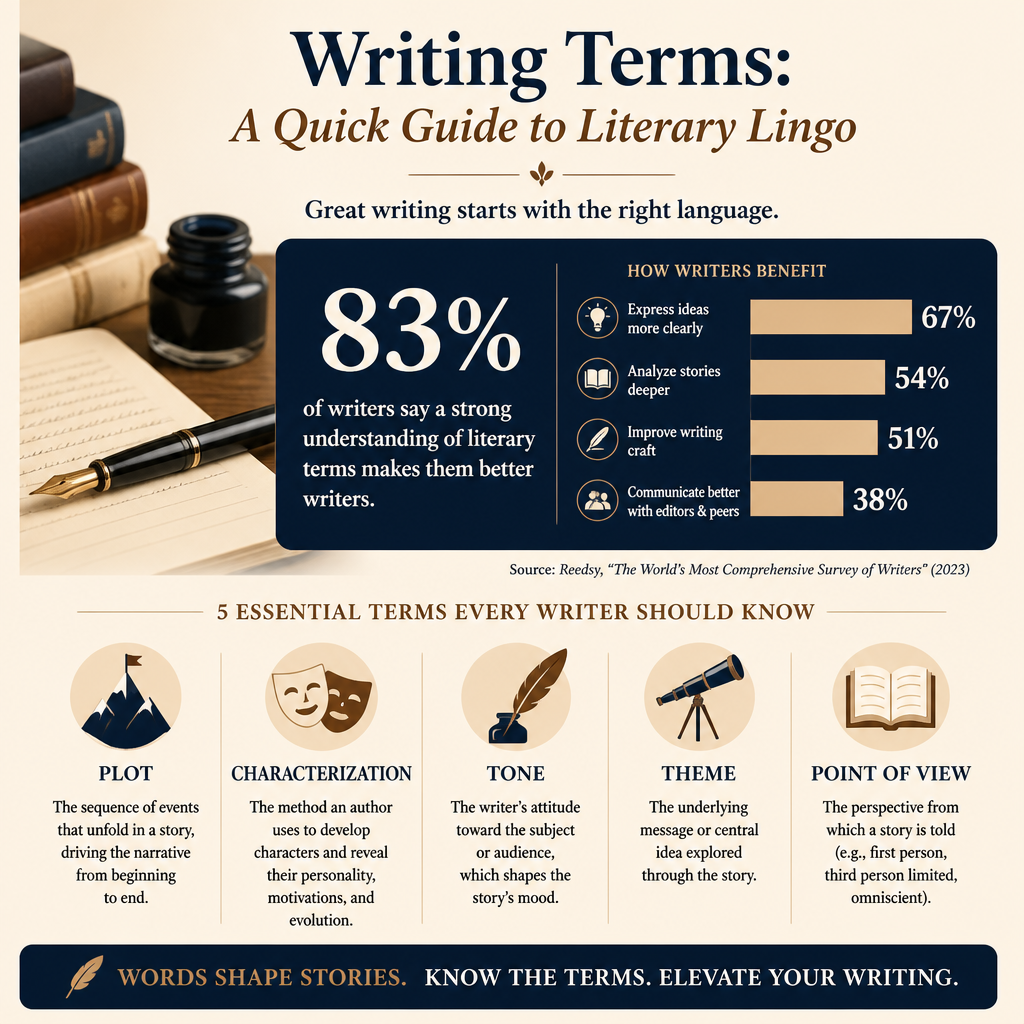
Point of view is the camera. It answers who is perceiving the story right now and what the reader is allowed to know. The common options you will hear are first person, third person limited, and third person omniscient.
Narrative distance is how close the camera sits to the character’s thoughts and senses. Close distance feels intimate and immediate. Far distance feels like a storyteller summarizing from across the room. Neither is morally better. The mistake I see most is unintentional distance shifts that read like the camera is teleporting.
What to do: Pick one default distance for each viewpoint character, then mark a page where you feel the prose suddenly gets colder or more report-like. Rewrite that paragraph two ways, once tighter and once looser, and choose the version that matches the emotional job of that moment.
Scene, Sequel, And The Value Of Aftermath
A scene is the unit where the character pursues a goal and collides with opposition.
A sequel is the unit after the collision where the character processes what happened, weighs options, and commits to the next goal. This vocabulary comes out of classic scene structure popularized by Dwight V. Swain in Techniques of the Selling Writer.
The trade-off is real. If you write only scenes, your book can feel breathless and emotionally thin. If you write only sequels, your book can feel like characters thinking in circles. You need both, even in action-heavy genres.
What to do: Take your last three chapters and label each chunk as a scene or a sequel. If you cannot find sequels, add short aftermath beats where the character makes a choice that raises the next problem.
Conflict, Tension, Stakes, And Turning Points
Conflict is opposition.
Tension is uncertainty about the outcome.
Stakes are what it will cost if the character fails.
A turning point is the moment a scene cannot return to the status quo because a decision, reveal, or consequence changes the direction.
Writers often say a chapter is “boring” when it is really missing one of these pieces. A quiet chapter can still have serious tension if the reader knows something the character does not, or if a relationship is about to snap.
What to do: At the end of every scene, write one sentence for what changed. If you cannot name the change, the scene probably did not turn.

Terms That Shape Your Draft And Revision Workflow
Drafting terms are not academic. They keep you from rewriting the same chapter ten times because you do not know what kind of work you are doing. The fastest writers I know are not magically more inspired. They separate drafting, revising, and polishing on purpose.
Draft, Revision, Rewrite, And Line Edit
A draft is you getting the story down.
Revision is structural problem solving, which can include moving scenes, changing goals, or rebuilding a character arc.
A rewrite is heavier than a revision, where you replace substantial text because the foundation was wrong.
A line edit focuses on style and clarity at the paragraph and sentence level.
If you line-edit a chapter before you know it belongs in the book, you are polishing a doorknob you might throw away. That is not discipline. That is avoidance dressed up as professionalism.
What to do: Set a rule for your current project. No line editing until the plot and character choices are locked. If you need help drafting cleanly without constant backtracking, I often point authors to tools like Adazing’s QuickWrite because it keeps you in forward motion instead of letting you fuss with commas for an hour.
Alpha Reader, Beta Reader, And ARC Reader
An alpha reader sees messy early material and helps you spot big issues.
A beta reader reads a near-final manuscript and reports the experience as a typical reader would.
An ARC reader receives an Advance Reader Copy for early reviews around launch.
Do not ask a beta reader to do an editor’s job. If you want craft-level diagnosis, ask someone for that explicitly and pay for it when appropriate. If you want reader reaction, keep the questions focused on confusion, boredom, and emotional impact.
What to do: Send beta readers a short form with five questions. Where did you skim? Where did you feel most? Which character did you distrust? What did you expect next? What did you want that you did not get?
Style Guide, House Style, And Consistency Passes
A style guide is a set of rules for spelling, punctuation, capitalization, and formatting. In US publishing, you will often hear about The Chicago Manual of Style.
A house style is the specific variant a publisher or imprint uses. Indie authors create their own house style, whether they realize it or not.
Consistency is where a manuscript starts feeling professional. It is also where a book stops generating one-star reviews that are really about trust. Readers do not consciously track whether you spell “okay” as “OK,” but they feel the wobble.
What to do: Build a simple style sheet as you revise. Track character names, place names, spellings, timeline facts, and recurring formatting choices. Hand it to your editor. This document saves hours, and it saves your sanity.
Terms That Keep Your Publishing Decisions From Getting Expensive
You can write a strong book and still lose money because you used the wrong publishing term in the wrong conversation. I have watched authors pay for the wrong service, hire the wrong freelancer, or misread a contract because the vocabulary was fuzzy.
ISBN, Imprint, And Edition Language
An ISBN is an identifier for a specific edition and format of a book. Paperback, hardcover, and ebook editions are different products in the supply chain, and they are treated that way. Bowker, the official ISBN agency for the United States, explains the basics and the “one ISBN per format” standard in its ISBN overview.
An imprint is the publishing name attached to a book. If you are indie, your imprint might be your business name. It signals professionalism in some channels, and it keeps your author brand from looking like a hobby if you publish widely.
What to do: Decide where you plan to sell. If you only sell ebooks through Amazon, you have fewer moving parts. If you plan to print distribution beyond Amazon, learn how identifiers and editions work so you do not create a metadata mess that is painful to clean up later.
Metadata, Categories, Keywords, And BISAC
Metadata is the descriptive information that helps stores and readers find your book: title, subtitle, series, author, description, categories, keywords, and contributor data.
BISAC codes are the category system used in much of the book trade, maintained by the Book Industry Study Group. You can see how BISAC works on the BISAC Subject Codes page.
Here is the trade-off. Tight categories help you reach the right readers and show up next to the right books. Overly narrow or inaccurate categories can bury you or attract the wrong audience, which tanks conversion and reviews.
What to do: Do an also-boughts audit on Amazon. Find five successful books that truly match your reader promise. Note their categories and their phrasing in the first two lines of the blurb. Then mirror the positioning without copying the language.
Royalties, Advances, And Rights
Royalties are your share of sales revenue, based on the contract or platform terms.
An advance is an upfront payment against future royalties in traditional publishing.
Rights define what formats and territories a publisher can exploit: print, ebook, audio, translation, and more.
I want you to treat rights language like you would treat a plot twist. Read it twice, then read it again out loud. If you grant world audio rights and do not have a plan, you can block yourself from an income stream for years.
What to do: When you see a contract clause you do not understand, stop and get qualified help. A one-hour consult is cheaper than a long rights headache.
Terms That Sell The Book Without Lying About It
Marketing terms matter because they describe a promise. When you misuse them, readers feel tricked, and bookstores and platforms punish confusion with invisibility. You do not need to write ad copy like a hype person. You need precision.
Hook, Logline, And One-Sentence Pitch
A hook is an interesting problem.
A logline is a compact statement of the main character, their goal, the opposition, and the stakes.
A one-sentence pitch is what you say when someone asks what your book is about and you do not want their eyes to glaze over.
What to do: Write three loglines. One should emphasize character. One should emphasize the situation. One should emphasize stakes. Use the version that fits your genre norms. Thriller readers buy danger. Romance readers buy emotional consequences. Fantasy readers buy wonder plus cost.
Blurb, Synopsis, And Back Cover Copy
A blurb is sales copy.
A synopsis is a plot summary, usually including the ending, used for submissions or internal planning.
Back cover copy is the print version of your blurb, shaped by space and layout.
If you hand a reviewer or an ad platform a synopsis when they need a blurb, you will choke curiosity. If you hand an agent a blurb when they request a synopsis, you look unprepared. These are different tools.
What to do: Write the blurb in three paragraphs. Paragraph one sets the character and disruption. Paragraph two tightens the conflict and raises the stakes. Paragraph three forces a choice and stops before the answer. Then run the thumbnail test on your cover and blurb together. If the cover promises cozy mystery and the blurb promises grimdark, you have a conversion problem, not a writing problem. If you need fast mockups for that test, Adazing’s cover tools can help you try variations without waiting a week for a designer.
Comp Titles, Positioning, And Reader Promise
Comp titles are comparable books that signal tone, audience, and shelf placement.
Positioning is the deliberate decision about where your book sits in the reader’s mental map.
Your reader promise is what experience the reader expects based on your cover, blurb, opening pages, and category.
The trade-off is that comps should be specific enough to guide people, but close comps can feel like you are trying to borrow someone else’s brand. I like comps that share audience and vibe while clearly leaving room for what is unique about your book.
What to do: Pick two comps. One should match genre and structure. One should match the tone. Then write one sentence explaining what you deliver that those books do not, in plain language. That sentence often becomes your ad angle and your newsletter pitch.
Terms That Help You Talk Like A Professional With Editors And Designers
When you hire freelancers, your vocabulary becomes money. Clear terms lead to clear quotes, clean timelines, and fewer rounds of frustrated revisions. Vague language leads to assumptions, and assumptions are where projects go off the rails.
Developmental Edit, Copyedit, And Proofreading
A developmental edit targets structure, pacing, character, argument, and chapter-level effectiveness.
A copyedit targets grammar, usage, consistency, and clarity.
Proofreading catches final typos after formatting.
Proofreading a book that has not been copyedited is like painting a house while the drywall is still wet. The paint job is not the problem.
What to do: When you request quotes, send the same sample pages to each editor and ask them what level of edit they think you need. If three professionals say “this is developmental,” believe them. You can still choose a cheaper step first, but you should choose it consciously.
Trim Size, Bleed, DPI, And Spine Width
Trim size is the final cut size of the printed book, like 5×8 or 6×9.
Bleed is artwork that extends past the trim so you do not get white slivers on the edge after cutting.
DPI is the resolution for print quality.
Spine width depends on page count and paper type, and it affects cover layout.
What to do: Pick your trim size early, before final cover design. If you change it late, you can force a full cover rebuild. Your designer will thank you, and you will pay less.
Typography Terms You Actually Use
You will hear kerning for space between specific letter pairs, leading for line spacing, and tracking for overall letter spacing. You do not need to become a typographer, but you should be able to say, “the leading feels tight” or “the kerning in the title is uneven,” and be right.
What to do: Do the thumbnail test on your cover and also a phone test on your interior. Export a page as an image and view it at the size readers will use. If your eyes work hard, your typography is costing you retention.
FAQs for Writing Terms: A Quick Guide to Literary Lingo
Which writing terms should I learn first if I feel overwhelmed?
I would start with point of view, scene and sequel, stakes, narrative distance, and blurb versus synopsis. Those five concepts fix the most common reader complaints I see: confusion, boredom, low emotional payoff, and weak sales copy.
Do writing terms matter if I write “by feel”?
They matter because “by feel” still produces patterns, and terms give you handles to repeat what works. You can draft by intuition and revise with vocabulary. That mix is how a lot of pros work, even if they sound casual when they talk about it.
How do I use literary lingo without sounding pretentious in critique groups?
I keep the terms tied to outcomes. I say, “the narrative distance jumped, and I stopped feeling close to her,” or “this scene did not turn, so I did not feel forward motion.” When you connect the term to the reader’s experience, nobody hears it as showing off.
A Working Vocabulary Beats A Big Vocabulary
You do not need to collect writing terms like trading cards. You need a small set of words that let you diagnose craft problems, communicate with publishing partners, and write marketing copy that matches what your book actually delivers.
If you want a practical way to lock this in, build your own mini-glossary as you revise. Each time you learn a term, add one example from your manuscript where it applies. That is how the lingo turns into control, and control is what gets you to a finished book that readers trust.
