
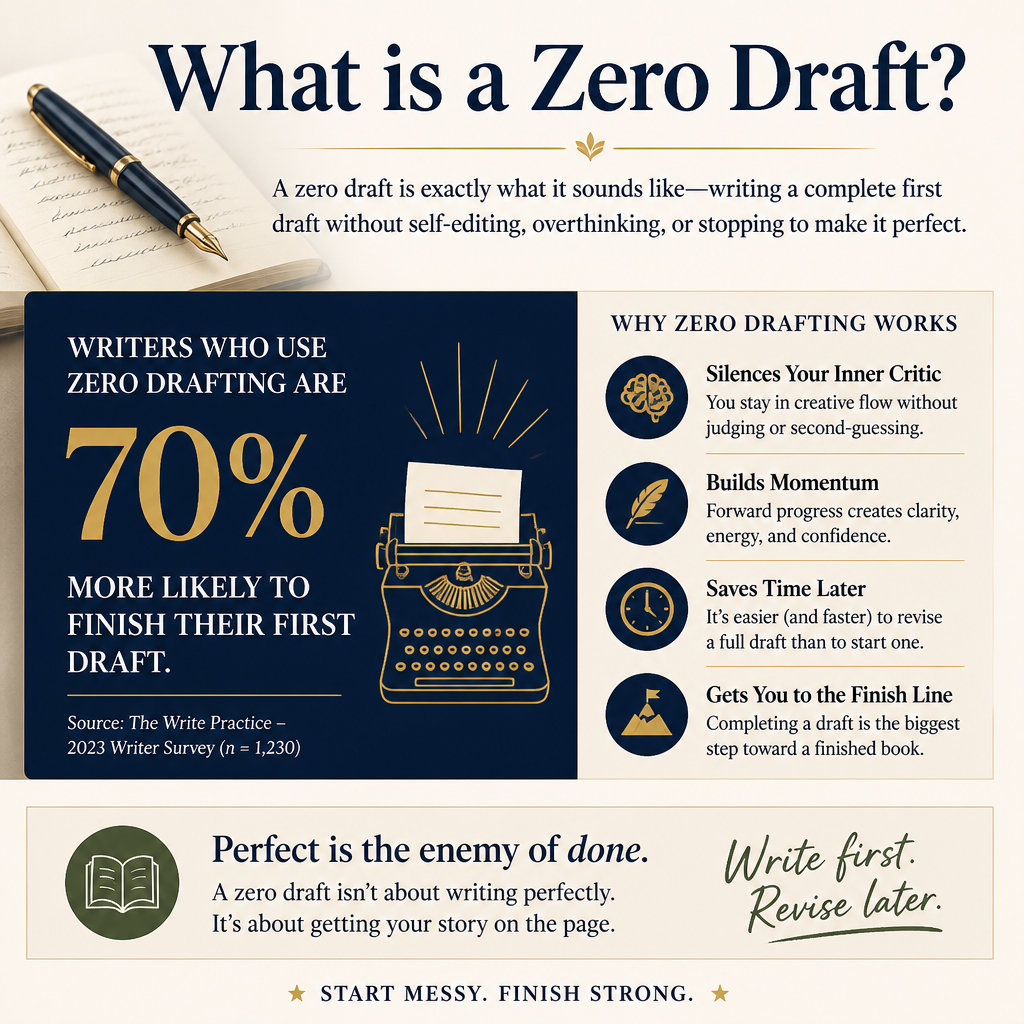
Most writers freeze because they think the first draft has to be readable. A zero draft is the permission slip you give yourself to write something that exists before it makes sense, so you can stop negotiating with every sentence and start moving.
I treat a zero draft as a messy, fast version of the book that captures the story’s bones, the argument’s spine, and the scenes I can already see. It is not the draft you hand to an editor. It is the draft that gives you raw material to revise.
If you are staring at Chapter One and polishing the first page for the ninth time, this is your way out. You write the book badly on purpose, then you write it well on purpose.
Table of Contents
What A Zero Draft Actually Is
A zero draft is the pre-draft. It sits before “first draft” in the same way a sketch sits before a finished painting. You are capturing intent, sequence, and momentum, not prose quality. If your first draft tends to stall because you keep trying to sound like your final version, the zero draft gives you a stage where sounding good is not allowed.
In practice, a zero draft can look like a lot of things. For novelists, it is often a scene-by-scene run where the dialogue is half-placeholder and the description is blunt. For nonfiction authors, it can be a chapter dump where headings, bullet points, and rough paragraphs coexist without shame. The common thread is that you are building a complete container for the book, even if the container leaks.
I want you to notice something important. A zero draft is not “planning” in the abstract. It is writing. It counts. It just counts differently.
The Job Of The Zero Draft
The job is to answer three questions with words on the page.
First, what happens, in what order? Second, what is the reader supposed to feel or learn at each step? Third, what do you need to set up earlier so the later parts pay off? When you can see those answers, revision becomes engineering instead of guesswork.
How A Zero Draft Differs From An Outline
An outline is a promise. A zero draft is evidence. Outlines are great for reducing uncertainty, but they do not expose the parts that collapse when you try to write them. A zero draft forces contact with the actual work: the transitions that do not work, the missing motivation, the chapter that has no point, the scene you “planned” but cannot visualize.
If you love outlining, keep outlining. Then convert your outline into a zero draft by writing through it in ugly paragraphs and blunt dialogue until you have a full manuscript-shaped document.
How A Zero Draft Differs From A First Draft
A first draft usually carries an unspoken expectation that it should read like a book, just an imperfect one. That expectation is the trap. The zero draft removes the performance pressure. It allows you to write “insert better banter here” and keep going, because the point is completion, not craft.
Why Writers Get Stuck Before The Zero Draft Exists
Perfectionism is not your personality flaw. It is a workflow problem. When your brain tries to solve story, language, continuity, voice, and market awareness in the same moment, it stalls because it is doing five jobs at once.
When I build a drafting process for an author, I intentionally separate those jobs. The zero draft takes the “sound like an author” job off the table so your brain can focus on sequence and meaning.
Decision Fatigue On The Page
Writing a publishable sentence requires a pile of micro-decisions: word choice, rhythm, clarity, subtext, and whether the sentence matches the voice you want. Multiply that by two thousand sentences, and you have a decision factory. Decision fatigue is one reason writers revise Chapter One forever and never reach Chapter Ten.
The zero draft reduces the number of decisions per paragraph. You write “he is mad here and says the thing that breaks the partnership,” and you keep going. You can write the line that breaks the partnership later, after you know what the partnership was for.
Working Memory Limits
Your working memory is limited. Psychologist George A. Miller’s famous paper “The Magical Number Seven, Plus or Minus Two” is often cited for the number of items we can hold in mind at once, even though modern research refines the exact number. The useful takeaway for writers is simple: you cannot hold the whole novel in your head and craft perfect prose at the same time. You can read Miller’s original argument in “The Magical Number Seven, Plus or Minus Two”.
A zero draft offloads the book from your head onto the page. Once the whole thing exists in any form, you can evaluate it with your eyes and fix it like a builder, not like a fortune teller.
Premature Line Editing
I see this constantly in indie circles. A writer calls it “revision,” but they are polishing paragraphs that will be deleted once the midpoint changes. Line editing before structural clarity is expensive, even when you are the one paying in time.
The zero draft changes the order of operations. Structure first, sentences later.
How To Write A Zero Draft Without Turning It Into A Trash Fire
A zero draft is allowed to be ugly. It is not allowed to be vague. Vague drafts create vague revisions, and that is how you end up with a book that never quite clicks.
My rule is “specific, blunt, and complete.” Your goal is to produce a manuscript that lets you see the whole story or argument from start to finish, with enough concrete content that you can diagnose what is broken.
Set Concrete Constraints
Constraints keep the zero draft from becoming an endless sandbox. Pick a deadline and a daily minimum that forces forward motion. For a novel, I like 30 to 90 minutes a day focused only on new words. For nonfiction, I like a chapter-per-week cadence with a hard cap on polishing.
During this phase, I recommend you ban two activities. First, reread anything except your last paragraph for continuity. Second, researching anything that is not required to write the next scene or section. If you catch yourself opening ten browser tabs to confirm the car’s model year, that is procrastination wearing a lab coat.
Write In Placeholders On Purpose
Placeholders are not cheating. They are speed tools.
Use bracketed notes in-line so you can keep moving: [insert fight choreography], [fact check this], [name this minor character], [better metaphor]. When you do this consistently, you generate a ready-made revision list. You also avoid the trap of stopping to solve a secondary problem that would be easier to solve later with context.
If you write with a tool that supports quick notes and consistent formatting, you will thank yourself. In Adazing’s QuickWrite, I like keeping a running “Fix Later” section at the bottom of the document so the interruptions do not sprawl across the manuscript.
Hold Onto Cause And Effect
The fastest way to create an unusable zero draft is to write a chain of events without causality. Your scenes and sections must push the next one. In fiction, that means each scene changes something: a plan, a relationship, a risk level, a piece of information. In nonfiction, each section needs to earn the next section by answering the reader’s question and raising the next one.
If you cannot articulate the cause and effect, add a single sentence inside the draft that states it bluntly. “Because she lies here, he decides to leave the crew.” You can make it subtle later. For now, you need it to be true.
Revision After A Zero Draft Works Faster And Hurts Less
A zero draft pays off when you revise in layers. Most writers know this in theory, and then still open the document and start rewriting the first paragraph. Layered revision stops that.
I use three passes that map to three different kinds of problems. Structural problems first, then scene or section problems, then language problems. Doing it in this order keeps you from perfecting pages that will disappear.
Pass One: Structure And Promises
On this pass, you look for missing promises and broken promises. In fiction, the opening promises a kind of story, and the ending pays it off. In nonfiction, the intro promises outcomes, and the chapters deliver them. If your book wanders, it is usually because the promises are unclear.
This is also where you check pacing and sequence. Does the inciting incident actually incite? Does the midpoint change the strategy? Do your nonfiction chapters build, or do they circle the same idea with new examples?
Pass Two: Scene And Section Strength
Now you go closer. In a novel, every scene should have a goal, opposition, and a turn. If a scene has atmosphere and dialogue but no turn, it usually reads like a pause button. In nonfiction, each section needs a claim and support. If you cannot point to the claim, the section is probably just you thinking out loud.
This is also where you tighten your transitions. Readers rarely complain about “transitions,” but they abandon books when the flow makes them work. Clean transitions keep your reader from feeling the seams.
Pass Three: Voice, Clarity, And Line-Level Craft
Only now do you worry about style. This is where you find the sentences that sound like you are trying to impress someone, the paragraphs that repeat, and the places where the reader’s mental image collapses.
For self-publishing, this pass matters commercially. Amazon “Look Inside” is ruthless, and readers will bail fast if your opening pages feel unsteady. Amazon explains how the preview works on its KDP help pages, including how content can appear in the preview. See Amazon KDP guidance on “Look Inside”.
Using The Zero Draft In A Real Author Workflow
If you are writing for publication, your drafting method connects to everything else: editing cost, cover timing, blurb clarity, and launch scheduling. A zero draft gives you something you can aim those business decisions at earlier, without pretending the manuscript is finished.
Here is how I like to fit it into an indie workflow that respects both art and deadlines.
Early Market Checks Without Derailing Drafting
You do not need comps, categories, and reader expectations nailed down to write a zero draft. You do need a rough sense of what shelf your book belongs on, because genre promises shape plot and pacing.
I recommend a 60-minute market scan before you start: look at the top 20 books in your Amazon category, read the top reviews for what readers praise and complain about, and note the cover patterns. Do not copy them. Use them to avoid avoidable mistakes.
If you want a fast way to handle the naming chaos that appears in a zero draft, tools help. Adazing’s name and word generators are useful here because you can plug holes without losing momentum. You can replace “Captain Guy” with a real name and keep writing the scene.
Drafting Tools That Support Speed
Speed is not a virtue by itself. Speed is useful when it prevents overthinking and gets you to the part where craft decisions are informed by the whole book. That is what the zero draft is for.
I like tools that reduce friction: quick chapter navigation, distraction-free writing modes, and a simple way to capture “fix later” notes. QuickWrite was built for exactly that kind of drafting rhythm, where you are trying to keep the story running instead of constantly rearranging the furniture.
When To Show A Zero Draft To Anyone
Most of the time, you do not. A zero draft is a private workspace.
If you have a critique partner who understands the process, you can share targeted chunks for only one question. “Does this protagonist’s goal feel believable?” or “Is the order of these chapters confusing?” Do not ask for prose feedback yet, because the prose is not real.
Save betas and ARC readers for after you have at least one full revision pass. If you send a zero draft to a reader who expects a book, you will get feedback that is accurate and useless. They will tell you the writing is messy because it is meant to be messy.
FAQs for What is a Zero Draft?
Is a zero draft the same thing as a vomit draft?
They are close cousins. People use “vomit draft” to mean fast and messy, while I use “zero draft” to mean fast and messy with a specific purpose: get the whole book onto the page in a form you can revise. If “vomit draft” makes you write with less shame, use it. If it makes you write vaguely, use a “zero draft” and hold yourself to cause and effect.
How long should a zero draft take?
Long enough to finish and short enough that you do not start polishing. For many novelists, that is two to eight weeks of consistent sessions, depending on length and life constraints. For nonfiction, it might be three to six weeks for a short book and longer for research-heavy work. If you are still in zero-draft mode three months later and you have not reached the ending, your constraints are too soft, or your plan is too fuzzy.
Can I publish a book that started as a zero draft?
Yes, and many good books do. You cannot publish the zero draft itself. Publish after structural revision, line editing, and proofreading, plus the usual self-publishing necessities: a cover that passes the thumbnail test, a blurb that sells curiosity, and a category setup that matches reader expectations.
A Zero Draft Gives You Something Real To Fix
If you are stuck, it is rarely because you lack talent. It is usually because you are trying to write, edit, and judge the book at the same time. Write a zero draft fast enough that your inner editor cannot keep up, then revise like a professional who has the whole manuscript in view. Your future draft deserves that advantage.
