
Most writing problems I diagnose in drafts come down to one gap: you know what you meant on the page, but you do not have the writing terminology to name what the page is actually doing. When you can label a thing, you can revise it on purpose, talk to editors and beta readers without hand-waving, and stop rewriting the same chapter six different ways, hoping it fixes itself.
Literary terms are not academic decoration. They are the control panel for your craft. If you are self-publishing, you also save money because clearer notes lead to faster edits, cleaner covers, better blurbs, and fewer rounds of confusion with freelancers.
I am going to give you the terms I see working authors use constantly, along with the practical decision each term helps you make. Read this like a field guide, then pick a few terms to bake into your revision checklist, so your next draft gets better faster.
Table of Contents
Terminology That Lets You Diagnose A Draft
If you can only say, “Something feels off,” you will revise by mood. The moment you can say, “The pacing drags because the scene lacks a turning point,” you have a fix. Diagnosis terms are the ones I reach for first when I open a manuscript.
Premise, Logline, And Theme
Premise is the core situation that creates ongoing pressure. In romance, it might be “two people forced to work together when they cannot stand each other.” In epic fantasy, it might be “a nobody discovers they are tied to an ancient catastrophe.” If your premise does not create repeatable conflict, you will keep inventing random events to keep the plot moving.
Logline is your premise with teeth. It names the protagonist, the goal, the stakes, and the opposition in one or two sentences. You need this for blurbs, ads, and even your own drafting sanity. If you cannot write a logline that sounds like your genre, you probably have a genre confusion problem, not a sentence-level problem.
Theme is the underlying question or claim your story keeps returning to. The theme is rarely a single word like “love.” It reads more like “love without honesty is just performance” or “power asks for your integrity first.” If your book feels scattered, check whether your scenes argue with the same thematic pressure or whether each subplot is chasing its own separate point.
Scene, Sequel, And Turning Point
Scene is action under pressure with a change at the end.
Sequel is the processing space after the hit where your character reacts, thinks, decides, and sets the next goal.
The pattern comes from Dwight V. Swain’s craft model, and it is still useful because it maps to how readers experience momentum. If your book feels like it is “all action” and still somehow slow, you might be stacking scenes without giving the reader sequels that clarify meaning and renew desire.
Turning point is the moment the scene cannot go back to how it was. A turning point can be a decision, a discovery, a failure, a kiss, a betrayal, a clue, a body. If a scene ends with nothing changed, it is usually a conversation the reader did not need.
Pacing, Tension, And Stakes
Pacing is how fast the reader feels the story is moving, not how many events happen. Pacing lives in compression, variation, and consequence.
Tension is the unresolved pressure that makes the reader turn pages. It can be external danger, social risk, romantic uncertainty, moral conflict, or pure curiosity.
Stakes are what it will cost if the character fails. If you are revising and you do not know what to cut, cut the pages where tension is absent or the stakes are foggy.
One practical trick I use is to summarize each scene in one sentence, then underline the cost of failure in that sentence. If you cannot underline anything, the scene is probably optional.

Point Of View Terms That Prevent Reader Confusion
Point of view is where a lot of competent drafts bleed trust. Readers will follow a complex plot if the lens stays stable. When the lens slips, they start rereading to figure out “where they are” instead of caring about what happens next.
POV, Viewpoint Character, And Narrative Distance
Point of view is the lens of perception for a passage.
The viewpoint character is whose thoughts, sensations, and interpretations you are allowed to report as true in that moment.
Narrative distance is how close the narration sits to that character’s inner life. Close distance gives you texture and voice. Far distance gives you sweep and clarity. If your prose feels flat, you are often too far away. If your prose feels claustrophobic or confusing, you are often too close to the complexity of the scene.
When I line edit, I look for a consistent “camera.” If you are in close third, do not suddenly describe your character like a stranger would unless you want distance for a reason.
Head Hopping, Omniscient, And Free Indirect Style
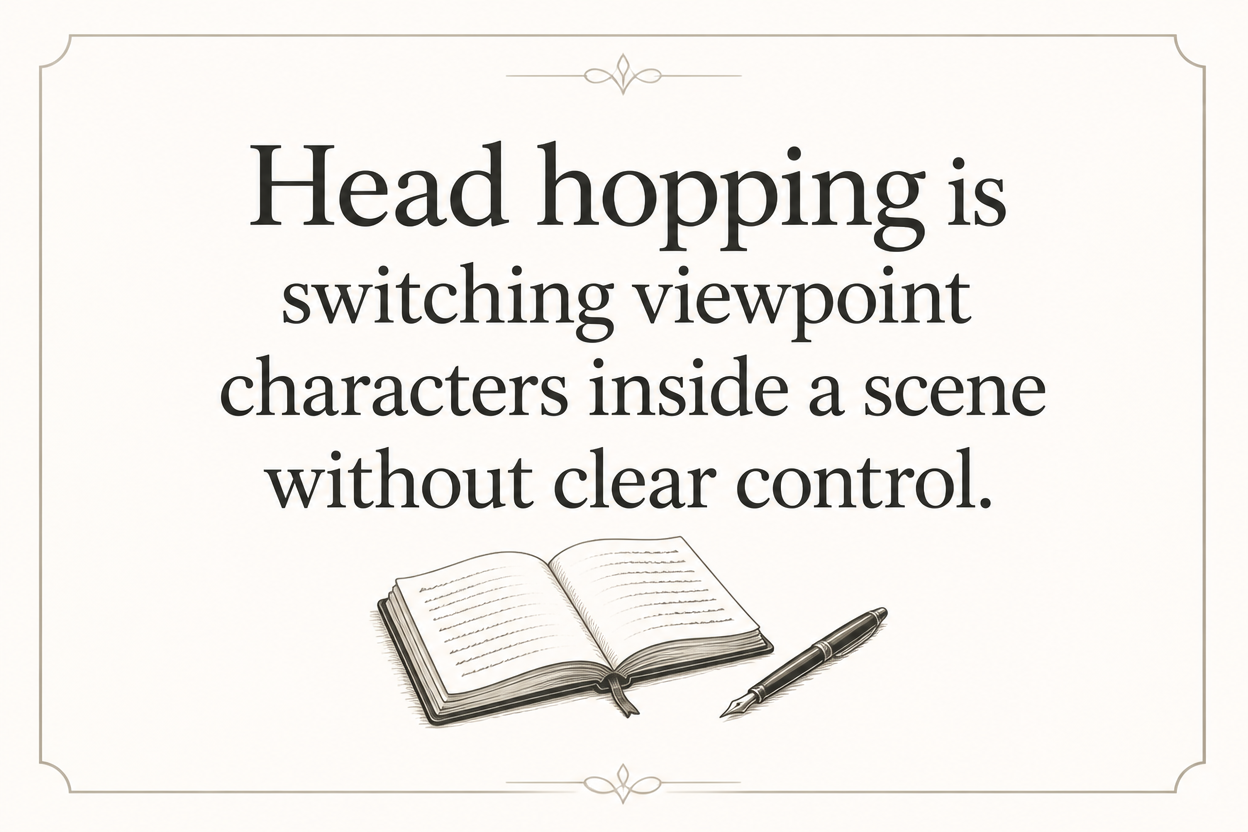
Head hopping is switching viewpoint characters inside a scene without clear control. It is not automatically “wrong,” but it frequently creates mushy emotion because no single perspective owns the moment.
Omniscient narration can move between minds, but it does so with a stable narrator voice and a deliberate pattern. If you want multiple minds, earn it with a consistent omniscient stance instead of accidental swapping.
Free indirect style is a technique where third-person narration slides into the character’s idiom without quotation marks or tags. Jane Austen uses it. Modern commercial fiction uses it constantly. It is powerful, but it demands discipline. If you use it, keep the reader oriented by anchoring each paragraph in whose attitude is steering the sentence.
If you are unsure which mode you are actually writing in, pick one chapter and mark every sentence that contains a judgment or interpretation. Ask yourself whose judgment it is. If the answer changes mid-paragraph, you have a control problem.
Unreliable Narrator
An unreliable narrator is a narrator whose account the reader cannot fully trust. That unreliability can come from deceit, self-deception, limited knowledge, or mental instability. The term matters because it changes what the reader expects. If you are writing unreliable narration, you must plant enough signals that the reader feels invited to question the account, not tricked by a late twist. Wayne C. Booth coined the term in “The Rhetoric of Fiction”, and his framing is still the cleanest way to think about it. Your job is to control the gap between the narrator’s story and the reader’s story.
Structure Terms That Keep Your Middle From Collapsing
The middle of a book is where good ideas go to die. You start strong, you can see the ending, and then the draft turns into travel, meetings, and “one more clue” until you finally drag the plot across the finish line. Structure terms give you handholds so you can fix the actual load-bearing beams.
Act, Plot Point, And Midpoint
Acts are large structural movements, usually defined by a major change in goal, stakes, or strategy.
A plot point is a turning event that spins the story into a new direction and makes the old plan impossible.
The midpoint is the central reversal or revelation that changes the character’s understanding of what they are dealing with.
If your midpoint is “something happens,” it will not carry enough weight. A functional midpoint usually forces a new approach. The protagonist stops reacting and starts choosing, or they realize the enemy is different from what they thought, or the personal cost becomes real.
Inciting Incident And Hook
The inciting incident is the event that disrupts the status quo and creates a story problem that cannot be ignored.
The hook is what makes the reader care enough to keep reading the early pages.
They are related, but they are not identical. You can hook with voice, mystery, or mood before the inciting incident arrives. If your opening is polished but readers still do not continue, your hook might be vague even if your inciting incident is solid.
Try this test: can you point to the exact page where the story becomes impossible to walk away from? If you cannot, your setup is drifting.
Subplot, B-Story, And Throughline
A subplot is a secondary line of conflict that intersects the main story.
A B-story is a structured secondary thread that often carries theme or relationship development, common in screenplay language but useful in novels too.
A throughline is the continuous thread that keeps the main promise present even when you detour.
If your book has sag, look for subplots that do not complicate the main conflict. A subplot should tighten the noose, not wander off to audition for a different book.
Language And Style Terms That Improve Your Pages Fast
Once your structure and POV are stable, style work starts paying off. Style terms are the fastest path to cleaner prose because they point to repeatable patterns. You fix one pattern, and a whole chapter improves.
Diction, Syntax, And Voice
Diction is your word choice.
Syntax is how you arrange words and clauses.
Voice is the cumulative effect of diction, syntax, rhythm, and worldview.
If your narrator sounds generic, start with diction. Build a list of words your viewpoint character would never use and words they default to under stress. Then adjust syntax to match how they think. A blunt character often thinks in shorter, more concrete sentences. A ruminative character loops and qualifies.
When I want to tighten my voice, I read one page aloud and circle the phrases that could have been written by anybody. That is where your book is leaking identity.
Show, Tell, And Summary
Showing gives the reader observable action, sensory detail, and inference.
Telling states conclusions directly.
Summary compresses time and events.
Good books use all three. The real skill is knowing what the reader wants to experience moment by moment and what they are happy to have compressed.
Here is a revision move that works: highlight paragraphs of pure telling and ask, “What is the reader supposed to feel here?” If the answer is “fear,” “desire,” or “shock,” you probably need a moment of showing. If the answer is “I just need the reader to know this happened,” a summary is usually fine.
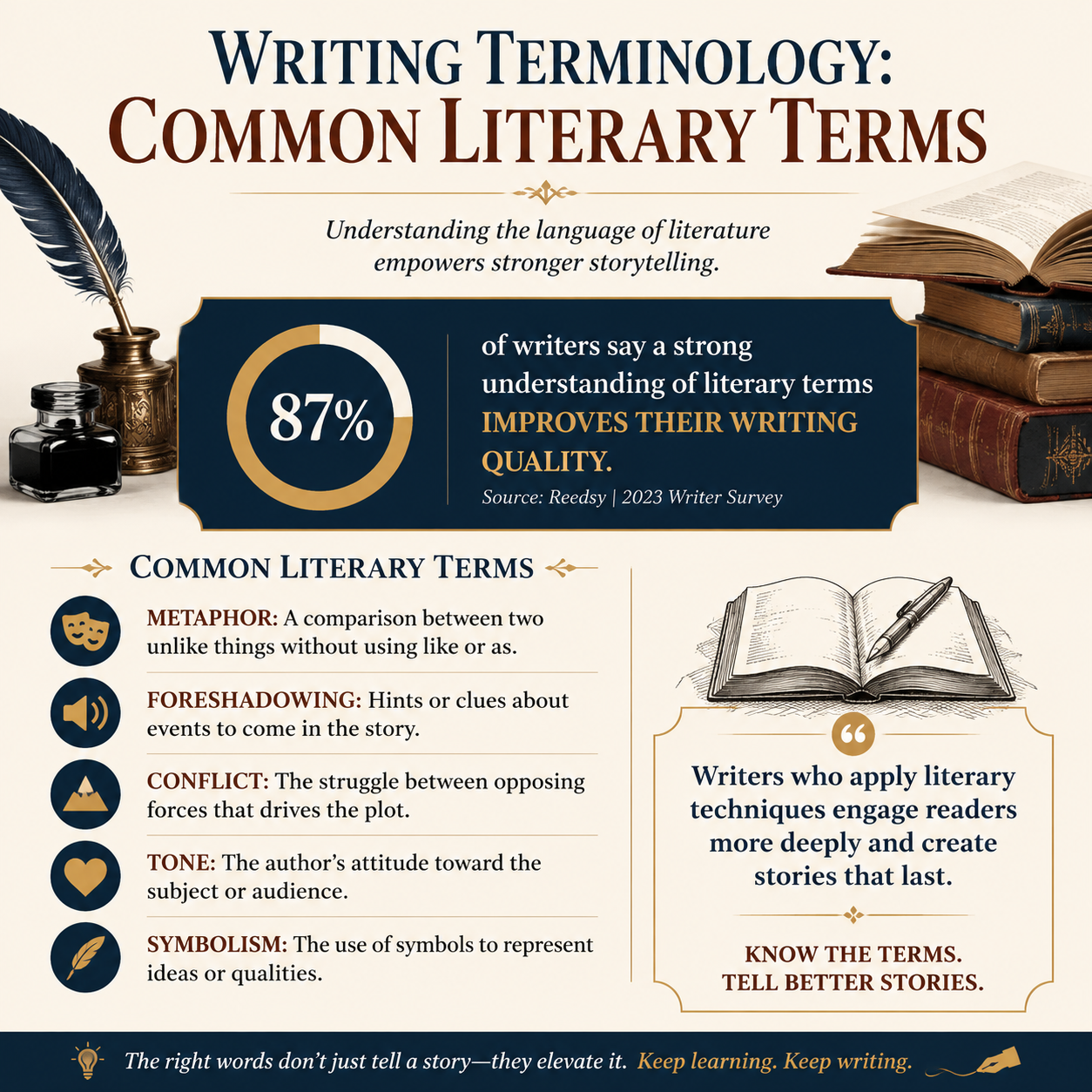
Metaphor, Simile, And Motif
A metaphor equates two things.
A simile compares using “like” or “as.”
A motif is a repeating image, phrase, object, or situation that gains meaning through repetition. Motif is one of the most reliable tools for giving a self-published book the feeling of intentional design. You do not need to be fancy. You need to be consistent.
If you want a practical motif, pick one object that naturally belongs in your setting, a coin, a train schedule, a church bell, or a recipe card. Then place it at three turning points where the character’s relationship to the story problem changes. Readers feel the pattern even if they do not name it.
Publishing And Marketing Terms Authors Actually Use
Craft terms help you write the book. Publishing terms help you sell it without guessing. I have watched excellent manuscripts disappear because the author did not understand the vocabulary of discovery and conversion on platforms like Amazon.
Blurb, Synopsis, And Query
A blurb is sales copy. It creates curiosity and stakes.
A synopsis explains the full plot, including the ending, usually for agents, editors, or some promotional contexts.
A query is the pitch letter, mostly relevant for traditional submission.
If you are indie publishing, you will live and die by the blurb. When you write yours, focus on character, desire, obstacle, and cost. If you want a fast draft, I often open a tool like Adazing’s QuickWrite to generate multiple blurb angles, then I edit by hand until it sounds like a human with conviction wrote it. The tool helps me get unstuck. The craft is in what I keep and what I cut.
Metadata, Categories, And Keywords
Metadata is the information that tells retailers what your book is: title, subtitle, author name, book description, categories, keywords, BISAC codes, and more, depending on the platform.
Categories and keywords affect where your book appears and who sees it. Amazon KDP documents how categories and keywords feed discovery through search and browse paths in Amazon KDP’s guide to keywords.
One habit I recommend is to pull up the top 20 books in your subgenre and write down the exact category path and the repeated language in their subtitles and blurbs. You are not copying. You are learning the market’s shared vocabulary so your book lands in the right mental shelf.
Read-Through, Also-Boughts, And Launch Team
Read-through is the percentage of readers who continue from book one to book two, and so on in a series. For many indie authors, read-through matters more than the royalties on book one.
Also-boughts are the recommendation links on Amazon that connect your book to other books readers purchased. Early buying patterns influence those connections, which is why a launch team of real genre readers can matter. You want your first wave of buyers to be the people who already buy the kind of book you wrote.
For evidence that pricing and promotions affect discovery behavior, Written Word Media has repeatedly published reader and promo data through its author-facing reports and surveys. Their analysis is worth reading when you are planning promos and series pricing, starting with Written Word Media’s report on how readers find books.
If you want to act on these terms, start small. Build an ARC list of 20 to 50 readers who genuinely read your genre, then give them a clear timeline and a single ask: an honest review during launch week if they finish. Anything larger gets hard to manage fast.
FAQs for Writing Terminology: Common Literary Terms
Which literary terms should I learn first if I am overwhelmed?
I would start with premise, scene turning point, stakes, and point of view. Those four terms fix the biggest causes of reader drop-off. If your scenes turn, your stakes are clear, and your POV stays stable, a lot of other problems shrink.
Is it bad to mix first-person and third-person point of view?
It depends on genre expectations and how cleanly you separate the modes. Mixing can work well in thrillers and romance when one character owns first person, and the other sits in third, or when framing chapters are in a different voice. The risk is reader whiplash. If you do it, keep the pattern consistent, signal the change at chapter breaks, and watch tense and voice like a hawk.
How do I use literary terms with editors or beta readers without sounding pretentious?
Use terms as shortcuts tied to a specific page. Say, “In chapter 6, I think the midpoint revelation lands too softly,” and then ask a concrete question like, “Did that change how you understood the antagonist?” When terms point to a shared problem, they feel professional, not showy.
A Working Vocabulary Beats Vague Instinct
Your instinct got you far enough to finish a draft. A working vocabulary gets you to a publishable book because it turns instinct into choices you can repeat. Pick ten terms from this list, write a one-line definition in your own words, and use them while you revise. The next time a chapter sags or a character feels thin, you will have something better than hope. You will have a name for the problem and a direct way to fix it.
