
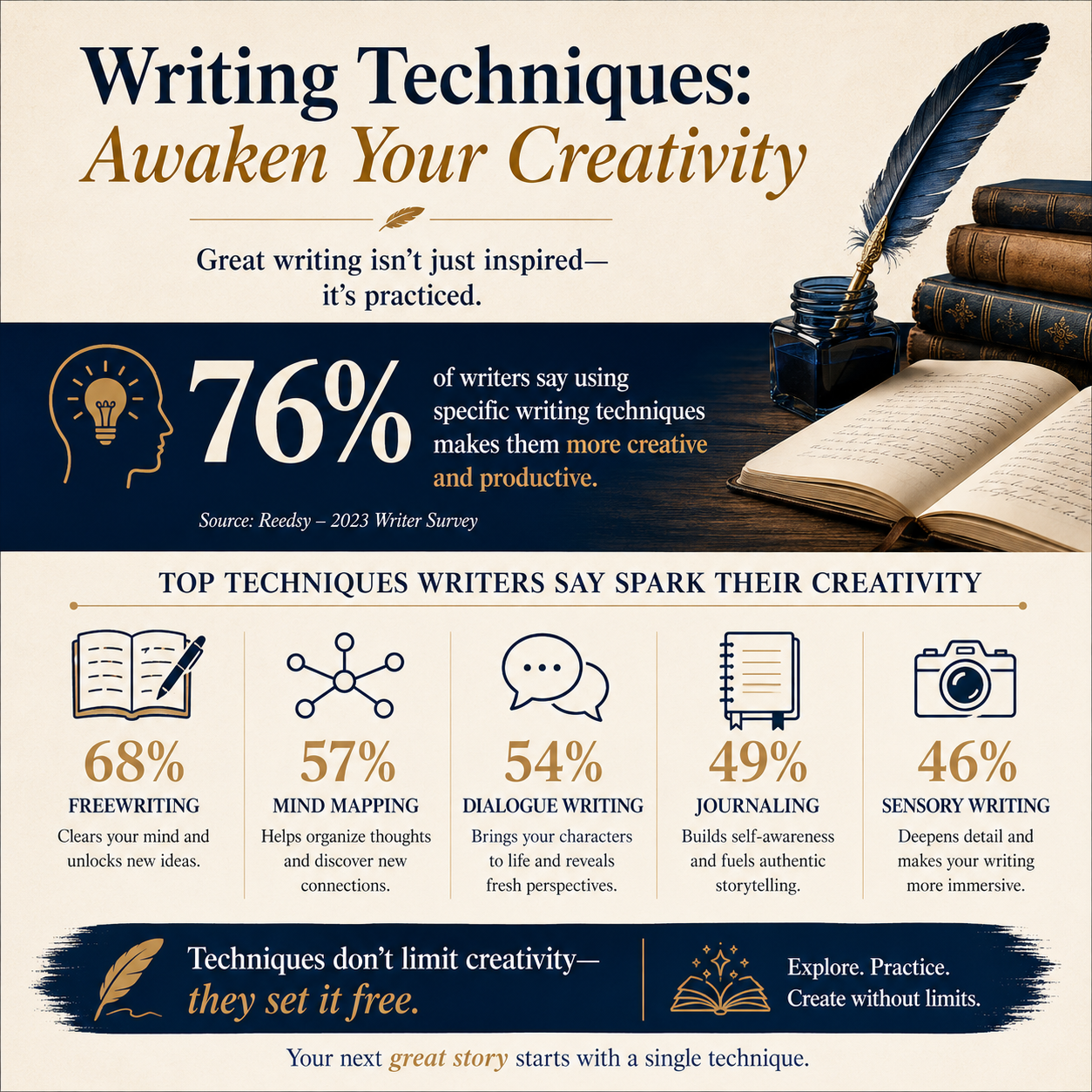
The best writing techniques for creativity are the ones that produce usable pages on your schedule, not the ones that feel inspiring in the moment. If you have ever stared at a blank document and felt your brain slide off every idea like it was Teflon, you already know the uncomfortable truth. Creativity is unreliable when you treat it like a mood.
I have edited enough drafts and watched enough author friends stall out to believe this strongly. Your creativity wakes up when your process gives it three things: constraints, friction in the right places, and a way to generate material you can revise. You do not need to become a different kind of writer. You need a set of repeatable moves you can run even on tired days, because tired days are most days when you are also publishing, marketing, and trying to live a life.
What follows is the approach I use when I want to get unstuck fast, and the approach I push authors toward when they tell me they want “more ideas.” You will notice that none of it relies on waiting for the muse. It relies on building a system that produces options, then choosing the option that best serves your reader.
Table of Contents
Creativity Runs On Constraints
When you give yourself infinite freedom, your brain does what any overwhelmed system does. It freezes. A blank page is not an invitation. It is a demand for a decision, and decisions are expensive.
Constraints reduce decision load and give your imagination a wall to push against. That wall creates pressure, and pressure creates shape. Even in literary fiction, the work gets easier when you decide what kind of problem the scene must solve for the story.
Choose One Scene Job Before You Write
If you start a scene hoping it will “be good,” you are gambling. If you start a scene knowing its job, you can draft it badly and still draft it correctly.
I want you to pick one job per scene, write it at the top of your document, and refuse to draft anything that does not serve it. Here are scene jobs that actually guide choices:
- Force a decision the protagonist cannot dodge.
- Reveal the cost of the protagonist’s goal.
- Make the plan worse.
- Pay off a promise you made earlier.
- Introduce a new constraint that changes future scenes.
When you get stuck mid-scene, check the job. If the line you are about to write does not move the job forward, cut it or save it for later.
Draft Inside a Container
A container is a pre-decided format that keeps you moving. I use three containers constantly, and they work for fiction and nonfiction.
- Time container: Write for 20 minutes and stop. The limit keeps you from “thinking” for 18 minutes and writing for 2.
- Word container: Draft exactly 300 or 500 words. You can fix ugly later. You cannot fix empty.
- Structural container: Write the scene in five beats: setup, pressure, pivot, decision, aftermath. Keep each beat to one paragraph.
If you want a simple tool for this, I often use Adazing’s QuickWrite style timers and prompts to keep the container firm. Any timer works, but the real win is not the software. The win is the rule you follow without negotiating with yourself.
Use Genre Constraints Like Guardrails
Some writers treat genre expectations as handcuffs. In practice, genre is a set of proven reader pleasures. When you honor those pleasures, your creativity has a direction to run in.
If you write romance, your scenes get sharper when you track proximity, vulnerability, and the cost of intimacy. If you write thrillers, your creativity wakes up when you escalate stakes with time pressure and information control. If you write nonfiction, the constraint is reader transformation. Each section should change what the reader believes, knows, or can do.
Do this today. Write down the three promises your genre makes to readers, then check your next chapter against them. If the chapter does not deliver at least one promise, rewrite the chapter’s job.

Generate Raw Material Fast With Productive Prompts
You do not need better ideas. You need more ideas than you can use. Quality shows up after volume because your first thoughts are usually your most familiar thoughts.
There is research support for this pattern. In a classic study on brainstorming, researchers found that individuals generated more and better ideas than interacting groups, largely because groups lose time to social dynamics and blocked turns. You can read the original work by Diehl and Stroebe in “Productivity loss in brainstorming groups: Toward the solution of a riddle” from the Journal of Personality and Social Psychology. For writers, the takeaway is practical. Private generation first, then you can workshop later.
The Ten Bad Options Drill
This drill is the fastest way I know to restart a stalled chapter.
- Write the problem you are stuck on in one sentence. “How does Mara get the file without the guards seeing her?”
- List ten solutions that are obvious, ridiculous, melodramatic, or wrong.
- Circle two that create consequences you would enjoy writing.
- Combine those two into a third option that you did not list.
The first five ideas will annoy you. Keep going anyway. The useful material tends to show up around idea seven, after your brain runs out of polite answers.
Write The Scene You Are Avoiding
When writers tell me they are blocked, I often find they are avoiding one scene that feels emotionally expensive or craft-intensive. It might be the confession. It might be the first kill. It might be the chapter where the business advice has to become specific and therefore arguable.
Write that scene as a rough monologue first. No stage directions, no perfect dialogue tags, no pacing. Just the core exchange or explanation. Once the spine exists, you can rebuild it into real fiction or clean nonfiction structure.
Switch Input, Then Output
Feeding your brain matters, but “consuming content” is often procrastination with better branding. I use a two-step rule.
- Input: ten minutes of specific stimulus tied to your project. For a historical novel, that might be a museum collection page. For a fantasy, it might be a field guide for plants or weapons. For nonfiction, it might be a primary source or a case report.
- Output: twenty minutes of drafting that uses one concrete detail from the input.
If you need a fast way to generate names, places, or sensory anchors so you do not stall mid-draft, Adazing’s name and word generators are handy. I treat them like a box of Lego bricks. They are not the story, but they keep me building instead of staring.
Replace Inspiration With A Revision-Friendly Draft
The draft that unlocks creativity is the one you can revise. A draft that tries to be publish-ready on the first pass will choke you, because your critical brain is louder than your generative brain.
I am not asking you to lower your standards. I am asking you to move your standards to the correct stage of the work.
Write With Placeholder Language On Purpose
Placeholders are a professional move, not a failure. I use bracketed notes like:
- [Insert better metaphor]
- [Need a sharper line of dialogue here]
- [Research: 1890s train schedule]
- [Add a gesture that shows she is lying]
This practice keeps momentum, and momentum is a creativity multiplier. You are not breaking immersion. You are preserving it.
Draft In Layers, Not Passes
“First draft” and “second draft” are too vague to help you. I prefer layers because each layer has a single focus and a clear finish line.
- Story layer: Does each scene change the situation?
- Character layer: Does each major choice reveal desire, fear, or belief?
- Line layer: Are the sentences clean and specific?
Pick the layer you are working on before you open the manuscript. If you are in the story layer, you are allowed to write clunky sentences. If you are in the line layer, you should not be moving scenes around. The focus keeps you from “revising” by rereading.
Use Distance To See What You Actually Wrote
Your brain reads intention. Your reader reads text. You need distance to tell the difference.
One of the simplest distance tricks is to change the medium. Print the chapter. Change the font. Read it on an e-reader. Listen to it with text-to-speech. The cognitive effect is real. Research on disfluency suggests that harder-to-process presentations can increase careful processing in some tasks. The evidence is mixed, but the mechanism is useful for revision when you want to slow down and notice errors. For a readable overview of the idea and its limits, see the Association for Psychological Science discussion of disfluency research in “Desirable Difficulties”.
Do not treat this as magic. Treat it as a way to force attention when you are skimming your own work.
Protect Your Attention Like A Publishing Asset
Most creativity problems are attention problems. If your writing time is fragmented, your brain never gets deep enough to produce surprising connections. You end up writing the obvious version of your scene because the obvious version is what fits inside interruptions.
Build A Start Ritual You Can Repeat
I do not care what your ritual is. I care that it is short, physical, and consistent. My go-to is two minutes of setup, then I write the next sentence I already know is true. You can do something similar:
- Open the document.
- Read the last paragraph you wrote.
- Add a one-sentence note about what happens next.
- Write that sentence as prose.
The ritual reduces the friction of beginning. Beginning is where most writers burn their time.
Stop Writing Mid-Sentence
This trick is old, and it works. If you end a session at a clean stopping point, tomorrow you will have to invent momentum again. If you stop in the middle of a sentence, you return with a dangling thread your brain wants to finish.
I use it when I know I will have a short session tomorrow. It is a simple way to keep continuity.
Set A Minimum That Keeps The Chain Alive
Big goals are motivating until they are not. A minimum keeps you at work during weeks when your life is loud.
Pick a minimum you can hit on a bad day, such as 200 words or 10 minutes. If you do more, great. If you only do the minimum, you still keep the project warm. That warmth matters when you are trying to finish a book, then turn around and manage covers, blurbs, Amazon KDP setup, and marketing.
Feed Creativity With Market-Aware Choices
Some writers fear that thinking about the market will sterilize their imagination. In my experience, the opposite happens. A clear audience gives you sharper creative constraints, and sharp constraints produce better work.
Start With A Reader Promise
A reader promise is the experience your book reliably delivers. For fiction, it is the emotional journey. For nonfiction, it is the outcome.
Write one sentence that describes the promise in plain language. “A cynical bounty hunter learns to protect the thing he was hired to steal.” “A practical guide for finishing a draft while working full-time.” Keep it human. Then use it as a filter for your ideas list. The ideas that match the promise stay. The clever ideas that do not match go into a parking lot file.
Use Comps To Generate Better Plot And Packaging
Comp titles are not only for marketing copy. They teach you what readers already pay for, and that knowledge gives your creativity a target.
Pick two recent books in your category that you genuinely respect. Study their opening chapters and their back-cover blurbs. You are looking for craft and structure signals, not vibes. Where do they introduce the central problem? How soon do they show stakes? How do they present the protagonist’s flaw?
Then run a thumbnail test on your own book cover, because your creativity still has to survive the store. Nielsen Norman Group has long documented that users scan web content and rely on quick visual cues. Their research on reading behavior explains why clarity at a glance matters in digital environments. A good starting point is Nielsen Norman Group’s “How Users Read on the Web”. Amazon is not your website, but the scanning behavior is the same. If your cover title disappears at small size, your brilliant premise will not get clicked.
If you need to mock up cover concepts fast, Adazing’s book cover maker is built for rapid iteration. I like it for testing typography and hierarchy before I commit to a final design or hand the brief to a designer.
Turn Your Draft Into A Repeatable Publishing Engine
Creativity does not end when the manuscript is done. Your marketing needs creative output too, and it is easier when you plan for it during drafting.
While you revise, tag moments you can later repurpose:
- A line of dialogue that can become a quote graphic.
- A scene premise that fits a newsletter teaser.
- A nonfiction framework that can become a thread or blog post.
- A character detail that can become a reader magnet bonus scene.
This practice turns one act of creation into many. Discovery is accumulation, and you build accumulation by saving what you already made.
FAQs for Writing Techniques: Awaken Your Creativity
How do I get creative when I only have 30 minutes a day to write?
I would run a tight container. Spend two minutes rereading the last page, write one sentence that states the next scene’s job, then draft for 20 minutes without stopping to fix lines. Use the last 8 minutes to add bracket notes for anything you skipped. Your creativity responds to continuity, so protect the chain more than the word count.
What if prompts feel like they pull me away from my real book?
Prompts only help when they are tethered to your project. I recommend prompts that answer a real draft question, such as “What does my protagonist refuse to admit in this chapter?” or “What is the worst plausible consequence of this choice?” If the prompt produces material you cannot insert anywhere, it was entertainment, not drafting.
Is writer’s block real, or am I just procrastinating?
The label matters less than the fix. When you cannot write, you are usually facing one of three issues: you do not know the next story move, you are trying to draft and edit at the same time, or the scene you need to write has an emotional cost you are avoiding. Diagnose which one it is, then apply the matching tool. Outline the next three beats, draft with placeholders, or write the avoided scene as a monologue first.
A Creative Process You Can Trust
Your creativity is not a fragile gift that disappears when you look at it wrong. It is a set of mental moves you can train, and it shows up more often when your process is specific enough to carry you through low-energy days.
If you want a practical starting point, I would pick one constraint for your next session, run the Ten Bad Options drill on the problem you are avoiding, and draft inside a 300-word container. When the pages exist, you can shape them into something good. Until then, you are only rehearsing the feeling of being stuck.
