
Most advice about writing thrillers fixates on twists, but the opening pages decide whether your reader will ever reach them. When you hook readers from the start, you are not showing off style. You are building a contract that says, “This story moves, the danger is real, and you will be rewarded for paying attention.”
I have edited and marketed enough fiction to tell you the painful truth. A thriller does not get extra patience because you love your premise. It gets judged like a product in a crowded store, and your sample pages are the packaging that matters.
So I want you to stop asking, “How do I begin?” and start asking, “What do I make the reader want within the first two pages, and how do I keep tightening it for the next thirty?” That is the whole game.
Table of Contents
Start With A Disturbance, Not A Description
A thriller opening works when something changes, and the change carries a threat. It can be a body, a warning, a betrayal, a mistake, a missing child, a safe cracking open, a text that should not exist. What it cannot be is your character waking up, thinking about their divorce, and noticing the weather in three lovingly rendered paragraphs.
This matters for a practical reason. Online retailers train readers to browse quickly, and previews reward books that create motion immediately. Amazon even tracks how many pages Kindle readers finish, and Kindlepreneur has a clear breakdown of how KDP page reads are measured through KENP. Page reads are not craft, but they are a reality check. A slow start leaks readers, and a thriller with leaky retention is harder to market because read-through suffers.
Pick The Type Of Disturbance Your Subgenre Promises
Your first disturbance should match the book you are actually writing. A serial-killer procedural can open on the discovery of a victim or the killer setting a trap. A domestic thriller can open on a lie spoken too smoothly at breakfast, or a missing phone, or a neighbor who knows something they should not. An espionage thriller can open on a blown cover or a compromised drop. The disturbance is your first genre signal, and if it is fuzzy, your reader feels it.
If you are unsure what your subgenre promises, study the “Look Inside” samples of the top twenty books in your exact Amazon category. You will notice patterns in how soon the problem appears, how much scene-setting happens before the first pressure point, and what the narrative voice does to create urgency.
Write The Opening As A Scene With Consequences
I want you to open on a moment where someone wants something and cannot have it easily. That desire can be small, like getting through a meeting without being exposed, or huge, like finding a kidnapped teenager. The important part is that the moment forces a decision. Decisions create consequences, and consequences create forward pull.
Here is a simple test you can run on your first three pages. Highlight every sentence that could be deleted without changing what happens. If you can delete most of the page and still reach the same beat, you are describing instead of dramatizing.
Use Specificity As Your Shortcut To Tension
Generic danger reads like a writing exercise. Specific danger reads like news. “Someone is following her” is fine. “The same gray Prius has made four right turns behind her, and the driver keeps his hands at ten and two like he is on a test,” lands harder because it is observable.
When you rewrite your opening, replace two vague nouns with concrete ones. Replace “car” with “tow truck.” Replace “gun” with “Glock 19.” Replace “hotel” with “airport Marriott.” Those choices imply a world, and the world is where threat feels real.

Build A Hook With Questions That Multiply
A hook is not one big mystery statement. It is a chain of small questions that stack. The reader answers one, and you hand them two more. That compulsion is what keeps them turning pages at midnight when they promised themselves they would stop.
The mistake I see most is an opening that asks a question the book cannot sharpen. “Who is the killer?” is too broad at page one unless you also give me a body, a signature detail, a reason the killer chose this victim, or a ticking clock. Early questions need handles.
Anchor Every Question In A Point Of View Cost
Thriller questions become addictive when the viewpoint character pays for not knowing. If your protagonist is curious but safe, curiosity fades. If your protagonist is curious and exposed, the reader feels the risk.
So write your hook around cost. A detective needs to identify a victim before the media frenzy ruins the case. A con artist needs to find out who is blackmailing her before her mark sees the message. A mother needs to learn why her son is lying because the lie is already attracting police attention. Your reader does not need to understand everything. They need to understand what it will cost to stay ignorant.
Control The Size Of The Unknown
If you open with ten unknowns, the reader cannot choose what to care about. If you open with one clean unknown and add complications in a controlled way, the reader settles into the story.
I like a three-layer structure for the first chapter:
First, a surface question the reader can track right away. Who left the note? What is in the trunk? Why is the security footage missing?
Second, a personal question tied to identity or relationships. Why is the husband lying? Why is the partner late? Why does the detective refuse to call the FBI?
Third, a looming question that hints at the scale. What organization is involved? What pattern is forming? Who else is at risk?
Draft those three questions in one sentence each before you revise your opening. If you cannot state them cleanly, your hook is probably muddled on the page.
Hide Exposition Inside Curiosity
You will need to orient the reader. The trick is to give information as the character reaches for it. A briefing scene can work in a thriller, but only if it carries friction, disagreement, or a withheld detail that matters. A calm explanation with no stakes reads like homework.
When you feel the urge to explain, ask yourself what the character wants in the moment. Then deliver the explanation as a tool or obstacle in that pursuit. Your reader will accept a lot of context if it arrives as part of a chase.
Make Your First Scene A Promise About Pace
Pace is not car chases. Pace is how often the reader has to update their understanding of the situation. A fast-paced thriller changes the terms of the scene frequently, even if the character never leaves a kitchen table.
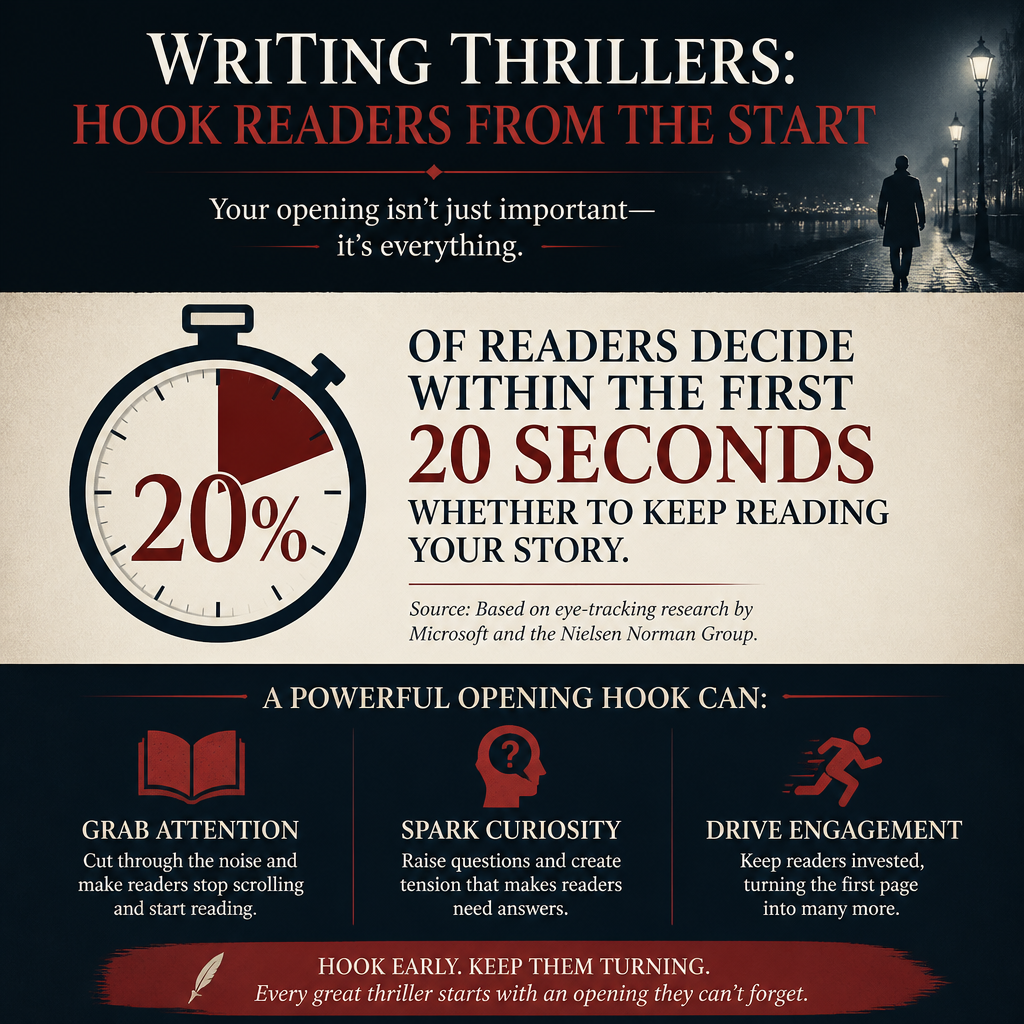
I recommend you treat the opening chapter like a promise you will have to keep. If you open with a sprint and then slow to a crawl for six chapters of backstory, readers feel tricked. If you open with controlled tension and escalate steadily, you train trust.
Use Ticking Clocks You Can Actually Maintain
A deadline creates pace because it turns every choice into a trade-off. The problem is that writers love deadlines they cannot maintain. “He has two hours” sounds great until you realize your plot needs three days.
Choose a clock you can support with scene math. If your protagonist is racing to stop a transfer at 3 p.m., your scenes between 10 a.m. and 3 p.m. need to move like real time. If your clock is “before the next victim,” you have more flexibility, but you have to seed the pattern early.
Write your first act timeline in a simple list. If it looks impossible, fix it now, because time logic errors are thriller-killers.
Cut Soft Entries And Soft Exits
Soft entries start a scene before anything matters. Soft exits linger after the decision has been made. Both flatten the pace.
Revise your first three scenes with one rule. Enter as late as you can, leave as early as you can, and still keep clarity. If you need a beat to orient the reader, you can keep it, but it has to earn its space by carrying mood, voice, or a revealing detail that increases tension.
Vary The Pressure, Keep The Forward Pull
A thriller that stays at maximum intensity becomes numb. You need modulation, but every quieter beat should still lean forward.
I use a simple alternation. Pressure scene, then processing beat, then new complication. The processing beat is where your character makes a choice, forms a plan, or misunderstands a clue. If your quiet scene is only reflection, you are pausing the book instead of tightening it.
Engineer The First Page For Trust And Clarity
Confusion and suspense are not the same thing. Suspense means the reader understands enough to worry. Confusion means the reader cannot build a mental model, so they stop caring.
The first page has three jobs. It introduces a viewpoint with a reason to stay. It establishes a setting with enough clarity to picture. It puts a problem on the table that demands attention.
Pick A Viewpoint Strategy And Commit
Thrillers often juggle perspectives, and that is fine, but the reader needs a stable grip. If you open with a killer prologue, write it as a complete mini-story with its own tension and payoff. If you open with your protagonist, stay with them long enough for the reader to attach.
I recommend you decide whether your opening is doing one of these things:
It introduces the hero in trouble. It introduces the villain creating trouble. It introduces the victim and the impending trouble.
Do not try to do all three at once on page one. The book is long. You have room.
Use Names And Concrete Roles Early
Readers track stories through labels. Name your viewpoint character quickly. Give them a role that implies competence or vulnerability. “Detective Lena Ortiz” or “Nurse Rachel Kim” lands faster than “a woman” for three paragraphs.
If you are worried about being too on-the-nose, remember that clarity is not clunkiness. You can write cleanly and still write beautifully.
Control Your First Paragraph Length
Long first paragraphs often hide the absence of an event. Short first paragraphs can become gimmicky if they are only there to look punchy. I aim for a first paragraph that contains one shift in the situation, expressed in plain language with one memorable detail.
Try this rewrite constraint. Draft your opening paragraph in three sentences.
- Sentence one establishes where you are and who is present.
- Sentence two introduces the disturbance.
- Sentence three reveals the cost or the decision.
You can expand later, but this forces the story to move.
Revise Your Hook Like A Marketer Without Writing Like One
Your hook is a craft problem and a sales problem at the same time. The words on page one influence reviews, also-bought placement, ad performance, and read-through. That is not romantic, but it is real.
Pew Research reports that many Americans still read books in multiple formats, and that matters because readers who switch between ebooks and audio are often reading in shorter bursts. A clean hook helps those readers re-enter the story fast without feeling lost.
I also see authors sabotage themselves by treating the opening like an untouchable artifact. You can love your first scene and still admit it is not doing its job. If the hook is weak, the rest of the book does not get a fair chance.
Run A Cold Read Test With Real Data
You do not need a massive beta team to learn something useful. You need five readers who actually read thrillers and who will answer direct questions.
Send them the first 1,500 to 2,000 words and ask:
What do you think the book is about right now? What do you think the main danger is? What question are you most curious about? Where did you feel your attention dip?
If three people point to the same dip, that is not taste. That is a structural issue you can fix.
Use Tools To Reduce Friction, Not Replace Judgment
When I am tightening a hook, I want speed and iteration. This is where tools earn their keep.
In Adazing QuickWrite, I will often generate a few alternate opening beats, not to steal from the machine, but to see my own scene from different angles. One version might open later, one might compress exposition, one might reveal the disturbance more visually. Then I pick the human version that fits my voice and the book’s promise.
If you need names that fit a specific setting or culture, Adazing name generators can save you from the placeholder-name trap where “Detective Bob” survives into the proof copy. Small credibility leaks add up in a thriller because readers are already scanning for logic errors.
Align The Hook With Your Blurb And Cover Promise
Your opening does not exist alone. It has to match what your cover and blurb imply, or you will get the wrong readers, and wrong readers leave the most confident one-star reviews.
Look at your cover at thumbnail size. Then read your blurb. Then read your first two pages. Do they feel like the same book? If your cover screams high-octane espionage but your opening is a slow small-town meditation, your marketing and your manuscript are pulling in opposite directions.
This alignment affects ads, too. Written Word Media has shared ad guidance over the years that highlights how conversion depends on matching reader expectations, and you can see some of that thinking in their resources on book promotion and reader targeting. Ads do not fix a mismatched promise. They accelerate it.
FAQs for Writing Thrillers: Hook Readers from the Start
How soon should the main conflict appear in a thriller?
I want a clear disturbance in the first two pages, and I want the main conflict to be visible by the end of chapter one. Some thrillers open with a prologue that plants the larger threat, then chapter one introduces the protagonist’s personal problem. That can work as long as both threads create tension and you tighten the gap between them fast.
Should I use a prologue to hook readers?
You can, but only if the prologue is a real scene with consequences and it pays off later in a way the reader can feel. I cut a lot of prologues because they exist to sound ominous, then the book restarts with unrelated material. If you keep it, keep it short, specific, and connected to the core threat.
How do I hook readers without a murder or chase scene?
Use a decision under pressure. A domestic thriller can hook with a lie, a missing object, or a social situation that turns predatory. A legal thriller can hook a client who refuses to tell the full truth. Suspense is about risk and cost, not blood. Give the reader something that can go wrong right now, and let the character’s choices tighten the noose.
A Hook Is A Promise You Keep For Three Hundred Pages
The opening of a thriller is where you teach the reader how to read your book. If you deliver a disturbance, stack clean questions, control clarity, and set a pace you can maintain, you build trust that carries you through the mid-book sag that kills so many drafts.
If you want a practical revision task, rewrite your first two pages three times. One version starts later than your current draft. One version starts earlier but adds immediate cost. One version keeps the same moment but changes what the character wants. Then pick the version that creates the strongest forward pull and revise from there, because your hook is not a mood. It is engineered.
