
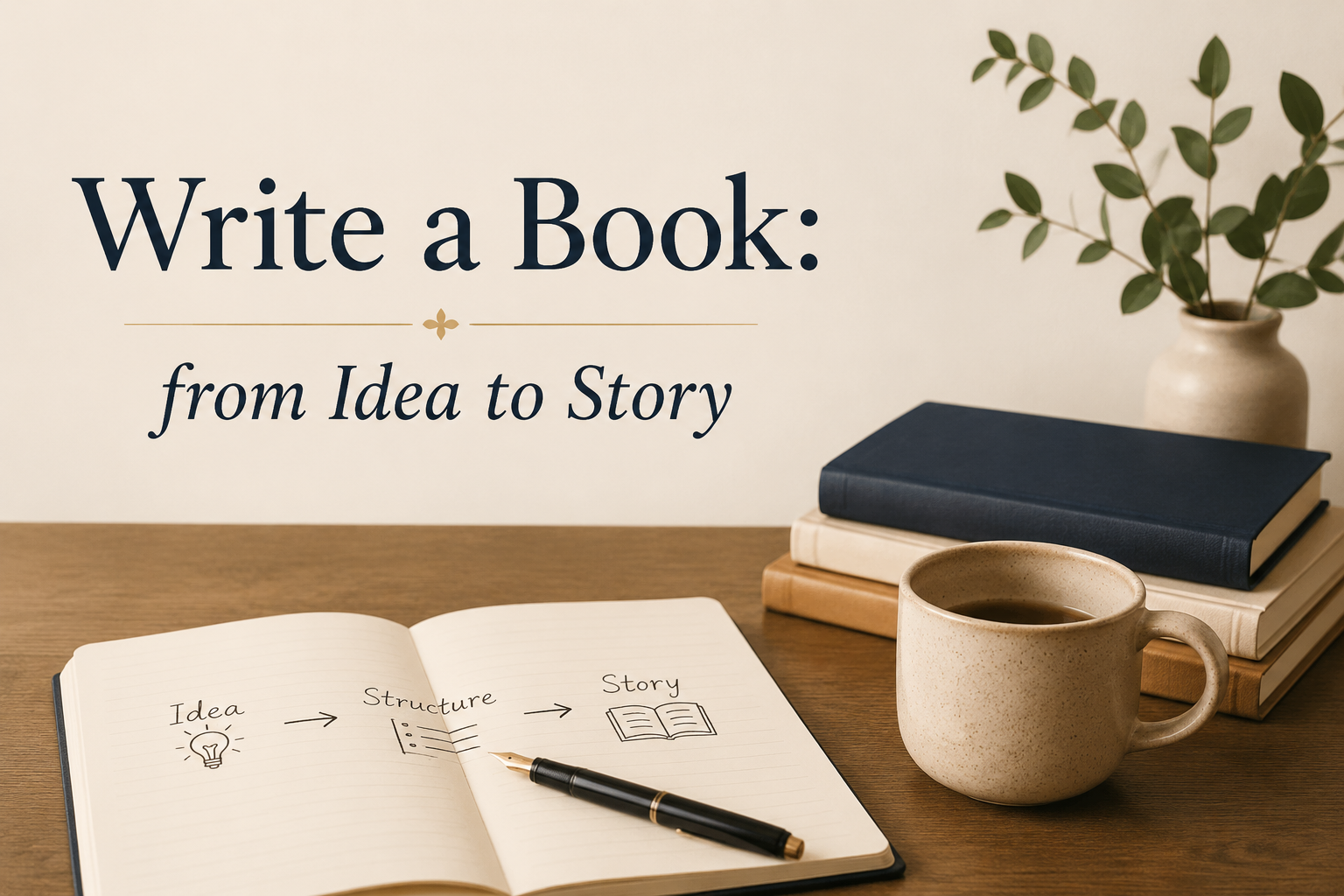
Most people who want to write a book get trapped at the same spot: the idea feels alive, but the story keeps slipping through their fingers. That is normal, and it happens because an idea is not yet a working story engine. If you turn the idea into a set of constraints you can actually draft against, you stop circling and start producing pages you can revise into a book.
I am going to walk you through writing a book from raw idea to draftable story using the same steps I use when I need a project to hold together through the messy middle. You will make a handful of decisions early, and each one will save you ten later when you are tired, and your confidence is negotiating with your procrastination.
And yes, you can do this as a discovery writer! You need a light structure that catches you when you fall, so the draft keeps moving.
Table of Contents
Ideas Become Books When They Create Pressure
An idea is a situation. Meanwhile, a story is a pressure applied to a character who cannot stay the same. When your premise does not generate pressure, you compensate by adding plot events, and the book turns into a parade of scenes that do not bite.
I look for three kinds of pressure right away, because they predict whether the draft will stay interesting past chapter five.
Desire With Teeth
Your protagonist needs a want that costs them something every time they pursue it. Wanting to be loved is fine. Wanting to be loved by the one person who will ruin their career if they get close is better. If the desire does not force trade-offs, the character can drift, and drift reads like filler.
Write one sentence that names what your protagonist wants and what they are willing to do to get it. If you cannot name the cost, you do not have a draftable desire yet.
Opposition That Is Personal
Readers can smell generic conflict. A villain who is “evil” is not opposition; it is a label. Opposition becomes personal when it threatens the protagonist’s identity, not just their schedule.
Give the opposing force a clear reason to push back that makes sense from their point of view. When both sides believe they are right, your scenes stop feeling like errands.
Consequences That Show Up On The Page
If failing only means feeling bad later, the story will sag. Consequences work when they are immediate, observable, and escalating. For example, the protagonist misses a deadline and now loses the client. The secret gets out, changing how people treat them in the next scene.
Draft a consequence ladder with three rungs. If your protagonist does nothing, what gets worse by the end of Act One, by the midpoint, and by the climax? If you cannot answer, you are still holding an idea, not a story.

The Fastest Way To Find Your Story Is To Choose A Promising Constraint
Writers hate constraints until they realize constraints create freedom. When you decide what kind of book you are writing, you stop rewriting the same first chapters in different genres.
I pick constraints in this order because it keeps the creative choices aligned with what readers already expect and pay for.
Genre Promise And Reader Contract
Genre is not a marketing afterthought. It is the set of emotional outcomes you are promising. Romance promises a central love story and an emotionally satisfying ending. A mystery promises a question, clues, and a fair reveal. Epic fantasy promises scope, power, and a sense of history. If you violate the promise, you can write something beautiful and still get one-star reviews for “not what I thought I bought.”
Pick one primary genre and one secondary flavor. “Cozy mystery with a foodie angle” is a constraint. “A story that blends everything I love” is a stall.
Length And Format
A 55,000-word thriller and a 140,000-word thriller are different reading experiences, and they draft differently. So are a standalone and a series starter. A series gives you room for a slow-burn character arc, but it also demands a hook that earns book two.
Decide your target draft length range and your format before you outline. If you are writing for Amazon KDP, keep an eye on reader expectations in your category and the practical pricing considerations for ebook and print. Amazon changes details over time, so I point people to Amazon KDP pricing and royalty information for the current rules rather than repeating numbers that go stale.
Point Of View And Narrative Distance
POV is a story constraint with teeth because it controls how much mystery, intimacy, and irony you can generate. For example, first-person POV brings intimacy and voice. Close third gives you flexibility with a similar emotional punch. Omniscient can work, but it requires control and a reason to be above the characters.
Choose a POV you can sustain for a whole novel, then write a 1,000-word test scene in that POV. If you feel yourself wanting to hop heads to make the scene work, the problem is not your discipline. The POV is fighting your premise.
Turn Your Premise Into A Story Spine You Can Draft
When writers tell me they are stuck, I usually find they are trying to draft without a spine. They know the vibe, the setting, the opening image, and maybe the ending. What they do not know is the chain of cause and effect that makes scene B inevitable after scene A.
I build a spine that is short enough to remember and strong enough to survive improvisation.
A One-Paragraph Core
Write a single paragraph that answers five questions in order.
- Who is the protagonist at the start, in terms of role and flaw?
- What do they want?
- What stands in their way?
- What do they do that makes things worse?
- What must they change to win or to lose in a meaningful way?
If you cannot keep it to one paragraph, you are still describing a world, not a story. Tighten until it is uncomfortable, because that discomfort is the signal you are choosing.
Scene Causality
A plot is not a list of events but a line of consequences. I use a simple test: can you connect scenes with “therefore” or “but” instead of “and then”? If you cannot, your story will feel episodic.
Take your next five planned scenes and write one sentence for each that starts with either “Therefore” or “But.” If you keep writing “And then,” you have identified exactly where the book will drag.
Midpoint Turn That Changes The Game
The midpoint is where a lot of drafts die. The fix is rarely “more twists”; it’s often a turn that changes the kind of problem the protagonist is solving. They go from reacting to acting, or from chasing a false goal to facing the real one.
Decide what new information, irreversible choice, or public exposure happens at the midpoint. Put it on the calendar of your story. If the midpoint could be removed without changing the ending, it is not a midpoint; it is a speed bump.
Build Characters Who Generate Scenes Without Begging
Plot gets the attention, but character generates the draft. When a character is built on a contradiction and a need, scenes write themselves because the character keeps making the same kind of mistake under pressure until they cannot afford it anymore.
I keep character design practical. I do not want a 12-page questionnaire. I want a character who produces choices.
Identity, Wound, And Lie
Give your protagonist an identity they protect, a wound that shaped them, and a lie they believe about how to stay safe. The lie is not a backstory fact. It is an operating system.
For example, a public defender who believes “If I stay emotionally detached, I will not break.” That lie creates a hundred scenes because it collides with clients, family, and their own burnout.
Write the lie as a sentence your character would actually think. Then write the truth as a sentence they cannot accept yet. That pair is your character arc in two lines.
Desire Versus Need
Desire is what the protagonist thinks will fix their life. Need is what will actually change them. You want those in conflict. If desire and need are the same, the book becomes a straight line with no internal fight.
Put desire and need on an index card. Every major scene should press on one of them. If a scene does not press, cut it or combine it with one that does.
Secondary Cast With Agenda
Side characters exist to apply pressure, reveal facets, and complicate choices. If a side character could be replaced by a text message without changing the story, they are probably doing atmosphere work that you can deliver more efficiently.
Give each major supporting character a want that intersects with the protagonist’s want. Intersection is where conflict lives. Alignment is where scenes go soft.
Draft With A Process That Respects Your Brain And Your Publishing Goals
A draft is a production problem as much as a creative one. The writers I see finish books reliably are not more inspired. They are more consistent about what the work session is for.
I separate drafting, diagnosis, and polishing. If you mix them, you will spend an hour moving commas and call it writing.
A Drafting Target You Can Keep
Pick a weekly word count that fits your life, then divide it into sessions you can protect. If you can do 1,000 words three times a week, that is 12,000 a month. In six months, you have a draft you can revise. If you keep waiting for a free weekend, you will keep imagining the same free weekend.
If you like writing sprints or timed sessions, tools can help. Adazing builds writing tools like QuickWrite that are designed to keep you focused on getting words down instead of fiddling with formatting and tabs. I like any setup that reduces friction and makes it harder to talk yourself out of starting.
Fast Feedback Without Derailing The Draft
Early feedback should test clarity and promise, not line-level style. I prefer a small group of trusted readers who understand your genre. Tell them what you need. Ask where they felt bored, confused, or emotionally disconnected. Those are the three signals that matter in a first pass.
When you are ready for a bigger push, ARC readers are useful for launch momentum, but they are not developmental editors. Use them after your revisions, when you are validating the reading experience and catching the last obvious problems.
If you want a data reality check on how readers actually buy and discover books, Written Word Media publishes surveys that help you think about marketing choices without guessing. Their How Readers Discover Books report is a solid starting point for understanding why your cover, blurb, and category decisions matter as much as your first chapter.
Revision Passes With A Purpose
I revise in layers because it stops me from repainting a house without a foundation. First, I fix structure and causality. Then I fix the character’s motivation and the scene’s goals. After that, I fix prose, voice, and line work. Copyediting comes after that.
Put your revision plan in writing as a checklist. If you do not name the pass, you will do all passes at once and finish none of them.
When you start thinking about publishing, remember that your book is competing as a product. Readers decide in seconds based on the cover and thumbnail, and that is not a moral judgment of your work. It is human attention. If you do not have a designer yet, tools like Adazing’s cover makers can get you to a professional-looking concept fast, which is useful for testing comps, running ads, or building a preorder page before you invest in custom design.
FAQs for Write a Book: From Idea to Story
How do I know if my idea is strong enough for a whole book?
Your idea is strong enough when it generates escalating consequences through character choice. If you can write a consequence ladder and a midpoint turn without inventing random disasters, you probably have a book. If you keep adding new villains, new magic systems, or new side quests to stay interested, your premise is not producing pressure yet.
Should I outline before I draft, or can I discovery write?
You can do either, but you need a spine either way. If you discover write, keep your structure light and update it as you go. I like a one-paragraph core and a short list of turning points. If you outline heavily, leave room for the characters to surprise you, because a rigid outline can turn into a draft that feels pre-decided.
When should I think about publishing and marketing?
Think about genre, category, and reader promise early because they shape the book you are writing. Save most marketing execution for after you have a revised manuscript, a cover direction, and a blurb concept. If you plan to run Amazon ads or build a launch team, you will want time for ARC distribution and review gathering, but none of that works well if the book itself is not delivering on its promise.
A Book Happens When You Choose And Commit
Your draft will get easier the moment you stop treating the story as infinite and start treating it as a set of chosen constraints. Decide the genre promise, build a spine with real causality, design characters who make pressured choices, and draft on a schedule you can keep. You do not need more ideas. You need one idea that you force into a shape that holds.
