
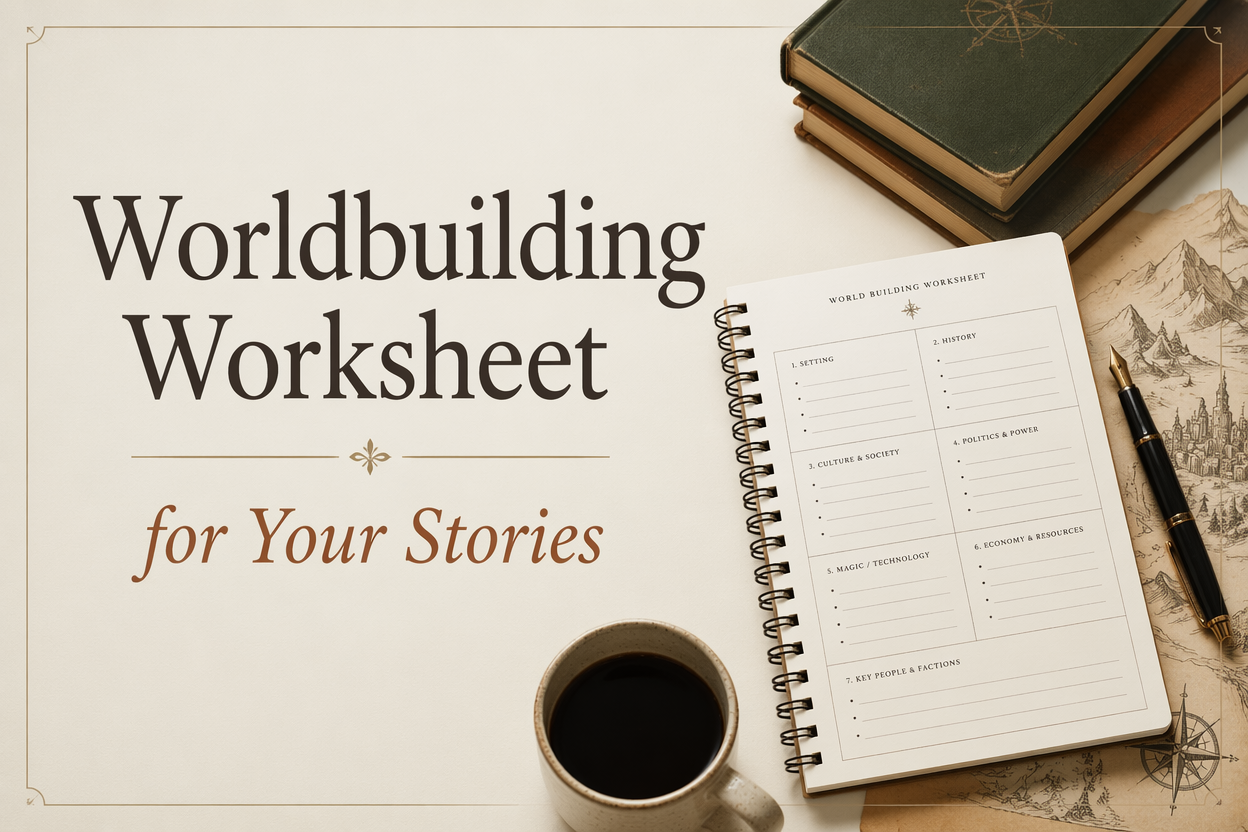
A worldbuilding worksheet is only useful when it stops you from writing encyclopedia pages and starts helping you write scenes that a reader can see, hear, and feel. If you fill in boxes about currency exchange rates but you cannot answer why your protagonist would break a law today, your “world” will read like a backdrop, not a place. I want you to build just enough structure to generate conflict on demand, then get back to the draft.
The stakes are practical. When worldbuilding sprawls, your book gets slower, your revisions get uglier, and your marketing gets harder because you cannot pitch the story cleanly. When worldbuilding is purposeful, your plot gets pressure, your characters get leverage, and your blurb starts writing itself because the setting creates problems a reader already understands.
I am going to give you a worksheet you can actually use while drafting. It is built around cause and effect, scene fuel, and reader comprehension, and it works for epic fantasy, cozy fantasy, sci-fi, alternate history, and contemporary with a speculative twist. You will answer fewer questions than most worksheets, and the answers you do write will pay rent in the manuscript.
Table of Contents
Purpose-Driven Worldbuilding
The mistake I see most is treating worldbuilding as a separate hobby that you do before you “start writing.” Drafting is where your world proves itself. A worksheet should be a set of decisions that constrain the story in interesting ways, because constraint is what creates plot.
Before you fill anything in, pick the story you are actually telling. Even if you are a discovery writer, you still have a working promise: a heist, a romance, a rebellion, a survival journey, a mystery, a chosen-family road trip. That promise tells you which parts of the world must be sharp and which parts can stay blurry until a scene demands them.
The Three Questions That Control Scope
If you answer these three questions in plain language, you will stop most worldbuilding bloat before it starts.
- What does your protagonist want that the world makes hard to get? Not a personality trait. A concrete want. For example, a pardon, a ship, a child, a spellbook, a safe town, a divorce, or a crown.
- Who has the power to grant or deny it? This can be a person, institution, creature, law, guild, god, algorithm, or social norm that can say no.
- What is the cost of trying? Money, status, safety, relationships, bodily risk, spiritual risk, moral compromise, or time.
Those answers tell you where to focus your worksheet. If your story is a court intrigue, your legal system and etiquette matter more than the geology. If it is a wilderness survival story, climate, navigation, and supply chains matter more than dynastic history.
The Reader’s Cognitive Budget
Readers have limited working memory, and every invented term and unfamiliar rule draws on it. That is not a theory; it is a basic finding of cognitive psychology. If you want a clean starting point, I point writers toward Simply Psychology’s overview of working memory, because it keeps the concept grounded in how attention actually works. Your job is to spend that budget on what creates emotion and conflict, not on trivia.
So I recommend a simple rule while filling out the worksheet. If an answer does not change a decision a character makes in the next three chapters, write one sentence and move on. You can always deepen it later when the draft proves you need it.

The One-Page Worldbuilding Worksheet
This is the version I use when I want a world that feels solid without delaying the book. Keep it to one page at first. You are allowed to expand later, but only after the draft asks for it.
Story Frame
- Genre and subgenre: (Epic fantasy, space opera, urban fantasy, dystopian romance, etc.)
- Primary promise: (Rebellion, heist, investigation, tournament, survival trek, marriage of convenience, etc.)
- Point-of-view range: (Single, dual, ensemble) and what that implies for how much of the world the reader will see.
World Snapshot
- Where are we? One sentence that names a place and texture. For example, “A canal city where fresh water is taxed by the liter.”
- When are we? Tech level and social vibe in one sentence. For example, “Late-industrial rail era with strict guild monopolies.”
- What is the everyday fear? The thing normal people avoid. For example, curfew patrols, crop blight, debt collectors, or spirits in the well.
- What is the everyday comfort? Food, ritual, entertainment, or community that makes the place worth living in.
Rules That Bite
- Three rules the world enforces: Laws, taboos, physics, magic constraints, social penalties.
- One rule people break all the time: Black markets, quiet heresy, bribery, forbidden love.
- Who profits from enforcement? Name the group, then write how they profit.
Power Map
- Top three power centers: Crown, church, corporation, cartel, academy, AI, elders, dragon council.
- What each one wants right now: Not ideology. A concrete short-term aim.
- What each one fears losing: The thing that makes them desperate.
Scarcity And Money
- What is scarce? Clean water, arable land, fuel, magic components, labor, information, time.
- How do people get by? Trade, rationing, patronage, debt, theft, communal sharing.
- What does a meal cost? Pick one common purchase and give it a price in a way you can keep consistent.
Culture In Motion
- One public ritual: What people do together, and what it signals.
- One private ritual: What families do when nobody is watching.
- One insult that cuts: A culturally specific jab that reveals values.
- One status marker: Accent, clothing, ink, jewelry, tech, magical glow, education token.
Place List For Scenes
- Five scene-ready locations: A market, a place of worship, a checkpoint, a rich home, a poor home, a workplace, a hidden route. Pick five that fit your promise.
- For each location: one sensory detail, one social rule, one way it can go wrong.
Character Pressure Points
- How the world rewards your protagonist: The one thing they are good at that the setting pays for.
- How the world punishes your protagonist: The trait or history that gets them targeted.
- One secret they keep because of local norms: Something that is only dangerous in this culture.
Reader Clarity
- Ten terms maximum for book one: Titles, ranks, magic words, tech. If you need more, you probably need fewer.
- Two comparison anchors: “Think Venice plus ration coupons.” “Think frontier mining town with corporate law.”
Once you fill this page, you have enough to draft chapters that feel grounded. You also have material for your book description and your cover brief, because the world’s hook is visible in simple language.
Turning Worksheet Answers Into Plot Fuel
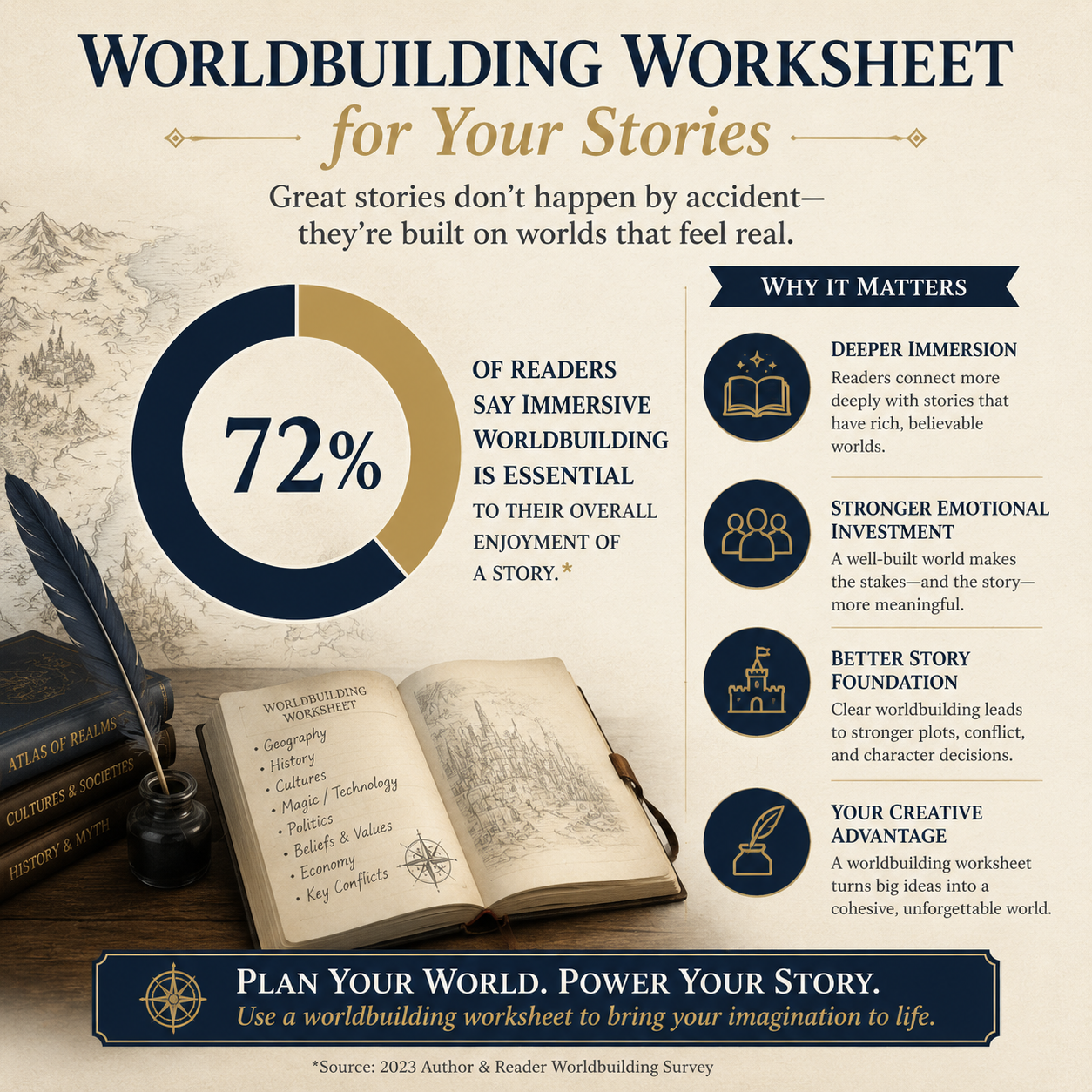
A world becomes believable when it pushes back. Your worksheet is not a scrapbook. It is a pressure system, and pressure makes choices meaningful.
Conflict From Rules And Enforcement
Pick one “rule that bites” and write three ways it can break a character’s day. One should be small and humiliating, one should be financially painful, and one should be dangerous. This technique keeps you from saving all the world’s consequences for the finale, which is where many drafts go soft in the middle.
For example, if “fresh water is taxed by the liter,” then a character can get shamed at a public pump, lose a week’s wages to an inspector, or watch a sibling get arrested for stealing condensate. Those are scenes, not lore.
Scarcity As A Story Engine
Scarcity is one of the most reliable plot generators because it forces trade-offs. Behavioral economics has a useful concept here: scarcity narrows attention and changes decision-making. If you want the research background, Sendhil Mullainathan and Eldar Shafir’s work on scarcity is a solid starting point. For writers, the takeaway is simple. When you define what is scarce, you define what people will lie, steal, and betray for.
After you identify your scarce resource, pick the one character who can move it. That could be a water hauler, a smuggler, a clerk who approves permits, a mage who can conjure, or a mechanic who can keep old engines running. Put that character in a scene with your protagonist, then decide what the protagonist has to give up to get what they need.
Power Centers And Cross-Pressure
Give each power center a goal that collides with the others, then force your protagonist into the collision. If the academy wants control over spell research, the church wants control over moral doctrine, and the crown wants control over taxes, your protagonist cannot satisfy one without angering another. That is how you get tension that feels “bigger than the character” while still staying personal.
When you outline, I recommend labeling every major scene with which power center benefits and which one is harmed. If you cannot name a beneficiary, your world’s politics are not yet affecting the story.
Worldbuilding That Shows Up On The Page
A worksheet is pointless if the world never makes it into the manuscript in a readable way. The goal is clarity plus texture; then you get out of the reader’s way.
Concrete Details Over Explanations
I trust a world faster when I see ordinary life. For example, a guard wiping dust off an inked permit stamp tells me more than three paragraphs about bureaucracy. A prayer ribbon tied to a ship’s mast tells me more than a theology lecture. Pick one detail per scene that signals a rule, then let characters treat it as normal.
When you revise, highlight every paragraph of explanation and ask a hard question. Could this be a decision instead? Could it be an argument? Could it be an obstacle that forces action? If the answer is yes, rewrite the explanation into a scene beat.
Names, Terms, And Pronounceability
Invented words are expensive. They cost the reader time and confidence. I am not saying you should write fantasy with modern names, and I am saying you should pick your battles. If a term appears once, keep it simple or translate it into a functional phrase the reader can hold onto.
For anything that needs repeated use, test it out loud. If you trip over it, your audiobook narrator will trip over it, and your reader will mentally skip it. I keep a short list of terms in my drafting notes and do consistency checks later, similar to when I do a character name list.
Consistency Checks That Save You In Revision
Worldbuilding errors are trust killers because readers notice patterns. If travel time changes based on what the plot needs, readers feel it even if they cannot articulate it. I recommend tracking three things from the start: distance and time, money and wages, and the consequences of breaking rules.
If you want a practical way to manage this, a simple spreadsheet is enough. If you prefer a drafting tool that keeps notes close to your scenes, I often see authors use Adazing’s tools, like QuickWrite, to keep world notes adjacent to their chapters. Hence, the information stays usable rather than buried in a separate document you stop opening.
Using The Worksheet While Drafting And Revising
The right workflow is the one that keeps you writing pages. Your worksheet should change over time because the draft will tell you what matters.
The 30-Minute Drafting Pass
When you sit down to draft a new chapter, do a short pass through the worksheet with a single question in mind. What part of the world is going to complicate this chapter? Pick one rule, one scarcity, and one cultural norm, then make at least one of them touch the scene in a physical way. It can be a checkpoint, a ration card, a prayer bell that interrupts a meeting, or a magic constraint that forces a workaround.
If you cannot find a complication, you are probably writing a scene that could happen in any setting. That is a red flag for pace and for premise delivery.
The Mid-Draft Expansion Rule
Expansion is allowed after the story demands it. I recommend you add a new page to the worksheet only when you hit one of these moments: a character leaves the original setting for more than two chapters, a new power center becomes a real antagonist, or a rule creates a plot hole you cannot patch without defining it.
This discipline keeps you from spending three days inventing the maritime law of a country your cast will never visit. Plenty of writers do that. It produces beautiful notes and zero chapters.
The Revision Audit That Catches Dead Lore
After your first draft, run an audit for “dead lore.” Dead lore is any world detail that never affects a choice, never creates a complication, and never changes the emotional temperature of a scene. It is trivia wearing a costume.
I cut dead lore ruthlessly, then I use the freed space to strengthen the world details that matter. A reader will remember three recurring, meaningful elements far more than thirty clever facts they skim.
FAQs for Worldbuilding Worksheet for Your Stories
How detailed should my worldbuilding worksheet be before I start drafting?
I recommend one page, filled with decisions that generate conflict. If you can name your power centers, your scarcities, and the rules with consequences, you have enough to draft chapter one. Extra detail is only worth writing when the story demands it in the next few chapters.
What if my genre is contemporary fantasy or soft sci-fi and I do not have “systems”?
You still have rules, even if they are social and emotional instead of mechanical. In contemporary fantasy, the “system” can be secrecy, jurisdiction, and the cost of using power without getting exposed. In soft sci-fi, it can be distance, bureaucracy, and the ways technology changes who gets to say yes or no. Put those into the worksheet under rules, power, and scarcity.
How do I keep my worldbuilding consistent across a series?
Keep a living series bible with three tracked categories: time and distance, money and access, and rule enforcement. Update it after you draft, not before. Tools help here because consistency is as much a data problem as a creativity problem, so I like having notes attached to chapters and a searchable term list. If you use Adazing tools, treat them like your working notebook, not an archive you never revisit.
A Worksheet That Earns Its Place
Your setting does its best work when it forces your characters to choose, pay, and change. Fill the worksheet with decisions that create obstacles, then write scenes where those obstacles land on the page in concrete ways. If a detail does not create trouble or meaning, keep it in your private notes or cut it entirely, because your reader is here for a story that moves.
