
Most worldbuilding tips fail because they treat your setting like wallpaper instead of a story engine. Your reader does not reward you for inventing twenty kinds of currency if none of it forces your protagonist into harder choices. If you build your world as a machine that creates pressure, you get cleaner plots, sharper character arcs, and fewer abandoned drafts.
I have seen plenty of manuscripts where the author clearly did the work, maps, calendars, pantheons, the whole binder, and still the first chapter drags. The fix is rarely “more detail.” It is choosing details that collide with your character’s goals in-scene, then paying those collisions off across the book.
Here is the through-line I want you to keep repeating while you build. Every world detail should do at least one of these jobs: constrain what characters can do, raise the cost of what they want, or tempt them toward a bad choice that still makes sense.
Table of Contents
Start With Story Pressure, Not Lore
Your worldbuilding earns its space when it creates consequences. I start by writing down three pressures that will keep showing up, and I pick pressures that are hard to ignore. Scarcity, surveillance, class barriers, environmental hazards, religious law, a fragile truce, a technology with a price, those are pressures. A list of noble houses is not a pressure until the houses control something the protagonist needs.
When you feel stuck, check whether you are building nouns instead of forces. For example, “The Ketheri Empire” is a noun. “The Empire drafts every second-born child into a border war” is a force. Forces generate scenes because the characters have to respond.
Write Three Recurring Constraints
Pick three constraints that will touch your main character weekly if this story were real. One physical constraint, one social constraint, and one moral or legal constraint work well. If your hero is a smuggler, the physical constraint could be tides that trap ships for hours, the social constraint could be a dockworkers’ union that checks cargo, and the legal constraint could be mandatory branding for anyone caught with contraband. Now you have scene fuel.
Convert Background Facts Into On-Page Costs
If you love a piece of lore, convert it into a cost. For example, “magic exists” becomes “magic burns five years of memory per spell.” “Airships exist” becomes “airship routes are controlled by three families who require blood oaths.” Each conversion gives you a lever you can pull in chapter five, not just trivia in chapter one.
Use The Reader’s Curiosity Like A Budget
You get a limited number of “wait, how does that work?” questions before the reader’s curiosity turns into fatigue. I ration answers the same way I ration backstory. I answer the question that blocks understanding of the current scene, and I delay the answer that only satisfies lore hunger. This is also a pacing issue, not a purity issue.

Build Only What The Plot Can Spend
The best way to avoid drowning in worldbuilding is to treat it like production design. You are building a set for the scenes you will actually film. If your story never leaves the capital, a fully developed continent map is procrastination dressed as planning.
I outline my plot beats first, even loosely, then I ask what the world must provide for those beats to happen. For example, if I need a chase, I need geography that shapes pursuit. If I need a forbidden romance, I need a taboo with teeth. If I need a revolution, I need a state apparatus that can plausibly hold power and plausibly lose it.
Draft A “Scene Needs” List
Take ten scenes you know will appear in your book, even if you have not written them yet. For each, write what the world must supply. A courtroom scene needs legal procedure, stakes, and a punishment system. A heist needs security norms, black markets, and some scarcity that makes the job worth it. Build those parts first, and you will feel productive because you are.
Use The Iceberg Rule With Intent
People love quoting Hemingway’s iceberg idea, and it can be useful when you do it on purpose. You can build a lot that never appears on the page, but it should still shape the part that does appear. If your religion has seven vows, you might show only one vow in dialogue, yet the other six should change how a priest reacts, what they refuse, and what they fear.
One caution. If the unseen material never changes a choice, it is not an iceberg. It is just a spreadsheet.
Test Every Detail With A One-Sentence Payoff
Here is a quick filter I use. For each world element, write one sentence that begins with “This matters because…” and ends with a specific moment. “This matters because the water rationing forces Mara to trade her wedding ring for two days of clean ice.” If you cannot finish the sentence, you do not need that element yet.
Make The World Legible In One Page
Readers will tolerate complexity when they feel oriented. They will not tolerate confusion that feels accidental. Your job in early chapters is to make the world feel learnable.
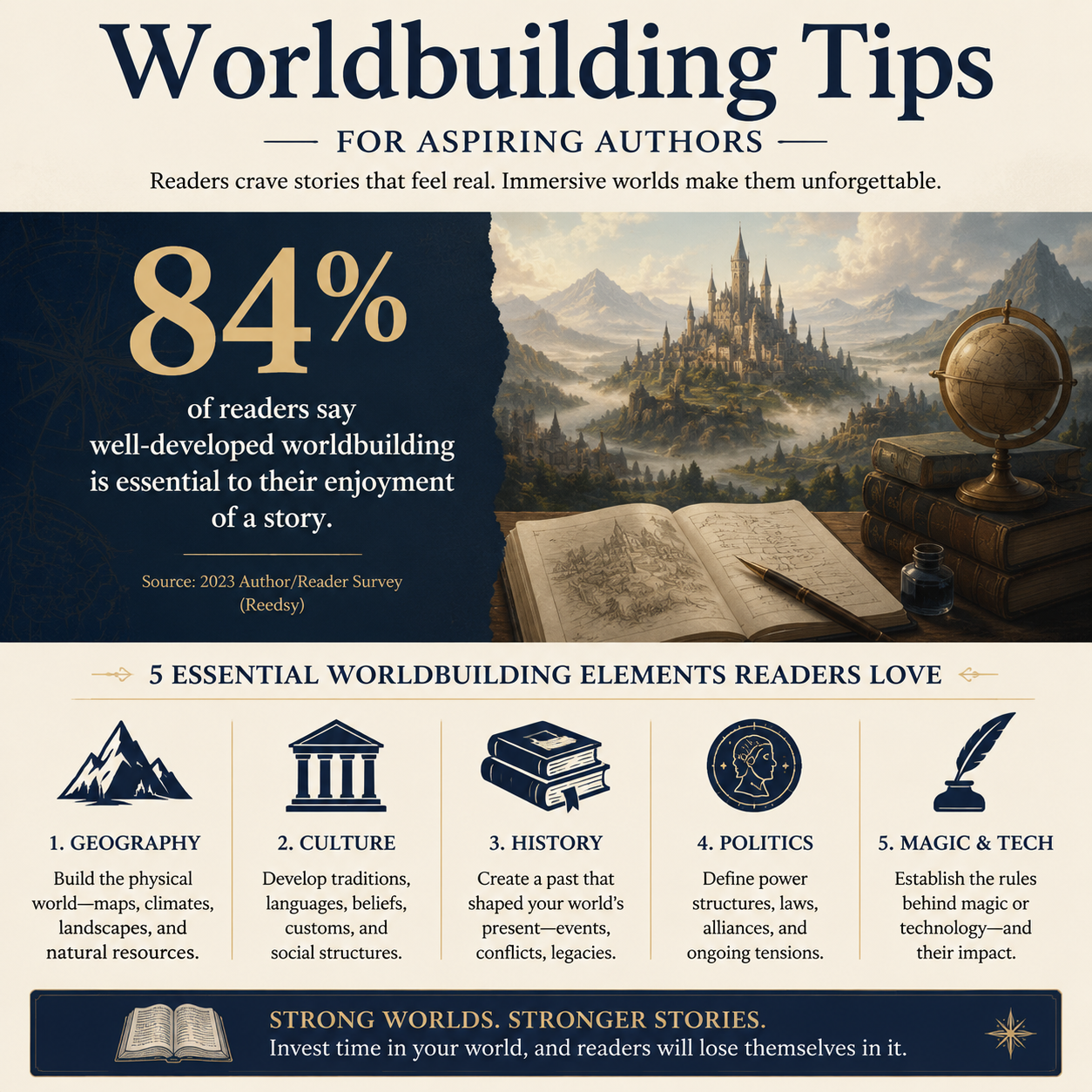
I aim to communicate four things fast. Who has power, what people do to survive, what happens when you break the rules, and what everyone wants that they cannot have. Once those are clear, I can layer in deeper history without losing the reader.
Anchor Exposition In A Concrete Task
The cleanest exposition hides inside action with a goal. For example, a character trying to get through a checkpoint can show you paperwork norms, policing culture, class markers, and slang, all while the reader tracks a simple objective. When you are tempted to explain, put your character in a situation where they must do something, then let the world be the obstacle.
Use Proper Nouns Like Spice
Too many proper nouns too early reads like homework. I introduce at least one new term per paragraph, at most in opening chapters, and I prefer terms that can be understood from context. If you must use an invented word, pair it with a familiar function. “They paid the brine tax” works because “tax” does the heavy lifting. “They paid the brinethal” does not, unless you immediately show what happens if they cannot.
Repeat The Rules In Different Forms
Readers learn through repetition, and repetition gets boring if it is the same sentence. I repeat rules through different channels. First, I show the rule as a normal routine. Then, I show it violated, and then I show the consequence. That three-step pattern teaches the reader and strengthens the stakes at the same time.
If you want a research-backed reason this works, look at the testing effect in cognitive psychology. Retrieving information strengthens memory more than rereading it, according to the American Psychological Association’s research on the testing effect. Your story can create “retrieval” by having characters repeatedly act on the rules.
Make Culture Do Work On The Character
Culture is not a costume rack. Culture is the set of defaults your characters think are normal, and those defaults should create conflict inside the character, not just conflict with outsiders. If your protagonist grew up in a debt-based apprenticeship system, they will treat obligation, gratitude, and freedom differently from someone raised with inheritance.
I also want you to watch for the worldbuilding trap where every culture becomes a single trait. Examples include warrior, merchant, or desert culture. That flattens people into set dressing. Give each culture internal disagreement, status games, and mundane needs. People argue about food, work, romance, and respect long before they argue about destiny.
Show Status Markers In Dialogue Choices
Status rarely shows up as a paragraph explaining the caste system. It shows up in who interrupts, who uses first names, who apologizes, and who gets listened to. Pick two status markers and make them consistent. Maybe only guild members may speak directly to magistrates. Maybe only the landless bow indoors. Then let your protagonist break or obey those markers depending on what they want.
Design One Cultural Temptation
Every culture sells a dream. Examples include honor, safety, belonging, wealth, or purity. Your protagonist should want that dream even when it harms them. If you build that temptation, you get a character arc that feels rooted in the setting. The choice becomes personal rather than ideological.
Handle Real-World Inspiration Responsibly
If you borrow from real cultures, treat them as living sources, not grab-bags. Read primary accounts where you can, talk to sensitivity readers when the book leans hard on a specific culture, and avoid stapling stereotypes onto your fantasy names. I have edited books in which one careless “exotic” detail poisoned the reader’s trust, and fixing it after publication is expensive in money and reputation.
For useful grounding on how stereotypes function and why they stick, the Encyclopaedia Britannica entry on stereotypes gives a clear overview. You do not need an academic lecture to write well, but you do need to understand what your reader might see between the lines.
Use Tools To Generate Options, Then Apply Taste
I like tools for worldbuilding because they keep me drafting rather than staring at a blank page, but I do not let tools make decisions for me. Generators produce raw material. Your job is to select, combine, and revise until the result feels inevitable for your book.
At Adazing, I have watched hundreds of thousands of authors use name generators, word generators, and drafting tools to break bottlenecks. The pattern is consistent. The writers who get the most value are the ones who treat generated material as a starting point and then run it through a story filter.
Generate Ten, Keep Two
If you need city names, generate ten. Then keep the two that communicate genre and tone at a glance. For example, a grimdark city called “Sunmeadow” asks the reader to do extra work unless you are using contrast on purpose. A cozy fantasy bakery called “Skullport” does the same. You want the name to carry the load, not create friction.
When I am naming, I also check for accidental similarity on the page. “Calen,” “Callan,” and “Kallen” will confuse even attentive readers. This is as much a typography problem as a creativity problem.
Build A Consistency Sheet You Actually Use
A consistency sheet should be short enough that you will consult it mid-draft. I keep mine to one page for early drafts: currency, calendar, measurement units, title forms of address, and three or four terms that appear constantly. Anything longer belongs in a separate world bible that you only update after you finish a draft.
If you want to speed up the drafting itself, a focused writing tool like QuickWrite can help you stay in the scene and postpone research spirals. The value is not the software. The value is the habit of separating drafting from fact-checking.
Use Market Reality As A Boundary
Your setting also has to sell the book you are writing. That means your worldbuilding should align with reader expectations in your category, then offer a twist that feels fresh. I look at comp titles and also-boughts to see what readers already accept as “normal” in the niche. Then I choose one or two big differentiators and commit to them rather than scattering novelty everywhere.
Whether you are publishing on Amazon KDP, categories and keywords shape who sees and reads your book. While Amazon’s own documentation on Kindle eBook categories is dry, it is worth reading because it affects discoverability. Worldbuilding is not separate from marketing. The premise you pitch is built out of the world elements you choose to foreground.
FAQs for Worldbuilding Tips for Aspiring Authors
How much worldbuilding should I do before I start drafting?
I start drafting when I can answer five questions without hesitation: who the protagonist is, what they want, what stops them, what the setting’s main pressure is, and what the protagonist will lose if they fail. If you have those, you can write chapter one. Build the rest in response to the scenes you are writing, and keep notes so you do not contradict yourself later.
How do I avoid info-dumping in the first chapters?
I give the reader only what they need to understand the immediate goal and the immediate danger. Then I repeat the world’s rules through action across several scenes, routine, violation, consequence. If you catch yourself explaining history, ask which character is trying to get what right now. Put the explanation in their mouth only if saying it advances that goal.
What if my world is complex and readers need definitions?
Complexity is fine when the story provides handholds. I introduce terms through context, keep early proper nouns to a minimum, and reuse the same few concepts until they feel familiar. If you truly need a glossary, keep it for the back matter and do not rely on it to fix confusing prose. Most readers never flip to the glossary, especially on Kindle.
A World Worth Reading Is A World That Pushes Back
Your setting becomes memorable when it resists the protagonist in specific, repeatable ways. Build pressures, spend them in scenes, and keep your lore tied to costs and temptations your character cannot ignore. If you do that, your worldbuilding stops being a side project and starts carrying your plot, your character arc, and your book’s pitch.
