
A compelling character rarely starts with a clever quirk. In my experience, what makes a compelling character is friction. It is the kind that presses on their values until they either bend or break in a way the reader understands.
If you have ever reread your draft and realized your protagonist feels like a camera on legs, you already know the stakes. Plot can be brilliant, and the prose can sing, but if the character does not produce meaningful choices under pressure, the book reads flat. You do not need a more complicated backstory first. You need a clearer engine.
Unforgettable personalities come from a small set of design decisions you can make on purpose, and then test scene by scene. You can build that in revision without rewriting your whole novel, as long as you stop treating character like a dossier and start treating character like a pattern of behavior.
Table of Contents
Design A Character Around Pressure, Not Description
Most writers start with adjectives, such as brave, sarcastic, or cold. That stuff does not survive contact with a scene. Readers remember what a character does when the cost is real, and they remember what the character refuses to do even when it would be easier.
I like to define a character with three pressure points: a want, a fear, and a rule they live by. The want gives the plot direction. The fear creates avoidance and self-sabotage. Meanwhile, the rule creates consistency that you can later stress until it snaps. If you are stuck, it is often because one of these is missing, or two of them are basically the same sentence.
Want That Generates Motion
Pick a want that forces your character to act in public, not just brood in private. For example, wanting to be “happy” is not a want. Wanting to win custody, get tenure, repay a debt to a criminal aunt, or expose a fraud at a megachurch creates moves you can dramatize. If your protagonist can pursue their want by thinking about it, your scenes will drift.
In your draft, underline every scene goal your protagonist has. If you cannot underline anything concrete, rewrite the scene’s first beat. This way, the character states, decides, or attempts something specific.
Fear That Produces Bad Choices
Fear works when it drives behavior that makes sense to the character and frustrates the reader in the right way. For example, a fear of abandonment can make someone test people, leave first, or cling too hard. A fear of being powerless makes someone control small details and pick fights they can win. Fear becomes “unforgettable” when it is the reason your character makes the wrong choice with total conviction.
When revising, mark the moments where your character hesitates. Then write one sentence in your notes that names what they think will happen if they act. If you cannot name that consequence, the hesitation is probably filler.
Rule That Creates A Line In The Sand
A rule is the character’s private law. It could be “I do not hit first,” “I never lie to children,” or “I always pay my debts.” A rule gives you a clean way to build escalation. Early in the book, they keep the rule under mild stress. Later, the story dares them to break it, and the reader leans in because the rule has become identity.
If you only take one craft move from this article, take this: give every major character one rule that will become expensive by the midpoint.

Build A Personality Readers Can Predict And Still Be Surprised By
Readers do not fall in love with randomness. They fall in love with coherence. The trick is to give them a pattern they can anticipate, then surprise them inside that pattern. That is where “unforgettable” lives.
I think of personality on the page as a set of visible habits: what they notice first, how they speak under stress, what they do with their hands when they are lying, what they refuse to discuss. Those habits create a promise to the reader. Break that promise only when it matters.
Selective Attention As Character Voice
What your character notices is character. For example, a con artist clocks watches, exits, and insecurity. A new parent clocks cleanliness, schedules, and hidden hazards. Meanwhile, a soldier clocks sightlines and hands. You can fix a bland viewpoint fast by shifting the attention filter, even if you keep the same plot events.
Here is a simple test I use: take a paragraph of description and ask, “Could any other character in this book observe the same things in the same order?” If the answer is yes, rewrite the paragraph through one obsession, one fear, or one professional competence.
Consistency Across Contexts
A character feels real when their behavior is consistent across different rooms. For example, they might be polite to their boss and cruel to their sibling, but the underlying driver stays stable. Maybe they worship hierarchy. Maybe they punish intimacy. They may also perform competence when watched and collapse alone. Give the reader that through-line.
On a notecard, write your character’s “social strategy” in one sentence, such as “I win by being indispensable,” or “I stay safe by being funny first.” Then check each major interaction for that strategy. When you break it, underline the break and make it a turning point, not an accident.
Surprise That Comes From Values
Surprise works best when it is value-driven, not twist-driven. If your mercenary risks their life for a stranger, it lands when you have already shown a value that outranks money, like protecting kids, repaying kindness, or refusing humiliation. The reader experiences surprise and recognition at the same time.
If you want a quick craft hack, write a list of three things your character will do for their want, and three things they will never do for it. Then put the “never” in the plot’s path.
Make Character Through Contradictions That Have A Cause
Contradiction is where characters start to feel alive. The problem is that writers often add contradictions like stickers. For example, a writer might write “He is kind but ruthless” or “She is confident but insecure.” That does not become a story unless you can explain when each side shows up and what triggers the switch.
A useful contradiction is situational. It has a pattern and cost. When you build that, the character starts generating scenes for you.
Context Triggers
Pick one contradiction and give it a trigger you can dramatize. For example, a therapist who is calm with clients and explosive with family makes sense if family means “I can finally stop performing.” A tough detective who cannot handle hospitals makes sense if the last case ended in an ICU. The trigger gives you repeatable beats you can place on the page.
In your scene planning, label which contexts bring out which side. Then avoid repeating the same context too often. If the character only ever appears in their “competent zone,” you will not get range.
Competence And Blind Spots
Unforgettable characters tend to be competent at something. Readers enjoy watching skill. The blind spot is where the story bites. The blind spot should relate to the competence rather than float separately. For example, a brilliant strategist who cannot read individual emotions. A charming influencer who cannot tolerate silence. A healer who cannot accept being helped.
When you revise, look for places where your character fails. If the failure feels random, tie it to their strongest skill. Skill plus blind spot creates a clean arc line.
Moral Compromise With A Receipt
Readers will follow a character into dark decisions when you show the receipt, meaning the internal math that makes the decision feel inevitable. For example, “I had no choice” rarely convinces anyone. “If I tell the truth, my sister goes to prison, and my father dies thinking I betrayed him” gives the reader a real bind.
Use this practical tool. Before any major moral choice, write a two-column note. Column one is what they gain. Column two is what they lose. Put that loss on the page as a specific image or consequence within the next three scenes.
Let Dialogue And Action Reveal More Than Backstory Ever Will
Backstory is a spice, and many manuscripts pour it like soup. If you want a character to feel compelling, put them in a moment where they have to choose, then let the reader infer the wound from the choice. You can add backstory later to deepen the echo.
Action and dialogue carry more character per word than memory paragraphs because they happen in real time, with consequences. They also keep your pacing healthy, which matters if you are publishing indie and your first 10 percent needs to keep a Kindle reader from tapping out.
Dialogue That Has A Job
Good dialogue is not banter. It is strategy. Every line should be doing something, like testing, hiding, seducing, recruiting, stalling, dominating, repairing. When you assign a job, voice emerges as the character’s tactics become apparent.
Try this on a scene you suspect is “talky.” Write a note over each speaker’s lines that names what they want from the other person. If you cannot name it, the dialogue is probably information delivery. Rewrite until each person is pushing for something incompatible, even in silence.
Micro-Actions That Signal Identity
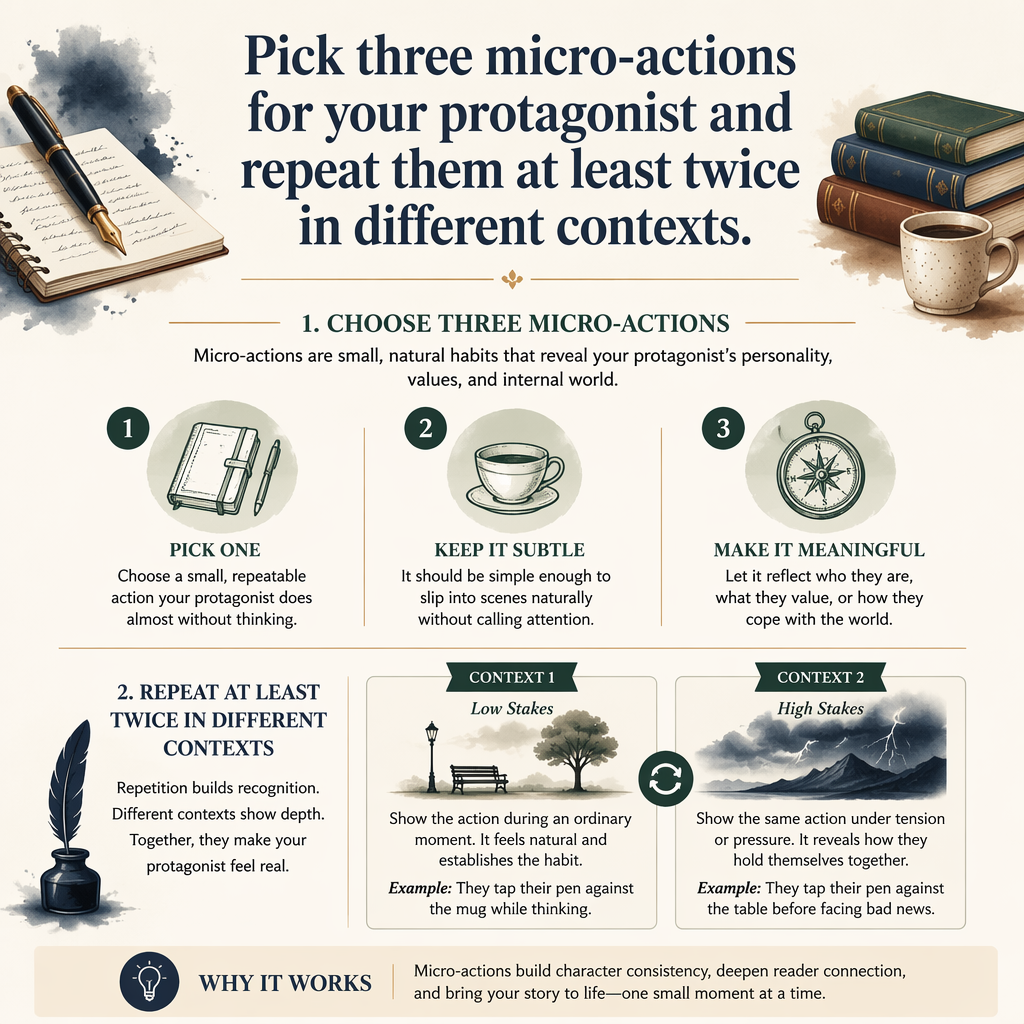
Small choices carry identity. Consider who pays the bill without asking, who watches the door, who moves their chair to control the space, or who cleans up after a fight. These micro-actions work because they are hard to fake and easy to picture.
Pick three micro-actions for your protagonist and repeat them at least twice in different contexts. Then, at a turning point, change one of them. Readers will feel the shift even if they cannot name it.
Backstory As Controlled Release
When you do use backstory, release it where it changes the scene. Consider a memory that arrives right before the character lies to someone they love has traction, or a memory paragraph dropped between two calm conversations does not.
If you have a heavy backstory section, move half of it into the moment that forces the character to act differently. You will cut words and increase impact at the same time.
Test Your Character Like A Product Before You Publish
You would never publish a cover without doing a thumbnail test. Character deserves the same level of practicality. If a reader cannot describe your protagonist after three chapters, you have a discoverability problem inside the book. That hurts reviews, read-through, and series sales because readers forget why they cared.
I treat character revision like a set of tests I can run fast. Some are craft tests. Some are market tests. They all reveal where your character is generic on the page.
The Three-Scene Diagnostic
Pick three scenes: one early, one mid-book, one late. For each scene, answer four questions in a single sentence each. What do they want right now? What are they afraid will happen? What rule are they trying to keep? What choice do they make that costs them something?
If you cannot answer those without rereading, your reader cannot either. Fix the scenes by clarifying the goal on the page and attaching a visible consequence to the choice.
Reader Memory And The Science Of Distinctiveness
Distinctiveness helps memory. Cognitive psychologists have studied this for decades, and one classic finding is that distinctive items are remembered better than common ones. If you want the academic handle, this effect is often referred to as the Von Restorff effect, and you can read an overview through Encyclopaedia Britannica’s entry on it.
On the page, distinctiveness does not mean “wacky.” It means one or two traits that show up as behavior under stress, plus a specific competence or obsession that shapes what they notice. Give your protagonist a signature pattern that appears in chapter one, and reinforce it before the first major plot turn.
Tools That Speed Up Character Work
When you are drafting, speed matters because you cannot revise a blank page. I built my process around quick generation and controlled choice. If you get stuck on names, I recommend using Adazing tools like a name generator to break the logjam, then committing to the best option and moving on. While a perfect name does not fix a blurry character, a bad placeholder can keep you from taking the character seriously on the page.
If you want help staying in the flow, a writing tool like QuickWrite can be useful as a drafting environment where your character notes sit beside the manuscript. I like having the want, fear, and rule visible while I write scenes. It reduces the number of “why did they do that?” moments I have to clean up later.
For market testing, use your ARC readers or a small beta group with one targeted question: “After chapter three, describe the protagonist in two sentences, and tell me what you think they will do next.” If the answers are generic or inconsistent, your character signals are too faint. Revise the early scenes until the pattern becomes obvious.
FAQs for What Makes a Compelling Character: Crafting Unforgettable Personalities in Fiction
How do I make a character compelling without making them likable?
Give the reader clarity. A character can be prickly, selfish, or even cruel and still hold attention when you show what they want, what they fear, and what code they live by. Add competence in at least one area, then force them into choices where their competence creates collateral damage. Readers stay when the character’s internal logic stays readable, and the consequences remain real.
How many traits should I focus on when building a main character?
Fewer than you think. I aim for one core driver, one fear-based reflex, and one rule. Then I build a small set of repeatable behaviors that express those elements in scenes. Ten traits on a character sheet often produce one bland voice in the manuscript because nothing is prioritized.
What is the fastest way to fix a flat protagonist in revision?
Rewrite goals and costs. In each scene, put a concrete goal on the first page, then make the protagonist’s choice cost them something specific by the end of the scene or the next one. If you do that across the first three chapters, the character starts to feel like a person with agency rather than a tour guide through your plot.
Characters That Stick Are Built In Choices
Your reader does not remember your character because you told them the character is “complex.” They remember the moment the character paid a price for a value, broke a rule they swore by, or chose the hard thing for a reason that felt human. If you design want, fear, and rule, then express them through repeated behavior under pressure, you will get a personality that holds up across a full-length novel and carries a series on its back.
