
Most arguments about what makes a book a novel start in the wrong place, such as the word count. In publishing, a novel is a piece of long-form fiction designed to deliver a sustained narrative experience, one that asks a reader to live inside a made-up world for hours and come out changed.
That definition matters because the label you choose affects everything you do next: your structure, your pacing, your genre placement on Amazon, your blurb, and the expectations a reader brings to page one. If you call something a novel and it reads like a collection, or a novella stretched thin, readers will feel the mismatch even if they cannot name it.
Treat this the way a working editor would. You will get a clean set of elements that separate a novel from other forms of fiction, plus practical checks you can run on your manuscript before you hit publish.
Table of Contents
Length Helps, Structure Decides
Length is a proxy, not a definition. The reason word count comes up so often is that novels usually require enough space to build an arc with meaningful complications and consequences. Yet a long draft can still fail to feel like a novel if it does not behave like one on the page.
Publishing categories use rough word-count bands that vary by genre. For example, a contemporary romance at 55,000 words can read like a full novel, while epic fantasy at 55,000 often feels like book one of three with the lid still on the pot. Treat those bands as reader-expectation signals, not universal law.
Common Word-Count Ranges You Can Use Safely
If you want a practical benchmark, the Science Fiction and Fantasy Writers Association word-count definitions are widely cited in the industry: a novella runs 17,500 to 40,000 words, and a novel is 40,000 words and up. That lower edge works better for some categories than others. However, it gives you a defensible line when deciding how to label a project.
When you publish, you are not labeling your art for a committee. Instead, you are setting reader expectations in a storefront. If your book is 38,000 words and you sell it as a novel, some readers will feel shorted even if the story is tight.
The Structural Difference Readers Actually Notice
A novel holds multiple movements of tension. It introduces a core problem, complicates it in ways that force new choices, and pays off with consequences that feel earned. On the other hand, short fiction often has one primary turn. A novella often has a strong arc but fewer layers of complication, and fewer subplots with their own mini-arcs.
Run this test on your draft. If you remove your middle 30 percent, does the story still basically work? If the answer is yes, you may have written a novella-shaped story that you padded with extra scenes. A novel collapses when you remove the middle because the middle is where the character pays for their early decisions.
What To Do When You Are Between Forms
If you have a 25,000 to 45,000-word manuscript, decide based on your reading experience and market fit. If the arc is clean, the pacing is brisk, and the book lands a satisfying ending, I would call it a novella and price it as one. If the story begs for more complications and you can add them without detouring, expand it with cause-and-effect scenes that deepen stakes and character change.
When you are unsure, do not guess. Give the manuscript to two beta readers who read your genre heavily and ask one question: Does it feel like a full meal or a strong appetizer?

A Novel Promises Character Change With Consequences
If I have to pick one element that separates a novel from other forms of fiction, it is sustained transformation under pressure. A novel-sized experience gives you enough runway to show a person being tested, adapting, and paying for the adaptation.
This does not mean every novel is a coming-of-age story. It means the protagonist and the world cannot be the same at the end as they were at the beginning, even in genres that reset the board. For example, in a series mystery, the detective may remain competent and recognizable. However, the case changes their relationships, their assumptions, and sometimes their scars.
Internal Arc And External Plot Have To Interlock
One reason manuscripts feel like they are “missing something” is that the external plot is busy while the internal arc is flat. You can have chases, betrayals, and magic battles for 120,000 words and still leave the reader oddly cold if the protagonist never has to revise their identity.
Try a simple alignment check. Write down what your protagonist wants on page one, what they actually need, and what they fear. Then list the three biggest plot turns in your story. Each turn should force a choice that hits the fear, threatens the want, and nudges the need into view.
Stakes Have To Escalate In Meaning, Not Only In Size
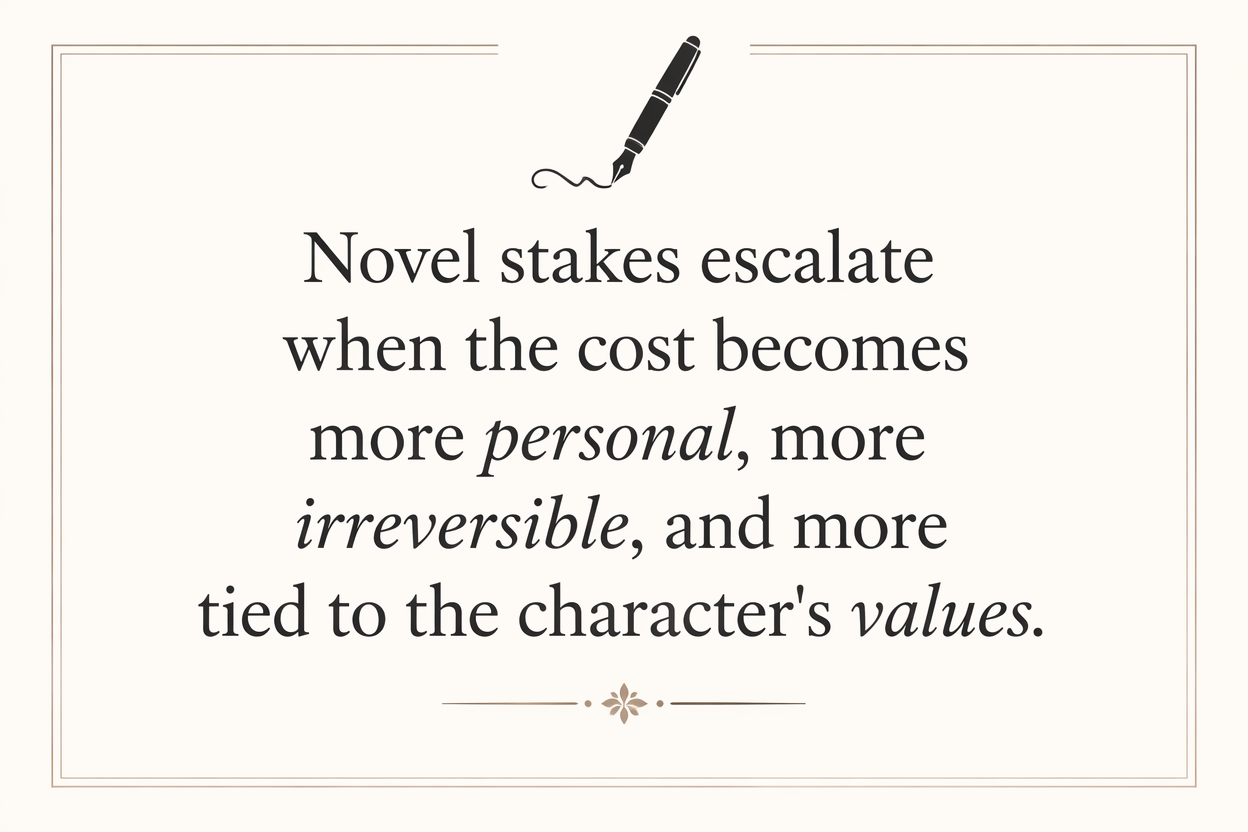
More explosions are not the same as higher stakes. Novel stakes escalate when the cost becomes more personal, more irreversible, and more tied to the character’s values. For example, a heist story often starts with money, shifts to loyalty, and ends with identity and consequence.
If your stakes only scale outward – bigger villain, bigger battle, bigger doom – you get fatigue. Readers keep turning pages when the cost sharpens. Who gets hurt? What does the character lose that they cannot replace? What line do they cross that changes who they are?
A Practical Revision Move That Fixes Flat Character Arcs
Pick five scenes that you think are “necessary” for the plot and ask what each one does to the protagonist’s view of the problem. If a scene does not change the protagonist’s options, commitments, or understanding, it is probably a plot delivery scene. Combine it with another scene, or rewrite it so the character must decide something that closes one door and opens another.
This revision move usually shortens a draft while making it feel more like a novel, because the pages start to carry consequence rather than explanation.
A Novel Creates A Continuous Reading Contract
A novel is a long-term agreement with the reader about what kind of experience they are buying. That contract is built through genre signals, voice, viewpoint control, and the pattern of tension and payoff.
When authors get pushback like “I could not get into it” or “It did not hold me,” I often find a broken contract. The opening implies one kind of book, and the middle becomes another, or the pacing drops into summary for long stretches, or the point of view drifts until the reader stops trusting the camera.
Genre Expectations Are Part Of The Definition
You can write any book you want, but you cannot pick any shelf without consequences. A novel in the market sense is a novel plus a genre promise. Readers do not buy “a novel” on Amazon KDP. They buy a thriller, a cozy mystery, a romantasy, literary fiction, and so on.
Pew Research reports that most Americans finish at least one book in a given year, but the share who do so is partial and shifts over time. That reality means discoverability is competitive, and readers use fast heuristics to choose books. Your genre signals are not decoration; they are how your book gets a fair audition.
Viewpoint Discipline Creates Novel Immersion
Short fiction can get away with leaps, gaps, and impressionistic distance. A novel usually cannot. Over hundreds of pages, the reader needs to trust how you handle information. If you are in close third, stay close. If you are omniscient, deliberately control the distance. Meanwhile, if you head-hop in a scene because it is convenient, readers do not think “craft issue.” They think “I do not feel settled here” and they drift.
I recommend you highlight every paragraph where the viewpoint character could not know what is being described. Those are the spots where you are breaking immersion without realizing it.
Payoff Cadence Matters More Than You Think
Novels train readers to expect periodic payoff. That does not mean constant twists. It means the story answers questions at a steady pace while raising better ones. If you stack mysteries and withhold everything for 300 pages, you are asking the reader to invest without receiving any proof that the investment will pay.
One technique I use is the “answered question” audit. After every major section, I write down one question I answered and one I raised. If I cannot list an answer for too long, the middle is probably sagging.
Scene Architecture Separates Novels From Long Summaries
If you want your book to feel like a novel, build it out of scenes that do real work. A novel can include summary, but the engine is scene: characters pursuing goals in a specific moment, meeting resistance, making choices, and creating consequences.
Many drafts that read “too long” are not too long. They are too often written in recap mode, where weeks pass in a paragraph, and the story becomes a report. Reports rarely create the kind of attachment a novel promises.
Every Scene Needs A Goal, Resistance, And A Turn
This is craft 101, but it is the difference between a novel and a stack of events. In a functional scene, someone wants something now. Something pushes back. By the end, the situation changes for good.
You can check this quickly. For each scene, write one sentence for the goal, one for the resistance, one for the turn. If you cannot write the turn, you may have a scene-shaped container holding information.
Subplots Should Collide With The Main Plot
A subplot in a novel is not a break from the main story. It is a pressure system that complicates the main goal. Romance subplots, family subplots, or rival subplots earn their pages when they force harder choices in the central conflict.
If your subplot could be removed without changing the main plot’s outcomes, it is probably ornamental. Either cut it, or connect it so the subplot adds cost. For example, the love interest is also the rival for the promotion, or the sister’s crisis forces the protagonist to miss the one meeting that mattered.
Pacing Is The Management Of Attention
Readers do not experience your book as “plot points.” They experience it as attention spent. A novel holds attention by alternating intensity and recovery without letting the recovery become drift.
Try reading your manuscript in one-hour chunks and mark where your mind wanders. Those spots are rarely about your sentence-level prose. They are about scenes that start too early, end too late, or do not force a choice. Trim the runway, enter later, leave earlier, and keep the pressure on the decision.
Publishing Labels Change How Your Novel Sells
This is the part authors often ignore until they are staring at an empty sales dashboard. The market definition of a novel affects your metadata, your cover design, your blurb, and the price a reader considers fair. You can write a great book and still sabotage it with the wrong label.
On Amazon KDP, readers browse by category and series. A 30,000-word “novel” priced at $4.99 will get punished by reviews in many genres, even if the writing is strong. On the other hand, a 120,000-word literary novel priced at $0.99 can also create distrust since it reads as a churn title. Pricing is a signal.
Format, Price, And Reader Expectations
If you are publishing short, call it short and price it like short. Kindle readers often tolerate shorter works in romance, erotica, and some thriller sub-niches, especially in series, because the read-through is the product. In other genres, readers expect a thicker spine, even in ebook form.
As a reference point, Kindle Direct Publishing has clear rules about what you can list as an ebook and how you set pricing bands. Their policies change, so I check the current documentation before a launch.
Covers And Blurbs Signal “Novel” Faster Than Your First Page
Readers decide whether your book is for them before they read a line. Cover, title, subtitle, or series branding, and blurb do most of the sorting. If your cover looks like a memoir and your book is a contemporary romance novel, you are forcing the wrong audience to evaluate it.
This publishing reality is one reason I like tools that let authors iterate fast. At Adazing, the cover maker exists for exactly this problem. You can test a concept, run a thumbnail check, and adjust genre cues without waiting weeks for a new draft from a designer. A tool does not replace taste, but it can shorten the distance between “close” and “clickable.”
Drafting Tools Help You Hit Novel-Length Structure On Purpose
Hitting novel form consistently is not about inspiration. It is about having a process that produces scenes, tracks arcs, and keeps you writing when the middle gets stubborn. When I draft quickly, I rely on light scaffolding, a scene list, a moving target outline, and a running log of open questions.
If you like writing software that nudges you forward, Adazing’s QuickWrite is built for that kind of momentum drafting. The best use case is when you already know the story problem and need pages on the table to revise like a professional.
FAQs for What Makes a Book a Novel? Unpacking the Elements of Fiction
How many words does a book need to be a novel?
Forty thousand words is a common lower boundary in genre organizations, including the Science Fiction and Fantasy Writers Association. In the market, many genres expect more, so I use word count as a signal and then judge the reading experience. If the arc feels complete and the book delivers layered complications and payoff, readers will usually accept it as a novel.
Can a book be a novel if it has multiple main characters?
Yes, as long as the narrative still behaves like a unified story with cumulative consequences. Multiple viewpoints work when each character’s arc pressures the others and the plot converges. If the book reads like several separate novellas sharing a setting, readers will call it episodic, even if the word count is high.
What is the fastest way to tell if my draft reads like a novel?
Ask whether the middle forces irreversible choices. If your protagonist can drift through the center of the book without closing doors behind them, the story will feel thin. I also ask beta readers one direct question: did the book feel complete at the end, or did it feel like it stopped?
A Working Definition You Can Use
A novel is long-form fiction that sustains a continuous reading contract, delivers escalating complications with meaningful consequences, and ends with a payoff that feels earned by the choices on the page. If you build scenes that turn, tie subplots to cost, and label your book honestly in the marketplace, you will not need to argue that your book is a novel. Readers will feel it.
