
Every author eventually has to decide how inclusive language in writing will shape a character’s voice, a nonfiction argument, or a book’s sales copy. The choice reaches beyond politeness. Your language tells readers who belongs in the story, whose experience counts as ordinary, and who has to explain themselves before the plot can begin.
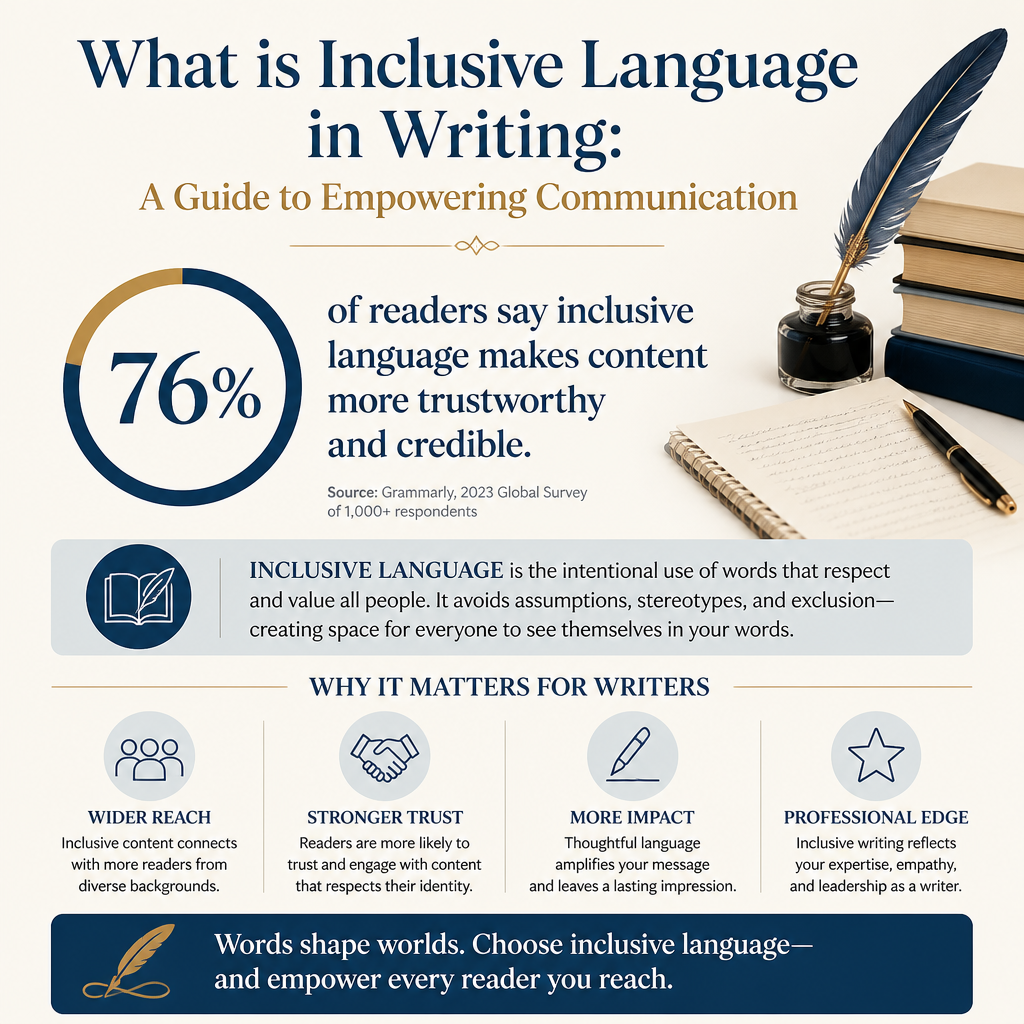
Inclusive language uses words that describe people with accuracy and respect, while avoiding stereotypes, assumptions, and labels that reduce a person to one trait. It applies to fiction, memoir, essays, instructional books, author bios, book descriptions, newsletters, and ad copy. I treat it as a craft decision with an ethical dimension and a practical consequence: careless wording can pull a reader out of your book before your story has earned their trust.
You don’t need to sand every sentence smooth or give every character the same vocabulary. For example, a historically accurate novel may include prejudice, a villain may use a slur, or a first-person narrator may misunderstand another person’s identity. Your responsibility is to control the language deliberately, understand its effect, and avoid making harmful language the default voice of the book.
Table of Contents
The Meaning Of Inclusive Language
Inclusive language names people as people first, gives them room to define themselves, and avoids treating one group as the unmarked standard. It also recognizes that language changes. A term that felt ordinary in a previous decade may now carry a history your intended reader knows immediately.
Identity And Specificity
Vague kindness won’t solve a sentence that carries a false assumption. Specificity does more useful work. You might write “the wheelchair user waiting by the stage” rather than describing someone as “wheelchair-bound.” For example, you might write “the couple” rather than assuming a man and a woman from a wedding photograph. You might name a character’s Indigenous nation when that detail matters, rather than using a broad label that erases a distinct community.
Identity-first and person-first language both have legitimate uses. Some disabled people prefer “autistic person” because autism forms part of their identity. Others prefer “person with autism” because they want the person to remain grammatically central. The National Center on Disability and Journalism’s style guide recommends asking people how they identify and following their stated preference when you have access to that information.
For a fictional character, you have a different task. Research how people in that community describe themselves, then give the character a preference, history, and voice of their own. Avoid making a character’s identity a decorative adjective attached to a generic personality.
Assumptions Hidden In Familiar Phrases
Many exclusionary phrases arrive disguised as convenience. “Ladies and gentlemen” assumes a binary audience. “You guys” can function as casual second-person plural in some regions, though it still reads as gendered to some readers. “Normal people” defines disabled, neurodivergent, or chronically ill people as deviations from a preferred standard.
Read the sentence again with the implied default exposed. For example, replace “your husband or wife” with “your spouse or partner” when the relationship details don’t matter. Replace “the elderly” with “older adults” when age is relevant. Replace “manpower” with “staffing” or “workforce” when you mean labor. The strongest revision preserves the meaning and removes the assumption.

Why Language Shapes A Reader’s Trust
Readers bring their own histories to your pages. A phrase that passes unnoticed for one person can signal laziness or contempt to another. You can’t predict every response, and you don’t need to write by committee. You do need to recognize the difference between a deliberate portrayal and a careless default.
The American Psychological Association’s bias-free language guidance advises writers to describe people with specificity, avoid irrelevant labels, and use the terms groups use for themselves. Those principles apply well to manuscripts because they keep description tied to the subject at hand. When race, disability, gender, age, religion, or sexuality has no bearing on a sentence, the label may have no place there.
Representation Begins In The Sentence
Representation has a structural side. Who gets named? Who gets a job, a home, a family, a desire, and a complicated interior life? Inclusive wording cannot repair a cast of characters built from one narrow version of humanity. It can reveal where your draft quietly assigns agency to some people and background status to others.
Take a sentence such as “The doctor explained the diagnosis to her assistant, a young woman who looked nervous.” The doctor’s gender remains unspecified, while the assistant receives age and gender markers that serve no narrative purpose. A revision could read, “Dr. Reyes explained the diagnosis to their assistant, who kept checking the clock.” The sentence now gives the reader behavior and context rather than a familiar hierarchy.
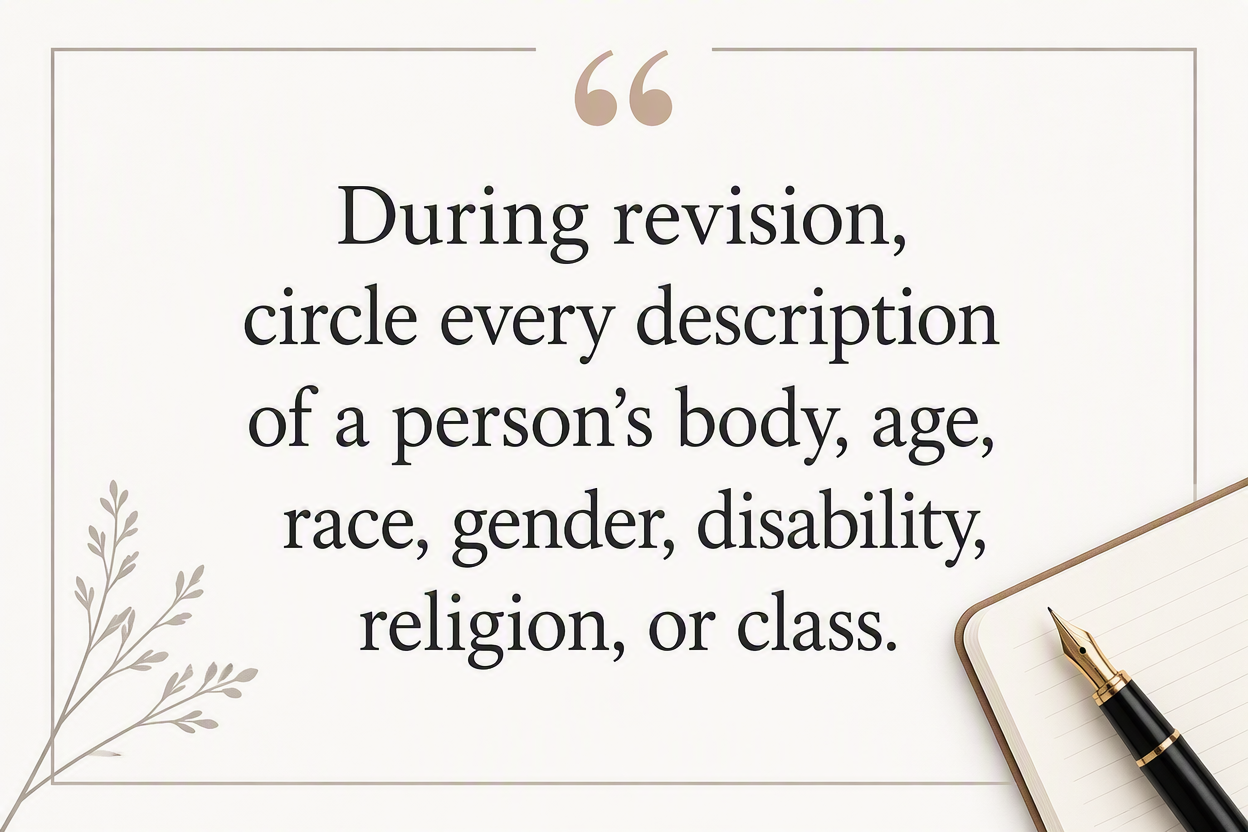
During revision, circle every description of a person’s body, age, race, gender, disability, religion, or class. Ask what the detail does in the scene. Keep details that reveal character, setting, conflict, or point of view. Cut details that exist only because the category felt like a default description.
Respect And Reader Expectations
Genre changes the stakes. For example, romance readers expect the central relationship to treat consent and identity with care. Young adult readers notice adult assumptions about gender and family. Meanwhile, historical fiction requires language that fits the period. Even so, a modern framing note or a character with a distinct perspective can help you handle difficult terms with control. Fantasy gives you room to invent cultures, though invented cultures still need internal logic and human variety.
Inclusive language also affects your book’s public face. A blurb that calls a heroine “feisty” may flatten a woman with anger, skill, and clear motives into a marketable temperament. A book description that calls a character “confined to a wheelchair” may misrepresent the character before a reader reaches page one. Write the sales copy with the same care you give the manuscript. Readers judge what a book offers using its cover, title, description, and sample pages as a whole.
Inclusive Language In Fiction And Creative Nonfiction
Fiction raises a difficult question: how do you write flawed people without endorsing their language? The answer sits in context, viewpoint, consequence, and proportion. A prejudiced character can speak from prejudice. The narrative needs sufficient control so that the reader can understand whose belief they are hearing and what the story does with it.
Voice, Viewpoint, And Harm
A close point of view places the reader inside a character’s perceptions; hence, a biased narrator may use biased language. That choice carries a cost. Readers may confuse narrative authority with the character’s judgment, especially when the book gives no counterpressure through other characters, events, or consequences.
Before keeping a loaded term, ask four questions. Who says it? Whom does it target? What does the scene require the reader to understand? How often does the book repeat it? A single term that establishes a character’s prejudice has a different effect from a novel that uses the same term as casual description across hundreds of pages.
Slurs deserve a higher threshold than general offensive language. A historically grounded scene or a confrontation might call for one. However, the same hostility often surfaces as evasions, insults, social exclusion, or a character’s physical reaction. Graphic repetition rarely adds depth by itself. Read the passage aloud and listen for whether the language reveals character or asks a targeted reader to absorb the injury.
Dialogue And Character Detail
Inclusive writing doesn’t require every character to sound like an editor. People misstate things, make assumptions, and change their minds. Give those choices consequences that fit the story. A character who uses the wrong pronoun might correct themselves, dismiss the correction, or learn through a strained relationship. Each response tells the reader something about that character.
Research community language before you draft. Read books by people from the group you are portraying, consult style guides, and hire a sensitivity reader when the material carries substantial risk. A sensitivity reader can identify stereotypes, implausible reactions, and language that your general copyeditor may miss. Their report remains advice. You retain editorial control, and you carry responsibility for the final page.
Memoir and personal essays need an additional boundary. You may describe your own experience through your own language, though another person’s private identity still deserves care. Remove details that expose someone without serving the story. Change identifying details when appropriate, and don’t use an entire community as shorthand for the lesson you learned.
An Editing Process For Inclusive Language
Inclusive editing works best in passes. Trying to solve every concern during the first draft can interrupt discovery, especially in a novel with a demanding point of view. I draft the scene I need, then examine the language with a cooler eye after the structure and character motives are visible.
Pass One For Assumptions
Search your manuscript for terms that often hide assumptions. Useful search terms include “normal,” “crazy,” “lame,” “guys,” “manpower,” “elderly,” “exotic,” “confined,” and gendered job labels such as “actress” or “chairman.” The list isn’t universal. Context determines whether a word carries harm, accuracy, or a character-specific purpose.
Review pronouns, family structures, occupations, bodies, and descriptions of appearance. Check whether you assign emotional labor to women, authority to men, criminality to racialized characters, helplessness to disabled characters, or comic relief to queer characters. You don’t need to force a reversal in every scene. You do need a cast whose agency isn’t accidentally distributed.
Pass Two For Accuracy And Preference
Create a one-page language sheet for your book. Record character pronouns, names, cultural terms, invented words, disability descriptions, and any period-specific vocabulary. Add a source beside each unfamiliar term. This prevents inconsistent usage across chapters and helps your copyeditor work from a clear reference.
For nonfiction, ask a member of the relevant community or a qualified editor to review sections that make claims about lived experience. Pay that person when you can. A single reader cannot represent an entire group, and no guide can settle every disagreement. The purpose of review is to find blind spots before publication, not to obtain a certificate of universal approval.
Run the finished manuscript through text-to-speech or read it aloud. Your ear catches repeated labels, awkward euphemisms, and sentences that treat a person as a diagnosis. Adazing’s writing tools can help you generate alternate wording during a revision pass, though your judgment and subject knowledge need to make the final choice.
Inclusive Language In Publishing And Marketing
Your book’s language reaches readers before the manuscript does. The cover subtitle, retailer description, author bio, ad image, email subject line, and social caption all make promises about who the book welcomes. A polished interior paired with careless marketing creates a trust problem you could have avoided.
Book Copy And Metadata
Write your blurb around the character’s goal, conflict, and stakes. Avoid reducing a character to a diagnosis, identity, or body unless that fact drives the story and the wording reflects the character’s humanity. Check your retailer categories and keywords for terms that accurately describe the audience rather than turning a community into a sales label.
Use the identity language your intended readers use in current conversations and in books from that community. While style guides can help with common questions, they cannot replace direct knowledge. The GLAAD Media Reference Guide offers guidance on LGBTQ terminology, pronouns, and common errors that affect public writing.
Ads, Newsletters, And Author Platforms
Audit your promotional templates before launch. Phrases such as “for every woman who has ever felt crazy” or “a thrilling tale of a brave disabled hero” may sound energetic in a marketing meeting. They can also reduce readers to a stereotype. Name the actual emotional experience, conflict, or promise of the book.
Invite readers to contact you through a clear channel when they spot a mistake, then respond without making them teach you in public. Correct a factual error in a future edition when the issue warrants it. Update your website and retailer copy at the same time so an old phrase doesn’t keep circulating through your ads. Adazing’s book promotion tools can help you coordinate those updates across a launch. However, the wording still needs a human review before it goes live.
FAQs for What is Inclusive Language in Writing: A Guide to Empowering Communication
What Is An Example Of Inclusive Language In Writing?
Use “partner” when a person’s gender or marital status has no bearing on the sentence. Use “people with disabilities” or the identity-first term a person prefers. Replace “mankind” with “humankind” when you mean all people. The right revision preserves the intended meaning and removes an assumption that serves no purpose.
Does Inclusive Language Limit A Character’s Voice?
It can shape a character’s voice, just as dialect, education, class, and profession do. A prejudiced character may use harmful language when the story requires it. Give the choice context, avoid needless repetition, and let the narrative show the character’s beliefs rather than presenting a slur as neutral description.
Should An Author Hire A Sensitivity Reader?
Hire one when your book centers a lived experience you don’t share, makes specific cultural claims, or includes material that could cause avoidable harm. Choose a reader with relevant knowledge, define the scope, and pay for the work. Their feedback can expose problems that a general copyedit will leave untouched.
Language That Gives Your Story Room
Inclusive language improves a manuscript through attention, specificity, and control. Review your assumptions, research the terms you use, protect character voice, and audit every public-facing description before publication. You don’t need perfect language on the first draft. You need a serious revision habit that treats readers as people rather than market segments.
Start with one chapter and one book description today. Circle every label, test every implied default, and replace weak shorthand with a detail that reveals the person. That work will sharpen your prose as surely as it strengthens the welcome your book offers.
