

Authors often ask, “What is it called when someone writes a book about someone else?” because the publishing label changes the contract, the byline, and the legal risk. The broad term is “biography,” though several more precise terms may fit your project. For example, a professional writer hired to produce the manuscript may be a ghostwriter; a writer who tells another person’s life story under their own name is usually writing a biography. Meanwhile, a book created from interviews and published under the subject’s name may be an as-told-to book or a collaborative memoir.
That distinction matters before you draft a proposal, sign a publishing agreement, or promise a subject that they will control the manuscript. The wrong label can create confusion about authorship, payment, permissions, copyright, and publicity. Name the relationship first, then choose the book category that describes the finished work.
Table of Contents
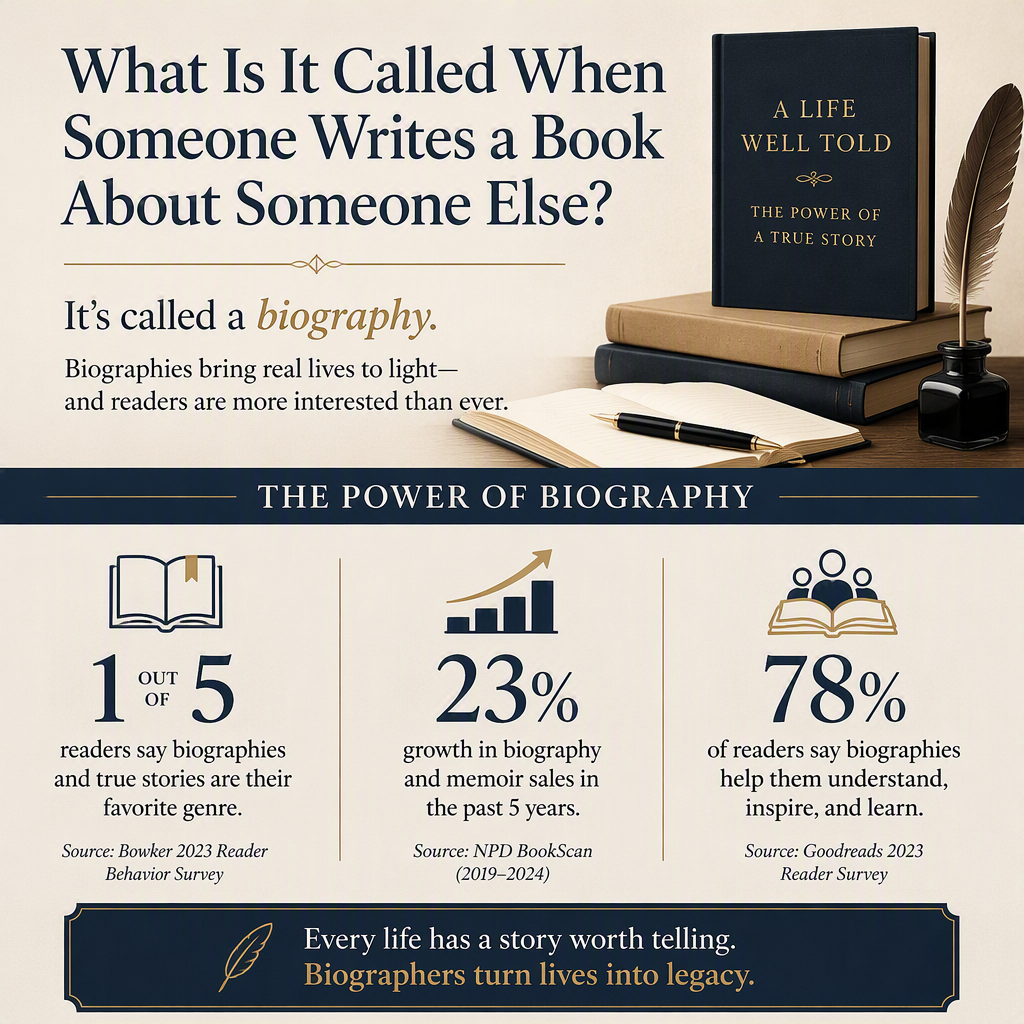
The Broad Name Is Biography
A biography is a nonfiction account of another person’s life written by someone else. The subject may be a president, musician, athlete, business founder, criminal, artist, or private person whose story has public interest. The biographer researches records, interviews people who knew the subject, studies existing accounts, and shapes the material into a narrative.
Biography covers a wide range of books. A full biography follows a person’s life from childhood through the present or death. Meanwhile, a partial biography focuses on one period, such as a novelist’s years in Paris or a scientist’s work on a particular discovery. A literary biography examines a writer’s life alongside the books that writer produced. Meanwhile, a collective biography places several people within a common subject, such as the women who built a technology company.
The Encyclopaedia Britannica’s definition of biography describes the form as a history of a person’s life written by another person. That definition gives you the basic answer. The publishing arrangement and the source material determine the more specific term.
Biography And Autobiography
An autobiography is a life story written by its subject. The author writes in the first person and controls the account directly, even when an editor provides substantial help. A biography uses the third person in most cases and places the writer outside the subject’s life.
Suppose a retired actor hires a writer to turn years of interviews into a first-person manuscript. The book may be sold as an autobiography or memoir, depending on its scope and marketing. The contract should identify the hired writer’s role, the subject’s approval rights, and the name that appears on the cover. A first-person voice alone does not settle the authorship question.
Memoir And Life Story
A memoir focuses on selected experiences and the meaning the author draws from them. It does not need to cover an entire life. When another person shapes a subject’s memories into a memoir, publishers often describe the project as a collaborative memoir, an as-told-to memoir, or a memoir with a writing partner.
Use biography when the book depends on independent research and your authority as the researcher, and use memoir when the emotional center comes from the subject’s personal recollection. A book about a chef’s complete career could be a biography. Meanwhile, a book about the chef’s recovery from addiction told through a series of intimate conversations could be an as-told-to memoir.

The Byline Changes The Category
The most useful question is simple. Whose name appears on the cover, and whose voice carries the story? Those answers separate a biography from ghostwriting, collaboration, and as-told-to publishing.
Ghostwritten Books
A ghostwriter writes a book for another person who receives the public credit. The credited author may be a celebrity, executive, athlete, politician, or expert with a strong platform and limited time. The ghostwriter researches, interviews, outlines, drafts, revises, and often matches the client’s speaking voice.
Ghostwriting covers fiction and nonfiction. For example, a romance author can hire a ghostwriter to produce a novel under the author’s established pen name, and a surgeon can hire one to turn professional experience into a health book. The subject of the book may be the client, though the term ghostwriter describes the writing arrangement rather than the book’s topic.
Your contract should state the byline, credit line, payment schedule, revision limit, confidentiality terms, approval process, and ownership of the manuscript. Decide whether you receive a flat fee, royalties, or both, and whether you can identify the project in your portfolio. A vague agreement can leave you with extensive unpaid revisions and no usable credit.

As Told To Books
An as-told-to book presents a person’s story through interviews conducted and shaped by a writer. The subject usually receives prominent cover credit, and the writer may receive a secondary credit such as “with Jane Smith.” The phrase signals collaboration to booksellers and readers who understand the form.
As-told-to projects require more than transcription. Spoken memories arrive in fragments, repeat themselves, and skip across time. You have to test dates, organize scenes, identify contradictions, and build a readable arc. The subject supplies lived experience. You supply structure, selection, prose, and often reporting.
Talk with the subject about voice before you write the first chapter. Some people want polished literary prose, while others want the texture of their speech preserved. Record the agreement in writing, then create a sample chapter for approval. A sample catches mismatched expectations before you spend six months building a manuscript around them.
Permission And Legal Risk
Writing about another person creates legal and ethical questions even when the story is true. You may have the right to describe public events. However, your manuscript can still create disputes over privacy, defamation, confidential information, photographs, letters, and copyrighted material.
Authorized And Unauthorized Biography
An authorized biography has the subject’s cooperation or approval. The subject may provide interviews, documents, photographs, and access to family members. An authorized project can still involve editorial conflict, so your agreement should say who approves factual corrections, whether the subject can remove material, and whether the subject can block publication.
An unauthorized biography proceeds without the subject’s approval. It may rely on public records, archival research, interviews with other sources, and independent reporting. Some subjects refuse cooperation because they dislike the project or want control over their image. That refusal does not automatically prevent publication, though it raises the need for careful sourcing and legal review.
Never promise a subject that you can remove every unflattering fact. Promise a fair process instead. Keep research notes, save source documents, distinguish direct evidence from hearsay, and give serious allegations the level of verification they require. The Cornell Law School Legal Information Institute’s overview of defamation explains why false statements that harm a person’s reputation can create liability. A publishing attorney should review a manuscript with allegations about living people.
Copyright And Source Material
Facts and ideas do not receive copyright protection in the same way that original expression does. A person’s life events are facts. A newspaper article, private letter, photograph, diary entry, or earlier biography contains expression that may belong to someone else.
Quote only what you need, track every passage that comes from a source, and obtain permission for material that exceeds fair use. The U.S. Copyright Office explains the requirements for transferring copyright in 17 U.S.C. Section 204. A contract that says you own the manuscript may still leave permissions for third-party material unresolved.
Photographs deserve the same care. The person pictured may have supplied the image without owning its copyright. Ask who owns each photograph, obtain a written license, and record where the image can appear. A beautiful family photograph can become an expensive production problem when nobody can provide proof of permission.
Choosing The Right Label For Your Project
Start with the work arrangement, then describe the book. This order prevents a common mistake in proposals. Writers often call every project about another person a biography, even when they are actually writing a ghostwritten memoir or an as-told-to business book.
A Simple Classification Test
Ask yourself four questions during your planning meeting.
- Are you researching the subject independently and writing under your own name? Call the project a biography.
- Are you writing the subject’s life story under the subject’s public byline? Call the arrangement ghostwriting.
- Will both names appear on the cover, with the subject’s name first and your name after a phrase such as “with”? Call it collaborative writing or an as-told-to book.
- Does the book focus on a specific period or a personal experience told through the subject’s memories? Call it a memoir, an as-told-to memoir, or a collaborative memoir.
These labels describe different business arrangements, and publishers may use them loosely. Your proposal should define the project in plain language after the label. For example, write, “This is an authorized biography based on archival research and forty interviews, written under my name,” or, “This is an as-told-to memoir written from recorded interviews and published under the subject’s name with a credit.”
The Contract Questions Writers Miss
Ask who owns the copyright, who controls revisions, who approves the title and cover, who pays for fact-checking, and who handles legal review. Include a deadline for feedback. Without one, a subject can revisit settled chapters whenever a family member recalls a different version of an event.
Clarify the treatment of sensitive material. A subject may disclose information during an interview and later decide that it belongs off the record. Set the rule before recording begins. I also recommend confirming whether you can use your drafts, notes, and research methods in future work. Confidentiality may protect the subject, though it should not quietly erase your rights as a writer.
Authors who self-publish have another decision. You may release the book under your own imprint, sell it to a traditional publisher, or produce it as a private memoir for the subject’s family and organization. Each path changes the budget for editing, fact-checking, cover design, permissions, and marketing. Adazing’s writing and publishing tools can help you develop your manuscript and prepare its cover and promotional materials. However, legal review still belongs with a qualified attorney.
Questions To Settle Before You Write
The best time to resolve authorship is before interviews begin. Once you have shaped a voice, promised a publication date, and built a chapter outline, changing the arrangement becomes expensive.
Write a one-page project brief that names the subject, the intended audience, the book form, the public byline, the research method, the approval process, and the rights arrangement. Send it to the subject or client before you draft. Their response will reveal whether you have a shared project or two incompatible ideas about the same book.
Then test the concept in the market. Read the descriptions of comparable biographies, memoirs, and as-told-to books on Amazon and Goodreads. Study the cover credit, subtitle, category, and sample pages. For example, a celebrity’s authorized memoir may sit beside biographies of that celebrity. However, readers expect a different level of intimacy and a different claim to authority.
Finally, use the label consistently. Put the same description in your proposal, contract, metadata, press release, author bio, and retailer copy. Conflicting language makes readers wonder who wrote the book and gives reviewers an easy reason to question its credibility.
FAQs for What Is It Called When Someone Writes a Book About Someone Else?
What Is A Book About Another Person Called?
It is generally called a biography when a writer researches and writes another person’s life story. The project may have a more specific name, such as an authorized biography, an unauthorized biography, a literary biography, or a partial biography.
What Is A Ghostwriter For A Biography?
A ghostwriter is a hired writer who produces a manuscript that appears under another person’s name. The book may be a biography, memoir, business book, or novel. The contract determines credit, payment, confidentiality, revisions, and copyright.
Can I Write About Someone Without Permission?
You may be able to write about a public person or public events without permission. However, the legal risk depends on your sources, claims, location, and use of private or copyrighted material. Get legal advice before publication when the manuscript contains allegations, private facts, or identifiable living people.
Name The Relationship Before The Book
The cleanest answer is biography when you write another person’s life story under your own name. Ghostwriting refers to writing when the subject receives the public credit. As-told-to describes a collaborative process built from interviews, and memoir describes a selective personal account.
Choose the term that matches the byline, the source material, and the control each person has over the manuscript. Put those decisions in the contract before you write. A precise label will not solve every disagreement. However, it will expose the disagreements early enough for you to handle them.
