
Before you revise a first chapter, you need to know “What is inciting incident in literature?” and why this single event determines whether a reader keeps turning pages. The inciting incident disrupts a character’s existing life, creates a problem that demands a response, and points the story toward its central conflict.
A compelling premise can sit quietly for pages without creating movement. Your protagonist may have a fascinating history, a vivid setting, and a beautifully written morning routine. Readers still need a reason to feel that ordinary life has become impossible to maintain. The inciting incident supplies that pressure.
I treat the inciting incident as a contract with the reader. You promise that the story will now pursue a specific question, threat, desire, or change. Your later chapters need to keep honoring that promise.
Table of Contents
The Inciting Incident Definition
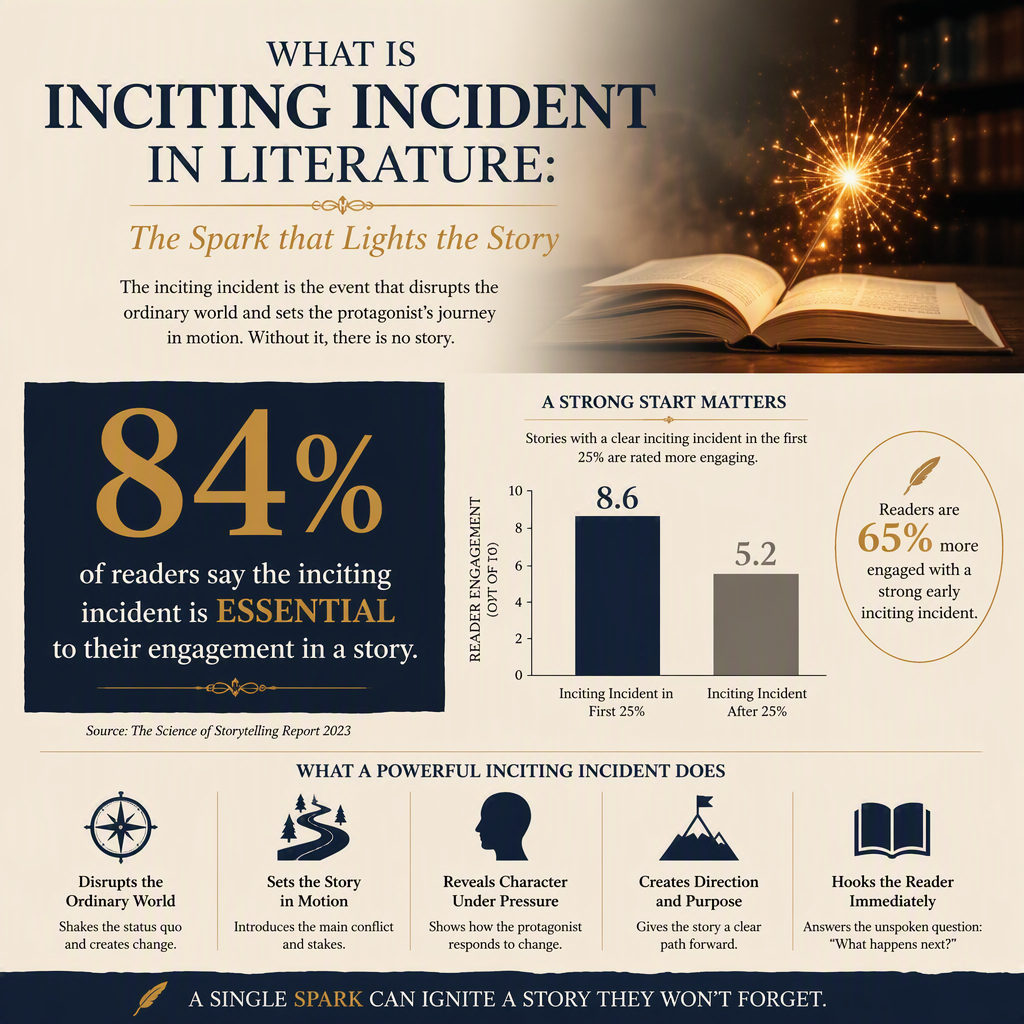
The inciting incident is the event that launches the main story by disturbing the protagonist’s normal condition. It creates a problem, opportunity, revelation, or demand that connects directly to the central conflict.
Genre shapes what this looks like. In a mystery, someone is murdered. In a romance, two people meet under circumstances that make attraction inconvenient. Fantasy might have the protagonist discover a forbidden ability or receive a summons from a dangerous power. Meanwhile, in memoir, a diagnosis, betrayal, move, or professional collapse forces the narrator to reconsider the life they thought they understood.
The event itself doesn’t need to be explosive. A quiet discovery can carry more narrative force than a car chase when it changes what the protagonist knows or wants. The important question is whether the event creates a problem your protagonist cannot comfortably ignore.
Aristotle described a complete plot as having a beginning, middle, and end in Poetics. Modern story structure gives the beginning several working parts, including exposition, the inciting incident, rising complications, and the first major turning point. These labels help you diagnose a manuscript. They don’t replace judgment.
The Normal Life Before Disruption
Readers need enough context to understand what changes. You might show a detective’s strained finances, a widow’s careful routine, or a young wizard’s fear of disappointing her family. A few well-chosen details can establish the baseline.
Writers often overbuild this section because background feels safe. Three chapters of childhood history rarely generate the same pull as a single present-day problem. Give the reader the information needed to understand the loss, risk, or temptation that follows, then move the pressure onto the page.
The Event That Changes the Question
A good inciting incident changes the question driving the story. Before the event, your protagonist might ask, “How do I keep my job?” After the event, the question becomes, “How do I clear my name before the police arrest me?”
Write both questions in your notes. If the question remains identical before and after the supposed inciting incident, you may have written an interesting scene that lacks structural force.

The Inciting Incident And Story Movement
Plot depends on consequence. The inciting incident matters because it forces a chain of decisions, each one making the protagonist’s situation harder or more revealing.
Consider Katniss Everdeen volunteering for Prim in The Hunger Games. The reaping creates danger, yet Katniss’s choice to take Prim’s place gives the event its personal force. The story now follows the consequences of that choice, from leaving District 12 to entering the arena.
In Harry Potter and the Sorcerer’s Stone, the letters from Hogwarts disrupt Harry’s life and reveal a hidden identity. Hagrid’s later arrival gives the discovery a human agent and moves Harry toward the magical world. The story gathers momentum because each revelation demands another response.
Aristotle’s discussion of plot also emphasizes causal connection among events. I use that principle when I revise: the next major scene should occur because the protagonist made a choice, suffered a consequence, learned something, or faced a new demand created by the preceding event.
Event, Decision, And Consequence
Many manuscripts contain an inciting event without an inciting decision. For example, a stranger leaves a threatening voicemail, a storm destroys the bridge, or a publisher offers a contract. The protagonist watches the event happen, then continues with the day.
That gap drains energy from the opening. Give the protagonist a response that reveals character. She deletes the voicemail, calls the stranger, lies to her spouse, or drives toward the danger. Her decision turns an interruption into a plot.
I often map the opening with three questions:
- What happens to the protagonist?
- What does the protagonist decide because of it?
- What immediate consequence follows?
Write one sentence for each answer. When the three sentences form a clear cause-and-effect chain, your opening has a working engine.
The Story Question
Your inciting incident should create a question with enough force to carry several chapters. For example, a murder raises the question of who killed the victim; a romance raises the question of whether two people will risk intimacy; a literary novel may ask whether a daughter can forgive her estranged father before his illness takes away the chance.
A question becomes useful when it contains personal stakes. “Who stole the painting?” gives a mystery its puzzle. “Can the curator solve the theft before her employer discovers she caused the security failure?” adds the same sense of mystery, pressure, shame, and risk.
Inciting Incidents Across Genres
The right inciting incident depends on the promise of your genre. Readers bring expectations about the kind of disruption they came to experience. You can challenge those expectations, though you need to give them a recognizable path into the story.
Mystery And Thriller Openings
A mystery often begins with a crime, a disappearance, an impossible clue, or a discovery that contradicts the official story. The event should give your investigator a reason to become involved. A body in a locked room has more force when the detective recognizes the victim, finds her own fingerprint, or receives a message that names the next target.
Thrillers usually raise the cost of delay. For instance, a spy learns that an informant has been exposed, a parent receives proof that a kidnapped child is alive, or a journalist discovers that the company funding her investigation has access to every draft she writes.
Plant the specific danger early enough that the reader understands the stakes. You may withhold the full explanation, but never every reason to care.
Romance And Relationship Fiction
Romance needs a meeting, collision, or revelation that puts the central pair in each other’s path. The event gains strength from an obstacle that threatens the relationship before it begins. For example, a wedding planner discovers that the best man is her former fiancé, two rival chefs must run one restaurant together after a family dispute, or a widow’s new neighbor turns out to be the person who received her late husband’s final letter.
The inciting incident should create emotional proximity. A glance across a ballroom rarely carries a whole novel unless it leads to a decision, obligation, or secret that keeps the characters connected.
Fantasy And Science Fiction
Speculative fiction often uses a summons, transformation, attack, discovery, or breach between worlds. The event can introduce the larger premise, though it still needs a character-level consequence. For example, a portal matters because someone must cross it. Meanwhile, a machine that predicts death matters because it names the protagonist’s sister.
Resist explaining the entire mythology before the disruption arrives. Readers can learn rules through the protagonist’s immediate problem. If your opening requires three pages of invented history before anything changes, move some of that material into scenes where the information affects a decision.
Placement And Timing On The Page
There isn’t one correct page number for an inciting incident. A commercial thriller may place it in the first scene. Meanwhile, a historical novel may spend several pages establishing a marriage, political pressure, or social constraint. Your test is narrative pressure, not a formula.
Many writers confuse the inciting incident with the first plot point. The inciting incident starts the disturbance. The first plot point often commits the protagonist to a course that can’t be abandoned without serious cost. In The Wizard of Oz, the tornado removes Dorothy from Kansas. Her commitment to follow the Yellow Brick Road toward the Wizard gives the story a sustained direction.
Britannica describes plot as the arrangement of events in a narrative, with each event contributing to the action and its consequences in its entry on literary plot. I use that standard when deciding whether a scene belongs near the beginning. The scene needs to alter the chain of events, reveal the pressure that will alter it, or deepen the reader’s understanding of the choice ahead.
The Early Chapter Test
Read your first three chapters and mark the moment when the protagonist’s normal life becomes unsustainable. Then mark the first scene where the protagonist makes a decision tied to that disruption. Compare the two marks.
If the distance between them is large, compress the material between them or give the protagonist stronger resistance. If the event arrives early, but the decision comes much later, let the consequences touch the protagonist sooner.
Also check whether the opening scene contains information your reader needs before the incident. Keep information that sharpens the stakes. Cut information that merely proves you invented a detailed past.
The Chapter Ending Test
A chapter ending after the inciting incident should leave the reader with a changed situation. The protagonist has accepted a task, lost protection, discovered a lie, or made an enemy. A final line that sounds ominous can’t carry the chapter by itself. The circumstances need to have changed on the page.
Read the last paragraph without your manuscript nearby. Describe what the protagonist must do next. If you can’t answer in one sentence, the chapter may end before the story has converted disruption into direction.
Revision Tools For A Stronger Opening
I revise inciting incidents with a simple cause-and-effect audit. It helps separate a genuine story launch from a scene that only looks dramatic.
The Five-Question Audit
- What ordinary condition exists before the event?
- What precise event disrupts that condition?
- Why does the event matter to this protagonist?
- What decision follows?
- What new problem does that decision create?
Answer these questions using concrete nouns and active verbs. “Her life changes” tells you nothing. “A debt collector posts an eviction notice on Mara’s bakery, so she accepts a smuggling job from her estranged brother” gives you a story path.
Pay attention to the answer to the third question. A generic disaster can happen to anyone. However, a personal disruption belongs to one character. The strongest openings make the event expose a flaw, desire, fear, secret, or obligation that was already waiting beneath the surface.
Tools For Testing The Premise
Try writing three versions of your inciting incident. Keep the protagonist and broad premise fixed, then change the disruption. One version might involve a public humiliation, another a private discovery, and a third an impossible request. Choose the version that creates the most difficult decision, not the loudest spectacle.
Adazing’s QuickWrite can help when you know the character and conflict but keep circling to the same opening. Use it to generate alternate pressures or consequences, then judge every suggestion against your genre promise and your protagonist’s psychology. A tool can produce possibilities. You still need to select the event that belongs to your book.
After choosing the event, write a one-sentence premise that includes the disruption and the consequence. Use that sentence as a test for your blurb, cover copy, and sample chapters. The cover should signal the genre, the blurb should raise the central question, and the opening scene should make that question unavoidable.
Common Opening Problems
A dream sequence often delays the story because it has no consequence after the protagonist wakes. For example, a weather opening has the same weakness when the storm becomes scenery. A violent prologue can also mislead readers when the main character and central problem appear much later.
Backstory creates a similar problem. You may have written ten pages about the betrayal that shaped your protagonist. However, the novel begins when she receives a message from the person who betrayed her. Start closer to the message and reveal the history as the present conflict demands it.
Another frequent problem appears when the inciting incident belongs to a secondary character. The villain discovers the artifact, the detective hears about the murder, or the spouse receives the diagnosis. Move the event into the protagonist’s experience when possible. If the protagonist can’t witness it, give the protagonist an immediate consequence that requires a choice.
FAQs for What is Inciting Incident in Literature: The Spark that Lights the Story
What is the difference between an inciting incident and a hook?
A hook captures attention through a striking image, voice, question, or moment. An inciting incident launches the central conflict by changing the protagonist’s situation. The same scene can contain both. For example, a detective who finds a body creates a hook through shock, with the following investigation serving as the inciting incident.
Can a story have more than one inciting incident?
A novel can have several major disruptions, especially when it contains multiple viewpoints or parallel plots. Each storyline needs its own initiating event. Your primary protagonist should still have one dominant incident that gives the main narrative its direction.
Does the inciting incident need to appear in the first chapter?
No. It needs to arrive before the reader’s patience runs out and before the manuscript spends too much time on material that exists outside the central conflict. A slower opening can work when every early scene increases pressure or makes the coming disruption matter more.
Give Your Story A Decision Worth Following
The inciting incident earns its place through the decision it forces. Build the event around your protagonist’s particular fear, desire, or obligation, then follow it with a choice that creates consequences. You don’t need an explosion. You need a problem your character can’t leave untouched.
Read your opening again and identify the first moment when the old life stops working. If you can’t find that moment, design one. Your reader should understand what changed, why it matters, and what your protagonist must risk by responding.
