
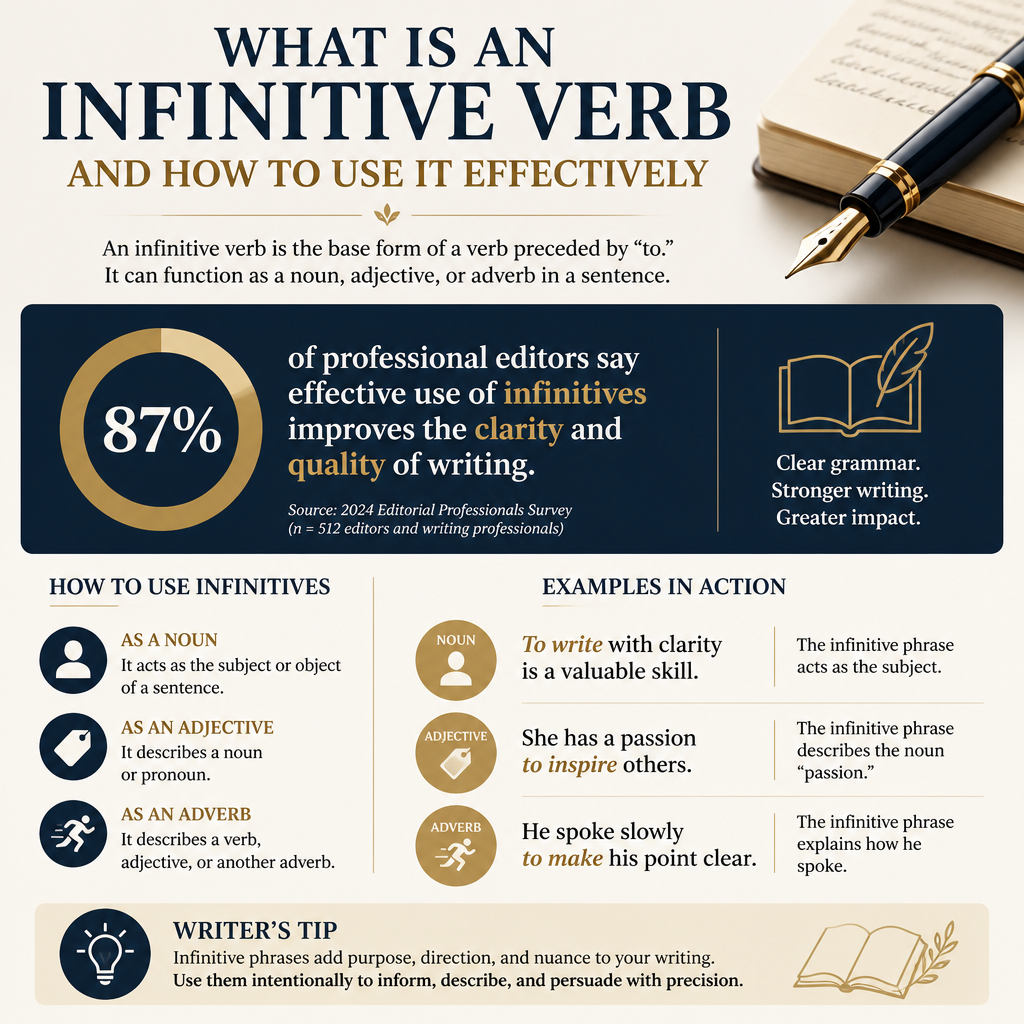
A manuscript can contain thousands of verbs. Still, a single question often sends a writer to the grammar books: what is an infinitive verb? An infinitive is a verb in its basic form, usually preceded by to, as in to write, to publish, or to revise. Once you recognize the pattern, you can use infinitives to control rhythm, explain purpose, and build cleaner sentences.
Infinitives matter to authors because they handle several jobs at once. They can name an action, complete another verb, describe a character’s intention, or compress a long explanation into a precise phrase. For example, they can also create trouble when a sentence contains too many of them or when the writer attaches one to the wrong subject.
I treat infinitives as flexible tools. I don’t remove them simply because a style guide once warned against them, and I only add one when the sentence genuinely calls for a more formal tone. I ask what the sentence needs, then choose the form that gives the reader the clearest meaning and the strongest rhythm.
Table of Contents
Infinitive Forms And Basic Grammar
The full infinitive follows this pattern: to + base verb.
Example:
- to read
- to remember
- to confess
- to disappear
The word to belongs to the infinitive phrase, and the verb after it stays in its base form.
That final point matters. You write to write, not to writes or to wrote. You write to finish, not to finished. The infinitive doesn’t carry tense by itself, so another verb or the surrounding sentence supplies the time.
Full Infinitives In Manuscript Sentences
Consider these examples:
- She hoped to finish the chapter before midnight.
- Marcus forgot to charge his phone.
- They planned to meet outside the bookstore.
- To forgive him required more courage than she expected.
In the first three sentences, the infinitive follows another verb and completes its meaning. In the last sentence, the entire infinitive phrase acts as the subject. While authors use this structure often in reflective narration, a more direct construction may produce a livelier line. “Forgiving him required more courage than she expected” has a different cadence and a more immediate feel.
Bare Infinitives After Certain Verbs
English also uses the bare infinitive, which means the base verb appears without to. Modal verbs create this pattern: can speak, must leave, should wait, and might return. Perception verbs and causative verbs can create it as well.
- I heard the door slam.
- She made him apologize.
- Let the witness speak.
Adding “to” after “made” or “let” produces a grammatical error in standard English. The correct form is She made him apologize, not She made him to apologize. The Cambridge Dictionary’s grammar reference identifies these patterns as separate uses of infinitives with and without to.
When you revise dialogue, pay close attention to these small words. A character who says “Let me to explain” sounds uneducated unless that error is deliberate. A narrator who uses the form by accident distracts the reader.

Infinitives As Sentence Parts
An infinitive can function as a noun, adjective, or adverb. Grammar labels can help you diagnose a sentence, though you don’t need to name the label every time you revise. Ask what job the phrase performs.
Infinitives As Nouns
When an infinitive acts as a noun, it can serve as a subject or object.
- To publish a novel takes patience.
- Her goal was to publish a novel.
- He wanted to publish under a pen name.
The first infinitive phrase serves as the subject. The second completes the linking verb was. The third completes wanted. In fiction, this construction often reveals desire or intention because verbs such as want, plan, hope, and refuse commonly take infinitive complements.
Watch for a difference in meaning between “remember to call” and “remember calling”. The infinitive points to an action that still needs to happen. Meanwhile, the -ing form points to a memory of a finished action. For example, a character who remembered to hide the letter acted on a duty. A character who remembered hiding the letter recalled an event.
Infinitives As Adjectives
An infinitive can modify a noun by explaining what the noun will do or what someone can do with it.
- She had a manuscript to revise.
- He needed a reason to stay.
- The bookstore found an author to interview.
These phrases often create useful compression. For example, “She had a manuscript that she needed to revise” is grammatical, though the infinitive reads with more speed. In a query letter or book description, that economy helps you protect every word.
Infinitives As Adverbs
Infinitives frequently explain purpose. You can usually test this use by asking why the action happened.
- She opened the email to read the contract.
- He drove across town to return the annotated pages.
- I use a scene checklist to track each character’s goal.
Purpose infinitives are especially useful in nonfiction. They connect a recommendation with its reason in a compact form. “Save your draft to preserve earlier versions” gives the reader both an instruction and its purpose.
During revision, circle each infinitive phrase and write its job in the margin. If you can’t explain what it modifies or completes, the sentence may need repair.
Infinitives And Sentence Rhythm
Infinitives can sharpen prose, though they can also drain it when they appear in a chain. Compare these sentences:
She went to the library to find a book to help her understand how to structure a mystery.
She went to the library for a mystery guide. The book explained how to build each clue.
The first sentence is grammatical. Its problem is density. Four infinitive relationships ask the reader to hold too much information in a single line. The revision gives the central action room to breathe and creates a clearer sequence for the reader.
Split Infinitives And Authorial Voice
A split infinitive places an adverb between to and the verb, as in “to quietly leave” or “to boldly publish”. Writers were once taught to avoid this structure because of a strong prescriptive tradition. Modern English usage now accepts split infinitives when the placement improves clarity or rhythm. Merriam-Webster’s explanation of split infinitives traces the history of the rule and describes why the construction remains useful.
Read these examples aloud:
- She decided to immediately call her agent.
- She decided immediately to call her agent.
- She decided to call her agent immediately.
All three can work, though each places emphasis in a different spot.
- The first stresses speed.
- The second gives “immediately” a broader connection to the decision.
- The third leaves the timing until the end.
I keep the split when moving the adverb would make the sentence stiff or change the intended emphasis.
Infinitive Chains And Revision
When several infinitives appear close together, identify the sentence’s main action. Then cut, combine, or recast the secondary actions.
He wanted to try to begin to write the opening chapter.
He wanted to begin the opening chapter.
The shorter version removes hesitation that the original sentence accidentally creates. If hesitation is the character’s point, write it directly: He stared at the opening chapter, unable to begin.
Use infinitives for precise relationships. Use a new sentence when the reader needs a new beat, image, or emotional turn.
Infinitive Tense, Voice, and Meaning
The ordinary infinitive has a present reference relative to the main verb, though its meaning depends on context. To express an earlier action, writers can use the perfect infinitive, to have + past participle.
- She claimed to have mailed the contract.
- He was relieved to have finished the edits.
In the first sentence, mailing happened before claiming. In the second, finishing happened before feeling relief. The form lets you establish sequence without adding a full subordinate clause.
Progressive And Perfect Progressive Infinitives
The progressive infinitive uses to be + present participle: to be waiting, to be revising, or to be hiding. It presents an action as ongoing.
She seemed to be hiding something.
The perfect progressive infinitive uses to have been + present participle: He appeared to have been working all night. This form carries both duration and an earlier time reference. It can serve a mystery writer well when a character’s activity must be inferred from evidence.
Passive Infinitives
The passive infinitive uses “to be” + past participle.
- The contract needs to be signed today.
- She expected the manuscript to be accepted.
The perfect passive infinitive uses to have been + past participle: He believed the files to have been deleted. These forms shift attention from the person performing the action to the person or thing receiving it. That choice can serve a purpose in a legal thriller, though active voice usually gives narrative prose more force.
Before you keep a passive infinitive, ask whether the actor matters. The pages need to be revised hides responsibility. I need to revise the pages identifies the person who must act.
Common Infinitive Errors For Authors
The mistake I see most involves an unclear subject. In this sentence, “To finish the novel, the deadline was extended”, the opening phrase appears to modify the deadline. A deadline cannot finish a novel, so the sentence creates a dangling modifier.
Attach the infinitive to the person who performs the action: To finish the novel, I asked for a two-week extension. You can also write I asked for a two-week extension so I could finish the novel. The second version makes the cause-and-purpose relationship unmistakable.
Verb Patterns Worth Checking
English verbs choose different complements. Some take infinitives: agree to leave, decide to revise, and promise to return. Others take an -ing form: avoid repeating, consider changing, and recommend cutting.
A few change meaning depending on the form.
- She stopped to read the message. She paused another activity to do so.
- She stopped reading the message. She ended the activity.
- He remembered to save the file. He completed the needed task.
- He remembered saving the file. He recalled the earlier action.
When a verb pattern feels uncertain, consult a reliable dictionary rather than trusting the sound of the sentence. I also search the manuscript for repeated structures. A page filled with she began to, he started to, and they tried to may contain weak verbs that need more direct choices.
Infinitives In Dialogue And Book Copy
Dialogue can tolerate a wider range of infinitive patterns because speech includes hesitation, repetition, and regional grammar. Your narrative voice deserves stricter control. A character might say, I didn’t mean to upset her, while the surrounding narration should still identify who did what and when.
Book descriptions need the same discipline. A line such as She must learn to trust him to survive can carry two meanings. Does she need to trust him to survive, or must she teach him to trust? Rewrite the sentence around the intended relationship: “She must trust him if she wants to survive” or “She must teach him to trust her before the attack”.
Read your blurb at thumbnail speed, meaning aloud in one breath. Any sentence that makes you pause to identify the infinitive’s subject deserves a rewrite before you spend money promoting the book through ads or retailer placement.
An Infinitive Editing Method
I edit infinitives in three passes. First, I search for every instance of to and confirm whether it introduces a verb. Some instances introduce prepositional phrases, as in to the station, so the search requires judgment. Second, I identify the phrase’s function. Third, I read the sentence aloud and test its rhythm.
For each infinitive, ask four questions:
- Does the phrase complete the right verb or modify the right noun?
- Does the reader know who performs the infinitive’s action?
- Does the infinitive express the intended time and voice?
- Would a finite verb, an -ing form, or a new sentence make the meaning clearer?
Keep a sentence when the infinitive provides useful compression. Rewrite it when the phrase hides the actor, creates two possible meanings, or adds a string of weak verbs. I use writing tools such as Adazing’s QuickWrite to generate alternate phrasings when a sentence has the right idea and the wrong shape. I still make the final grammar and style decision myself because software can suggest a sentence without understanding the scene’s emphasis.
Apply the same review to your opening chapter, book description, author bio, and advertising copy. An infinitive that works in a quiet explanation may sound flat in a tense scene. Grammar supports voice when you treat it as a choice rather than a box-checking exercise.
FAQs for What Is an Infinitive Verb and How to Use It Effectively
What Is The Difference Between An Infinitive And A Finite Verb?
An infinitive uses the base form of a verb, usually with to, as in to write. A finite verb carries tense or agrees with a subject, as in writes, wrote, or are writing. In “She wants to write”, “wants” is finite and to write is an infinitive.
Is It Wrong To Split An Infinitive?
No. A split infinitive can be the clearest and most natural choice, especially when the adverb belongs closely to the verb. Keep “to carefully examine the evidence” when moving “carefully” creates a clumsy sentence or changes the emphasis. Revise it when the adverb placement makes the line harder to read.
How Can Authors Find Infinitive Problems During Revision?
Search for to, then check each phrase for its subject, function, and relationship to the main verb. Read long sentences aloud. Rewrite any line that hides the actor, piles up several infinitives, or creates two plausible meanings. Your copy editor can catch remaining errors, though a clear sentence usually begins with your own careful diagnosis.
Use Infinitives With Purpose
Infinitives give you a compact way to express action, intention, purpose, sequence, and possibility. They become a problem when you use them by habit or leave their subjects unclear.
During your next revision, mark every infinitive in one scene or one page. Keep the phrases that sharpen meaning and rhythm. Rewrite the ones that slow the sentence or obscure responsibility. That small grammar pass can make your narration cleaner, your dialogue more natural, and your book copy easier for a busy reader to understand.
