
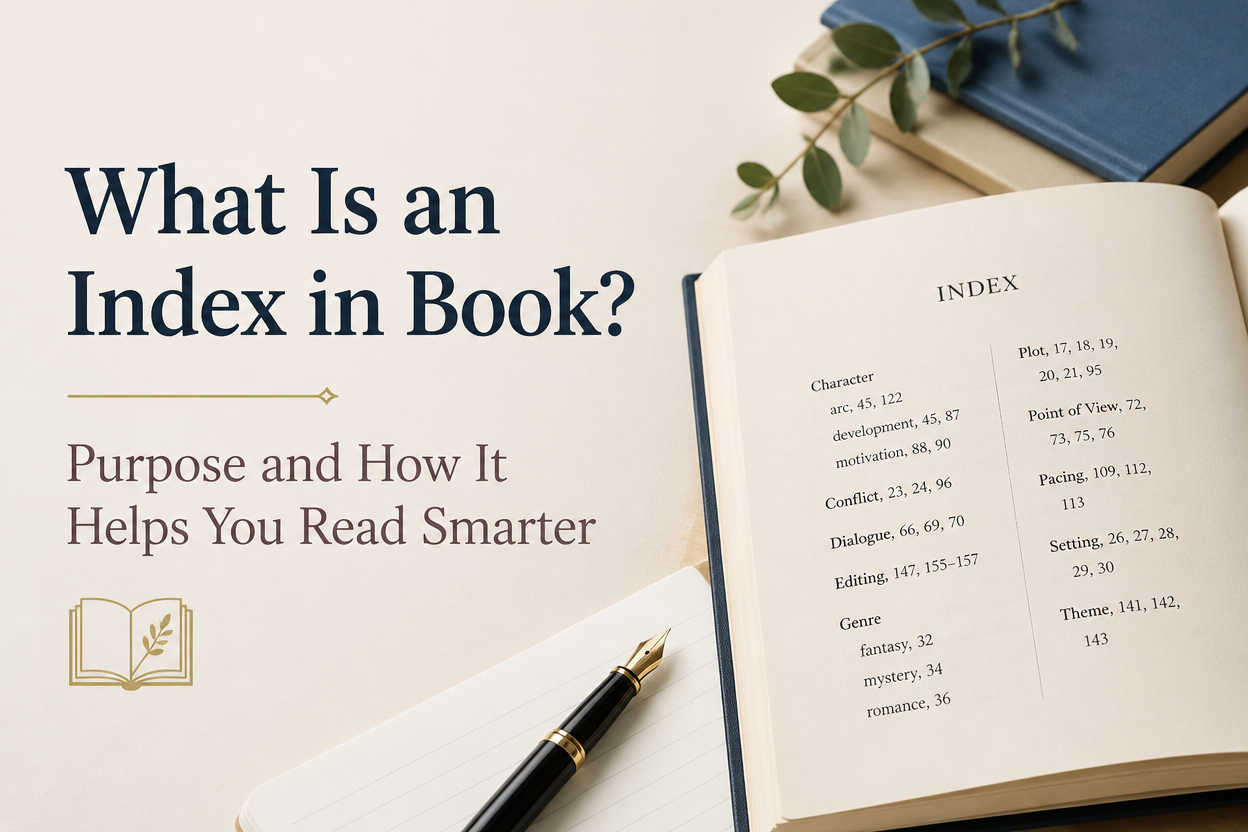
Authors often ask, “What is an index in a book?” when they reach the back matter of a nonfiction manuscript and see a carefully arranged list of names, subjects, and page numbers. An index is a reader’s finding tool. It points someone to every useful discussion of a subject, even when that subject never appears in a chapter title.
A table of contents helps a reader understand the book’s route. Meanwhile, an index helps a reader return to a specific idea after the route is over. For an author, that difference matters because a good index turns a book from a one-time read into a reference readers can revisit, quote, teach from, and recommend.
I recommend treating the index as part of the book’s architecture rather than a decorative page added during the final hour. A rushed index usually repeats obvious chapter headings and misses the terms readers will actually search. On the other hand, a thoughtful index reflects the ideas your audience brings to the book, including the questions your manuscript answers without stating in its headings.
Table of Contents
Index Definition And Book Function
An index is an alphabetized list of subjects, names, places, concepts, and sometimes titles that appear in a book, followed by the page numbers where readers can find meaningful discussions of them. The entries may include subentries that divide a broad subject into useful parts.
For example, a book about independent publishing might include an entry such as cover design, followed by subentries for typography, genre signals, thumbnail testing, and image licensing. A reader who wants help with typography can go directly to the relevant pages without scanning every chapter.
Publishers generally place the index in the back matter after the main text, appendices, notes, and bibliography. The exact order depends on the book’s style and production plan. A scholarly book may include separate indexes for subjects and names. Meanwhile, a trade nonfiction book often uses one combined index with cross-references.
Index Entries And Page References
Each entry needs a clear label and a page reference. The page number should lead to a substantial discussion, example, definition, argument, or useful mention. A page that contains a passing reference usually leaves the searcher with an unsatisfying result.
Indexes can include cross-references such as book marketing. See also launch strategy. Those references help users who use a different language for the same idea. For instance, an author might call a concept a reader magnet in the text. A subscriber might search for email list incentive instead. The American Society for Indexing notes that a strong index brings together scattered references to the same concept, even when writers describe it in different terms — which is exactly what a cross-reference does here.
Index And Table Of Contents
The table of contents presents the book’s structure from front to back. On the other hand, the index presents the book’s subjects in alphabetical order. For example, a chapter titled “Building Your Author Platform” tells readers where a major section begins. An index entry for email lists can point to pages in that chapter, a later launch chapter, and an appendix with sample messages.
You need both tools when your book teaches, explains, or documents a body of knowledge. A table of contents supports planning and browsing. An index supports retrieval after a reader has a particular need.
Before you draft your index, write down the five to ten questions a reader may ask months after finishing your book. Those questions will reveal better entries than your chapter titles alone.

Reader Value And Reference Use
A strong index reduces the work connecting a reader’s question to your answer. That matters for practical nonfiction, memoir with substantial subject content, textbooks, cookbooks, craft books, business books, history, biography, and academic work. Readers in these categories often return to a book with a task in mind.
Suppose your book teaches authors how to launch on Amazon KDP. A reader may remember a discussion about preorders yet forget the chapter title. For example, an index entry for preorders can lead to the launch timeline, the metadata discussion, and the section on reader expectations. The book keeps earning its place on the reader’s shelf.
Indexes Support Skimming And Retrieval
Readers rarely approach a reference book in a straight line. They scan the table of contents, flip to a promising chapter, search for a term, and return later for a related point. An index supports that behavior by offering several entry points across the material.
The American Society for Indexing treats the index as a detailed access point to the topics covered in a work. That principle has a direct production consequence: index the ideas and relationships a reader needs, rather than copying every noun from the manuscript.
Indexes Signal Serious Use
An index also tells your reader what kind of book you have made. A carefully edited index signals that the book invites repeated use. In a writing guide, entries such as point of view, scene goals, and dialogue tags help a writer return to a craft problem during revision. In contrast, entries in a history book on people, places, events, and policies let readers trace a subject throughout the narrative.
The signal only works when the index has substance. An index with ten broad entries in a 300-page reference book creates the appearance of care without delivering much access. I would rather see a shorter book with a precise, useful index than a long alphabetical list assembled from every page.
Read your finished manuscript with a reader’s future problem in mind. Mark the places you would revisit to answer a question, then build entries around those marked passages.
Index Types And Book Categories
The right index depends on the material and the people who will use it. A novelist rarely needs a traditional subject index. Meanwhile, a nonfiction author may need one badly, especially when the book contains specialized vocabulary, multiple people, or a method readers will apply over time.
Subject Indexes
A subject index lists ideas, topics, processes, objects, and themes. This is the standard choice for most practical nonfiction. A book about writing might include character arcs, first chapters, query letters, and revision.
Use the language your readers are likely to use. You can include a formal term with a familiar cross-reference. For example, the term “protagonist” can guide the reader toward the more common phrase “main character,” since your audience consists of beginning writers.
Name Indexes
A name index lists people, organizations, fictional figures, authors, and sometimes geographic names. Academic books, biographies, histories, and publishing books often benefit from a name index.
Keep names consistent. A person with a title, middle initial, or alternate spelling needs a clear primary entry, and cross-references can direct a reader from a shortened name to the form used in the index.
Specialized Indexes
Some books need specialized indexes for songs, legal cases, scripture passages, quotations, artworks, products, or technical terms. For example, a poetry collection with extensive references may use a first-line index. A book about software development may need an index of commands, languages, and functions.
A glossary explains terms in one place. An index, on the other hand, points to the places where the book discusses those terms. A glossary entry for read-through may define the publishing term. Meanwhile, an index entry for read-through can point to its use in launch planning, series strategy, and backlist marketing.
Choose the format by asking how your reader will use the book. List the subjects, names, and specialized terms that deserve their own route through the manuscript before you decide how many separate indexes to create.
Index Creation For Authors
Indexing begins after the page layout has stabilized. Page numbers can change during editing, design, and conversion, so an index created too early will need extensive repair. I recommend completing the substantive edit, locking the interior layout, and then indexing the final proof.
Build A Candidate List
Start with a pass through the manuscript. Record concepts, names, places, products, recurring examples, technical language, and alternate terms. Include subjects that appear in captions, tables, sidebars, footnotes, appendices, and case studies.
Then remove entries that have no value for retrieval. A mention of the word “book” on thirty pages tells the reader very little. However, an entry for “book description” with references to the pages where you explain its structure gives the reader something useful.
Write Useful Subentries
Broad entries become helpful when subentries divide them according to a reader’s purpose. Consider this pattern for a book marketing guide:
- author website
- author website, about page
- author website, book links
- author website, email signup
- author website, reader expectations
Keep subentries parallel and specific. A list that mixes topics, opinions, and random phrases becomes hard to scan. Use a cross-reference when a second entry would duplicate the same page references.
Choose Depth With Judgment
Every book needs a sensible level of detail. An index for a 70-page workbook may be unnecessary. On the other hand, a 250-page book about tax rules for freelance authors may need deep coverage because readers will consult it by topic.
I would also consider the book’s format. Print readers rely on page references. Ebook readers can search a term, though a well-edited index still helps them see the range and structure of the discussion. A Kindle conversion may change page locations, so test the digital file and confirm that the index remains useful in that format.
For a first pass, highlight meaningful passages in your final PDF and transfer those page references into a spreadsheet. Sort the entries alphabetically, combine duplicates, add cross-references, and review the list as though you were a stranger looking for help with one precise problem.
Index Editing And Production Checks
Index editing requires judgment beyond alphabetical sorting. Your reader needs accurate page references, consistent terminology, sensible grouping, and enough coverage to find the material that matters.
Test Search Intent
Ask someone who understands your audience to find five specific subjects in the finished book using only the index. Give an author friend terms such as comp titles, ARC readers, or launch team and observe where they look first. Their search language may expose gaps your author vocabulary hides.
Review synonyms carefully. A reader may search for “book promotion” even when your text uses “marketing,” so add a cross-reference when both terms matter. Avoid filling the index with every possible synonym, since excessive cross-references create visual noise.
Check Page Ranges
Use a page range for a sustained discussion that spans several pages. A range such as 42–47 marks where a subject begins and carries on, but a long range such as 42–81 usually needs subentries so the reader can find the relevant section.
Check every page reference against the final PDF, not an earlier draft. A single paragraph added during design can shift dozens of pages. Ask your proofreader to compare the index with the interior proof after the last text change.
Preserve Reader Trust
A broken index wastes time and weakens confidence in the book’s editorial care. Readers notice when a page number leads to a passing mention or when a promised term disappears from the list. The Library of Congress indexing guidance emphasizes consistent headings and references. These principles apply to independent books as much as institutional publications.
Use your production checklist to verify spelling, alphabetization, capitalization, cross-references, page ranges, and the final file. Adazing’s writing and publishing tools can help you organize manuscript material during development. However, the editorial judgment behind an index still belongs to you or a qualified indexer.
FAQs for What Is an Index in a Book? Purpose and How It Helps You Read Smarter
Does Every Book Need An Index?
No. A novel, short poetry collection, or brief personal essay collection usually has little to gain from a subject index. Practical nonfiction, academic books, histories, biographies, and technical guides often benefit from one because readers return to specific information. Judge the decision by reader use, page count, subject density, and the book’s long-term purpose.
How Long Should A Book Index Be?
No fixed percentage fits every book. A useful index may span from a few sheets to several dozen sheets, depending on the manuscript and its audience. Coverage matters more than length, so review the entries for meaningful subjects, names, subentries, and accurate references before you judge the index by its page count.
Can I Create My Own Book Index?
Yes, especially when you know the material and have a stable final layout. A professional indexer can save time and bring a reader-centered view to a dense or scholarly book, while doing it yourself means working from the final proof, recording meaningful references, adding synonyms and cross-references, and having another person test the index with real search questions.
Use The Index To Extend Your Book’s Life
An index gives readers a reliable way back into your work. It supports reference use, exposes the subjects your book truly covers, and adds value long after the first reading. For an author, it also forces a useful editorial question: what readers will need to find when they remember the problem but forget the page.
Answer that question during your final production pass. Build the index from the locked layout, write entries in reader language, test the references, and check the final file. A strong index rarely attracts praise on its own, but it quietly helps your book get opened again, which is the result that matters.
