
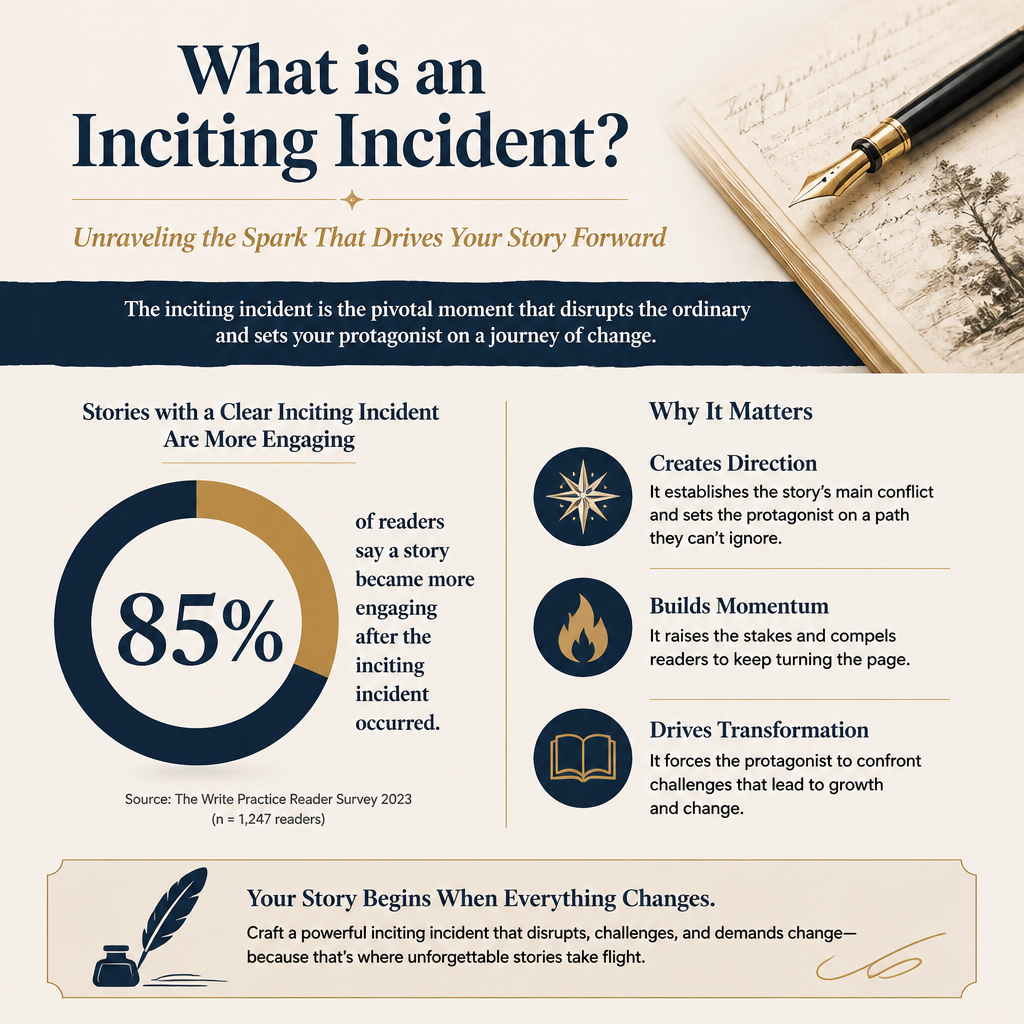
Every novelist eventually asks, “What is an inciting incident?”, because a promising premise still needs a moment that forces the story into motion. The inciting incident is the event that disrupts your protagonist’s ordinary life and creates a problem they can no longer ignore. It gives the reader a reason to keep reading and gives your character a reason to act.
That event doesn’t need to be explosive. For example, a missing wedding ring may do the work in a domestic mystery. A fantasy novel might turn on a sealed letter from a dead monarch to set everything moving. A memoir might hinge on a diagnosis, dismissal, divorce, or sudden discovery that divides life into before and after. The scale can vary widely; the pressure has to be real.
I treat the inciting incident as a contract with the reader. You promise that the story’s central trouble has begun, and the reader expects the protagonist’s choices to grow from that trouble. An opening drifts when the event is wrong. Get it right, and even a quiet story gains forward pull.
Table of Contents
Inciting Incident Definition
An inciting incident is the event that upends the protagonist’s familiar routine and launches the main story problem. It may happen on the first page, in the first chapter, or before the opening scene, with the consequences appearing as the book begins. The event matters because it changes what the protagonist must deal with.
Consider a romantic suspense novel about a forensic accountant who wants a promotion and a quiet life. Her inciting incident might be a client found dead after she discovers an irregular transfer in his accounts. The death brings danger, the transfer raises a question, and her professional knowledge gives her reason to investigate. Her life has acquired a direction.
A useful test is simple. Before the event, your protagonist can continue with their usual life. After the event, continuing in the same way carries a cost. The cost might be moral, financial, emotional, physical, or social. Without pressure, the event remains background information.
Story Change And Character Pressure
The strongest inciting incidents affect both plot and character. A spaceship crash gives your science fiction protagonist a survival problem. For example, a message from an estranged sister can expose guilt, resentment, or an old promise. The outer event sets the plot in motion, and the inner consequence gives the plot meaning.
I look for a connection between the event and the protagonist’s particular weakness. A public defender who receives a threatening note may react differently from a retired judge or an investigative reporter. Your protagonist should have a reason to respond that grows from who they are, not from authorial convenience.
Inciting Incident And Premise
Your premise describes the larger story. The inciting incident activates it. A premise such as “a widowed chef rebuilds her life through a failing restaurant” needs a triggering event. For example, the lease might be suddenly terminated, an estranged son might return, or a rival might offer a deal with a hidden cost. Each version points the story toward a different book.
Write your premise in one sentence, then write the event that makes the premise unavoidable. If you can’t name the event, your idea may still be a situation rather than a plot.

Story Disruption And Forward Motion
The inciting incident earns its place by creating a question the reader wants answered. Who stole the manuscript? Why did the bride leave the reception? What will the teacher do after finding a child alone in the locked school? A question creates forward motion when the protagonist has a reason to pursue the answer.
Writers often confuse a revelation with an inciting incident. A revelation gives the protagonist information. The inciting incident, by contrast, changes the choices available to them. If a detective learns that a victim had a secret brother, the discovery becomes a story trigger only when it forces a new action, such as contacting the brother before the killer does.
Backstory creates context. On the other hand, the inciting incident creates present-tense trouble. You can reveal the protagonist’s history later, after the reader has a reason to care about how that history affects the current problem.
External And Internal Disruption
External incidents arrive from outside the protagonist. For example, a flood might destroy the family home, a publisher might reject a book that contains dangerous evidence, or a stranger might leave a baby on the protagonist’s porch.
Internal incidents begin with a decision, realization, or emotional break. For example, a recovering alcoholic might choose to attend one meeting after years of avoidance, or a daughter might decide to open her mother’s sealed journals.
Many strong openings combine both forms. The external event supplies pressure, and the internal response reveals character. For example, your protagonist might receive a job offer in another city, then hide it from a partner because accepting it would reveal an old ambition. The event creates the problem. The response tells us whose problem it is.
Consequences And Reader Questions
Draft three consequences for your inciting incident. One should affect the protagonist’s immediate plans, another should create a complication, and the third should point toward the larger conflict. For the accountant, missing work to investigate the dead client creates professional risk, the transfer links her to a criminal network, and the network puts someone she loves at risk.
Then write the reader’s question in plain language. “Will she solve the murder?” may be too broad. “Can she prove the transfer was a warning before her employer discovers her investigation?” gives the opening a sharper line of tension.
Placement And Timing
There is no universal page number for an inciting incident. Thrillers usually benefit from early pressure because readers expect danger to arrive soon. Literary novels may spend more time establishing a pattern before disrupting it. On the other hand, romance stories often introduce the event that brings the couple together early, even if the emotional consequences develop over many chapters.
Placement depends on the promise your genre makes. The first chapter should give the reader enough evidence of the book’s direction to form a reasonable expectation. For example, a murder mystery that spends 40 pages on unrelated childhood memories has delayed its central engine. On the other hand, a family saga that begins with a funeral may need several quiet scenes before the event’s full meaning emerges.
I usually ask whether the opening begins as close as possible to the moment the protagonist’s choices change. If the event happens before the book, start with its immediate consequence. You don’t need to show the anonymous email arriving if the protagonist begins the chapter after reading it and deciding to lie to the police.
Early Inciting Incidents
An early incident works well when the story depends on a clear external problem. For example, the discovery of a body may appear in the opening pages of a cozy mystery, or a royal summons may arrive before the protagonist has finished breakfast in a quest fantasy. The reader understands the direction and can watch the character resist, accept, or misunderstand the call.
Early placement carries a risk. Your protagonist may react before the reader understands why the reaction is difficult. Give the reader a few precise details about the character’s normal life, then disturb it. Two pages of grounded detail can carry more weight than a chapter of general history.
Delayed Inciting Incidents
A delayed incident can work when ordinary life contains its own tension. For example, a marriage already under strain, a detective haunted by an old case, or a musician hiding a damaged hand can hold attention before the main disruption arrives. The opening still needs a question, desire, or threat to keep the reader engaged.
Delay becomes a problem when the first chapters only explain. If the protagonist attends work, remembers childhood, describes the town, and thinks about a problem without making a choice, the story has postponed its pressure. Give each early scene a consequence that limits the protagonist’s next move.
Inciting Incident Design
Start by writing the protagonist’s ordinary situation in two or three sentences. Include the routine, the desire, and the unresolved weakness. Then write an event that attacks one of those elements. For example, a reluctant pastor might want a quiet transfer while carrying guilt over a failed counseling session, and the event could be a teenager from that session appearing at the new church, asking for help.
Next, define the protagonist’s first goal after the event. The goal should be concrete enough to appear in a scene. “Find out who sent the letter” gives you a sequence of actions. “Deal with her feelings” leaves you with fog.
Give the event an opposing force. Someone may conceal evidence, impose a deadline, spread a rumor, or offer help for a price. Conflict grows when the protagonist’s attempt to respond produces a new problem. A good inciting incident keeps generating decisions after the initial shock has passed.
Genre-Specific Pressure
In a romance, the incident often creates proximity, attraction, or a threat to the relationship’s future. Fantasy incidents may reveal a calling, breach a boundary, or reveal a political danger. Horror incidents can introduce an impossible fact that the protagonist tries to explain away. Nonfiction incidents may be the failures, questions, or personal encounters that give the book’s argument urgency.
Use genre expectations as a floor rather than a formula. Readers want the story’s promised experience to begin. They don’t require the same event in every book, and they will notice when you force a familiar trigger into a plot that doesn’t support it.
Cause And Effect Revision
After drafting, draw a line from the inciting incident to the climax. List the major choices your protagonist makes along the way. Each choice should connect to the original disruption through cause and effect. Subplots can widen the story, although the main conflict should still feel active.
Cut scenes that would happen the same way if the inciting incident had never occurred. Those scenes may contain attractive writing or useful backstory. They aren’t carrying the plot. Move the information into scenes where the central problem forces it into the open.
Inciting Incident Revision Tests
Read your first three chapters with one question in mind: what changed? Mark the event that altered the protagonist’s options. If you find several minor disturbances, decide which one launches the main story and give it the strongest position.
Test the event against five questions. Who causes it, and what does the protagonist lose or risk? What immediate choice follows, and why can’t the protagonist return to ordinary life? What question does the reader carry into the next chapter? Weak answers usually point to a scene that needs sharper stakes or a protagonist who lacks a reason to engage.
Then read the opening aloud. Slow explanations often become obvious when spoken. If the event arrives through three pages of report, consider dramatizing the moment. A character receiving bad news in a conversation has more pressure than a paragraph explaining that the news arrived yesterday.
Your book description should also reflect the inciting incident. A blurb needs the protagonist, the disruption, the goal, and the threat. A synopsis can explain the full chain of events. Mixing those jobs produces a blurb that reads like a compressed plot summary and gives away the very question your opening worked to create.
Before publishing, check the first chapter at thumbnail scale only for the cover, then check the opening sample for the story. Readers find the book through the cover and description, then decide whether the opening delivers the promised conflict. Adazing’s writing tools, including QuickWrite, can help you generate alternate scene openings or test different versions of a character’s first response. Keep the version that creates the clearest pressure for your actual book.
FAQs for What is an Inciting Incident? Unraveling the Spark That Drives Your Story Forward
Does An Inciting Incident Need To Happen In Chapter One?
No. It needs to happen early enough that the reader understands the story’s direction and feels a reason to continue. A literary novel may delay the central disruption after establishing a tense ordinary life. A thriller usually has less room for delay. Judge the timing against your genre’s promise and the strength of the opening question.
Can A Character’s Decision Be An Inciting Incident?
Yes. A decision qualifies when it changes the character’s available choices and sets off the main conflict. A woman deciding to expose her family’s financial fraud can launch a novel even though no outside event forces her hand. Show the pressure behind the decision and give it consequences that prevent an easy retreat.
What Is The Difference Between An Inciting Incident And A First Plot Point?
The inciting incident disturbs the protagonist’s situation and starts the story problem. The first plot point usually commits the protagonist more deeply to the central conflict. For example, discovering a murder may begin a mystery. In another story, choosing to hide evidence from the police can push the detective into the larger danger. The exact labels vary among writing teachers, so track the function of each event in your manuscript.
Story Motion From The First Disruption
Your inciting incident should do more than create a dramatic opening. It should force a character with a specific desire and weakness to choose pressure. That choice produces consequences, and those consequences carry the reader toward the next scene.
Write the event in one sentence, write the first choice in another, and then follow the consequences for three scenes. If the chain stays alive, you have a working story engine. If it stops, sharpen the stakes or connect the event more closely to what your protagonist wants. A spark drives a book only when the character gives it something to burn.
