

When you edit a scene, understanding “what is an intensive pronoun” can add emphasis without changing who performed the action. That small grammatical choice gives your prose a stronger voice, especially when a character wants credit, insists on responsibility, or draws attention to an action.
Writers often confuse intensive pronouns with reflexive pronouns because both use forms such as myself, yourself, himself, herself, itself, ourselves, yourselves, and themselves. The spelling stays the same, but the job changes. A reflexive pronoun receives the action. An intensive pronoun reinforces a noun or pronoun that already identifies the actor.
I recommend treating the distinction as an editing test. Remove the pronoun from the sentence. If the sentence keeps its basic meaning and grammar, you’re likely looking at an intensive pronoun. If removing it leaves the action incomplete or changes who receives the action, you’re looking at a reflexive pronoun.
Table of Contents
The Meaning Of An Intensive Pronoun
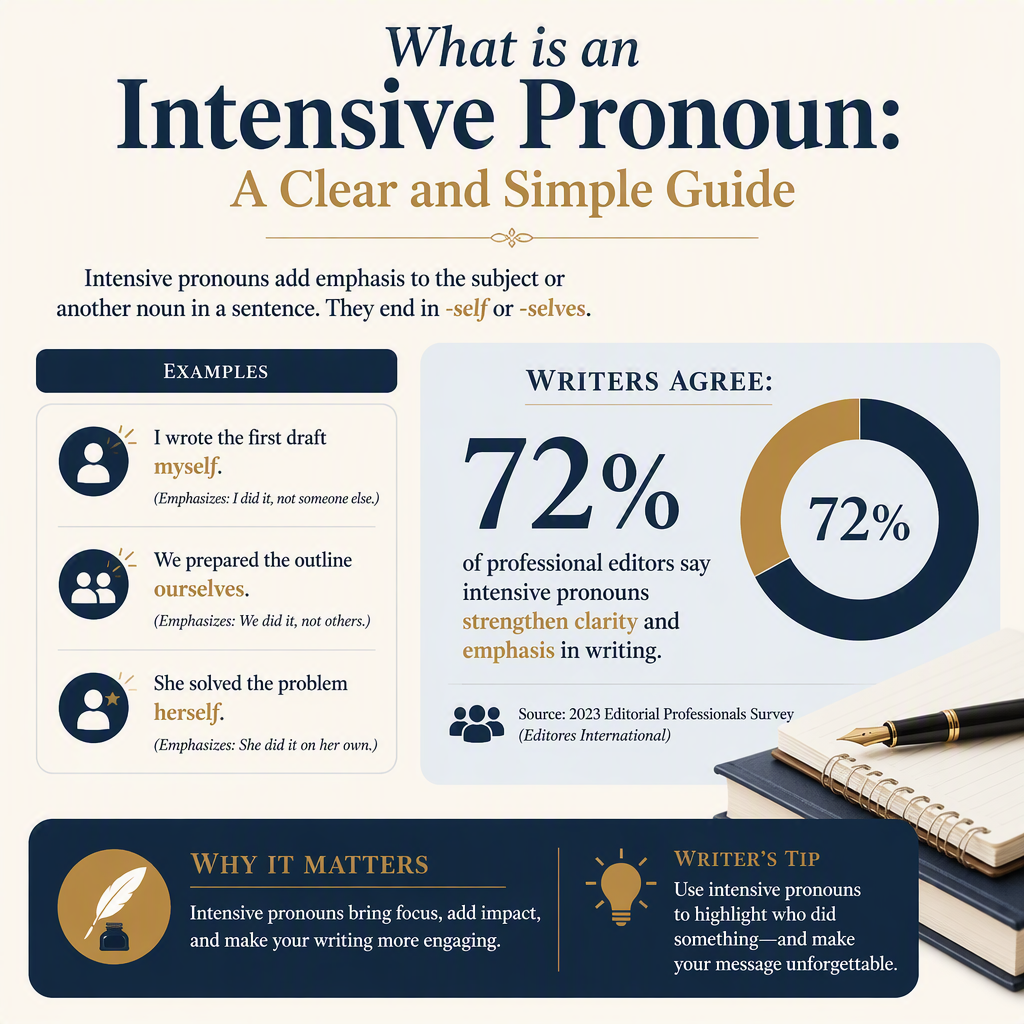
An intensive pronoun emphasizes the person or thing performing an action. It adds force, ownership, or personal involvement to a sentence. Consider these examples:
- I myself revised the final chapter.
- The author herself designed the cover.
- The characters themselves discovered the hidden passage.
Each sentence already has a complete grammatical structure without the intensive pronoun. “I revised the final chapter” makes sense. “The author designed the cover” works. “The characters discovered the hidden passage” remains clear. The added pronoun gives the subject extra weight.
Merriam-Webster defines an intensive pronoun as one that emphasizes a preceding noun or pronoun. The antecedent is the noun or pronoun that the intensive pronoun refers to. In “The editor herself marked the pages,” editor is the antecedent and herself supplies emphasis.
Emphasis And Ownership
Authors use intensive pronouns when the actor’s identity matters. A character may want readers to understand who made a decision, completed a task, or accepted a consequence.
Compare these two lines:
- Marcus signed the contract.
- Marcus himself signed the contract.
The first line reports an event. The second line hints at doubt, surprise, or a dispute over responsibility. Perhaps the reader expected Marcus’s lawyer to sign, or perhaps another character claims Marcus never saw the contract. The pronoun adds narrative pressure without adding a full explanatory sentence.
Use the form when the emphasis carries meaning. If the sentence contains no possible dispute, surprise, or personal stake, the pronoun may add clutter. “The baker herself baked the bread” sounds strange unless the story has a reason to stress the baker’s direct involvement.
Position In The Sentence
An intensive pronoun often appears directly after its antecedent or at the end of a clause.
- The novelist herself answered every reader email.
- The novelist answered every reader email herself.
- I myself chose the title.
- I chose the title myself.
Placing the pronoun after the subject creates early emphasis, while placing it at the end gives the sentence a firm closing beat. Read both versions aloud and choose the one that suits the character’s voice.

Intensive Pronouns And Reflexive Pronouns
The same words can perform two different grammatical jobs. That fact causes most of the confusion. The difference depends on whether the pronoun adds emphasis or functions as part of the action.
Cambridge Dictionary explains that reflexive pronouns refer back to the subject and appear when the subject and object of an action refer to the same person or thing. In “Lena blamed herself,” Lena performs the action and receives it. Remove herself, and “Lena blamed” feels incomplete because the reader needs to know whom Lena blamed.
In “Lena herself solved the mystery,” the pronoun adds emphasis. Remove it, and “Lena solved the mystery” remains complete. That pronoun intensifies Lena’s role without receiving the action.
The Removal Test
The removal test works well during a manuscript pass. Find a word ending in -self or -selves, then delete it temporarily. Read the remaining sentence aloud.
Consider these examples:
- Daniel taught himself to draw. Remove himself, and the sentence loses its intended meaning. This pronoun is reflexive.
- Daniel himself illustrated the interior. Remove himself, and the sentence remains complete. This pronoun is intensive.
- The queen defended herself in court. Remove herself, and the sentence becomes incomplete or changes meaning. This pronoun is reflexive.
- The queen herself addressed the crowd. Remove herself, and the sentence still works. This pronoun is intensive.
The test gives you a reliable answer in ordinary prose. Some sentences require closer attention because a pronoun may add both emphasis and a necessary reference. In those cases, examine the action first, then ask whether the pronoun functions as the object.
The Antecedent Test
Next, locate the noun or pronoun that the -self form reinforces. In “The publisher herself approved the cover,” publisher is the antecedent. In “The publisher congratulated herself,” “publisher” remains the antecedent, but “herself” receives the action.
Ask two questions. Who performs the action? Who receives the action? When both answers point to the same person, the pronoun may be reflexive. When the sentence already identifies the receiver or has no receiver, the pronoun may be intensive.
Forms And Agreement For Writers
Intensive pronouns must agree with the noun or pronoun they emphasize. Singular subjects take singular forms. Plural subjects take plural forms.
| Antecedent | Intensive Pronoun | Example |
| I | myself | I myself checked the proof. |
| you | yourself | You yourself chose the subtitle. |
| he | himself | He himself wrote the dedication. |
| she | herself | She herself negotiated the rights. |
| it | itself | The machine itself generated the error. |
| we | ourselves | We ourselves reviewed the manuscript. |
| you (plural) | yourselves | You yourselves approved the changes. |
| they | themselves | They themselves funded the launch. |
Agreement matters because the pronoun points back to its antecedent. A mismatch distracts readers and can make polished prose appear careless. In a sentence such as “The editors themselves approved the proof,” the plural noun editors calls for themselves.
Singular They
Modern English also uses singular they for a person whose gender is unknown, irrelevant, or described with they pronouns. The corresponding intensive form is themselves.
For example, “The author themselves approved the final cover” can be grammatically appropriate when the author uses they pronouns. Your character’s identity and stated pronouns determine the form. Follow the usage standard your publisher or house style requires when writing nonfiction for a specific market.
Compound Subjects
Compound subjects need plural intensive pronouns when two or more people act together.
“Mara and I ourselves reviewed the audiobook script” emphasizes the direct involvement of both people. In many sentences, the pronoun adds unnecessary weight. “Mara and I reviewed the audiobook script” has a cleaner rhythm. Keep the intensive form only when the scene has a real reason to stress personal responsibility.
Intensive Pronouns In Fiction And Nonfiction
Grammar becomes useful to an author when it changes the reader’s experience. An intensive pronoun can reveal defensiveness, pride, authority, or urgency. It can also create a deliberate echo in a sentence, which helps a line of dialogue sound spoken rather than assembled.
Dialogue And Character Voice
Characters reach for emphasis when they feel challenged. Imagine an agent accusing a novelist of handing the cover decision to someone else.
“I myself chose the image,” the novelist said.
The line carries irritation and ownership. The writer could express the same idea with “I chose the image,” but the shorter version lacks the defensive pressure. In dialogue, intensive pronouns often work as small signals of conflict.
Use them sparingly. A character who says “I myself” in every other exchange will sound theatrical unless that heightened speech belongs to the character. Read dialogue aloud and listen for intention. The pronoun should reveal a pressure in the conversation or clarify responsibility.
Narrative Emphasis
Narrators can use intensive pronouns to focus attention on a decisive action.
“The detective herself opened the envelope” tells readers to watch the detective’s involvement. The sentence might introduce a reveal, challenge an assumption, or show that the detective refuses to delegate the task.
In nonfiction, the same construction can distinguish direct experience from secondhand knowledge. “I myself tested the revision process on three chapters” signals personal participation. Use that claim only when it accurately describes your work. Precision builds authority faster than decorative emphasis.
Editorial Restraint
The mistake I see most often involves adding myself, yourself, or themselves for a grander sound. Writers sometimes believe the extra word adds formality. However, it usually just makes the sentence heavier when the surrounding context already provides emphasis.
Compare “I myself personally reviewed every page” with “I reviewed every page myself.” The first sentence repeats the same idea three times. The second sentence keeps one emphasis word and gives it a natural position. During revision, delete every intensive pronoun that contributes no attitude, contrast, or clarification.
Common Errors In Manuscripts
Several patterns deserve attention during a copyedit. They often appear in memoir, author bios, marketing copy, and dialogue.
Using Myself As A General Substitute
Some writers use “myself” where “I” or “me” belongs. For example, “Please send the contract to myself” sounds formal but follows the wrong pattern. Write “Please send the contract to me.” Use “myself” when it refers back to “I”, as in “I myself signed the contract” or “I reminded myself to sign it.”
Adding Extra Emphasis
Intensive pronouns already carry emphasis. Pairing them with words such as personally, alone, or by myself can create repetition.
- Heavy: I myself personally revised the chapter.
- Cleaner: I revised the chapter myself.
- Heavy: The author herself alone handled the launch.
- Cleaner: The author herself handled the launch.
Choose the version that communicates the exact idea. “I revised the chapter myself” emphasizes direct work. “I revised the chapter alone” emphasizes the absence of help. Those meanings overlap in some contexts, but they deserve separate words when both matter.
Confusing Possession With Reflexive Forms
Myself and ourselves cannot replace possessive forms. Write “my manuscript” and “our launch plan,” not “myself manuscript” or “ourselves launch plan.” Possessive pronouns identify ownership. Intensive and reflexive pronouns, by contrast, refer to people in relation to an action or emphasis.
Run a search for myself, yourself, himself, herself, itself, ourselves, yourselves, and themselves after you complete a draft. Apply the removal test to each result. This pass takes minutes and catches a surprising number of errors before your manuscript reaches a proofreader.
Editing With Intensive Pronouns
I edit intensive pronouns at three levels: grammar, meaning, and sound. Grammar tells me whether the form agrees with its antecedent. Meaning tells me whether emphasis serves the scene. Sound tells me whether the sentence belongs in the narrator’s or character’s voice.
Start with grammar. Circle the pronoun and underline its antecedent. Confirm their number and person. Then remove the pronoun and read the sentence again. If the core action remains clear, you have found an intensive use.
Next, ask what the emphasis accomplishes. Does it settle a question of responsibility, reveal pride or defensiveness, or create a useful contrast with another character’s claim? If the answer is no, delete the pronoun and keep the leaner sentence.
Finally, listen to the line. A pronoun placed after the subject can sharpen a spoken interruption, while one placed at the end can give a narrator a firm close. Your ear matters because grammar offers several correct choices, and your scene still needs the right one.
Tools can support this pass. Adazing’s writing tools, including QuickWrite, can help you generate alternate sentence versions when a line feels stiff. I still recommend making the final choice yourself because emphasis depends on character, context, and the scene’s promise. A grammar tool can spot a form, but it cannot decide whether your detective sounds proud, frightened, or ridiculous.
FAQs for What is an Intensive Pronoun: A Clear and Simple Guide
What Is An Intensive Pronoun?
An intensive pronoun is a form such as myself, herself, or themselves that emphasizes a noun or pronoun. In “The author herself approved the cover,” “herself” highlights the author’s direct involvement. Remove it, and the sentence still has a complete basic meaning.
How Can I Tell An Intensive Pronoun From A Reflexive Pronoun?
Remove the pronoun from the sentence. If the sentence remains grammatically complete and keeps its basic meaning, the pronoun is probably intensive. If the action needs the pronoun as its object, the pronoun is reflexive instead. “I myself edited the chapter” uses an intensive pronoun. “I edited the chapter myself” also uses an intensive pronoun. “I reminded myself to edit the chapter” uses a reflexive pronoun.
Can An Intensive Pronoun Appear At The End Of A Sentence?
Yes. Writers often place it after the verb or object for a stronger closing emphasis. “She designed the cover herself” emphasizes direct work. Place the pronoun where the sentence needs the stress, then read the line aloud to test its rhythm.
Use Emphasis With Purpose
An intensive pronoun earns its place when it signals who deserves attention or responsibility. I recommend searching your manuscript for every -self and -selves form, testing each one for grammar, meaning, and sound. Keep the words that sharpen a character’s voice or clarify the action. Cut the rest and let the sentence carry its weight without extra decoration.
