
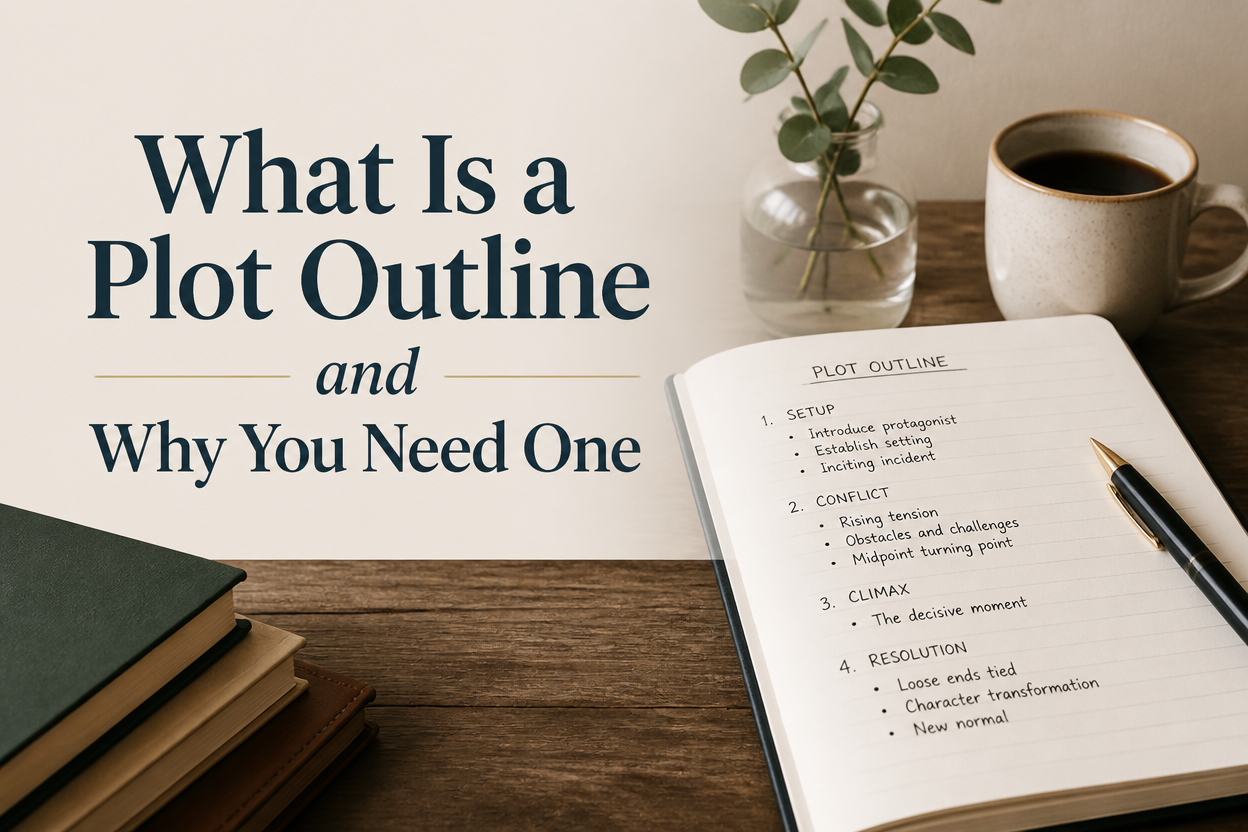
Every writer eventually wonders, “What is a plot outline?” when a promising idea starts growing beyond a few scenes. A plot outline is a working map of your story’s major events, turning points, character choices, and consequences. It gives you enough structure to draft with purpose while leaving room for discovery.
I recommend outlining before you commit to a full manuscript, especially if you’re drafting a mystery, thriller, romance, fantasy, or any novel with several major threads. An outline can expose a missing motive or a weak middle in an afternoon. Finding the same problem on page 240 costs weeks of drafting and a painful round of revisions.
You don’t need a rigid chapter-by-chapter plan. What you need is a chain of cause and effect that explains why each important event follows the one before it. Once you can see that chain, you can draft faster, revise with better judgment, and give your ending the preparation it deserves.
Table of Contents
What A Plot Outline Actually Does
A plot outline records the story’s dramatic movement. It tracks a character who wants something, meets resistance, makes choices, suffers consequences, and reaches a changed understanding or circumstance. The outline gives those movements an order you can test before prose makes the structure harder to see.
Many writers confuse an outline with a synopsis. A synopsis is written for another person, often an agent, editor, or publisher, presenting the whole story in a polished summary. An outline is written for you. The outline can contain questions, rough notes, alternative scenes, reminders about clues, and blunt comments such as “the villain has no reason to risk this.”
Cause And Effect
The strongest outlines answer one question repeatedly: why does this happen now? For example, your protagonist accepts the job because the previous scene reveals a debt. In another scene, the investigation reaches the abandoned hotel because a witness lies about where she was. Or the romance deepens because one character sees the other make a costly sacrifice.
A sequence of events can fill twenty chapters and still lack a plot. Plot develops when an event changes the character’s choices or the reader’s understanding. I look for those changes first. If removing a scene leaves every later decision untouched, the scene may offer atmosphere or information without doing enough structural work.
A Drafting Reference
Your outline should answer practical questions during drafting. What does the character want in this scene? What stands in the way of success? What new problem appears afterward? Which information reaches the reader here, and how does the scene alter the next decision?
Write answers in plain language. A useful outline entry might read, “Mara discovers the missing ledger in her father’s workshop, hides it from her brother, and later lies to the police about the visit.” That sentence gives you an event, a choice, and a consequence. “Mara learns more about the family” gives you almost nothing to draft.
The Core Parts Of A Useful Outline
You can outline with index cards, a spreadsheet, a notebook, or a writing app. The format matters less than the information you record. I want every major beat to show a character pursuing something, facing pressure, and creating a new condition for the story.
The Protagonist’s Want And Need
Start with the protagonist’s visible goal. A detective wants to identify the killer. Elsewhere, a young wizard wants to control a dangerous inheritance. Or, a divorced architect wants to win a contract that could save her firm.
Then identify the internal problem beneath that goal. A detective trusts evidence more than people. A wizard may believe control will protect everyone. An architect might measure her worth through professional approval. The external plot forces each character to confront that internal problem through decisions. Speeches about personal growth accomplish nothing.
Write both elements near the top of your outline. They give you a test for every major scene. A scene should pressure the external goal, the internal problem, or both.
Turning Points And Escalation
Turning points change the direction of the story. The protagonist receives information, loses an ally, makes an irreversible choice, discovers a hidden cost, or commits to a more dangerous course. Mark these moments before you fill in individual chapters.
Escalation means the consequences grow more personal, dangerous, expensive, or difficult to reverse. In a thriller, events can move from a suspicious email to a threatened witness to a public accusation to a direct attack on the protagonist’s family. In a romance, the arc can move from attraction to vulnerability to a choice that risks reputation, security, or a plan.
Raise pressure through consequences rather than random obstacles. A new problem should grow from a previous choice whenever possible. That connection gives the story momentum and makes the protagonist feel responsible for the trouble, even if the original decision seemed sensible.
Subplots And Payoffs
List each subplot beside the main plot. Record where it begins, where it develops, and where it resolves. For example, a subplot about a sister’s addiction should affect the protagonist’s choices or reveal something that the main plot needs. If it vanishes for 150 pages, readers may forget it or assume it was dropped.
Track promises and payoffs as well. A mysterious ring, a rival’s unusual knowledge, or a repeated image creates reader expectations. Your outline should show when you introduce the promise, when you complicate it, and when you answer it. Mysteries require special care because every major clue needs a fair place in the structure.
A Reliable Process For Building Your Outline
I build an outline in passes. Trying to solve premise, character, chapter order, scene detail, and prose style in one sitting creates a pile of notes you can’t use. A sequence of focused passes gives each problem the attention it needs.
Pass One: The Story Spine
Write five to ten sentences that describe the whole story. Include the opening disturbance, the protagonist’s first major decision, the midpoint discovery or reversal, the lowest point, and the final confrontation. Keep each sentence focused on an event that changes the story.
For example, a contemporary mystery spine might read like this: A restoration architect finds a dead donor inside a historic theater. She learns the donor planned to expose forged ownership records. Her own firm appears in the documents. After trusting the wrong partner, she loses access to the theater and becomes the public suspect. She returns with evidence that forces the real owner to confess during the building’s reopening.
That spine still leaves room for voice, scene design, and surprises. It also exposes the central question: can the architect uncover the truth before her professional reputation collapses?
Pass Two: The Major Beats
Expand each spine sentence into three to five beats. Write the protagonist’s goal, the opposition, the decision, and the result. You can use a three-act structure, a four-part structure, the Hero’s Journey, Save the Cat beats, or a structure drawn from your genre. Treat these systems as diagnostic tools rather than laws.
Genre gives you useful expectations. In romance, readers expect a believable emotional progression and a satisfying relationship resolution. Mystery readers expect clues, investigation, misdirection, and a solution that respects the reader’s attention. Fantasy readers expect rules, costs, and consequences for its magic. Your outline should test those promises before you spend months drafting.
Pass Three: The Chapter And Scene List
Now divide the major beats into chapters and scenes. Give each scene a short label and answer four questions: who is present, what the viewpoint character wants, what blocks that goal, and what shifts by the end.
Keep the scene notes short at first. Two or three sentences are enough. You can expand a scene when you reach it in the draft. If you write a full page for every chapter before testing the larger structure, you may become attached to material that needs revision or removal.
Adazing’s QuickWrite can help when you know the scene’s purpose and need several ways to approach it. I use tools like that for prompts, complications, and alternate phrasing. I still make the structural decisions myself. A generator can produce possibilities. Only you know which choice belongs to your character.
When Your Outline Starts Failing
An outline can create false confidence. A neat list of chapters may look healthy even when the protagonist has no meaningful choices. Read each entry for movement. A scene that only delivers background, repeats an argument, or delays the same decision needs a clearer purpose.
The Middle Loses Pressure
A weak middle often features a series of investigations, conversations, or travel scenes that leave the central situation unchanged. Add a decision with a cost. Force the protagonist to choose between two valuable outcomes. Reveal information that makes the original goal harder to pursue.
Don’t solve the entire problem at the midpoint. Instead, change how the character understands the problem. In one story, the detective learns the victim was involved in the crime. In another, the bride discovers her fiancé hid a debt. Or the rebel learns the person she planned to rescue leads the regime she opposes. A strong midpoint makes the second half more difficult because the character understands more.
The Ending Arrives Without Preparation
Readers accept surprise when the details were present even though the meaning was hidden. They reject an ending that depends on information introduced in the final chapter. Review your climax and list every fact, skill, relationship, or object it requires. Place each one earlier in the book, then give it a plausible reason to exist before the final scene.
This work matters especially in mysteries and fantasy. For example, a detective who suddenly remembers a vital clue feels convenient. A wizard who suddenly possesses a previously unmentioned ability feels like a cheat. Seed the material early, then give it a different interpretation until the climax.
The Character Acts Out Of Character
Plot pressure should reveal character. It should never erase it. If your cautious protagonist runs into a burning building, the outline needs a reason that fits her values, such as a child trapped inside or evidence that can save her brother.
Review every major decision and connect it to desire, fear, belief, or relationship. When a choice feels forced, revise the pressure around it before rewriting the character. The problem may sit in the scene’s setup, the information available to the protagonist, or the cost of refusing.
How Much Outline Your Book Needs
Different writers need different levels of planning. A plotter may want a detailed chapter list with scene goals and reversals. In contrast, a discovery writer may need only the ending, the protagonist’s desire, and the next few obstacles. Both methods can produce strong books when the writer keeps checking cause and effect.
Genre also affects the amount of planning. A 70,000-word romance with a small cast may stay manageable from a loose beat sheet. An epic fantasy of 120,000 words, by comparison, with several viewpoints, invented history, and interlocking subplots deserves a fuller map. A mystery requires enough planning to place clues fairly, even if you discover the prose as you draft.
I recommend outlining until your next move in the draft becomes clear. Then write. When you reach a point where you cannot explain the character’s goal, resistance, or choice, pause and revise the outline rather than producing ten pages of fog.
Flexibility matters too. Move scenes. Combine characters, or cut subplots entirely. Write alternative endings when you need to test the emotional result. Your outline serves the novel’s pressure and meaning, so it should change as you learn what the story actually wants to become.
FAQs for What is a Plot Outline and Why You Need One
How long should a plot outline be?
It should be long enough to reveal the major choices and consequences. For a short novel, that may mean one page of beats. For a complex fantasy or mystery, several pages plus character and subplot notes may be necessary. Start with a one-page spine, then add detail only where the structure remains unclear.
Can I write a novel without a plot outline?
Yes. Many writers discover the story through drafting. You still need a way to monitor the protagonist’s goal, the escalation, and the ending. A loose outline written after the first few chapters can give you direction without restricting discovery.
What should I do when my draft leaves the outline?
Stop and compare the new scene with the planned story. Keep the change when it creates stronger motivation, sharper conflict, or a more satisfying ending. Then revise the remaining outline to reflect the new cause-and-effect chain. An outline that describes an abandoned version of the book will only create confusion.
Use Your Outline As A Decision Tool
A plot outline earns its place by helping you make better decisions before revision becomes expensive. It gives your protagonist a sequence of choices, gives your scenes consequences, and gives your ending the preparation readers expect.
Write the story spine first. Mark the turning points, test the middle, and plant the material your climax requires. Then draft with enough structure to stay oriented and enough freedom to follow a better idea when one appears. Your outline doesn’t need to predict every sentence. What it needs is to show you why the next important event must happen.
