
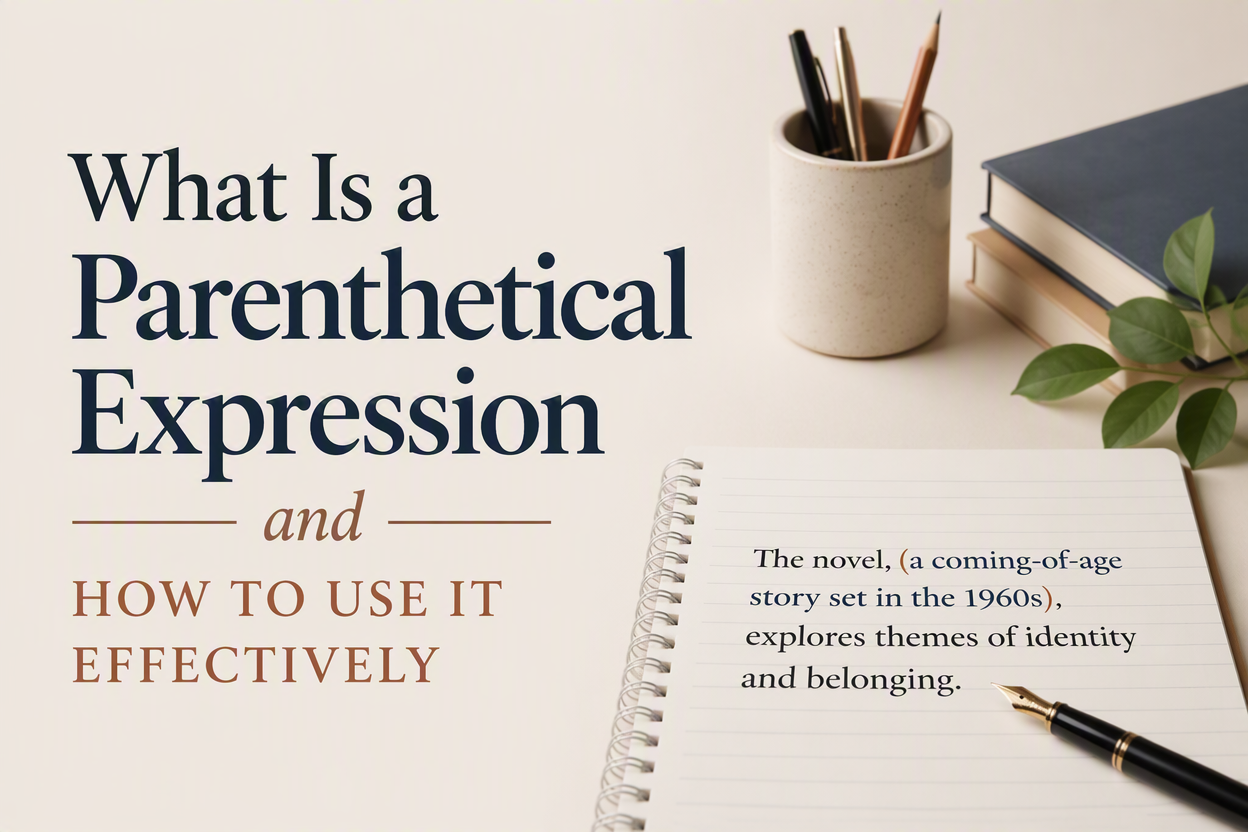
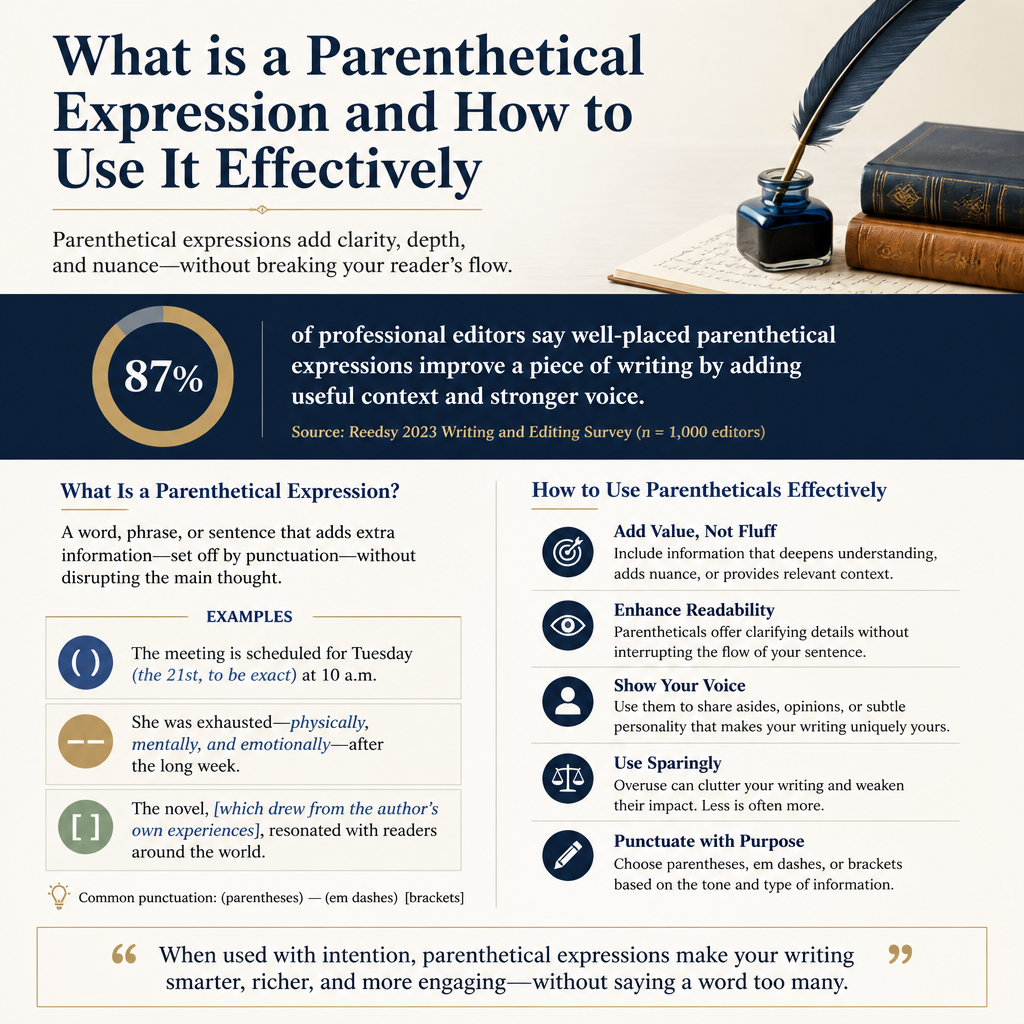
What is a parenthetical expression? It’s a sentence element that carries a second thought without losing its main direction. That small piece of punctuation gives an author room to add timing, attitude, background, or a private observation without forcing the reader through a new sentence.
Used with restraint, parenthetical expressions create intimacy. They let a narrator whisper to the reader, give a nonfiction explanation its needed qualification, or add a sharp detail to dialogue. Used too often, they make prose wobble. The reader keeps stepping aside to process interruptions, and your strongest sentences lose their shape.
I recommend treating every parenthetical expression as a control decision. Decide what information belongs in the sentence, what deserves its own sentence, and what should disappear during revision. The punctuation matters. The editorial judgment matters more.
Table of Contents
What Parenthetical Expressions Do
A parenthetical expression is a word, phrase, or clause inserted into a sentence as extra information. The sentence can usually stand without it. The added material may still change the tone, precision, or rhythm.
Consider this sentence:
Marisol opened the letter (the one she had hidden for twelve years) and read the first line.
The central sentence is clear without the inserted phrase: Marisol opened the letter and read the first line. The parenthetical detail adds history and tension. It tells the reader that this letter carries more weight than an ordinary piece of mail.
Parenthetical material can also qualify a claim:
The manuscript reached 82,000 words, a reasonable length for this genre.
Here, the phrase after the comma offers a judgment tied to the first statement. You could place it in parentheses. The commas, however, create a smoother flow because the qualification belongs closely to the sentence.
Extra Information And Narrative Voice
In fiction, parentheses often reveal a narrator’s attitude. A first-person narrator might write, I agreed to meet him at the station (because apparently I had learned nothing). The words inside the parentheses create a private aside, as if the narrator were speaking directly to the reader.
That effect works well in comic fiction, memoir, essays, and conversational nonfiction. In literary fiction, it needs a reason. Random asides can make a serious scene sound flippant, especially amid grief, danger, or intimate conflict.
The Removal Test
Delete the parenthetical material and read the sentence aloud. If the sentence remains grammatical and complete, the punctuation probably fits. If the sentence collapses, the material may belong to the main structure.
The removal test gives you a useful editorial boundary. It also exposes filler, since a phrase can qualify as technically removable and still add nothing. When the words contribute no image, context, voice, or precision, cut them.

Choosing Parentheses, Commas, and Dashes
Parentheses, commas, and dashes can all mark an interruption. They signal different levels of separation, so choosing among them changes how the reader experiences the sentence.
Parentheses push information into the background. Commas keep the information inside the sentence’s normal rhythm. Dashes give the inserted material more force and draw the eye toward it.
Compare these versions:
- The final chapter, which takes place in Kyoto, changes the meaning of the title.
- The final chapter (which takes place in Kyoto) changes the meaning of the title.
- The final chapter, which takes place in Kyoto, changes the meaning of the title.
The first version reads as a smooth grammatical addition. The second makes Kyoto feel like a side detail. A dash would make the location feel more dramatic, fitting for a reveal or a strongly voiced essay. Punctuation carries emphasis, so treat it as part of your book’s sound.
Parentheses For Quiet Asides
Use parentheses when the inserted material matters less than the sentence around it. A travel memoir might say, We arrived before sunrise (after a bus ride that deserves its own chapter) and found the market already open. The aside adds personality without taking control of the scene.
Parentheses also work well for brief definitions, dates, translations, and references. In a craft book, you might write, “The protagonist needs a clear desire (the thing she pursues through the story). The explanation supports the main point and remains easy to skip.”
Commas For Integrated Details
Commas fit when the inserted words flow naturally with the sentence. In Elena, exhausted after the reading, packed the leftover books into her car, the phrase describes Elena. It sits naturally between the subject and verb.
Commas require careful placement. A phrase enclosed by commas needs both marks when it sits inside a sentence. A closing parenthesis does the same job for parenthetical material. Avoid adding a comma simply because the thought feels finished. For example, write He signed the contract (after three rounds of revisions) and sent it to his agent.
Dashes For Dramatic Interruption
Dashes signal a stronger break. They suit a sentence that pivots, surprises, or loads the inserted phrase with added weight. In a thriller, “She opened the safe, the one her father had forbidden her to touch, and found the passport” carries less force than a version that gives the discovery a sharper interruption.
Reserve dashes for moments that deserve that pressure. When every paragraph contains several, the punctuation stops marking emphasis and starts creating noise. I often see manuscripts where parentheses would provide a calm aside and dashes are doing all the work.
Parenthetical Expressions In Fiction
Fiction writers can use parenthetical expressions to shape voice, reveal thought, and control pacing. The strongest examples feel native to the narrator. They don’t appear because the author needed somewhere to put an explanation.
First-person narration offers the most obvious opportunity. A narrator might say, I told Sam I had forgiven him (I hadn’t) and watched him smile. The parenthetical phrase exposes the gap between speech and truth. It gives the reader information the other character lacks.
Third-person narration requires more care. A parenthetical aside can pull the narrative voice away from the character’s perspective. In close third person, the aside should sound like something the viewpoint character might think. In a distant or comic narrative, the narrator may have more freedom.
Parentheses And Character Voice
Use the punctuation as part of a character’s mental pattern. A self-conscious narrator may add constant qualifications. A confident narrator may use one parenthetical remark to puncture a boast. A child narrator may include an explanation because the reader needs to understand a rule adults take for granted.
Dialogue follows a different rule. Characters can speak in asides. Ordinary spoken dialogue, however, doesn’t need parentheses for every interruption. Use them when the printed form represents a private thought, a stage direction, or an editorial note. Otherwise, quotation marks, sentence breaks, and dialogue tags usually give you cleaner control.
Parentheses And Pacing
A parenthetical phrase slows the reader for a moment. That pause can heighten suspense when the information arrives at the right time. It can also drain an action scene of its urgency.
Read the passage at the speed you want the scene to move. If the hero is running through a burning hotel, a long aside about the wallpaper will interrupt the danger unless the detail changes the reader’s understanding of the scene. In a reflective chapter, the same aside may deepen the narrator’s character.
During revision, mark every parenthetical expression in a chapter. Count them, then ask what each one contributes. Keep the phrases that create voice or meaning. Move background information into a sentence of its own when the reader needs to absorb it fully.
Parenthetical Expressions In Nonfiction
Parentheses have a practical role in nonfiction, especially in craft books, memoir, history, and instructional writing. They let you define a term, clarify a date, identify a source, or add a limitation without breaking the main discussion.
For example, a writing guide might say, A scene needs a change in the character’s situation (even a small discovery can qualify). The parenthetical phrase gives the reader a useful boundary. A memoirist might write, My father moved to Detroit in 1978 (three years before I was born). The date adds context without taking over the paragraph.
Style authorities treat parentheses as a form of enclosure for material that sits outside the main grammatical flow. The Purdue Online Writing Lab’s explanation of semicolons, colons, and parentheses covers common uses such as providing supplemental information, using abbreviations, and citing sources.
Definitions And Qualifications
Technical nonfiction often needs short definitions. The first appearance of a specialized term may include a parenthetical explanation, such as read-through (the percentage of readers who continue from one book in a series to the next). After that, use the term plainly. Repeating the definition makes the prose feel instructional in the wrong way.
Qualifications deserve special attention. A statement such as Readers often judge a book by its cover (especially when they encounter it in a crowded online category) contains a useful condition. The qualification keeps your claim honest. If the condition carries major weight, give it a full sentence and support it with evidence.
Citations And House Style
Parentheses often hold in-text citations in academic and nonfiction writing. Your publisher’s style guide controls the details. The Purdue OWL’s guide to MLA parenthetical citations explains how enclosed source information interacts with surrounding punctuation and quoted matter.
Self-publishing authors should settle these choices before line editing. Pick a style guide that fits your category, then apply it consistently across the manuscript. Readers may never identify a single punctuation decision. They will, however, notice an inconsistent pattern across 70,000 words.
Editing Parenthetical Expressions For Control
Good parenthetical writing depends on removal. During a revision pass, I look for every pair of parentheses and ask three questions. Does the phrase add meaning? Does the chosen punctuation match its importance? Could the sentence carry the information more clearly in another form?
Those questions protect your prose from a common manuscript problem: the author keeps adding small explanations because the draft feels uncertain. The result resembles a book wearing dozens of tiny adhesive labels. Each label explains something. Together, they obscure the object.
Trim Repeated Explanations
Watch for parenthetical material that repeats a nearby sentence. For example:
The launch team asked readers to post reviews (reviews help a book gain visibility). Reviews can also give new readers confidence.
The first explanation adds little because the following sentence covers the point. Delete the parenthetical phrase or combine the ideas into one clean paragraph.
Check Punctuation At Sentence Ends
When a parenthetical expression appears at the end of a sentence, punctuation rules depend on whether the entire sentence or only the inserted material is enclosed. Write “The event begins at six (doors open at five).” The period inside the parentheses belongs to the complete parenthetical sentence. In contrast, write “The event begins at six (an early start for a Saturday).” The period after the closing parenthesis belongs to the main sentence.
A question mark or exclamation point inside parentheses belongs to the enclosed material. For example, “She agreed to the plan (did she have another choice?) and signed the form.” The main sentence remains a statement, so its period follows the closing parenthesis.
Read For Your Book’s Voice
Grammar can tell you whether the punctuation works. Your ear must tell you whether it belongs in the book. A literary novel with spare, controlled prose may need very few parentheses. In contrast, a humorous memoir may depend on them. A business book, meanwhile, may use them for definitions and conditions, and heavy use can still make an already dense page harder to scan.
Paste a chapter into a clean document and temporarily remove the parenthetical phrases. Read both versions aloud. The stronger version will usually reveal itself through rhythm. If the aside contains a detail you love, give that detail enough room to earn its place.
Adazing’s writing tools, including QuickWrite, can help you generate alternate phrasing during this pass. I still recommend making the final punctuation decision yourself, as software can suggest punctuation. It can’t know whether the aside belongs to your narrator or your reader’s experience.
FAQs For What Is A Parenthetical Expression And How To Use It Effectively
What Is A Parenthetical Expression?
A parenthetical expression is a removable word, phrase, or clause that adds information to a sentence. Writers commonly enclose it in parentheses. However, commas or dashes may fit when the added material sits more closely within the sentence’s main rhythm.
Can A Parenthetical Expression Begin A Sentence?
Yes. A sentence can begin with an aside such as (After three failed attempts) Lena finally opened the file. Use this structure when the introductory material provides useful context. A separate sentence may read more naturally when the opening phrase carries substantial information.
Should Authors Use Parentheses In Fiction?
Authors can use parentheses in fiction when the punctuation supports narration, humor, private thought, or a deliberate pause. Count them during revision and remove any phrase that adds no voice, image, context, or precision. Genre and viewpoint should guide the final choice.
Clearer Prose Through Deliberate Punctuation
Parenthetical expressions give you a quiet way to add meaning. They work best when the main sentence remains strong, and the inserted words earn their interruption. Use parentheses for background and private asides, commas for integrated details, and dashes for forceful breaks.
Then read the passage aloud. Your reader should understand what belongs in the foreground and what can remain at the edge of attention. That distinction turns punctuation from decoration into craft.
