
Readers often ask “What is a limitation of the first-person narrator?” when they discover how much a single viewpoint can control a novel. The central limitation is access: your narrator can report only what they know, notice, remember, believe, or choose to reveal. That restriction can create intimacy and suspense. It also closes doors you may need for plot, character development, and reader understanding.
First-person narration drops the reader inside a single consciousness through pronouns such as “I” and “me.” Britannica’s overview of point of view in literature describes first-person narration as a perspective presented through the narrator’s own experience. For an author, the craft question is practical: how can you keep the intimacy of “I” without making the story feel blind, repetitive, or artificially convenient?
I recommend treating the limitation as a design constraint. You decide what your narrator can witness, what they misunderstand, and what they hide. Once those boundaries are firm, first person gives you a powerful tool for suspense and character depth. Move them around for the sake of the plot, and readers will hear the gears turning.
Table of Contents
Restricted Access To Information
Your first-person narrator cannot enter another character’s mind and report private thoughts as fact. For instance, a murder in a locked room stays off the page unless they witnessed it, heard about it later, or got the story from someone trustworthy. A friend’s guilty heart is just as invisible, so lying cannot simply be known. Your narrator can observe a pause, a changed expression, a missing detail, or a strange decision. The interpretation belongs to them.
This restriction affects the entire plot. For example, a mystery lets you use it to control evidence. A romance turns it into tension built from misread signals. In literary fiction, the same limit shows how a character’s private assumptions shape every relationship around them. The limitation becomes useful when you plan its consequences before drafting.
Knowledge Boundaries
Build a knowledge map for your narrator before you revise. List the events your narrator directly witnesses, the facts they learn through conversation, the information they infer, and the facts they never discover. Give each category a different level of certainty in the prose.
For example, a narrator might write, “Mara left the restaurant at 9:14 because I watched her push through the door.” A second sentence, “She was angry because her hands shook,” has quietly crossed into interpretation. A third, “She went home to destroy the letter,” earns its place only after Mara says so or the narrator turns up convincing evidence. Those sentences carry different kinds of knowledge, and your diction should show the difference.
Plot Information And Suspense
Many first-person drafts weaken suspense by giving the narrator information through convenient explanations. For example, a character overhears a conversation through a wall with perfect clarity. Somewhere else in the draft, a stranger explains an entire criminal scheme to someone they intend to silence. Two hundred pages of ignoring a detail end with the narrator suddenly remembering it, and the central mystery falls open. Readers accept discovery when the scene earns it. They resist information that arrives because the outline requires it.
During revision, mark every paragraph that reveals new plot information. Beside each revelation, write how the narrator obtained it. If you cannot name the source, the timing, or the reason the narrator understands it, rewrite the passage as a question, an observation, or a partial inference. Confusion can create tension. Unjustified knowledge breaks trust.

Subjective And Potentially Unreliable Perception
A first-person narrator filters every event through personal history, desire, fear, and language. The narrator may describe a stern father as cruel, a rival as arrogant, or a lover as mysterious. Those descriptions tell you how the narrator sees the world. They do not automatically establish objective truth.
This subjectivity gives you access to a character’s inner life. It also creates the risk of accidental unreliability. A narrator can be unreliable because they lie, misunderstand, forget, protect themselves, or lack the emotional vocabulary to name what happened. You need to decide which form you are writing before you sprinkle contradictions through the manuscript.
Bias In Description
Every narrator has a vocabulary of judgment. For example, a wealthy narrator may describe a worn apartment as “shabby.” The tenant who grew up there calls it “crowded and familiar.” Silence works the same way. A soldier hears discipline in it. Meanwhile, a grieving sibling hears abandonment. The physical facts can remain stable even as the emotional meaning changes.
Give your narrator three recurring filters. Consider what they notice first, what they routinely dismiss, and what they describe with unusual precision. In practice, a chef may register the burnt oil before the argument begins. A lawyer catches contradictions in a witness’s wording. A teenager tracks who looks at whom during dinner. These patterns make the viewpoint feel inhabited.
Unreliable Narrator Signals
An unreliable narrator needs a readable relationship with the truth. Readers should sense that the account contains pressure points, even if they cannot identify every falsehood. Contradictory memories, evasive answers, excessive certainty, and sudden changes in tone can signal unreliability. So can a mismatch between the narrator’s words and the visible consequences of their actions.
Subtlety matters. If every paragraph announces that the narrator is lying, the device becomes a performance. Plant evidence that readers can understand later. For example, a narrator who says, “I never touched the envelope,” and then mentions the wet paper fibers on their fingers has created a fair puzzle. Lying about a fact the reader has never encountered creates fog instead.
Read your manuscript once from the narrator’s perspective and once as a skeptical reader. The first pass protects the voice. The second circles claims that require outside confirmation. Decide which claims are deliberate distortions and which ones are simple continuity errors.
Limited Access To Other Characters
First-person narration can make secondary characters difficult to develop because every detail reaches the reader through the protagonist. A supporting character may exist only as a lover, rival, mentor, parent, or obstacle. Readers meet the role your narrator assigns long before they meet the person’s own wants.
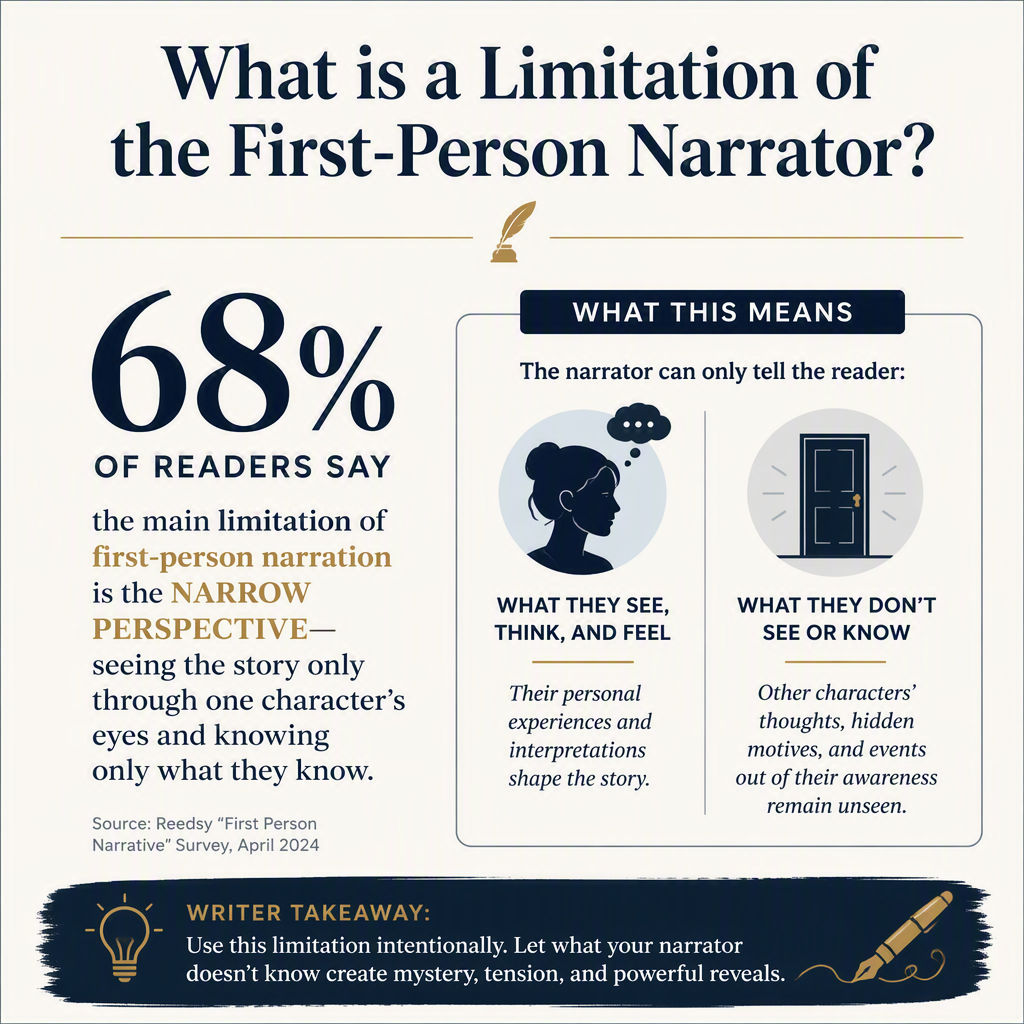
This limitation becomes severe when the narrator spends every scene interpreting other people. You may describe a friend’s sadness, a villain’s ambition, or a partner’s jealousy without giving that character a chance to act beyond the narrator’s expectations. The cast begins to resemble a set of mirrors angled back at the protagonist.
Independent Character Goals
Give every major supporting character a goal that exists beyond the narrator. For example, a narrator who wants to save the family business can have a sister who wants to sell it. The narrator who wants the relationship to continue can have a partner already picturing a life in another city, and a detective partner who wants the case closed for reasons the narrator finds morally weak.
You do not need access to those private goals in every scene. You need evidence of them. Let characters refuse requests, change plans, conceal resources, and pursue conversations the narrator cannot control. A character becomes real when they create complications without waiting for the protagonist to interpret them.
Dialogue As Evidence
Dialogue carries more weight in first person because it may be your clearest route into another character’s thinking. Use what people say alongside what they avoid saying. For example, a father who answers a question about money with a story about his childhood has revealed something through evasion. A friend who remembers an insignificant detail from the narrator’s past may be signaling affection, guilt, or surveillance.
After drafting a dialogue-heavy scene, temporarily remove the narrator’s explanations. Read only the spoken words and physical actions. Ask whether the relationship, conflict, and hidden agenda still exist. Add internal commentary where it sharpens the narrator’s experience. Cut commentary that translates an obvious exchange.
Voice Consistency And Narrative Control
First person requires a stable voice with enough range to avoid monotony. The narrator’s vocabulary, rhythm, metaphors, and level of reflection should match their age, education, profession, region, and emotional state. For example, a sixteen-year-old narrator can use sophisticated language. The manuscript still needs a reason for that voice. A homicide detective can notice procedural details, and every observation should sound like a person rather than a case report.
Voice consistency does not mean emotional sameness. Your narrator can become more honest, more frightened, or more perceptive as the story progresses. The change should result from experience. If the voice turns lyrical only for the beautiful chapter and clinical only for the plot explanation, readers will feel the author reaching through the character.
Voice Under Pressure
Test the narrator’s voice in three different scenes: a private reflection, a confrontation, and a mundane task. The narrator may use long analytical sentences in private, short evasive answers in confrontation, and concrete sensory details while washing dishes. Those variations should feel like pressure changing the same voice rather than three separate narrators.
Read several pages aloud. Your ear will catch repeated sentence openings, favorite adjectives, and interior phrases that your eye overlooks. Writing tools such as Adazing’s QuickWrite can help you generate alternatives when a passage stalls, as long as the narrator’s established diction remains yours own. A tool can suggest language. It’s still up to you to decide whether the character would actually say it.
Narrative Distance
First person can sit close to the narrator’s immediate sensations or farther away in reflective narration. For example, a close version might say, “My hand slipped on the doorknob, and I tasted metal.” A reflective version might say, “I understand now that I had already decided to leave before I opened the door.” Both belong to first person. Each creates a different relationship with time and knowledge.
Choose the distance that serves each scene. Immediate narration works well for danger, attraction, and confusion. Reflective narration works well for memoir, confession, and stories shaped by hindsight. If your narrator knows the outcome, use that knowledge deliberately. Do not allow future wisdom to leak into scenes where the character needs to remain genuinely uncertain.
Practical Revision For First Person
The limitation of first person becomes manageable when you test the manuscript for access, bias, character independence, and voice. I use a focused revision pass rather than trying to repair every issue at once. Each pass answers one craft question and produces a visible change on the page.
Start with access. Highlight every sentence that reports another person’s thoughts, intentions, or private actions. Rewrite unsupported statements as observations or discoveries. Then examine bias. Circle descriptions that present judgment as fact and decide whether the narrator’s prejudice should remain visible, deepen, or change.
Next, review your supporting cast. Write one sentence for each major character describing what they want from the story and from the narrator. If the answer in both columns is identical, give that character a separate pressure, obligation, or fear. Readers need to see a life continuing beyond the protagonist’s attention.
Finish with a voice check. Copy a page from the opening, a page from the midpoint, and a page from the final act into one document. Read them without the surrounding plot. Look for shifts in vocabulary, sentence rhythm, humor, and emotional honesty. A developing narrator may change. The change should still have a cause readers can trace.
Your book’s genre will affect how much restriction readers expect. For example, a psychological thriller may build its entire engine around a narrator’s blind spots. A cozy mystery needs sufficient fair evidence for readers to reason alongside the detective, and a memoir asks for careful handling of memory, privacy, and claims about other people’s motives. I recommend setting the rules in your opening chapters and honoring them through the ending.
FAQs on What is a Limitation of the First-Person Narrator?
Can A First-Person Narrator Know What Other Characters Think?
The narrator can report what another character says, does, or appears to feel. They can also offer an interpretation based on experience. Direct access to another character’s thoughts belongs to a different narrative arrangement unless the information arrives through dialogue, documents, telepathy, confession, or another established device. Keep the source of the knowledge visible to the reader.
Does First Person Always Create An Unreliable Narrator?
No. First person creates a subjective narrator, and subjectivity differs from deliberate unreliability. A narrator may misunderstand an event without lying about it. A reliable narrator can still have limited knowledge, strong preferences, and emotional blind spots. Decide whether the reader should question the narrator’s honesty, perception, memory, or only their conclusions.
How Can I Avoid Making First Person Repetitive?
Give scenes different purposes and vary the narrator’s attention. Your protagonist can track physical detail in one scene, social power in another, and memory in a third. Cut repeated explanations of the same fear or relationship. Let external action carry meaning through choices, interruptions, and consequences. A strong first-person voice grows through pressure on the character rather than through constant interior commentary.
Use The Limitation As The Story’s Pressure
First-person narration limits what your reader can know. That limit hands you control over discovery. The narrator’s blind spots can create suspense, their bias can expose character, and their voice can make an ordinary event feel personally charged. I recommend defining the narrator’s knowledge and distortions before you get far into the draft. Give every revelation a source, every supporting character an independent desire, and every change in voice a cause. Your reader will accept a narrow viewpoint when the boundaries feel deliberate.
