
If you write fiction, the question of “What is a flashback in a story?” will come up on its own, and the answer affects your plot’s timing, your character’s depth, and the reader’s trust. A flashback is a scene that carries the narrative back to an earlier moment, giving the reader a chance to experience a past event rather than receive a thin explanation of it.
Place one well, and it gives present action emotional weight. Drop one in carelessly and the story stalls just when the reader has begun to care about what happens next. I treat every flashback as a working scene with a job to perform. It must reveal pressure, change the meaning of a current event, expose a decision, or force the character toward a new choice.
The craft problem sits in the timing. You have information about the past. Information about the present is what your reader actually wants. The strongest flashbacks connect those two points so tightly that the earlier event feels active inside the current scene.
Table of Contents
Flashback Meaning And Purpose
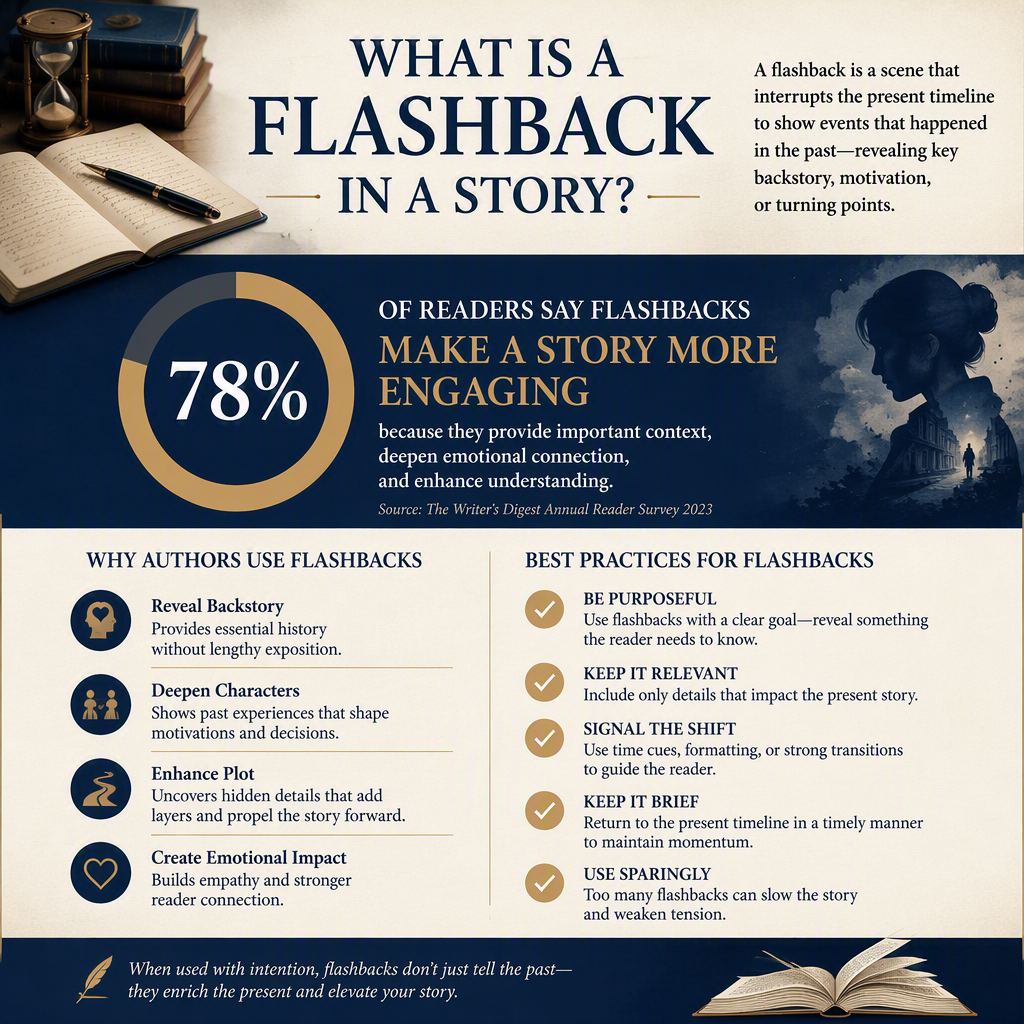
A flashback interrupts the story’s current timeline to dramatize an earlier event. In literary terms, critics often call this movement analepsis. The Encyclopaedia Britannica entry on flashback describes the device as a break in the chronological order of events that lets a past moment take the stage, a definition at home in fiction, film, and other storytelling forms.
The word “dramatize” matters. Your character remembering that her brother died tells the reader information. Put her in the hospital corridor where he died, hearing the vending machine click and smelling antiseptic on her coat, and the reader gets an event instead. The second version can alter what she does in the present.
Story Jobs For A Flashback
A flashback can reveal the origin of a fear, explain a broken relationship, expose a lie, complicate an apparent victory, or show the cost of a past decision. Pick one primary job before you draft. A scene that tries to explain a character’s childhood, a marriage, a war, and a secret inheritance will usually read like a file being opened rather than a story unfolding.
Consider a thriller in which a detective refuses to enter an abandoned school. A flashback to the night she escaped from that building can explain the refusal. The scene becomes more useful when it also shows that she left someone behind. Now the memory creates a present dilemma. Entering the school may solve the case. It may also force her to face the person she failed.
I recommend writing one sentence that names the flashback’s job. Try, “This scene shows why Mara believes she causes harm when she tries to help.” If you cannot finish that sentence with a specific consequence, the scene probably needs a sharper purpose.

Flashback Versus Backstory
Backstory is the larger category of information about what happened before the current narrative. A flashback is one way to deliver that information. You can also use dialogue, interior thought, documents, setting details, rumors, or a character’s habits.
The distinction matters because backstory often arrives in small pieces while a flashback usually takes up the whole scene. A sentence such as “Jon had avoided his father for twelve years” gives the reader context. Show Jon at seventeen instead, watching his father burn the family photographs, and the reader gets a moment with conflict, sensory detail, and choice.
Scenes Carry Pressure
A flashback needs a problem inside it. The character should want something during the remembered event, and something should obstruct that desire. Without pressure, the past becomes an explanation dressed in stage directions.
Suppose your historical novel follows a woman who hides a forged letter. A weak flashback shows her receiving the letter and explains its history. In a stronger version, she tries to destroy it as her sister walks into the room. She must choose between protecting herself and preserving evidence against a powerful official. The present-day plot gains a living source of tension.
Dialogue can carry a flashback, so long as it never turns into a transcript of information. Let people evade, interrupt, misunderstand, and pursue separate aims. Readers learn the past through conflict, just as they learn the present through conflict.
Memory Has A Point Of View
A flashback arrives through a character’s perception, even when you write it in third person. That perception shapes what the reader receives. A frightened child may misunderstand an adult’s conversation. An older narrator may remember the same event with knowledge the child lacked.
Point of view also affects how much certainty you can offer. A first-person narrator may remember a slammed door precisely and invent the reason for it. A close-third narrator may notice the character’s hands shaking as the memory sidesteps the central fact. The Purdue Online Writing Lab’s overview of point of view explains how narrative perspective controls the information a reader can access, a principle that applies directly to remembered scenes.
Choose the memory’s limits deliberately. A reliable memory can reveal an event with clarity. Distort the memory instead, and you create mystery or expose self-deception. Either choice needs evidence in the larger book so the reader understands how to interpret what has been shown.
Timing And Triggers
The cleanest flashbacks begin because something in the present activates the past. A song, a location, a smell, a photograph, a phrase, or a physical gesture can open the door. The trigger gives the transition a cause and keeps the memory attached to the current story.
Imagine a romance novel in which Elise sees a blue suitcase beneath her new partner’s bed. The suitcase recalls the night her former partner left without warning. That memory belongs in the scene because the present discovery raises the same fear. The flashback should return Elise to the suitcase and the unanswered question, not wander through the entire old relationship.
Strong Entry Points
Place the trigger at a moment of pressure. A character who sees an old photograph during a quiet breakfast may remember the past. The scene gains far more force when she finds that photograph in the blackmailer’s apartment. The reader needs the memory because the present has become dangerous.
Signal the shift with a clear change in time and place. A line break, a chapter break, or a phrase such as “Three years earlier” can orient the reader. You can also use a sensory transition, provided the first sentence in the past gives the reader a firm anchor. Disorientation rarely creates the kind of suspense authors hope to achieve. It usually creates a reader searching backward through the page.
I often mark each shift in a draft with plain tags such as PRESENT, FLASHBACK, and RETURN. Those labels come out during revision. The test still helps me see whether the scene has entered and exited at the right moments.
Returning To The Present
End the flashback when its work is complete. A return can happen after a decision, a revelation, an image, or a line of dialogue that connects directly to the present scene. The character may remember her father’s warning, then hear her own son repeat the same words from the next room.
The return should produce a changed present. The character knows something, feels something, decides something, or sees someone differently. If the current scene continues exactly as it would have without the memory, cut the flashback or move it to a place where it can alter the action.
Flashback Structure And Length
There is no correct length for a flashback. A single paragraph can carry a powerful memory. A full chapter can carry a second timeline. Length depends on the amount of conflict, the importance of the past event, and the reader’s need to remain oriented.
Short flashbacks work well when you need a sharp emotional association. For example, a character touches a scar and remembers the sound of the gunshot. Longer flashbacks earn their space when the earlier event contains its own goal, obstacle, reversal, and consequence.
The Compressed Memory
Use compressed memory when the reader needs context rather than a complete scene. Keep the detail specific. “After the divorce, he learned to sleep with the television on” carries more character information than a paragraph explaining that he struggled with loneliness.
Compressed memory also suits repeated history. You do not need to dramatize every argument between a married couple when a single image can represent the pattern. Choose the image that affects the current choice, then return to the present before the narrative loses pressure.
The Full Flashback Scene
A full flashback needs the same discipline as any other scene. Give the character a goal, establish what can be lost, and build toward a change. Open close to the moment of conflict. You rarely need the morning before the argument, the drive to the house, and the weather report unless those details create pressure inside the event.
Keep the tense stable within the remembered scene. Past tense works naturally for a past event. Some writers reach for present tense to make a traumatic memory feel immediate. Either approach can work. The surrounding manuscript should establish the pattern so the reader understands the shift.
Watch the proportion of past to present. A late-book flashback that runs forty-odd pages may satisfy your need to explain the villain’s history while quietly bleeding the momentum from the climax. I would split the information across earlier scenes, convert some of it into behavior, or shorten the flashback to the moment that changes the final confrontation.
Flashback Revision And Reader Control
Revision determines whether a flashback feels inevitable or intrusive. Read the chapter with every flashback removed. Mark the exact information the reader loses and the exact emotional change the scene supplied. This test separates a necessary scene from material you enjoyed writing.
Read the flashback alone next. The scene should contain enough context to follow the immediate conflict, even if it withholds larger answers. Check every paragraph for movement. A remembered scene still needs escalation.
Questions For The Draft
- What present event triggers the memory?
- Why does the reader need this information at this point in the book?
- What does the viewpoint character want during the earlier event?
- What new fact, feeling, or decision reaches the present?
- Can the reader identify the time and place within the first few lines?
- Does the scene change the next piece of action?
Ask a beta reader where they realized the story had moved into the past. If several readers miss the shift, revise the opening signal. Find out, too, where they wanted to return to the present. Their answer may reveal a slow middle or an explanation that has outgrown its dramatic purpose.
Genre And Placement
Genre sets different expectations. A mystery may delay a memory to protect a revelation. A romance may use a flashback to expose the wound that shapes a character’s behavior. Movement between decades can serve as the central design of a literary novel. Over in fantasy, a mythic past may surface through records, visions, or lived memory.
Readers accept complexity when the pattern stays legible. Look at successful comp titles in your category and study where they place past events. Pay attention to chapter openings, transition signals, and the amount of present-day consequence after each memory. You can learn more from marking those choices in three novels than from collecting another dozen general writing rules.
For a manuscript with several timelines, I recommend creating a one-page chronology during revision. List each past event, its date, the character who knows it, and the chapter where the reader receives it. This exposes repeated revelations and gaps in cause-and-effect before your editor or ARC readers catch them first.
FAQs for What is a Flashback in a Story?
How Long Should A Flashback Be?
A flashback should last as long as its conflict requires. A brief memory may need a few lines. A formative event may call for a full scene or chapter. Cut the moment the past stops changing the present. Test the scene without its opening and closing paragraphs, since many flashbacks take too long to enter and leave.
Can A Flashback Start A Chapter?
Yes. A chapter can open in the past when the event creates a question that the present will answer or complicate. Label the time clearly through a date, age, location, or concrete historical detail. Give the reader a reason to continue before you return to the main timeline.
What Is The Difference Between A Flashback And A Dream?
A flashback presents an earlier event as remembered experience. A dream creates imagined or subconscious material, and it can still hold real memories inside it. Treat each device according to its effect on the reader. A flashback usually supplies information about what happened. A dream may reveal fear, desire, prediction, or symbolic association, and its images need different standards of certainty.
Use The Past To Pressure The Present
A flashback earns its place when the past changes what the character can do now. Give the remembered event a trigger, a goal, and a consequence that reaches forward. Then revise until the reader understands the time shift and feels the present scene tighten under the weight of what has been revealed.
Before you keep a flashback, write down the next action it changes. If you cannot name that action, you have background material waiting for a different form. Shape the memory into a scene that places pressure on the page you are writing now.
Adazing’s writing tools, including QuickWrite, can help you test alternate triggers, scene openings, and character responses during revision. The tool can generate possibilities. Your judgment still decides which memory belongs in the book. Your flashback should leave the reader with a sharper question about what happens next.
