
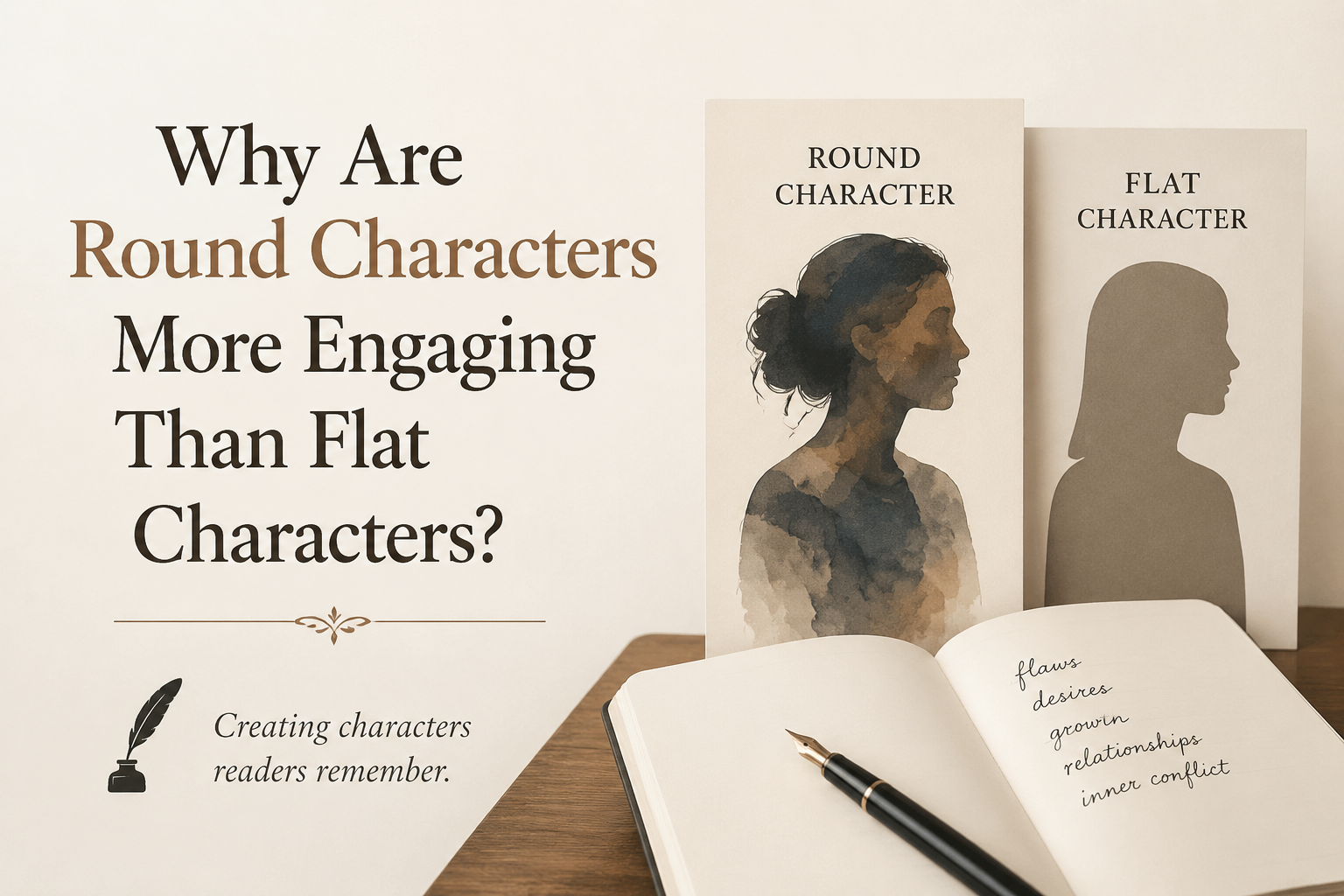
Why are round characters more engaging than flat characters? Round characters give your reader a working model of the human mind, not a cardboard cutout that only exists to push the plot. When your protagonist surprises themselves, rationalizes a bad choice, or wants two incompatible things at once, you create the kind of tension that makes a reader keep turning pages, even when nothing is exploding.
If you have ever gotten feedback like “I couldn’t connect,” “I didn’t care,” or the brutal classic “cool premise, but I drifted,” you are usually looking at a character problem that plot cannot fix. You can tighten scenes, sharpen dialogue, and polish prose, and the book will still feel hollow if your cast moves like chess pieces.
I am going to be direct about what actually changes reader engagement. It is not the number of quirks or the size of your backstory file. The reader senses that your character makes choices for reasons, pays for those choices, and would still exist if the plot stopped chasing them.
Table of Contents
Engagement Lives In Prediction and Surprise
When a reader is engaged, they are doing two things at once. They are predicting what your character will do next, and they are watching to see if they are right. Round characters feed that loop because they are consistent enough to be legible and complex enough to stay interesting.
Flat characters break the loop. If the “jealous ex” exists only to be jealous, the reader can predict every move with zero risk. If the “wise mentor” exists only to dispense wisdom, every scene becomes a vending machine. That is not suspense. That is waiting.
Readable Motives
A round character has motives you can name in a single sentence, even if the character would never admit them. They want approval, safety, to be seen as competent, revenge, or to believe they are a good person. Those motives create patterns, and patterns create predictability.
If you cannot state what your character wants in plain language, your reader cannot predict anything. When that happens, they stop investing because the story starts to feel random.
Competing Desires
The fastest way to add depth is to give your character two wants that cannot both win. They want love, control, freedom, belonging, honesty, or to avoid consequences. This conflict is internal plot, and internal plot is where engagement gets sticky.
I recommend you write one sentence that starts with “They want X, but they also want Y.” Then make at least three scene choices flow from that conflict, not from the external situation.
Small Betrayals of the Reader’s Expectation
Roundness shows up as micro-surprises that still feel inevitable in hindsight. For example, the pacifist throws the first punch because their kid is threatened. The disciplined leader lies to protect their reputation. The flirt backs away when it gets real. This type of surprise works because you have already seeded the values and fear underneath.
A flat character can only surprise by being inconsistent, and inconsistency reads as author manipulation. Your reader notices, even if they cannot articulate it.

Round Characters Create Meaningful Stakes
Plot stakes are easy to announce. For example, “The bomb will go off” and “the kingdom will fall” are straightforward. Emotional stakes are harder, and they are the ones that turn a competent story into a book a reader recommends to a friend at midnight.
Round characters create emotional stakes because they can lose in more than one way. They can fail externally and still win internally, or succeed externally and feel ruined. That tension is why readers argue about endings and keep thinking about your book after the last page.
Consequences That Land
A flat character can lose a job or a fight, but it does not register as cost if the character does not change, resist change, or understand the loss. Round characters have identities. When you threaten identity, consequences land.
Think in terms of “status,” “self-image,” and “belonging.” If the heroine is terrified of being seen as ordinary, winning the tournament and being called lucky can hurt more than losing the trophy. That is not melodrama. That is a recognizable human bruise.
Reader Empathy Runs On Specificity
Empathy does not come from generic goodness. It comes from specificity. For example, a character who always does the right thing is hard to feel. A character who makes a defensible bad choice is easy to recognize, even when you dislike them.
Psychologist Paul Bloom argues that empathy tends to be narrow and spotlighted rather than evenly distributed, which is one reason specificity matters so much for drawing a reader into one mind at a time. How should that help you?
I recommend you stop writing “they are kind” and start writing the kind of kindness they practice. Are they kind as a way to avoid conflict? Are they kind because they feel guilty? Are they kind because they cannot stand to see discomfort? Each version creates different story pressure.
Flat Characters Are Tools, Round Characters Are Engines
You do not need every character to be round. You need the right characters to be round. Flat characters can be functional, even helpful, when they exist to frame contrast, deliver information, or represent a clear social force. The problem is when your protagonist, antagonist, or love interest is flat. Then the story has no engine.
The engine is the character’s decision-making under pressure. A round character makes decisions that produce plot. A flat character waits for plot to happen to them, or they do the one predictable thing on cue.
When Flat Works
In genre fiction, flat side characters often work as clean signals. The strict headmaster. The crooked cop. The cheerful barista who hands over the clue. If you round every minor role, you bloat the cast and slow the book down.
Rather than swear off flat characters, use these characters intentionally. A purposeful flat character acts like a road sign. The reader reads it once, understands the function, and keeps moving.
Where Authors Get Tricked
The trap is mistaking “detailed” for “round.” A ten-page backstory does not equal depth if it never changes choices on the page. Quirks do not equal depth either. Your assassin can love pastries and still be flat if every scene choice is “be an assassin.”
If you want a quick diagnostic, look at three big moments and ask, “Could any competent person have made this choice?” If the answer is yes every time, you have written a role, not a person.
Antagonists Need Roundness Too
A flat villain is a convenience. A round antagonist is a pressure system that keeps generating trouble. Readers engage harder when they can see why the antagonist thinks they are right, even when the antagonist is doing ugly things.
For moral psychology support on how people justify their own actions as right, Jonathan Haidt’s “rider and elephant” model is a useful lens. Haidt lays the broader argument in his book “The Righteous Mind.” Use the idea to build self-justifications that sound plausible inside the antagonist’s head.
Roundness Is Built Through Choice, Not Description
If you want round characters, stop trying to describe your way into depth. Depth shows up through decisions under constraints. Description tells me what you want me to think. Choice shows me how the character thinks.
This is where many drafts fail. The author writes an “about” paragraph in chapter one, then writes the character as generic for the next 300 pages. Readers do not bond with résumés. They bond with patterns of action.
Constraints That Force Trade-Offs
Real people are interesting because they cannot have everything. Give your character constraints that force them to sacrifice something they value. This includes time pressure, financial pressure, social pressure, loyalty, physical limitation, professional ethics, and family obligation. Constraints turn personality into plot.
I recommend you list three constraints that will keep showing up in your story world, then attach at least two of them to your protagonist in a way they cannot escape. It can be a debt, a public reputation, a promise, a chronic injury, or a dependent sibling. Then write scenes where the constraint makes the “right” choice expensive.
Revealed Values Under Stress
Values are invisible until something threatens them. For example, a character who claims to value honesty but lies to avoid humiliation is suddenly three-dimensional. On the other hand, a character who says they do not care about status but melts down when ignored is suddenly real.
If you want to design this cleanly, use the idea of “sacred values” from behavioral research, which explores how some values resist trade-offs and can drive extreme reactions. Scott Atran and Jeremy Ginges discuss this line of work in “Religious and Sacred Imperatives in Human Conflict.” You do not need to write extremists to use the concept. You can decide what your character treats as non-negotiable, then test it.
Contradictions With a Spine
Contradictions create depth when they share a root. For example, a character who is generous to friends and ruthless to strangers might be obsessed with loyalty. Meanwhile, a character who is brave in public and cowardly in private might be addicted to admiration. The spine is the underlying need.
Write the contradiction, then write the spine in one plain sentence. If the spine feels vague, you are still in trait-land. Push until it is a need that can be threatened in a scene.
Round Characters Improve Read-Through and Word of Mouth
As an author, you do not only want a reader to finish book one. You want them to buy book two, leave a review, and tell a friend. Round characters are among the most reliable drivers of that behavior because they form relationships, and relationships drive return visits.
When you look at reader discussions on Goodreads or BookTok, they rarely talk about your subplot architecture. They talk about who they “miss,” who made them angry, who they defend, and who they cannot stop thinking about. Flat characters do not get missed.
Series Momentum
A series sells because of familiarity plus change. Round characters give you both. You can carry a cast across multiple books while still generating fresh conflict because the internal tensions keep evolving with new experiences.
If your series stalls, I often find the cause in character stasis. The protagonist keeps winning the same way. The love interest keeps having the same fight. The sidekick keeps making the same joke. Readers feel the loop and drop off.
Marketing Copy Gets Easier
Here is a practical publishing truth. A strong character concept writes your blurb for you. When you can state who the character is, what they want, and what it will cost them, you can write back-cover copy that creates clean curiosity.
This is also where tools help. If you use Adazing, I would start with QuickWrite when you are drafting character decision scenes, then use a name generator to remove the friction of placeholder names that make characters feel generic longer than they should. Tools do not replace craft, but they reduce the tiny delays that keep you from writing the scenes where roundness actually appears.
A Simple Reader Test
If you want to know whether you have written a round character, ask a beta reader two questions. “What does this character want most?” and “What lie do they tell themselves?” If the reader cannot answer, you have work to do. If they answer in a way you did not consciously write but you recognize as true, you are close.
I recommend you run this test before you pay for line editing. A line editor can polish a flat character into a beautifully written flat character, and that is an expensive way to stay stuck.
FAQs for Why Are Round Characters More Engaging Than Flat Characters?
Do I need round characters in every genre?
You need them wherever the book asks the reader to invest in a person over time, which is most genres. In some fast, plot-forward niches, you can get away with simpler leads for a while, but even there, a character with a clear internal conflict lifts the whole book. If you are writing a series, roundness matters more because it fuels read-through.
How do I make a character round without slowing the pacing?
You build roundness through choices that already move the plot. Give the character a decision with a trade-off, then let the decision create the next complication. You do not need extra introspection chapters. You need one or two lines that reveal the motive behind the action, and then consequences that touch identity, not only logistics.
What is the fastest revision that adds roundness?
Pick three major scenes and rewrite the decision point in each so the character sacrifices something they value. Then add one later scene where the sacrifice comes due. This revision works because it creates a pattern the reader can track, and patterns are what make a character feel like a real mind.
A Reader Stays For A Person, Not A Premise
Premise gets the click. A round character earns the late-night binge and the pre-order. If you want your book to feel alive, build characters who want something specific, protect something non-negotiable, and make choices that cost them.
If you do that, your plot stops feeling like a sequence of events and starts feeling like a set of consequences. That is the engagement your reader cannot fake, and it is the kind that sells books long after launch week.
