
What is urban fantasy? Urban fantasy earns its keep because it lets you steal the reader’s real world and then bend it without needing a 30-page atlas. If you’re writing, marketing, or simply reading with your craft brain switched on, urban fantasy is one of the cleanest demonstrations of how to build an immersive story fast while keeping stakes intimate and personal.
Most genre explanations stop at ‘magic in a modern city’ and call it a day. As an author, you need a tighter definition than that because your cover, blurb, categories, and comps depend on it. When you get the subgenre wrong, you do not get an artistic misfire; you get a sales page mismatch.
Learn what urban fantasy really is, what readers expect on page one, and how to use the genre’s strengths to sharpen your own writing and packaging choices.
Table of Contents
Urban Fantasy Defined by Setting, Voice, and Problem Type
Urban fantasy is fantasy that takes place in a recognizable contemporary world, then introduces the fantastic as a pressure on everyday life. The setting is usually a city or dense community, but what matters more is the proximity of the magical to the mundane. The story keeps one foot on the sidewalk.
That definition sounds broad until you add what actually separates it from neighboring genres. For example, epic fantasy externalizes how the world shifts and asks you to track nations, bloodlines, prophecies, and maps. Paranormal romance often centers the romantic arc as the spine and uses the supernatural as a relationship engine. Meanwhile, urban fantasy usually centers a problem you can feel in the character’s day-to-day life: a body in an alley, a curse in a family line, a supernatural turf war that spills into the protagonist’s rent and friendships.
Contemporary Reality as a Contract
Urban fantasy works because readers bring the world model with them. You do not have to explain what a parking ticket is, how a bar feels at 1 a.m., or why a missing person poster catches your eye. That shared context buys you pacing. As a writer, you can spend your exposition budget on the weird parts that matter.
The practical move is simple: when you draft your opening, list ten ordinary details your viewpoint character notices before anything magical happens. Choose details that reveal personality and socioeconomic reality, then let the supernatural disturb that baseline. Your reader believes the magic because they believed the bus schedule.
Voice and Attitude as Genre Signals
A lot of urban fantasy leans on a close, grounded voice that can stand next to the supernatural without sounding like a tour guide. Snark is common but not required. What is required is presence. For example, the protagonist is not floating above the city. They are late, tired, and carrying responsibilities when the vampire shows up.
If your narration drifts into distant mythic language, readers may file you closer to high fantasy even if the story is set in Chicago. That classification affects expectations around pacing, romance weight, and how much lore you need to pay off.
The Problem Type That Keeps Pages Turning
Urban fantasy problems are often investigative or confrontational in shape. Someone is missing, something is feeding, a treaty is broken, or a supernatural rule is being enforced in the real world. The protagonist’s job, unofficial or literal, is to go toward the mess.
To test whether your story reads as urban fantasy, write a one-sentence logline that includes a concrete modern constraint. ‘She has to solve the murder before rent is due’ is closer to the genre than ‘She must defeat ancient evil.’ The second can work, but the first tells the reader where they are standing.

Where Urban Fantasy Came From and Why It Still Sells
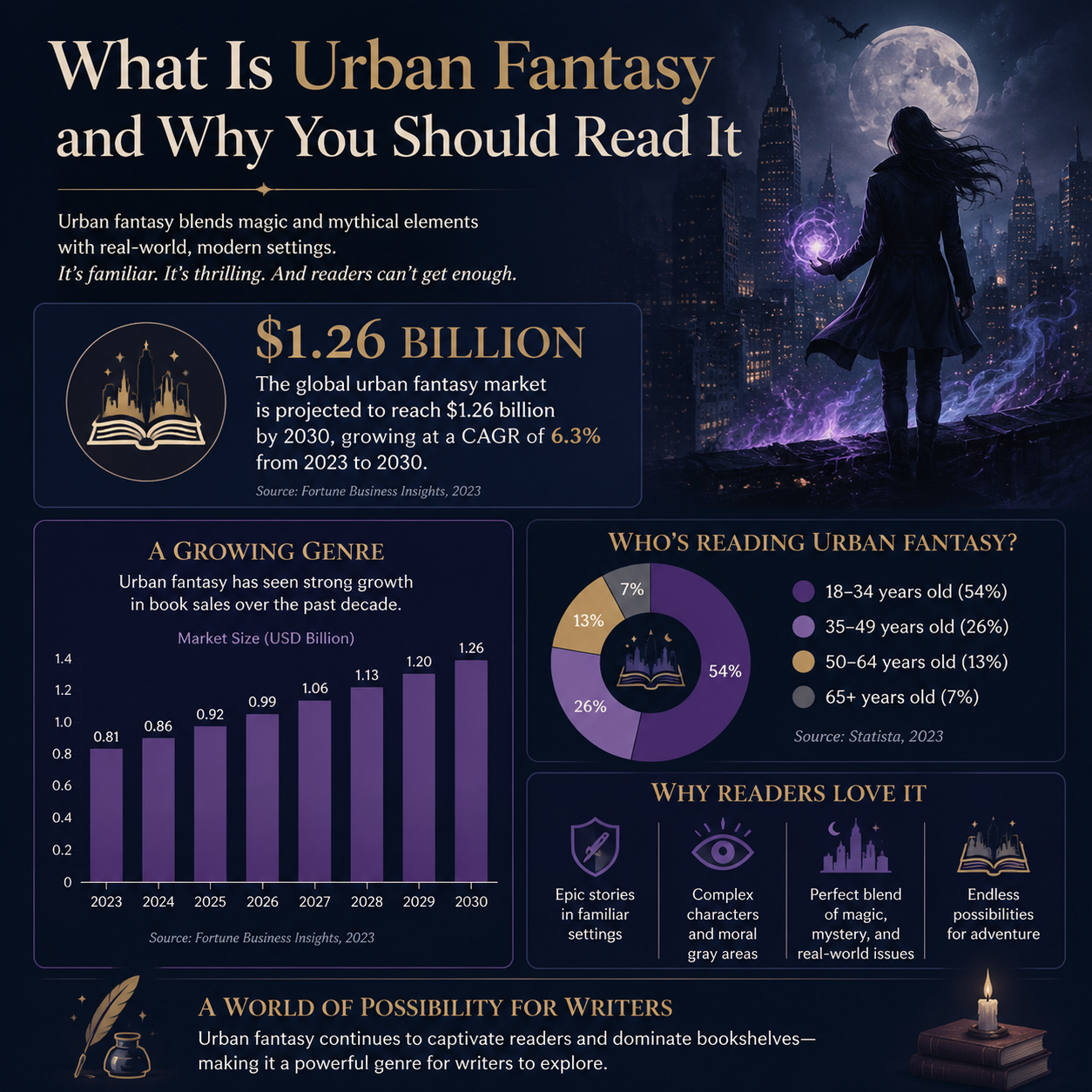
Urban fantasy feels modern, but it sits on older bones. Folklore has always placed the uncanny next to the familiar. The contemporary subgenre took off when authors began treating the modern city as a myth engine. The reason it keeps selling is even simpler: it delivers escapism without asking the reader to learn a new operating system.
Publishers and retailers also treat urban fantasy as a dependable browsing experience because it has recognizable packaging signals. That matters to you as an author because discoverability is visual and categorical long before it is literary.
Cities as Myth Machines
Modern cities already contain hidden corridors, private security, underground economies, and neighborhoods with their own rules. Urban fantasy uses that real complexity as camouflage for the supernatural. You can write fae politics into zoning disputes, and it does not feel forced, because cities already run on invisible agreements.
When you plan a series, map the human institutions first: police, hospitals, local government, property management, social services, nightlife. Then decide where the magical layer touches each institution. Your setting starts generating plot for you.
Reader Habits and Series Momentum
Urban fantasy has strong series culture. Readers tend to binge, and binge behavior is where indie authors make consistent money through read-through and backlist depth. Written Word Media’s analysis of reader trends has repeatedly emphasized that series perform well in digital markets because they help readers stick with an author after book one, spreading your marketing cost across multiple purchases. You can see their framing in Written Word Media’s guide to promoting your series.
That does not mean every urban fantasy must be a 12-book saga. It does mean you should design book one to answer one big problem while leaving the larger ecosystem unresolved. If you cannot name your book one ‘case’ or central conflict in a phrase, the series hook is probably mushy.
Market Labels and Shelf Logic
Retailers sort to help readers buy. For example, Amazon categories, Goodreads shelves, and ad targeting all reward clarity. Urban fantasy sits near paranormal romance, contemporary fantasy, and sometimes supernatural thrillers, so you need to pick the lane you actually wrote and then package for that lane.
A concrete exercise that saves you months: pull the top 100 in your likely categories on Amazon and note three things for the top 20. Track cover color families, typography weight, and the ratio of solo figure covers to symbolic covers. Do the same for blurbs, especially how fast they introduce the protagonist and the inciting trouble. When you see the pattern, you stop guessing.
Reader Expectations You Need to Hit on Page One
Urban fantasy readers are generous about impossibility and picky about momentum. They will accept a talking raven if the scene moves and the character feels real. They will not forgive a slow, self-indulgent opening that delays the first disturbance in the normal world.
When I edit urban fantasy drafts, the recurring issue is delayed genre proof. The author knows there is magic coming, but the reader has no reason to trust that promise yet. Your first chapters have to signal the subgenre and the protagonist’s relationship to the supernatural, even if you hold back the full reveal.
The Opening Disturbance
You need a concrete disturbance in the first chapter or very early in the second. That disturbance can be direct magic, a supernatural consequence, or a mystery that points to the uncanny. The point is to stop the book from reading like general contemporary fiction with a fantasy twist that might show up later.
Write your first chapter and highlight every paragraph that is pure status quo. If the whole chapter is yellow, cut it in half. Then add one specific supernatural or uncanny detail that changes how the protagonist must act, even if they rationalize it away.
A Competent, Burdened Protagonist
The classic urban fantasy lead is competent in a narrow way and carries human burdens. They may be a private investigator, a bartender who knows the supernatural clientele, a witch who pays taxes, or a medic who has seen too much. Readers want someone who can take action. They also want that capability to come at a personal cost.
If your protagonist is passive for the first 30 pages, you are borrowing tension against future earnings. Give them an active goal in scene one, then let the supernatural interfere with that goal.
Rules That Feel Enforced
Urban fantasy does not require hard magic, but it does require consequences. When magic happens, something changes. A debt comes due, a ward burns out, or a secret gets harder to keep. Without a cost, your story reads like a sequence of cool moments rather than a system that pressures the character.
Draft a one-page ‘rule sheet’ for yourself. Include three costs for using magic and three limits on supernatural beings. You do not need to show the sheet to the reader. You keep it so your plot cannot cheat.
What Urban Fantasy Can Teach You About Craft
Even if you never plan to write urban fantasy, reading it as a writer is a masterclass in efficient storytelling. The genre rewards clean scene goals, strong voice, and fast contextualization. It also punishes wandering subplots because the promise is immediate conflict in a world that looks like yours.
I often recommend urban fantasy to authors who struggle with slow starts or overbuilt lore. The subgenre gives you permission to stop explaining and start dramatizing.
Fast Worldbuilding Without Exposition Dumps
Because the baseline world is familiar, urban fantasy worldbuilding happens through contrast. A normal coffee shop becomes a safe house, a city park becomes contested ground, and a mundane office job becomes a cover identity. The reader learns through action.
Try this on a revision pass: cut any paragraph that explains supernatural society in general terms and replace it with a scene where a rule is enforced. Instead of telling me that vampires cannot enter uninvited, show the protagonist watching a vampire negotiate a threshold while someone bleeds on the doorstep.
Scene Structure That Actually Moves
Urban fantasy scenes tend to have a clear goal, a clear obstacle, and a clear change at the end. That is basic craft, but the genre makes it obvious because it runs on propulsion. You can feel when a scene is decorative.
After each scene, answer three questions in one sentence each. What did the protagonist want, what stopped them, and what changed? If you cannot answer, the scene is probably a mood interlude wearing a trench coat.
Voice as a Marketing Asset
In urban fantasy, voice carries brand. Readers follow a character across cases and books because they like being in that head. That matters for you commercially because it increases read-through and makes ads cheaper when book two and three convert well.
Write a 300-word sample in your protagonist’s voice that has zero plot. Let them describe their kitchen, their weapon, their neighbor, or their hangover. If you cannot keep it engaging without events, your voice may be underpowered. Fixing that early pays you back across every book you write.
Why You Should Read Urban Fantasy as a Working Writer
You should read urban fantasy because it hands you tools you can reuse. It teaches you how to build a story engine, merge the familiar with the strange, and package a promise so the right reader buys and stays happy.
Even better, it is a genre where craft, marketing, and reader psychology meet in plain sight. The covers telegraph tone. The blurbs declare the problem fast. The series structure is visible. You can reverse-engineer it.
Studying Covers, Blurbs, and Category Placement
Do not read only for pleasure. Screenshot covers that stop your thumb and then ask why. Is it the silhouette, the color contrast, the urban skyline, the magical glow, the typography, the weapon, the posture? Urban fantasy covers often rely on a central figure with attitude, a city texture, and a single supernatural cue. That visual shorthand is a promise of pace and tone.
If you design your own covers, Adazing’s cover maker can help you prototype multiple directions fast so you can run a thumbnail test before you commit. Your goal is recognition at phone size, because most readers are browsing in an app, not admiring your art full-screen.
Using Urban Fantasy to Fix Your Draft
When your draft feels slow, read the first 10 percent of three successful urban fantasy novels in your target lane and outline what happens on each page. Track how soon the protagonist’s problem becomes unavoidable. Notice how often the author anchors the scene with a concrete place detail before the supernatural enters.
Then revise your opening to match the tempo without copying the content. You are borrowing cadence and clarity, not plot.
Building Your Own Story Engine
Urban fantasy series often run on a repeating engine: case of the book, evolving personal stakes, and an expanding supernatural network. You can adapt that structure to other genres. Mystery, romance, thriller, even cozy fantasy benefit from the same mechanical reliability.
Sketch your engine in five lines: protagonist role, recurring setting, recurring threat type, personal vulnerability, and the long arc question. If you cannot write those lines, your series may be built on vibes rather than a machine that produces books.
When you get stuck naming factions, neighborhoods, or supernatural groups, I like using tools that keep me drafting instead of spiraling. Adazing has name generators that are useful for this, and QuickWrite is handy when you want to push through a scene without second-guessing every sentence.
FAQs for What Is Urban Fantasy and Why You Should Read It
What is the difference between urban fantasy and paranormal romance?
The cleanest difference is spine. Paranormal romance typically puts the romantic relationship as the primary arc, with the external plot supporting it. Meanwhile, urban fantasy usually places an external problem or investigation as the primary arc and treats romance as a secondary thread. There are hybrids, so I look at what the book resolves at the end. If the emotional commitment is the payoff, you are closer to paranormal romance. If the case or threat is the payoff and the romance continues unresolved, you are closer to urban fantasy.
Does urban fantasy have to be set in a big city?
No. The ‘urban’ label points to contemporary life and dense social systems more than skyscrapers. Small towns, college campuses, and suburbs can work if the story holds modern baseline and weaves the supernatural into daily routines and institutions. If your setting feels isolated and the story depends on invented geography, you are drifting toward contemporary fantasy with a secondary-world feel.
How do I choose comp titles for an urban fantasy book?
I choose comps by matching reader experience, not by matching supernatural species. Pick books with similar tone, protagonist role, romance weight, and heat level, then check that they sit near your intended categories on Amazon and Goodreads. You can confirm your instincts by looking at also-boughts and ad targeting options, then adjust your comps to reflect how readers actually shop.
Reading Urban Fantasy With Your Writer Brain On
Urban fantasy rewards craft that is visible on the page: fast orientation, a protagonist who acts, and magic that costs something. Read a handful in your lane and study how they prove the genre early, how they keep scenes turning, and how they package the promise on the cover and in the blurb.
If you do that work, you will not only enjoy the books. You will steal techniques you can use in your next draft, and you will package your own book so the right reader finds it and trusts it.
