
What is women’s fiction? Calling a book women’s fiction is a promise to the reader that the story will track a woman’s interior life as seriously as the external plot. If you treat it as a vague label for “books women like,” your marketing will wobble, and your manuscript will often drift into another shelf entirely.
I’ve seen this genre sell brilliantly when the author commits to what it really is: character change under pressure, shaped by relationships, identity, work, family, community, and the cost of becoming someone new. It fails when the book tries to be a romance, a thriller, and a coming-of-age all at once, then wonders why readers and algorithms look confused.
If you’re writing and publishing, the stakes are practical. Your category and blurb control who clicks, your cover controls who even reads the blurb, and your first chapters decide whether that click turns into a page-turn. Get the genre promise right, and you buy yourself a clean path through Amazon categories, comp titles, also-boughts, and reader expectations.
Table of Contents
Women’s Fiction as a Reader Promise
Women’s fiction centers a woman’s emotional journey and personal transformation. The plot matters, sometimes a lot, but the emotional arc is the spine. The reader comes for the lived-in interiority, the complicated choices, and the consequences that ripple through relationships and self-concept.
That definition sounds simple until you try to position a book that has romance, suspense, grief, motherhood, career stakes, or a small-town secret. Those ingredients are common here, but they function differently than they do in neighboring genres.
What Must Be Central On The Page
I look for three craft signals when I’m diagnosing whether a manuscript belongs in women’s fiction.
First, the protagonist’s internal conflict is sustained and specific. It has a shape you can summarize in one line, like “she believes she has to be indispensable to be loved,” or “she built a life around being the responsible one, and it’s killing her.”
Second, the story delivers earned change. That does not mean a makeover, a new boyfriend, or a new zip code. It means the protagonist makes different choices by the end because she understands something she could not face earlier, with the book showing the cost of learning it.
Third, relationships are written as systems, not props. Friends, sisters, mothers, partners, coworkers, and kids are not there to dispense advice or trigger a plot beat. They are mirrors and pressure points that push the protagonist to renegotiate her sense of self.
What Readers Expect You To Deliver
Women’s fiction readers usually want emotional authenticity over spectacle. When you give them a dramatic event, they still expect the aftermath to feel real. Grief lingers; resentment doesn’t evaporate in one heart-to-heart, and a reconciliation without real repair reads as author convenience.
These readers also notice when the book talks down to them. If your narration “explains” the lesson, you flatten the experience. Let the scenes do the work. For example, a woman choosing boundaries for the first time is more convincing when it costs her something on the page.
A Fast Shelf Test For Your Draft
Ask yourself what the book would still be about if you removed the biggest external event. If the answer is still a coherent emotional journey, you are probably in women’s fiction territory. If the book collapses because the chase, the murder, or the romance plot is the whole engine, you are likely writing suspense, mystery, or romance with a strong character thread.

Women’s Fiction Versus Romance, Thriller, and Literary
Genre boundaries are not moral boundaries. They are sorting tools. They tell the reader how to judge your ending, your pacing, and your focus. You can blend genres, but you cannot blur the promise you’re selling.
Women’s Fiction Versus Romance
Romance has a structural requirement: the central love story must end with an HEA (happily ever after) or HFN (happy for now). If your book spends equal narrative weight on a love story and the protagonist’s personal change, it may be romantic women’s fiction, but the ending promise still matters.
If your ending is ambiguous, bittersweet, or focused on selfhood over couplehood, you are describing women’s fiction more than romance. You can still include a love interest, even a sweeping one. The question is which relationship is the book’s primary engine, and what kind of ending your target reader will feel rewarded by.
Trade-off you should accept: romance readers can be fierce and loyal, but they also punish broken promises. I’d rather you market as women’s fiction and lose a few romance clicks than market as romance and collect one-star reviews for an ending that was never meant to be an HEA.
Women’s Fiction Versus Thriller and Mystery
Thrillers and mysteries are plot-first by contract. The reader wants momentum, danger, and a satisfying resolution to the core question. Meanwhile, women’s fiction can absolutely include a secret, a crime, or a threat, but the pacing tends to breathe more, and the emotional processing takes up more space.
A useful diagnostic is scene purpose. In a thriller, many scenes either increase danger or reveal information. In women’s fiction, many scenes increase understanding, complicate relationships, or force a choice that reshapes identity.
If you are blending, decide where you want reader patience. Thriller readers tolerate less introspection before they start skimming. Women’s fiction readers tolerate less “chase scene filler” before they start wondering why the emotional thread vanished.
Women’s Fiction Versus Literary Fiction
Literary fiction is less about content and more about emphasis: language, thematic density, ambiguity, and experimentation often take precedence over clean commercial beats. Meanwhile, women’s fiction can be beautifully written and theme-rich. It also generally prioritizes a more accessible reading experience and a clearer emotional payoff.
There is overlap, and the industry sometimes uses women’s fiction as a catch-all for literary work by women, which is a real frustration. Your job as an author-publisher is to choose the shelf that matches your reader’s buying behavior, not the shelf that feels most flattering.
Common Themes and Story Engines That Work
Women’s fiction runs on recognizable pressures, even when the setting is heightened. The emotional engine usually comes from a tension between who the protagonist has been trained to be and who she can become.
Identity Shifts With Visible Consequences
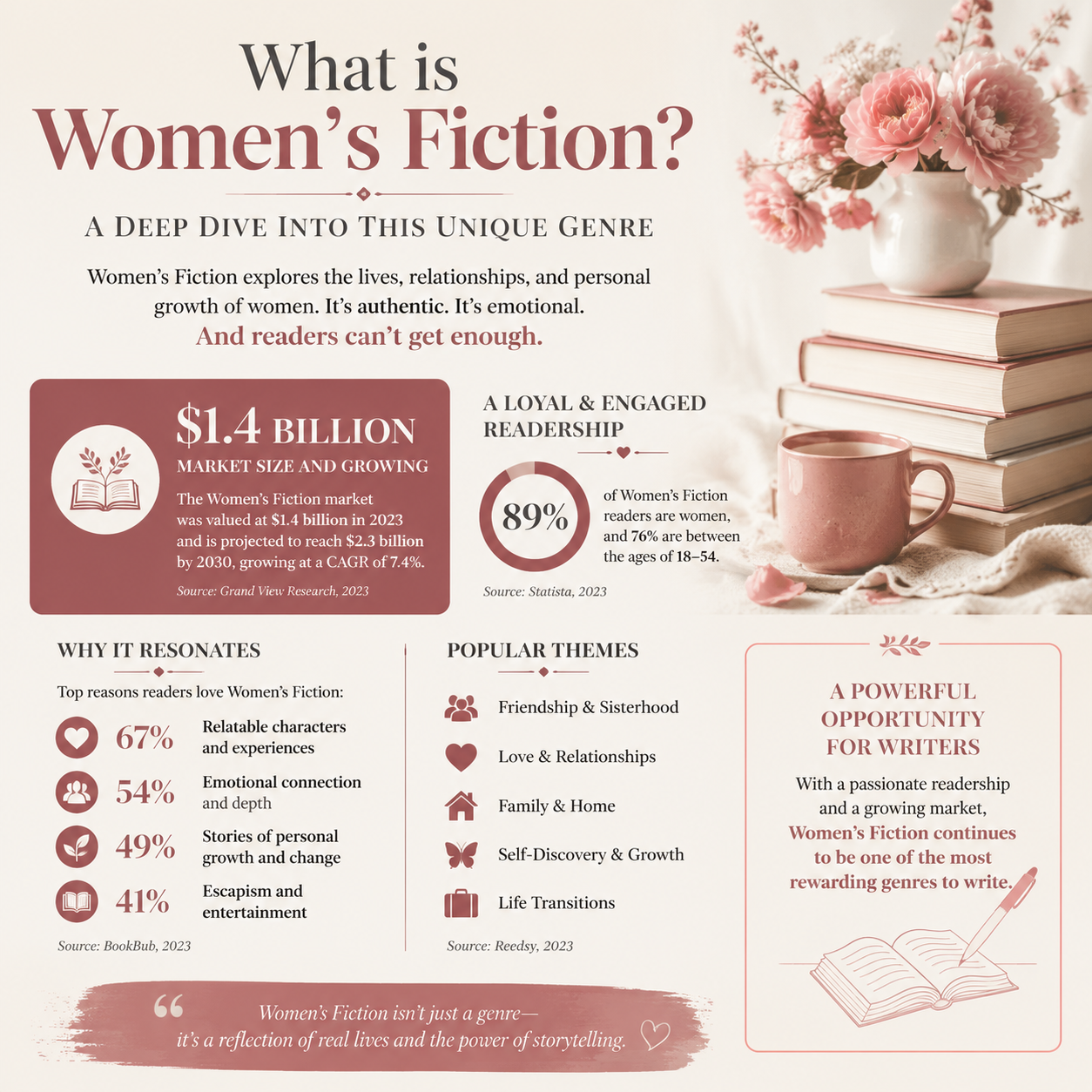
Career reinvention, motherhood, divorce, caregiving, empty nest, grief, immigration, recovery, late diagnosis, returning home, and starting over after a public mistake are among the many identity disruptions that force decisions.
On the page, you earn that disruption by making it specific. For example, “She’s burned out” is vague. “She is a nurse who cannot sleep without checking her phone, and she’s started fantasizing about getting fired so she can stop choosing” is a story.
Relationships as the Battleground
In women’s fiction, the relationship map usually spans more than one axis as the protagonist faces multiple obligations and loyalties. For example, a mother wants her daughter close, a best friend expects the old version of her, a partner benefits from her self-erasure, and a community that rewards compliance.
If you want the book to feel full without feeling busy, build a small set of relationships where each one tests a different belief. I often outline this like a craft grid: “Who rewards her mask, who punishes it, who sees through it, who needs it?” Then I write scenes that force collisions.
Settings That Reinforce the Emotional Arc
Place matters here, but not as wallpaper. For example, a small town can squeeze. A family home can trap. A city can anonymize. Pick setting elements that create recurring friction and use them repeatedly so the reader feels the pressure build.
This is also where you can be smart about comps and market cues. Book clubs and readers who love “found family” and community arcs often respond to setting-driven women’s fiction. If you want a strong book club angle, aim for a premise that naturally produces discussion questions about choice, responsibility, and selfhood.
How to Position Women’s Fiction So Readers Click
You can write a strong book and still lose the sale if the packaging tells the wrong story. Positioning is where a lot of talented authors accidentally sabotage themselves, especially in women’s fiction, where covers and blurbs do a ton of genre signaling.
Categories, Keywords, and Comp Titles
On Amazon, your categories and keyword choices influence who sees you and what your book is compared against. I like to start with comp titles, then work backward into categories. Choose recent books that share your emotional engine and tone, not just your setting or demographic.
When you pick comps, study their blurbs and reviews. The reviews tell you what the reader thinks the book “really” is. If reviewers keep praising the love story as the main draw, that comp leans romance. If they keep talking about a twisty reveal, that comp leans suspense. If they talk about “I felt seen,” that’s the women’s fiction lane.
For a grounded look at how Amazon’s category system works, I point authors to Amazon KDP’s guide to categories. It’s not glamorous reading, but it keeps your expectations realistic.
Cover Signals That Match the Shelf
Your cover is your fastest genre promise. Women’s fiction covers often lean toward illustrated figures, evocative landscapes, domestic detail, or bold type with warm palettes, depending on sub-genre and tone. For example, suspense-leaning women’s fiction will often darken the palette and tighten typography. Meanwhile, book club and contemporary women’s fiction often feels brighter and more human.
I’m blunt about this: if your cover reads romance at thumbnail size, romance readers will click, and women’s fiction readers may scroll past. Then your reviews punish you for the mismatch. Run a thumbnail test. Shrink your cover to Amazon search size, then ask a few genre-savvy readers which shelf they expect to see it.
If you need a fast way to iterate, Adazing’s cover maker is useful because you can test multiple typography and imagery directions without waiting weeks for a new concept. You still need taste and market awareness, but speed helps you find the right signal.
Blurb Copy That Sells the Emotional Arc
Women’s fiction blurbs work best when they combine an external situation with an internal stake. Tell the reader what changed in her life, then what that change threatens within her.
A strong pattern is: protagonist snapshot, disruption, choice, consequence. Keep it tight, keep names to a minimum, and end on a question that reflects the emotional decision the reader will care about.
If you want a credible data point on why this packaging work matters, Nielsen has reported for years that online discovery heavily depends on metadata and description quality. Their public-facing summaries vary by year, but Nielsen’s book and media insights are worth browsing when you need a reality check about how readers find books outside your existing audience.
Drafting and Revising Women’s Fiction With Intention
The most common problem I see in women’s fiction drafts is an emotional arc that exists as an idea but not as scene-level causality. The author can explain the protagonist’s change: the pages show a series of events where she mostly reacts, then “realizes” something near the end.
You fix that by building the change into decisions, not speeches.
Scene Work That Builds Transformation
I like a simple checkpoint for revision. In each major scene, identify what the protagonist wants, what fear or belief blocks her, and what small shift happens because of the conflict. If nothing changes, the scene often belongs in a different book, or it needs a sharper choice point.
Another reliable move is to plant “old self” behaviors early and then force them to fail. People do not transform because someone gives them good advice. They transform because their coping strategy stops working, and the story gives them no safe exit.
Voice, Interior Monologue, and Emotional Honesty
Women’s fiction leans heavily on close psychic distance, even in third person. Your reader wants to live inside the protagonist’s judgments, rationalizations, shame spirals, and little private triumphs. This is where specificity beats eloquence. Name the thought she would never say out loud.
If you lean on therapy-speak as a shortcut, the emotional texture turns flat. Real people rarely think in perfectly packaged insights when they’re under pressure. Let her be defensive. Let her be funny. Let her be wrong.
Pacing Without Losing the Reader
A slower pace can work, but it still needs forward pull. I usually recommend you track three threads across chapters: the external situation, the relationship tension, and the private belief that’s cracking. When one thread softens, another should tighten.
If you struggle with momentum, a drafting tool that keeps you moving can help. I built many of my own productivity around timed drafting and prompt-driven jumps when I get stuck. Tools like Adazing QuickWrite are useful because they reduce the friction between “I know what this scene needs” and “I’m staring at a blank page.” The craft still has to be yours, but the workflow matters.
For a broader reading trend you can cite, Pew Research Center’s survey on book reading offers a clean picture of how many adults report reading books and in what formats. It will not tell you how to write women’s fiction, but it will remind you that your reader is real and reachable when you package correctly.
FAQs for What is Women’s Fiction? A Deep Dive into This Unique Genre
Does women’s fiction have to be written by a woman?
No. The genre label describes what the book delivers to the reader, not the author’s identity. If you write women’s fiction as a man, your bar is the same as anyone else’s. You need convincing interiority, relationships that feel lived-in, and an emotional arc that lands without condescension or caricature. Use beta readers who actually buy and read women’s fiction, then listen when they tell you where the voice rings false.
Can women’s fiction include romance or a mystery plot?
Yes, and many successful books do. The decision comes down to your primary promise. If the love story must resolve happily to satisfy your target reader, position it as romance or romantic women’s fiction and respect the ending expectation. If the mystery plot is the main engine and the emotional arc rides alongside it, you may be closer to mystery or suspense with strong character focus. Package based on what a reader would tell a friend after finishing it.
How do I choose Amazon categories for women’s fiction?
Start with comps and reader expectations, then choose categories that align with tone and stakes. Browse the bestseller lists in the categories you’re considering and compare covers, blurbs, and pacing. If your book looks and reads like those books, you belong there. If it stands out as a different promise, adjust your packaging or pick a better-matching category. Amazon’s own documentation on KDP categories will keep you grounded on what you can control and what you cannot.
Where Women’s Fiction Wins for You as an Author
Women’s fiction gives you room to write about change with sharp teeth and a soft center, and readers reward that honesty when you package it clearly. Decide what transformation your protagonist must earn, build scenes where her old self stops working, and signal the right shelf through cover, categories, and blurb. When the promise is clean, you stop fighting your own marketing and start attracting the readers who already want what you wrote.
