
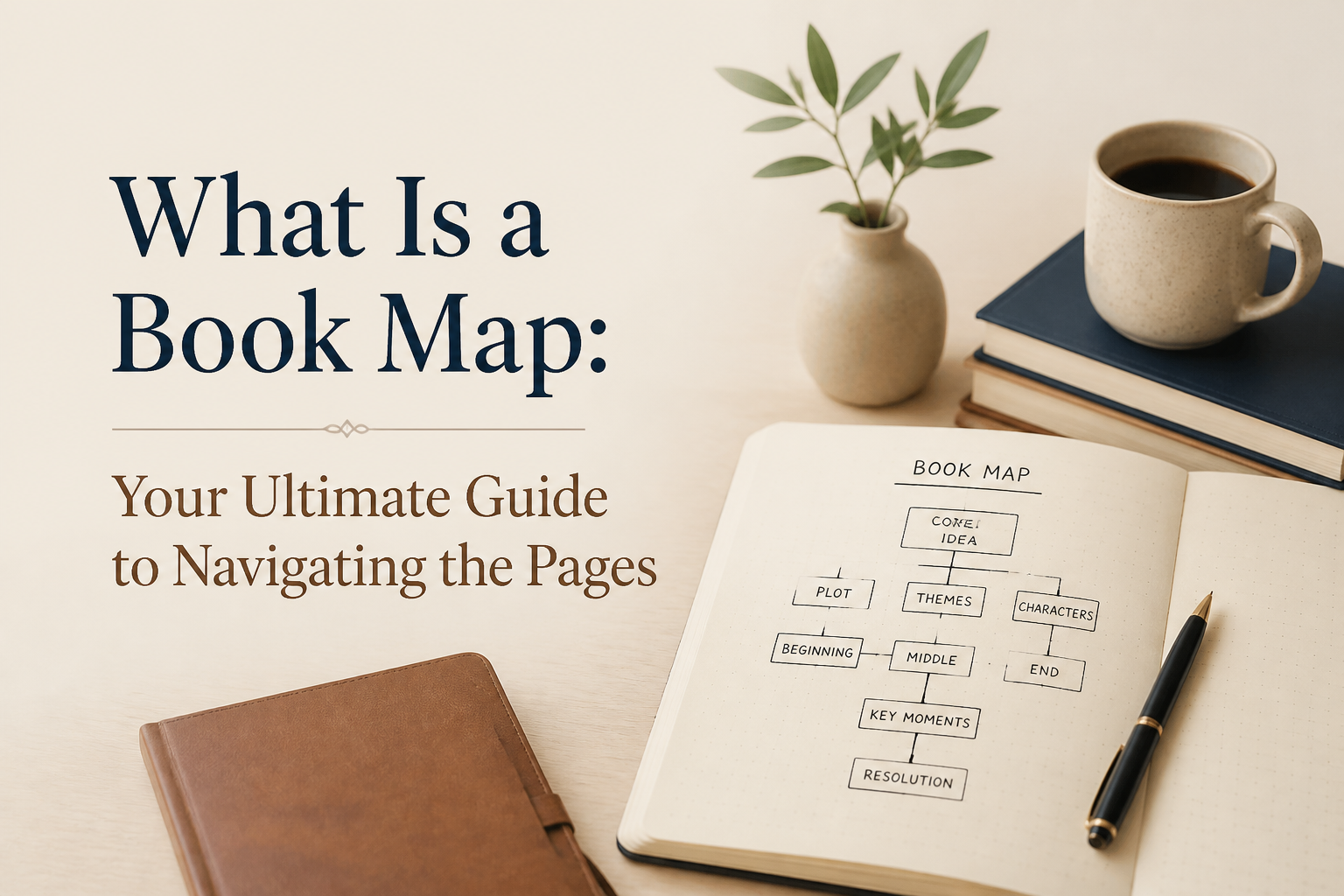
Before you revise another chapter, ask “What is a book map?” and whether your manuscript has one guiding it. A book map gives you a working view of the book’s structure, purpose, movement, and pressure points before you get lost in sentence-level edits.
Authors use the term in several ways. Some mean a chapter-by-chapter outline. Others mean a scene map, a nonfiction argument plan, or a visual chart that tracks characters and ideas across the manuscript. The format can change without altering the function. You need a record of what each part does and why the reader should keep turning pages.
I recommend creating a book map before the first serious revision. It exposes missing steps, repeated scenes, weak transitions, wandering subplots, and chapters that exist because you wrote them before you understood the book. A map also gives you a practical brief for your cover copy, table of contents, launch messaging, and reader promise.
Table of Contents
What A Book Map Does
A book map turns a long manuscript into a set of visible decisions. You can see the order of chapters, the movement of information, the rise and fall of tension, and the connection between the opening promise and the final payoff.
An outline usually tells you what you plan to write. A book map can describe the manuscript you already have, the manuscript you intend to build, or both. That distinction matters during revision. For example, a planned outline may look elegant because it contains no failed chapters. A map of the draft shows every detour, gap, and overloaded section you need to address.
A Structural View Of The Manuscript
Think of the map as a control panel for the book. Each chapter receives a short entry with its purpose, major events or claims, emotional effect, and relationship to the surrounding chapters. You do not need a beautiful diagram. A spreadsheet, index cards, or a plain document can do the job.
For example, in a mystery, the map might track the clue introduced in each chapter, the investigator’s current theory, the reader’s knowledge, and the pressure applied to the suspect. A memoir map might follow the external event, the narrator’s understanding at that moment, and the reflection that connects the memory to the book’s larger question.
A Test Of The Reader Promise
Your book map should answer a difficult question for every chapter. What does the reader gain here that could not be delivered more effectively elsewhere? The answer may be a discovery, a reversal, a skill, a decision, a piece of evidence, or a change in the narrator’s perspective.
When several chapters have the same answer, the manuscript probably repeats itself. When a chapter has no clear answer, the material may belong in another section, a shorter passage, or a separate book. I see this problem often in nonfiction manuscripts in which the author has gathered excellent research and arranged the material in the order of discovery. Discovery order rarely creates the clearest reading experience.

The Parts Of A Useful Book Map
A useful map carries enough information to support decisions without becoming a second manuscript. I usually start with one row per chapter and add detail only where the structure needs investigation.
The Chapter Record
Give each chapter a number and a working title. Then write four short entries.
- Purpose: The work this chapter does for the book.
- Content: The main events, claims, examples, or discoveries.
- Movement: What changes between the chapter’s opening and its close.
- Handoff: The question, consequence, or promise that carries the reader onward.
Keep each entry to one or two sentences at first. Long descriptions usually hide uncertainty. When you cannot explain a chapter in a few clear lines, pause before polishing its prose and identify the chapter’s actual work.
The Questions Beneath The Plot
Fiction authors need more than a list of events. Add the viewpoint character, the immediate goal, the opposition, the cost of failure, and the new information revealed. Track the character’s internal shift as well. A scene may contain plenty of action and still leave the character in the same emotional position.
Pay attention to knowledge. Mark what the reader knows, what each major character knows, and where those knowledge sets change. Suspense often comes from controlled information. A book map makes accidental early reveals and late explanations much easier to spot.
The Argument Beneath The Chapters
For nonfiction, record the central claim, supporting evidence, reader benefit, and practical application for each chapter. Then identify the relationship between chapters. Does Chapter 4 depend on a concept from Chapter 2? Does Chapter 7 ask readers to act before you have given them the information or confidence required?
Use a simple evidence label such as example, research, case study, instruction, or reflection. A chapter filled with reflection may need a concrete example. A chapter packed with studies may need plain-language explanation of what those studies mean. Good nonfiction alternates between understanding and use.
Amazon KDP’s table of contents guidance distinguishes the visible HTML contents page from the Kindle Interactive TOC that appears in the device menu. Your map can support both versions by recording the final chapter titles early, then checking that the digital links and printed page references match the finished interior.
Book Maps For Fiction And Nonfiction
The same basic tool behaves differently across genres. For example, a romance map tracks emotional escalation and relationship milestones. A thriller map follows danger, information, and consequence. In a business book, the map covers the reader’s problem, the explanation, and the decision you want the reader to make. Start with the promises your genre makes, then map the evidence that fulfills them.
Fiction Maps And Scene Pressure
For fiction, I recommend adding a tension score from one to five for each scene. The number has no scientific authority. It gives you a visual pattern. If twenty scenes sit at the same level, the story may lack acceleration. If the final act drops after a strong midpoint, your ending needs examination.
Track setting, point of view, active characters, and unresolved threads. For example, a character who vanishes for 100 pages may require a reminder or a stronger reason for the absence. A subplot that receives three scenes in the opening act and none afterward creates a promise your ending has to address.
Try color-coding scenes by function. Blue can mark investigation, green can mark relationship development, and red can mark physical danger. The colors reveal imbalance at a glance. A thriller with a page full of red cards may exhaust the reader. A romance with long stretches of relationship talk and no external pressure may lose momentum.
Nonfiction Maps And Reader Progress
For nonfiction, map the reader’s starting knowledge and desired condition. Each chapter should move the reader across that distance. For example, a chapter on email marketing may define a list, explain permission, show a welcome sequence, and provide a draftable template. Those pieces create a usable progression.
Memoir needs its own care. A chronological map can preserve the order of events, yet chronology alone rarely supplies meaning. Add the question the narrator is trying to answer. Then mark where the present-day narrator interprets the past. The strongest memoir chapters usually contain a tension between what happened and what the narrator understands now.
Reference books and how-to books benefit from a second map for navigation. Record cross-references, glossary terms, worksheets, and repeated concepts. A reader who opens Chapter 9 first should find enough context to use the material without reading the entire manuscript in order.
How To Build Your Book Map
You can build a first map in an afternoon for a short book or a weekend for a long one. Set aside the manuscript’s polished language. The map needs decisions, not elegant sentences.
Start With The Existing Draft
Open a spreadsheet with columns for chapter, title, purpose, content, movement, open questions, and revision status. Read each chapter’s first and last page, then skim the middle for major turns. Record what the chapter currently does. Allow yourself to write an unflattering description such as “the author explains the same point again” or “the detective waits for information.” Precision will help you revise.
After mapping the chapters, read only the purpose column. The sequence should create a visible progression. In a novel, the protagonist’s choices should produce consequences that shape later choices. In nonfiction, each concept should prepare the reader for the next decision or skill.
Mark The Structural Problems
Use three marks during the second pass. Circle a chapter that repeats earlier material. Star a chapter that carries a major promise or turning point. Add a question mark beside a chapter whose purpose remains unclear. Then look for patterns rather than isolated flaws.
For example, a single slow chapter may need trimming. Four slow chapters in the same stretch suggest a pacing problem. One repeated concept may need a clearer explanation. Six repetitions point to a structural decision about where the concept belongs. Your map provides evidence for the size of the repair.
Create The Revision Version
Make a second copy of the map and describe the book you want after revision. Move chapters, combine scenes, divide overloaded sections, and write new material as a short note. Keep the original map beside it so you can compare intention with draft reality.
Do not revise every sentence in sequence simply because the manuscript begins on page one. Work in structural passes. Begin by repairing order and omission. Then address character motivation or argument logic. After that, revise scene rhythm, transitions, and prose. A polished paragraph still sits in the wrong chapter until you move it.
Using The Map Through Revision And Publication
Your book map remains useful after the structural revision. It becomes a reference document for editorial decisions and book marketing. The language you use to describe each chapter can reveal the book’s strongest promise in plain terms.
For your back-cover copy, study the map’s repeated tensions and outcomes. A synopsis reports the full sequence for an agent, editor, or publishing partner. A blurb selects the most compelling conflict and leaves room for curiosity. Your map helps you keep those jobs separate.
For a launch, pull out the questions each chapter answers. For example, a memoir chapter about caring for a parent may become a newsletter reflection. A craft chapter about dialogue can turn into a short teaching post, and a mystery’s setting details may guide social posts or reader-group discussion prompts. The source material already exists in the manuscript, so you can create promotion that sounds connected to the book.
Adazing tools can support parts of this process. I use a writing tool, such as QuickWrite, when a map reveals a thin scene or an underdeveloped explanation. A name or word generator can help when a character, place, or technical term still carries a placeholder. I treat those tools as drafting support. The map remains the editorial judgment that decides what belongs.
Before publication, compare the map with the final files. Check chapter titles, sequence, recurring names, glossary references, and table of contents entries. For an ebook, test every contents link on the actual file. For print, review page references after the interior layout has settled. A title change in Chapter 6 can create errors in the contents page, marketing copy, and reader guide.
Keep the map after publication. It can guide a workbook, companion volume, discussion guide, audiobook script, or revised edition. It also gives you a clean record of the book’s architecture when you return to the series months later.
FAQs for What is a Book Map: Your Ultimate Guide to Navigating the Pages
Is A Book Map The Same As An Outline?
An outline usually captures the plan before or during drafting. A book map can capture the plan, the existing draft, or the revised structure. Authors often use a map to diagnose a finished manuscript, so it records what each chapter actually does rather than what the author hoped it would do.
How Detailed Should A Book Map Be?
Make it detailed enough to support a decision. A chapter entry usually needs its purpose, major content, movement, and open question. Fiction may need scene-level entries for a complex thriller or a book with several viewpoints. A short business book may work well with one row per chapter and a few notes on examples and exercises.
When Should I Create A Book Map?
Create one before drafting if structure gives you confidence, during drafting if the book keeps changing, or after a rough draft when you need distance for revision. I recommend making a map whenever you feel confused about sequence, repetition, pacing, or missing material. Those feelings usually contain useful structural information.
Give Your Manuscript A Working Map
A book map gives you distance from the prose and control over the whole reading experience. Build one from the draft you have, record what each chapter does, mark the promises and gaps, then create a revised map that reflects the book you want readers to receive.
You do not need special software or an artistic diagram. Start with a spreadsheet and honest chapter descriptions. Once the structure becomes visible, your next editorial decisions become smaller, clearer, and far less expensive to discover after publication.
