
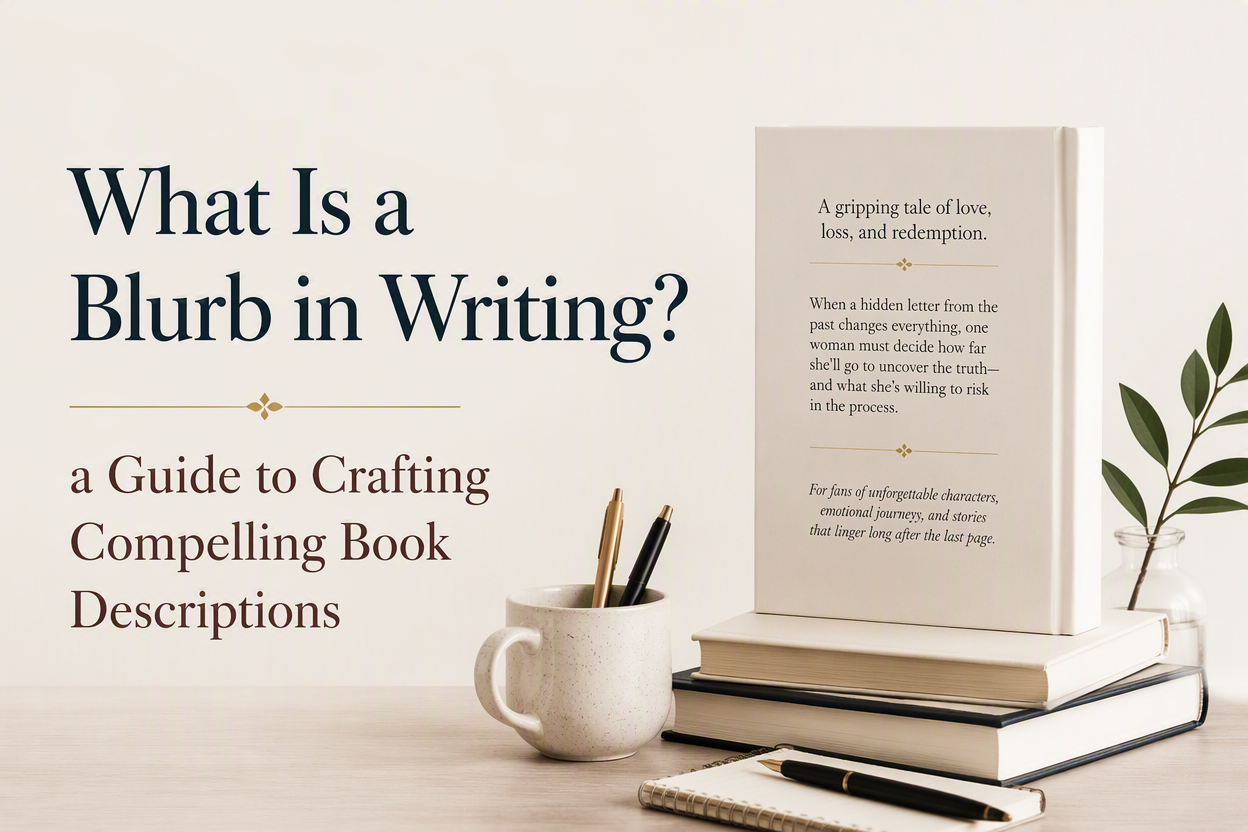
The question of “What is a blurb in writing?” comes up early for most authors, since the answer determines how a reader meets your book before reading a page. A blurb is the short piece of sales copy on a book’s back cover, retailer page, or promotional material. It presents the story’s central promise and stirs enough curiosity in a stranger to crack the spine.
Your manuscript can be beautifully written and still struggle to sell if the description gives readers no reason to care. I see this problem often with self-published books. For example, authors spend months refining chapters, then write the blurb in ten minutes by listing everything that happens. The result reads like a plot report rather than an invitation to read on. Strong blurbs send the reader straight to the first page.
The sections below cover what a blurb should do, how it differs from a synopsis, the pieces it is built from, and a revision process you can use for fiction or nonfiction. You will also see why genre expectations matter more than clever phrasing when you write for Amazon KDP, Kobo, Apple Books, or a print back cover.
Table of Contents
The Job A Blurb Must Do
A blurb sells the reading experience. It gives your reader a fast answer to three questions: who is this book about, what problem or desire drives it, and why should I keep reading? Every sentence needs to support one of those answers.
A synopsis serves editors, agents, publishers, or your own planning process. It explains the whole story, including the ending and major reversals. A blurb serves a potential reader who has already seen your cover and title. That reader needs a compelling reason to open the sample or buy the book. Revealing the ending defeats the purpose.
Story Promise And Reader Curiosity
Think of your blurb as a promise about the experience ahead. For example, a thriller promises danger, pursuit, and escalating stakes. Similarly, romance readers expect attraction, emotional resistance, and a relationship that must change. In a cozy mystery, the promise is an appealing community, a puzzling crime, and a satisfying investigation.
Here is a simple fiction example:
After a fire destroys the only bakery in her coastal town, Mara finds a charred wedding ring in the ruins. The ring belongs to a woman who vanished twenty years ago, and Mara’s search draws her toward the family that owns the town’s oldest secret.
This passage gives us a character, an inciting discovery, a setting, and a question. Who vanished? What does the family know? Why did the ring survive? The reader supplies those questions without receiving a full plot summary.
The Cost Of A Weak Description
A vague blurb pushes the sales work onto the reader. Phrases such as “a journey of self-discovery” or “a gripping tale of love and loss” could describe thousands of books. They communicate mood without giving the reader a situation to imagine.
I recommend replacing broad praise with a specific disturbance. Name the decision, threat, promise, crime, discovery, or deadline that changes the protagonist’s life. Your description gains force when the reader can picture the trouble within a few seconds.

Blurb, Synopsis, And Book Description
Publishing uses these terms loosely, so context matters. In trade publishing, a blurb usually refers to promotional copy that persuades a buyer. A synopsis usually describes a fuller account of the story. On Amazon KDP, the retailer-facing field is called the book description. Authors often call that same copy a blurb.
Amazon’s KDP book description guidance treats the description as sales copy and gives authors formatting rules for the detail page. Read those rules before you paste formatted text into your listing, since retailer displays can strip unsupported code or create awkward spacing.
What A Synopsis Includes
A synopsis follows the complete narrative. It may explain the protagonist’s backstory, turning points, midpoint reversal, climax, and resolution. An agent or editor reads it to assess how the story is built. A reader on a retailer page reads a blurb to decide whether the premise deserves attention.
For a 90,000-word fantasy novel, your synopsis might run several pages. Your retailer description may contain 150 to 250 words. Those formats require different choices. The synopsis values completeness. The blurb values selectivity.
What A Book Description Needs
A retailer description needs clear HTML-friendly formatting, readable paragraphs, and language that matches the category your book is listed under. A long block of text looks difficult to read on a phone. Short paragraphs help a reader scan the page without sacrificing substance.
Write the description for the reader who has seen your cover thumbnail and title. That reader already knows something about the genre. You can give your limited space to the conflict at the heart of your book rather than explaining that a novel contains characters and events.
The Anatomy Of A Compelling Blurb
A reliable blurb usually moves through four stages: a character or subject, a disturbance, rising stakes, and an unanswered question. You can vary the order for your genre. The reader still needs a clear promise.
Character And Desire
Start with the person who gives the story emotional focus. Name the role, situation, or defining pressure that makes this character distinct. “A detective” has little shape. “A disgraced detective who now finds missing pets” creates a sharper image.
Give the character a desire or duty. In nonfiction, replace the protagonist with the reader’s problem. For example, a book about query letters might open with the writer who has a finished manuscript and nothing but form rejections in the inbox. In a memoir, the opening might be the decision that changed the author’s family, career, or identity.
Conflict And Stakes
The conflict interrupts the character’s ordinary plan. Make the interruption concrete. A stolen manuscript, an impossible diagnosis, a vanished witness, a failed restaurant, or a legal deadline gives the reader something to hold onto.
Stakes answer the question, “Why does this matter now?” Personal stakes often work better than grand language. For example, a detective may need to solve a murder before the suspect leaves town. The chef in a culinary novel races to save the restaurant before the building’s owner sells it. In another book, a parent has to uncover the truth before a child is sent away.
The Unanswered Question
End with pressure, a choice, or a question that the book will answer. Avoid vague claims about suspense. Show the dilemma itself. “To save her brother, Lena must expose the one secret that will destroy her family” gives the reader a clear reason to continue.
Do not stack six questions at the end. One strong question carries more force than a row of rhetorical questions. Leave the outcome unknown and the stakes visible.
The Nonfiction Promise
Nonfiction blurbs require a different center of gravity. State the reader’s problem, describe the result the book helps them pursue, and identify the method or perspective that makes your book useful. For example, a leadership book might promise a repeatable meeting system for managers whose teams lose decisions in long email threads.
Give evidence when you have it. Credentials, case studies, a distinctive method, or a clearly defined audience can support a nonfiction description. Avoid inflated promises such as “change your life forever.” Name the work the reader will do and the result that work can produce.
Genre Signals And Reader Expectations
Your blurb must sound like the book you wrote. Genre readers use descriptions to sort books into familiar reading experiences; hence, a description that hides the genre creates the wrong expectation. A lyrical paragraph may suit literary fiction. That same paragraph may confuse a reader shopping for a fast military thriller.
Fiction Conventions
Romance readers expect the central relationship to appear early, along with the emotional obstacle that keeps the couple apart. Mystery readers want the crime, the investigator, and the investigative problem. Fantasy readers need a sense of the world’s unusual rules, threats, or power struggles.
Look at the descriptions of five successful books in your exact category. Study their order of information, paragraph length, vocabulary, and level of spoiler. Do not copy their sentences. Identify the promise your book makes to readers, then state your own version of that promise.
Series And Standalone Books
A series description needs enough context for a new reader to step in without wading through a catalog of previous events. Name the ongoing character or conflict, then focus on the problem in this installment. You can mention the series name and reading order on a final line.
A standalone description has more freedom to delay background information. Use that space to sharpen the central choice. In either format, keep proper nouns under control. Three invented kingdoms and four family names in the opening paragraph create paperwork for the reader.
Comp Titles And Category Language
Comp titles help you identify the audience and promise you share with recognizable books. They rarely belong in the blurb itself unless a publisher or retailer campaign calls for them. Use them during drafting to test whether your copy sounds like the shelf where you want the book to appear.
Category language also affects discoverability. Your description cannot repair a mismatched category or weak metadata. It can, however, reinforce the right audience. Pair precise copy with accurate categories and relevant keywords in your retailer dashboard. Amazon provides official guidance on book metadata and keywords, including the limits and purpose of keyword fields.
Revision And Testing For Your Blurb
I draft a blurb after I understand the book’s central promise, then revise it with the same care I give a chapter opening. The first draft usually contains too much setup. Revision removes background until the conflict has room to breathe.
A Four-Pass Revision
On the first pass, underline every phrase that identifies the character, desire, conflict, or stakes. Cut sentences that perform none of those jobs.
Second time through, circle abstract nouns such as destiny, journey, darkness, secrets, and power. Keep them only when the story gives them a specific meaning. Replace “a battle against darkness” with the actual threat whenever you can.
The third pass belongs to the ending. The final lines should create forward motion without revealing the resolution. If the blurb explains how the protagonist solves the problem, remove that explanation and retain the choice that leads into the story.
Finally, read the copy beside your cover at thumbnail size. The cover, title, subtitle, and description should point toward the same audience. Ask two people who read your genre to describe the book after reading the blurb. If they name different genres or different central conflicts, revise for clarity.
Length And Formatting
There is no universal word count for a blurb. A romance retailer page may support a longer emotional setup than a short children’s book description. Your back cover also has physical limits determined by trim size, font, endorsements, and barcode placement.
Draft around 150 to 250 words for many novels, then adjust after you see the copy in the actual retailer field or cover layout. Use paragraphs of one to three sentences. Mobile readers may scan only the opening section, so the strongest premise belongs near the top.
Reader Feedback
Ask beta readers and ARC readers what they expect after reading the description. Their answers reveal whether your promise is clear. Do not ask only whether they like the wording. Ask which character they remember, what problem they think the book presents, and what they expect to happen next.
Adazing’s writing and book marketing tools can help you generate alternate phrasing when a sentence refuses to work. I use tools such as QuickWrite for ideation, then apply my own editorial judgment. A generator can produce possibilities. It cannot know which promise your manuscript actually keeps.
Common Blurb Problems And Repairs
The most common problem is summary overload. Authors describe childhood, employment, family history, travel, and three plot turns before the reader reaches the conflict. Start closer to the moment when the character’s plan breaks.
Empty intensity is the next offender. Words such as explosive, unforgettable, and breathtaking have little value without a concrete event behind them. Replace praise with evidence. Tell the reader what happens, who suffers, and what decision follows.
Some descriptions have no protagonist at all. Copy about “a town caught in an ancient war” gives setting and scale, though readers usually need a person to follow. Put a named character, role, or sharply defined subject in the first paragraph.
Authors also hide the genre in hopes that the book will appeal to everyone. Broad appeal usually produces vague copy. State the reading experience plainly. A specific promise helps the right reader recognize the book. It also helps the wrong reader move on before leaving a disappointed review.
FAQs for What is a Blurb in Writing? A Guide to Crafting Compelling Book Descriptions
How Long Should A Book Blurb Be?
Many novel blurbs work well between 150 and 250 words, though genre, retailer, and cover design affect the final length. Write the shortest version that presents the character, conflict, stakes, and reading promise. Test the copy on a phone and in your print layout before you publish.
Should A Blurb Reveal The Ending?
A blurb should preserve the outcome readers bought the book to find out. Reveal the setup, central conflict, and pressure surrounding the protagonist. Save the solution, final pairing, killer’s identity, or major victory for the book itself, unless your genre convention calls for a different approach.
Can I Use The Same Blurb Everywhere?
You can use a strong core description across Amazon KDP, Kobo, Apple Books, and your website, then tailor the length and formatting for each platform. A paperback back cover may need tighter copy than an online product page. Keep the central promise consistent and adjust the presentation.
A Blurb Gives Your Book Its First Chance
A blurb earns attention by making a specific promise and withholding the answer that gives the story its forward pull. Write toward the reader’s curiosity, name the conflict, signal the genre, and cut every sentence that merely praises the book.
Draft several versions, read them beside the cover, and ask genre readers what they expect to find. Your final blurb should help the right reader recognize the book within seconds. The description has done its work at that point. The pages then have the job of keeping the promise.
