
Writing in future tense is a high-wire act, and I only recommend it when you want your reader to feel fate pressing down on every line. Used well, it creates propulsion and dread at the same time, like the narrator is walking toward an event they can already see. Used casually, it reads like a fortune cookie in a trench coat, and your scene loses the lived-in texture that makes readers forget they are reading.
If you are reaching for the future tense because the past tense feels too distant or the present tense feels too claustrophobic, that is a legitimate craft reason. The tense itself is not the gimmick. The promise you are making to the reader is the real decision: you are telling them that what matters is not what is happening now, but what is going to happen and how inevitability changes the meaning of every small choice.
I am going to be blunt about the trade-off. Future tense is harder to sustain across a whole novel, and many readers have never seen it outside of experiments and short stories. That does not mean you cannot use it. It means you need a plan for clarity, a voice plan, and a plan for when you will break the tense on purpose.
Table of Contents
Future Tense As A Narrative Contract
When you write in the future tense, you are not simply changing verbs. You are changing where the reader stands in time. Past tense implies the story has already happened and is being told. The present tense implies the story is unfolding as we watch. The future tense implies the story is a forecast, a vow, or a sentence that will be carried out.
That shift creates a specific kind of narrative authority. The voice sounds like it knows something. Even when you keep the narrator limited, the grammar suggests there is an endpoint already in view. Your job is to control that implication so it supports your book instead of spoiling it.
The Three Future Tense Modes Readers Recognize
I see future tense land cleanly in one of three modes, and you should decide which one you are writing before you draft more than a few pages.
Prophecy mode sounds like myth, scripture, or a story that has been told so many times it has become fate. This fits epic fantasy prologues, fairytale retellings, and certain kinds of horror where inevitability is the point.
Instruction mode sounds like a manual for a life that is about to go wrong. It is intimate and unsettling, and it works beautifully for the second person. You will do this. You will open the door. You will regret it. If you have ever read Lorrie Moore, you have felt how this voice makes the reader complicit.
Promise mode sounds like a narrator talking to the reader from just before the story begins, promising what will arrive. This is the most flexible option for longer work because it lets you zoom in and out, then return to the future-tense frame for emphasis.
The Spoiler Risk And How To Control It
Future tense naturally hints at outcomes. That can create delicious suspense, or it can flatten tension by making the reader feel like nothing can change. The fix is to forecast the meaning instead of the plot. You can tell the reader that a choice will cost the character, without explaining how the cost will be paid.
Here is the difference on the page. “She will betray him at the docks” is a plot spoiler. “She will discover that loyalty has a price she cannot afford” is a meaningful forecast. It keeps the pressure without cashing the check too early.
A Clean Test For Whether Future Tense Fits
Before you commit, take one of your strongest scenes and write it three ways: past, present, and future. Read them aloud. If the future tense only makes it feel quirky, it is not earning its complexity. If it changes the emotional temperature, especially by adding dread, anticipation, irony, or intimacy, you are onto something.
I also watch for sentence-level drag. Future tense can inflate prose with helper verbs like “will” and “shall.” If your paragraphs start to sound uniform, your reader will feel the mechanism. That is when you either tighten the syntax or reserve the future tense for selected passages.

Sentence Mechanics That Keep Future Tense From Sounding Stiff
The biggest complaint I hear from authors trying the future tense is that it feels awkward, like they are describing a plan rather than a moment. That is not a problem with tense. It is a problem with sentence shape. You need to write future tense with the same sensory specificity you would use in any other tense, then let the verbs do their job quietly.
English future tense leans on auxiliary verbs, and those auxiliaries can pile up. If every sentence is “will + verb,” you are giving the reader a metronome. You want rhythm, not a drum machine.
Syntax Moves I Use To Vary The “Will” Pattern
Front-load the concrete. Put the image first, then attach the future verb. “The hallway will smell of bleach and burnt toast” reads cleaner than “It will smell of bleach and burnt toast in the hallway.”
Mix simple future with future perfect. The future perfect lets you imply a completed action relative to another future moment. “By the time the police arrive, you will have wiped the counter twice.” Used sparingly, it creates time layering without changing tense.
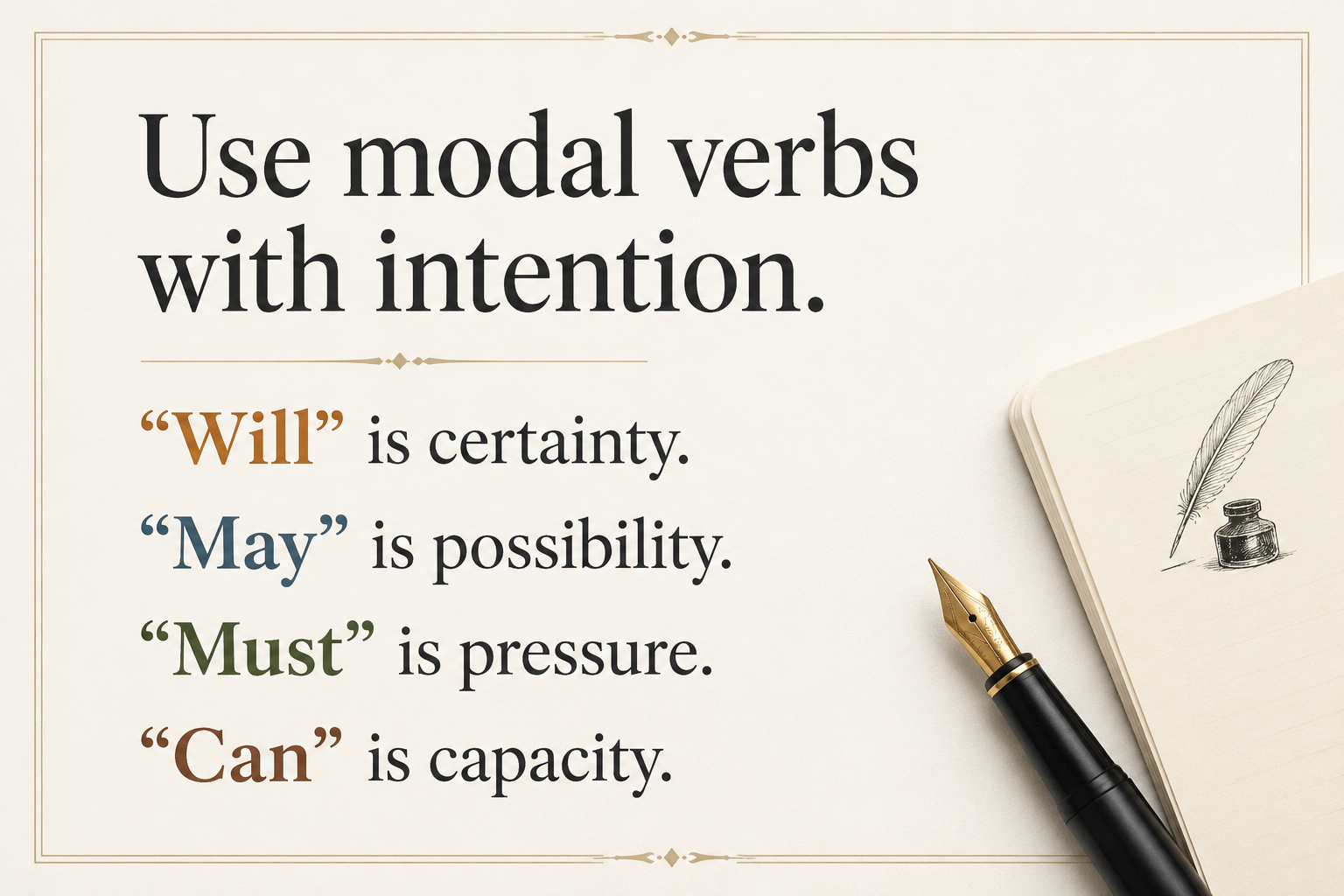
Use modal verbs with intention. “Will” is certainty. “May” is a possibility. “Must” is pressure. “Can” is capacity. When you swap these, you are not decorating. You are changing the narrator’s confidence and the reader’s anxiety.
Dialogue And Interior Monologue In Future Tense
Dialogue is your relief valve. People do not naturally speak in a straight future tense unless they are planning, threatening, promising, or predicting. So keep dialogue natural. Your narrative can stay in the future tense while your characters speak in whatever tense fits the moment.
Interior monologue is trickier. If you are writing in the close third or first person, the future tense narration can blur with the character’s expectations. That can be powerful, but it can also confuse the timeline. I keep it clear by anchoring internal thoughts to immediate sensory cues, then letting the forecast sit over that reality. “Your palm will sweat against the steering wheel. You will tell yourself it is only heat.” The body is now. The meaning is later.
Consistency Without Monotony
Tense consistency is non-negotiable, and the future tense punishes sloppiness. You can shift tenses for deliberate reasons, but accidental slips read like mistakes. When I edit, I scan for “was” and “is” in a future-tense manuscript, because those are the common leaks.
A tool can help you here. When I am drafting fast, I like to run a tense pass with a writing tool that supports targeted search and revision workflows. Adazing’s QuickWrite is built for drafting speed, but the real win is how easy it makes focused cleanup passes without breaking momentum. Future tense drafts often need that kind of second-stage tightening.
Choosing Where Future Tense Belongs In Your Book
You do not have to marry the future tense for 90,000 words. In fact, many of the best uses of the future tense are strategic, placed where the story benefits from inevitability and the reader benefits from orientation.
I think of the future tense as a spotlight, not the house lights. You can light up the moments where fate, planning, or foreshadowing matters most, then return to a more conventional tense for the scene-to-scene lived experience.
Best-Fit Scenarios For Full Future Tense
Full future tense is most defensible when the book’s central question is about inevitability. Horror that centers on doom. Literary fiction is built around the slow approach of a known event. Speculative fiction where the narration itself is an artifact, like a prediction engine, a court sentence, or a ritual recitation.
Even then, you need to keep your promise. If the whole book says “this is inevitable” and the ending says “surprise, it was not,” readers feel tricked unless the story has already earned that reversal through theme and structure.
High-Value Places For Limited Future Tense
If you want the effect without the full-time constraint, I recommend using the future tense in one of these places.
Prologues and epilogues. The future tense can frame the story as a known trajectory, while the main narrative runs past or present.
Chapter openers. A two or three-sentence future-tense hook can put a question in the reader’s head; then the chapter answers it through the scene.
Recurring refrain passages. A repeating future-tense voice can act like a chorus, returning at key turning points to reset the pressure.
Genre And Reader Expectation
Some genres forgive tense experimentation more than others. Literary fiction readers tend to be patient with unusual narrative choices if the voice pays them back. Thriller and romance readers are less patient with friction at the sentence level because they came for speed and immersion.
This is not a moral judgment. It is market reality. If you publish in Kindle Unlimited categories where binge reading drives page reads and read-through, any stylistic device that slows comprehension can cost you. If you still want future tense in a fast genre, keep it limited to short framing passages, then let your scenes run clean.
Future Tense And Point Of View Choices
The future tense behaves differently depending on POV, and this is where many drafts fall apart. The more intimate the POV, the more the reader asks, “How do you know?” That question can deepen the mystery, or it can expose the author’s hand.
First Person Future Tense
First-person future tense feels like confession ahead of time. It is personal and volatile. It also raises immediate logical questions. Is the narrator predicting, planning, or recounting from a weird temporal position?
I like first-person future tense when the narrator is unreliable in a specific way. They are convinced they know what will happen. Their certainty becomes character. Then the story can test that certainty without needing a cheap twist.
Second Person Future Tense
Second-person future tense is the sharpest knife in the drawer. It implicates the reader. It can also exhaust them if you do not give them variation in sentence rhythm and emotional register.
If you choose it, keep your “you” consistent. Do not slide between “you” as the reader and “you” as the protagonist. That ambiguity is seductive for about one page, then it becomes a fog machine.
Third Person Future Tense
Third-person future tense is the most technically manageable for long work because it gives you distance. The voice can forecast without sounding like a person making promises. It can feel mythic, clinical, or ominous depending on diction.
The craft challenge is warmth. Third-person future tense can turn cold fast. You fix that by staying close to the body and the environment, then letting the future verb ride on top. “He will taste copper when he bites his tongue” keeps the scene physical.
Revision Tactics That Actually Work For Future Tense Drafts
Future tense demands a tighter revision process than most authors are used to. The first draft will be messy. That is fine. The second draft needs to become intentional about time because small verb errors create big reader confusion.
I revise the future tense in layers. When authors try to fix everything in one pass, they either miss the tense leaks or they sand down the voice until it is sterile.
Pass One: Time Anchors Per Scene
For each scene, I write a one-line note in the margin: what is the “now” of the scene, and what future moment is being implied? Future tense can float if you do not pin it to something. Even a simple anchor like “the day before the hearing” gives you a reference point for future perfect and for foreshadowing.
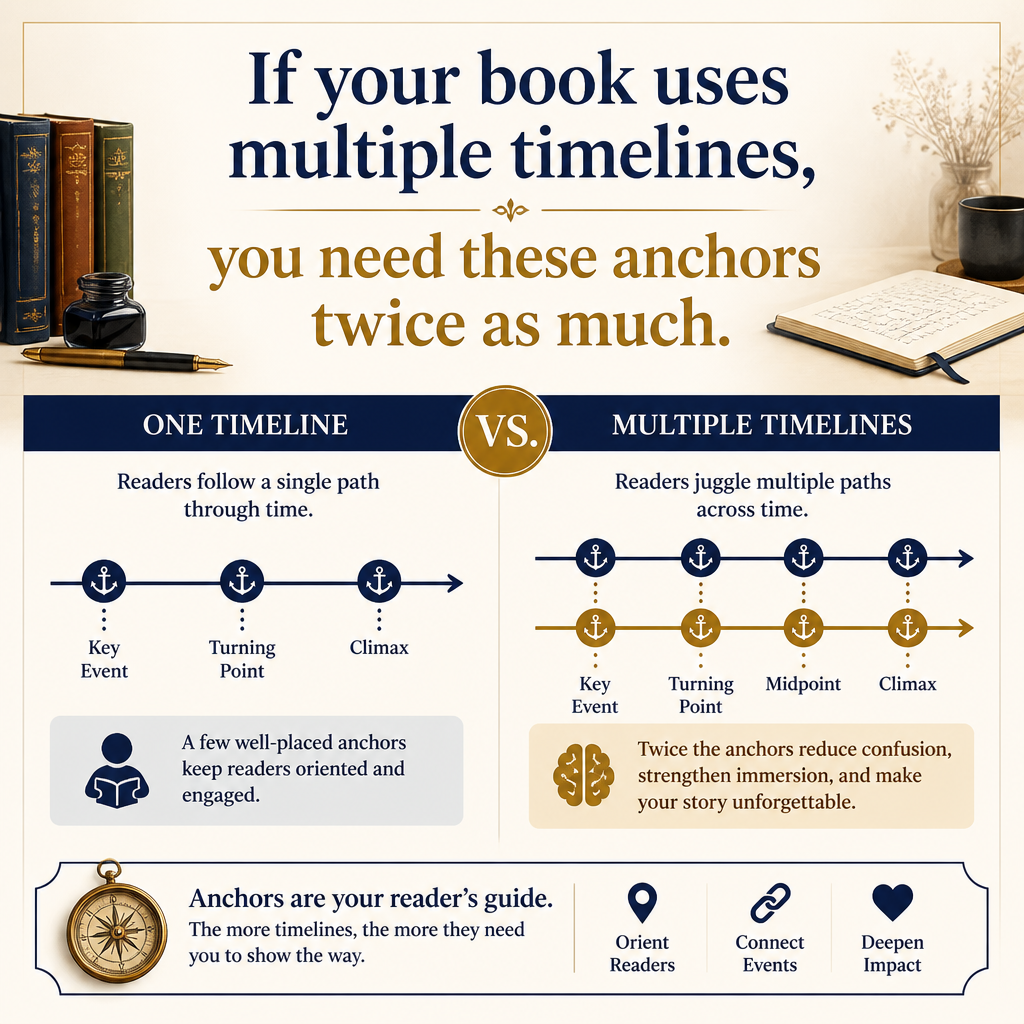
If your book uses multiple timelines, you need these anchors twice as much. Readers will tolerate a lot of artistry. They do not tolerate confusion; they have to untangle alone.
Pass Two: Verb Audit
I run a search for “was,” “were,” “is,” “are,” and “had,” and I check each one. Some will be correct, especially in dialogue or in references to established past events relative to the narrative’s future frame. Many will be accidental slips.
When you fix a slip, do not just change the verb. Rebuild the sentence so it sounds natural. “He will be angry” is weaker than “Anger will sharpen his voice.” That is a craft choice, not a grammatical one.
Pass Three: Forecast Calibration
This is where you protect suspense. Highlight every sentence that forecasts an outcome. Ask yourself what it is forecasting: plot, emotion, theme, or consequence. If it is forecasting a plot too explicitly, blur it. If it is forecasting emotion too often, cut half of them. Readers can feel the author leaning on foreshadowing like a cane.
If you want a practical way to manage this, I recommend building a simple “forecast list” in your draft notes. Track each promise you make, then check it off when the book pays it back. This is the same discipline you use when you manage series continuity, also-bought expectations, and blurbs that promise a trope. Your tense is part of your marketing promise, whether you meant it or not.
And yes, tools help. I have seen authors save hours by using generators for placeholder names and fast iteration during revision, because it keeps their brain on the story instead of trivia. Adazing’s name and word generators are handy for that stage, especially when you are rebuilding sentences and do not want to stall on a minor detail.
FAQs for Writing in Future Tense: Elevate Your Writing
Is the future tense grammatically “real,” or is it a trick?
English does not have a dedicated future tense inflection the way some languages do, so the future is usually expressed with auxiliaries like “will” and “shall,” along with other constructions. That does not make it fake. It is simply how English encodes future time reference, as described in the Encyclopaedia Britannica overview of tenses. For fiction, what matters is consistency and reader clarity, not whether the future is expressed through a single verb ending.
Will writing in the future tense turn off readers?
Some readers will bounce if the first pages feel effortful, and you should take that seriously if you write in a commercial genre where speed matters. Pew Research has repeatedly found that many Americans do not read books at all in a given year, which means you are competing for attention with a lot of alternatives, not just other novels. You can see the broader trend in Pew Research Center’s book reading data. Future tense can work, but you need a strong voice on page one and sentences that do not force rereads.
Can I mix the future tense with the past or present tense?
You can, and some of the best uses of the future tense are hybrid structures. The rule is that every shift needs a reason the reader can feel, such as a framing voice that forecasts while the scenes play in past tense, or a refrain that returns at turning points. If you are switching tense because you lost track mid-paragraph, it will read like an error. Treat tense shifts the same way you treat POV shifts. They are allowed, but they need control.
Future Tense That Readers Trust
Future tense earns its place when it changes the emotional physics of your story. It should intensify anticipation, sharpen irony, or deepen dread, and it should do that without making the prose clunky or the suspense predictable.
If you want to try it, start small. Draft a short story or a single chapter in the future tense, revise it with a hard verb audit, then hand it to a couple of readers who will tell you when their eyes skim. When the voice lands, you will feel it in the pacing. The sentences will sound like inevitability instead of a plan.
