
Writing in first person is the fastest way I know to build intimacy on the page, and it is also the fastest way to trap your story inside one person’s blind spots. When you choose “I,” you choose a camera that can’t leave the narrator’s head, and after that, every craft decision has to respect the lens.
If you are wrestling with first person right now, you are probably feeling one of two pains. Either your narrator sounds flat and report-y, like they are giving a witness statement. Or the voice is loud, but the book feels cramped because you can’t show what matters without awkward eavesdropping or convenient confessions. The fix is not “more voice.” The fix is understanding what first person does best, what it does poorly, and how to design your scenes so the limitations become tension rather than friction.
I’m going to walk you through the real trade-offs, the techniques that keep first person from turning into a diary, and a practical revision pass you can run on your own manuscript. You can do this whether you are writing romance, thriller, fantasy, memoir, or business nonfiction.
Table of Contents
First Person As A Story Engine
First person is not a viewpoint you sprinkle on top. It is a story engine that changes what your reader notices, what they believe, and how fast they bond with your protagonist. When it works, it feels like someone slid a chair next to you and started telling the truth. When it fails, it reads like a character summary with “I” swapped in.
Intimacy, Bias, And Trust
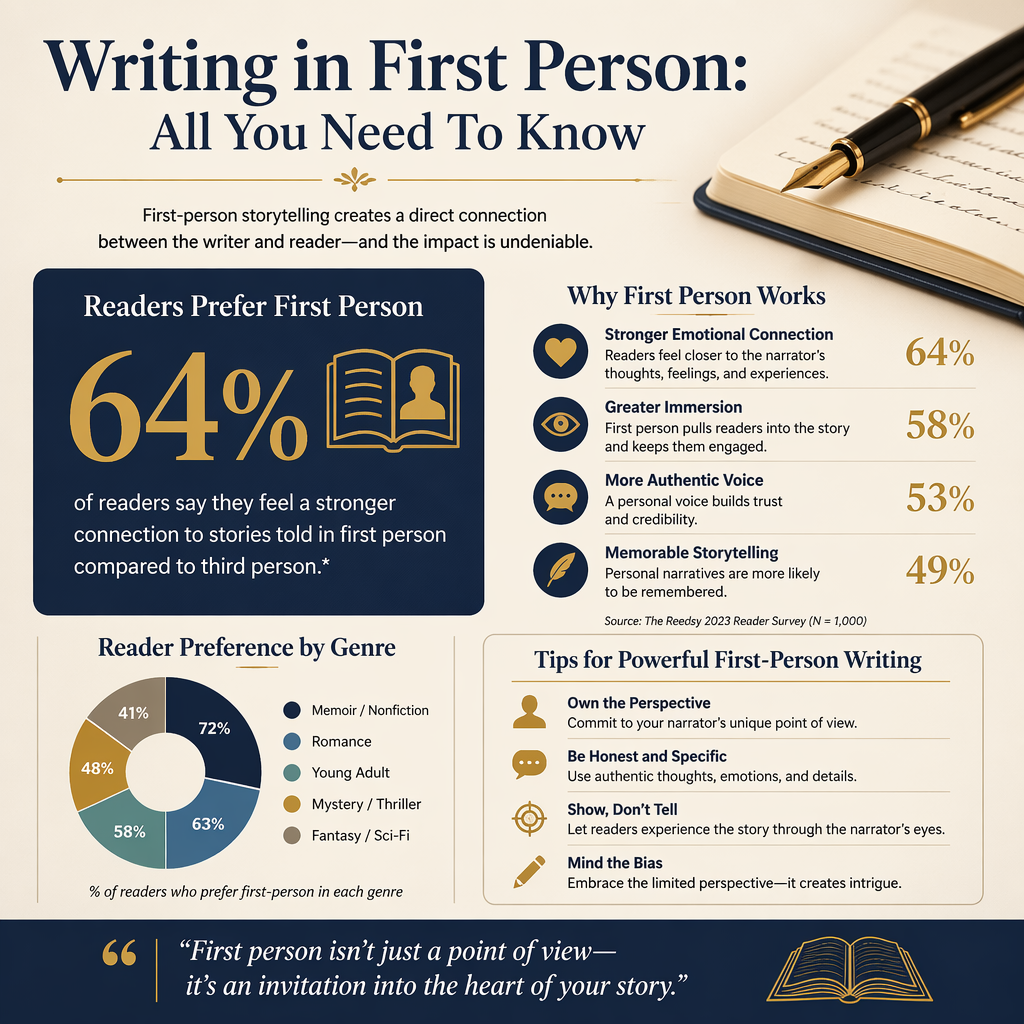
The main strength of the first person is psychological closeness. Your reader gets access to the narrator’s perceptions and meaning-making in real time. That immediacy is one reason first-person narratives can feel more “voicey” even when the prose is simple. Researchers who study narrative engagement often focus on transportation, the feeling of being mentally carried into a story world, and viewpoint is one of the levers that can increase that effect. If you want a research-grounded overview of transportation as a mechanism for persuasion and engagement, read Green and Brock’s work on narrative transportation.
Here is the craft implication. Your narrator is not a neutral reporter. Their biases, values, and blind spots become part of the plot’s texture. If the narrator is deeply judgmental, the whole book becomes judgmental unless you counterbalance it with consequences, contradictions, or the reader’s ability to read between the lines.
Speed, Compression, And Scene Design
The first person can move fast because you can compress experience into selection. Your narrator notices three things in a room, not thirty, and that curation creates momentum. The risk is that you use that speed as an excuse to summarize everything that should be dramatized.
When I revise first-person drafts, I look for places where the narrator “tells” because the author is avoiding the hard work of staging the scene. You do not need more internal monologue. You need more action that forces the narrator to make choices under pressure.
Where First Person Struggles
First person struggles with three recurring problems. The first is information control. You cannot cleanly show the villain plotting unless your narrator is there or has a believable pipeline to that knowledge. The second is scope. Epic fantasy and sprawling political thrillers can work in first person, but you are choosing a narrow aperture that has to be compensated for by structure. The third is credibility. If your narrator sounds like the author showing off, trust breaks.
Your job is to pick first person because it serves your specific reading experience, not because it feels easier than third.

Choosing The Right First-Person Variant
“First person” is not one thing. The tense, distance, and narrator situation create different reader contracts. If you do not choose deliberately, you will get unintentional wobble that feels like an inconsistent voice.
Past Tense Versus Present Tense
Past tense is the default for a reason. It gives you room for reflection, compression, and pacing control. Present tense creates urgency and immediacy, which can be perfect for certain thrillers, YA, and high-emotion romance. It also amplifies every line of interiority. If the narrator is anxious, the present tense can become exhausting because the reader never gets a breath.
I recommend you decide based on what emotion you want to sustain for 300 pages. If your book needs dread that never lets up, the present tense may fit. If your book needs irony, hindsight, or a sense of a life being interpreted, the past tense tends to serve you better.
Single Narrator Versus Multiple Narrators
Multiple first-person narrators solve the scope problem but create a voice problem. The mistake I see most is “same voice, different name.” If you are going to rotate narrators, each one needs a distinct worldview that shows up in word choice, what they notice, what they refuse to name, and how they justify themselves.
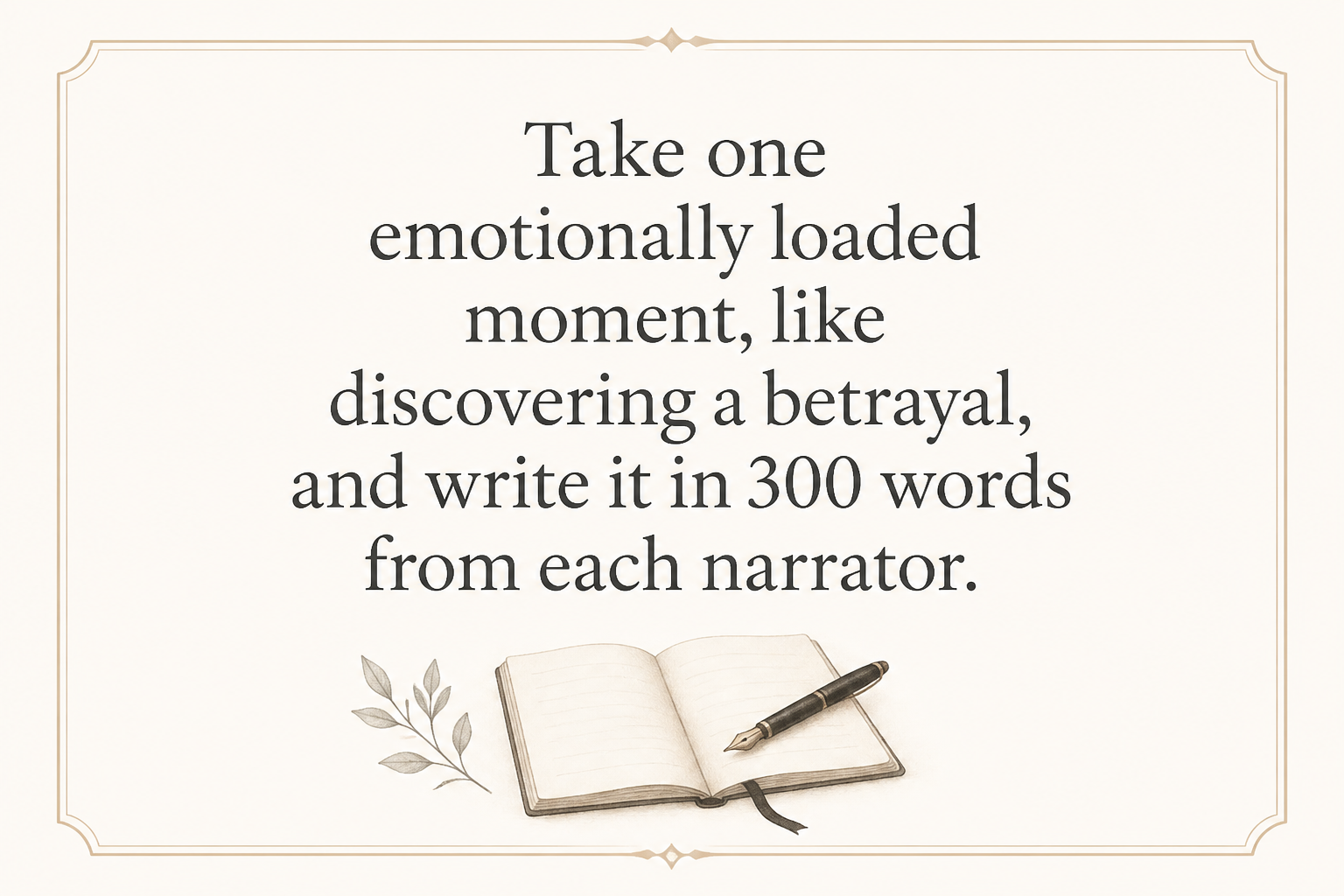
A practical test helps. Take one emotionally loaded moment, like discovering a betrayal, and write it in 300 words from each narrator. If you can swap the names and nothing changes, you do not have multiple narrators yet. You have multiple camera angles with the same operator.
Unreliable Narrators With A Purpose
Unreliable does not mean “lying for a twist.” It means the narrator’s perception is meaningfully limited or distorted, and the reader can sense the gap. The cleanest way to pull this off is to let the narrator be honest about what they think is true, then let the world contradict them through outcomes.
If you want a language handle for what you are doing, Wayne C. Booth coined the modern critical framing in The Rhetoric of Fiction. It is still useful because it treats unreliability as a relationship between narrator, implied author, and reader, not a cheap trick.
Voice That Carries A Whole Book
Voice is what first-person sells, and “voice” is not a pile of quirks. It is a consistent pattern of attention plus a consistent attitude toward what is happening. If you have ever read a first-person sample that felt electric on page one and tiresome by page thirty, you have seen what happens when the voice is built on surface personality rather than a durable perspective.
Diction As Character, Not Decoration
Your narrator’s word choices should come from who they are and what they know. A homicide detective will name different details than a pastry chef. A fourteen-year-old will reach for different metaphors than a divorced forty-year-old trying to keep custody. When the diction matches the life, the voice feels effortless.
Try this on your draft. Highlight ten places where the narrator uses a vague verb, like “went,” “got,” “looked,” or “felt.” Replace five of them with verbs that reflect the narrator’s temperament. A cautious narrator “edges,” “hesitates,” “tests.” An impulsive narrator “lunges,” “snatches,” “blurts.” This single pass often strengthens voice without adding any extra words.
Interior Monologue With Restraint
Internal thoughts are a gift in the first person, but too much feels like the narrator is stopping traffic to narrate their own brain. The cure is to tie interiority to decision points. Thoughts are most compelling when they are attached to choice, conflict, or consequence.
I like to audit for “unattached thinking.” If a paragraph of thoughts does not change what the narrator does next, it often belongs as a shorter line embedded in action, or it belongs in the cut pile.
Voice Consistency Under Stress
The narrator’s voice should change under stress, but predictably. People do not become different people when scared. They become more themselves. A narrator who is funny as armor will get sharper. A narrator who intellectualizes will get colder. A narrator who avoids conflict will become passive-aggressive or disappear.
Pick one pressure scene and look at the language. Are you writing the character, or are you writing yourself trying to make the scene “good”? Fixing this usually means simplifying the sentences and letting the character’s coping style do the work.
Handling Information, Suspense, and What the Narrator Cannot Know
First person forces you to earn every piece of information the reader gets. That constraint can sharpen suspense, because the reader experiences uncertainty at the same time as the narrator. It can also sabotage your plot if you rely on offstage knowledge.
Information Pipelines That Feel Real
Your narrator needs information they cannot witness; build a pipeline. Give them a friend who talks, a job that grants access, a habit of snooping, or a believable digital trail. The pipeline should cost something. Cost creates credibility. If your narrator can access everything with zero friction, the book stops feeling like a story and starts feeling like a guided tour.
In practice, I write down three questions for any critical reveal: Who knows this? How would my narrator learn it? What does it cost them in time, risk, money, or relationships? Answer those, and your exposition problems shrink fast.
Suspense Through Controlled Ignorance
Suspense is often stronger when the narrator does not know what the reader suspects. That difference creates dramatic irony, and dramatic irony is fuel. The trick is to plant the suspicion without cheating. Let the narrator notice the clue and misinterpret it, or dismiss it for a character-relevant reason.
If you want to ground your intuition in something more formal, Alfred Hitchcock’s classic distinction between surprise and suspense is still one of the cleanest teaching tools. The BBC offers a clear overview in this explainer on Hitchcock’s suspense technique, and it maps well to first-person constraints.
Dialogue As A Delivery System
Dialogue in first person carries more weight because it is one of the few ways your narrator can receive new information in-scene. Do not waste it on small talk unless the small talk is a weapon. Every dialogue exchange should do at least one of these things: move a plan forward, reveal a value, raise the cost, or change what the narrator believes.
A tight exercise helps. After a dialogue scene, write one sentence that states what changed. If you cannot name a change, revise the scene until you can.
Revision Checks That Fix First Person Fast
Most first-person problems are not solved by rewriting the whole book. They are solved by running a few targeted passes that reveal where you broke the viewpoint contract. When I edit, I treat viewpoint like continuity in film. If you break it, the reader feels it even if they cannot name it.
The Viewpoint Contract Pass
Read a chapter and underline anything the narrator could not directly perceive. That includes emotions you claim to know (“he was jealous”), motivations stated as fact (“she wanted to hurt me”), and physical details the narrator could not see (“my face turned red” without a mirror or comment).
Then fix each line by converting it into perception. “He was jealous” becomes “his smile held, but his eyes didn’t.” “She wanted to hurt me” becomes “she chose the sentence that would land hardest.” You keep the meaning while honoring the camera.
The Voice Drift Pass
Voice drift happens when the narrator suddenly starts sounding like a neutral author, usually during exposition or worldbuilding. It is common in fantasy and sci-fi, and it shows up in nonfiction too when you slip into lecture mode.
I recommend you highlight any paragraph that could appear in a Wikipedia entry. Rewrite it so it reflects what the narrator cares about, fears, or wants right now. If the narrator is hungry, the city is described by smells and food. If the narrator is being hunted, the city is described by exits, cover, and sightlines.
The Scene Pressure Pass
First person thrives when scenes apply pressure. Go through your manuscript and mark scenes where the narrator talks or thinks for a page without being forced to act. Add pressure by introducing a clock, an interruption, a consequence, or another character who will not let the narrator stay comfortable.
If you draft in Adazing’s QuickWrite or any other focused writing tool, this is a good place to use a timed sprint. Give yourself fifteen minutes and rewrite the scene with a ticking deadline. The goal is not fancy prose. The goal is decisions on the page.
FAQs for Writing in First Person: All You Need To Know
Should I use first person for my genre?
Use first person when intimacy and voice are part of the promise you are making to the reader. Romance, YA, memoir, and many thrillers often benefit when readers want emotional proximity and a strong lens. If your genre leans on large scope, frequent scene cuts, or intricate political maneuvering, first person can still work. However, you will need structural support, like multiple narrators or a tightly designed information pipeline.
How do I avoid “I, I, I” repetition?
Vary sentence structure so the subject is not always “I.” Lead with sensory details, objects, or actions. “The window rattled” reads cleaner than “I heard the window rattle.” You can also embed the narrator in verbs and reactions. “My stomach tightened” replaces “I felt nervous” and usually sounds more natural in the first person.
Can I head-hop in first person?
If you switch heads inside a scene without a clear break, most readers will experience it as a mistake. You can use multiple first-person narrators, but you should separate them by chapter or clearly marked section breaks, and each narrator needs a distinct voice. If you want the flexibility to move the camera positions, third-person often works better.
A First-Person Draft That Readers Trust
First person wins when you treat it as a contract: the reader gets one human lens, and you deliver a story that becomes sharper because of that limitation. The practical move is to run the three passes that catch most failures, viewpoint contract, voice drift, and scene pressure, then revise your information pipelines so every reveal has a believable cost. Do that, and your “I” stops being a gimmick and starts feeling like a person the reader will follow anywhere.
