
Most manuscripts that fail at writing dark romance fail because the author writes “dark” like a filter instead of a structure. Your readers will forgive a lot, including taboo fantasies and morally bad decisions, but they will not forgive confusion about what kind of book they just bought or a romance arc that feels unsafe in the wrong way.
Dark romance is a promise with teeth. You are promising erotic charge, psychological pressure, and a relationship dynamic that pushes boundaries while still delivering a satisfying romantic payoff for the subgenre you are actually targeting. If you treat that promise as vibes, your pacing drifts, your consent signals get muddy, and your ending lands like a shrug.
I’m going to walk you through how I build a dark romance that reads cleanly for the target audience, survives the Amazon thumbnail test, and gives you the kind of reader trust that leads to read-through. The craft is the point, and the marketing follows because you wrote a book that knows what it is.
Table of Contents
Reader Contract And Subgenre Alignment
Dark romance is not a single lane. It is a neighborhood with specific houses, and readers know which door they meant to knock on. If you casually blend subgenres, you will get the reviews that say the book was “well written” right before they one-star you for betrayal.
Start by deciding what you are selling on page one. Is it captive romance, stalking, bullying, mafia, revenge marriage, religious taboo, monster, or something closer to gothic romance with a modern heat level? You can cross, but your primary promise has to be legible fast, because that is how readers decide if they feel thrilled or tricked.
Dark Versus Horror Versus Gothic
Dark romance uses fear and power as fuel for attraction. Horror uses fear as the destination. Gothic uses dread, atmosphere, and obsession, often with a mystery spine. You can borrow techniques from all three, yet your romance arc still has to function as a romance. That means the book centers the relationship, and the ending resolves it in the way your target readership expects. If your ending is tragic or your couple is not the couple, you may have written dark romantic suspense or horror with spice, and you should market it that way.
Taboo And Consent Signaling
Taboo is not the same thing as unclear consent on the page. Dark romance readers often enjoy fantasies that would be unacceptable in real life, which is exactly why you need better craft, not looser craft. Consent signaling is how you keep the fantasy readable. That signaling can be explicit, it can be negotiated, it can be CNC that is clearly framed, or it can be a steady chain of choices the protagonist keeps making even when the options are ugly.
If you want a useful north star, I like the framing by the Romance Writers of America definition of the romance genre, which centers on a love story and an emotionally satisfying ending. Dark romance can get there through morally rough terrain, but it still has to get there.
What To Do Before You Draft
Write a one-paragraph “reader contract” and keep it visible while you draft. Name the couple, name the central power dynamic, name the hard limits you will not cross on-page, and name the ending type. Then pick 3 comp titles you can genuinely stand beside and study how fast they declare their lane in the first 10 percent.

Boundaries, Content Notes, And Trust
The fastest way to lose the dark romance audience is to treat content notes like an apology. They are not. They are a sorting tool that helps the right readers find you and helps the wrong readers walk away before they buy and punish you for it.
You are writing in a space where reader experience matters, and the market has developed norms around warnings for a reason. If you choose to skip them, you are not being bold. You are being vague, and vagueness is the enemy of trust.
How I Handle Content Notes
I keep them short, specific, and easy to find. A “dark themes” warning tells nobody anything. A list that includes sexual assault, non-consensual scenarios, captivity, self-harm, or pregnancy tells the reader exactly what kind of ride they are buying. You also get to decide where to place it. Some authors put it in the front matter, some put it at the back with a note that it exists for those who want it.
If you need a mainstream example of how warnings change behavior, the American Psychological Association has published research on how people prepare for distressing content when they are informed beforehand, which can reduce the shock effect for some audiences. For a readable summary and links to the research, see APA coverage of research on trigger warnings. You do not have to adopt any single policy, yet you should know you are participating in a real reader expectation, not a passing internet mood.
Boundary Setting Inside The Story
Content notes handle the purchase decision. Your scenes still need internal boundaries. That means you show what the character is afraid of, what they want anyway, and what they will not accept. A character can be coerced and still have agency in how they respond, and that agency is where readers locate their footing.
On the page, trust comes from clarity. If a scene is meant to be CNC, flag it in the dynamic, the dialogue, and the aftermath. If a scene is meant to be assault, write it as assault and accept the consequences for those who will keep reading. Half-and-half usually reads like the author is hedging, and hedging reads like confusion.
What To Do During Revision
Do a “boundary pass” on the manuscript. Highlight every scene where power is unequal and track what the protagonist agrees to, what they resist, and what changes between the start and end of the scene. If you cannot explain why the reader should feel turned on instead of sick, you need either clearer framing or a different scene goal.
Power Dynamics That Stay Erotic And Coherent
Power is the engine of dark romance. The mistake I see most is authors writing power like a costume: a man in a suit, a gun on the nightstand, a locked door, a growled threat. Those are props. The real power dynamic is decision-making. Who can change the other person’s options, and what does it cost?
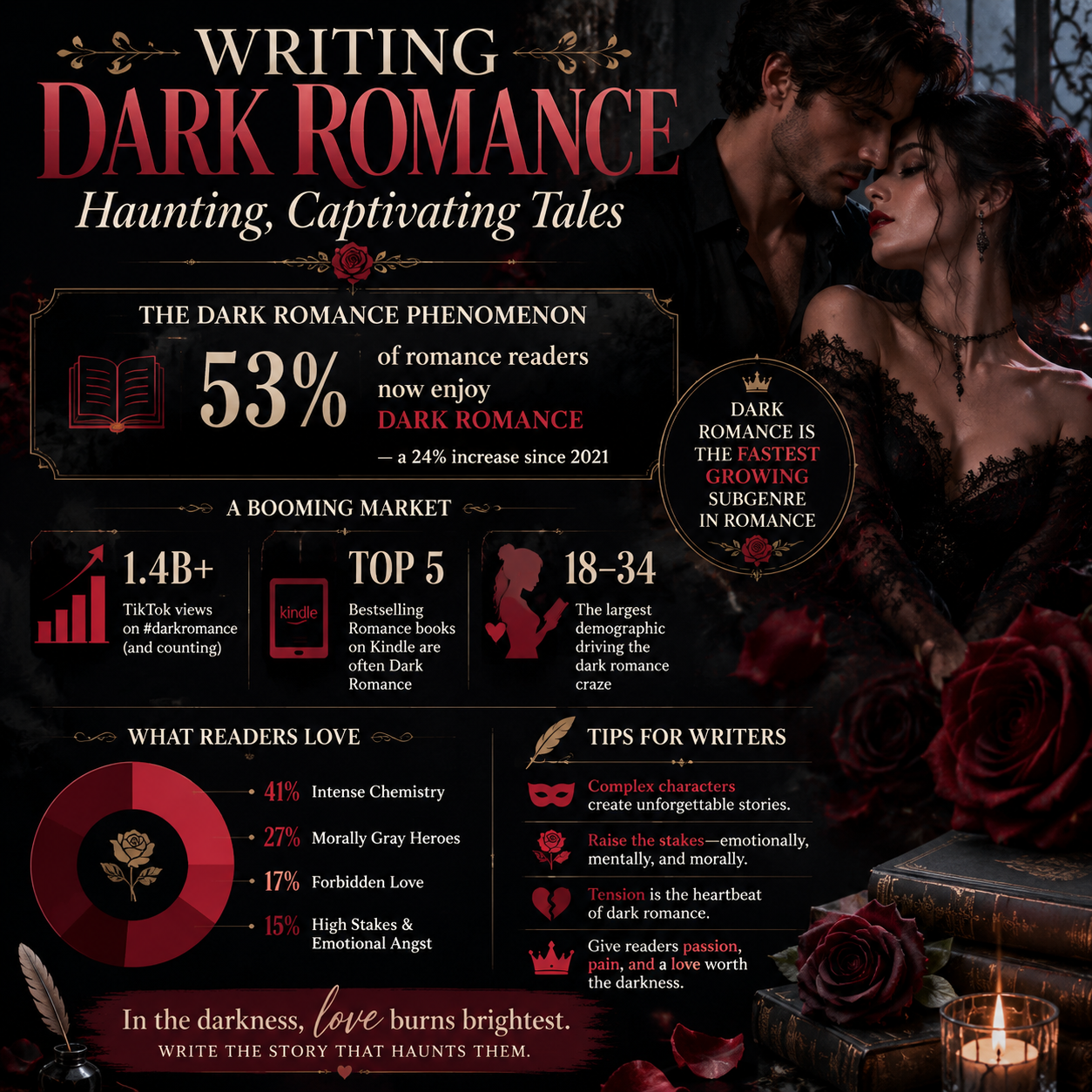
If you want your book to feel haunting and captivating in a way that sustains for 300 pages, build power in layers. External power gives you plot pressure. Internal power gives you intimacy pressure. When both are present, the relationship becomes the arena, which is exactly what romance readers came for.
External Power: Money, Status, Violence, Leverage
External power is easy to draft and easy for readers to understand. Among its examples are mafia hierarchy, employer control, blackmail, family obligation, public reputation, and legal threats. Pick one or two that you can keep consistent. If your villain-hero can do anything at any time, there is no tension because there is no rule set.
Write a simple constraint list. Who does he answer to? What can he not buy? What happens if he is seen? What is the one line he will not cross for his own reasons? Constraints create believable danger.
Internal Power: Shame, Desire, Identity, Dependency
Internal power is what makes the story feel personal. This is where you earn obsession. A character who cannot tolerate being wanted, a character who equates love with control, a character who needs pain to feel real. Handle this with specificity. Name the wound, show it in choices, and let the relationship press on it until it either breaks or heals in the way your story promises.
If you want a craft tool that works, map each lead’s fear and desire in a two-column table. Every major scene should poke one fear and feed one desire. When a scene does neither, it is usually filler, no matter how hot it is.
Erotic Tension As A Scene Job
Sex scenes in dark romance are not rewards. They are turning points. Each intimate scene should change the power balance, reveal a new boundary, or create a new problem. If a sex scene ends and nothing is different, the scene probably belongs in a fantasy vignette, not in a novel built for read-through.
I write the “before” and “after” of a sex scene before I write the mechanics. What does each character believe when they walk in? What belief is impossible to hold when they walk out? That is the erotic payload.
Plot Spine, Pacing, And The Haunting Effect
Haunting does not come from extra description. It comes from a pressure system that does not let up, paired with moments of tenderness that feel dangerous because they cost something. Dark romance pacing should feel like escalation with brief, sharp breaths.
Build your plot spine so the external threat and the relationship threat trade places. In one chapter, the world squeezes them together. The next chapter, being together, creates a new risk. That alternation keeps the book from turning into either nonstop melodrama or repetitive spice.
Escalation That Readers Can Track
I like escalation in three lanes. Lane one is external stakes. Lane two is relational stakes. Lane three is self-concept stakes. Early scenes raise lane one. Middle scenes twist lane two. Late scenes force Lane Three, where one or both characters must become someone new to survive the relationship.
If you want a simple diagnostic, outline your turning points and label which lane has moved. If you have five turning points in a row that only raise external danger, your romance is riding in the trunk. Move a relational lane at the next turn.
Suspense Techniques That Work In Romance
Cliffhangers work, yet constant cliffhangers numb readers. A better tool is the “unanswered question” that matters emotionally. Will she tell him she enjoyed it? Will he choose control or protection? Will he admit the thing he is ashamed of? Those are questions that pull the reader through chapters without turning the book into a serial stunt.
If you want a reference point for why curiosity drives reading behavior, George Loewenstein‘s information-gap theory is a classic in behavioral science. You do not need to quote it in your book. You can use it to design chapter endings that create genuine pull.
What To Do When The Middle Sags
Most dark romance middles sag because the couple keeps rehashing the same fight with new furniture. Fix it by introducing a new constraint or temptation, then forcing a choice that cannot be walked back. A choice is what changes a story.
When I revise, I mark every scene with a single verb: confront, confess, bargain, punish, protect, flee, submit, retaliate, forgive. If I see the same verb too many times in a row, I rewrite one scene so the power moves in a new direction.
Packaging, Platforms, And Selling The Right Book
Your cover and blurb are part of the reader contract. If they signal one thing and the book delivers another, your ads get expensive, and your reviews get mean. Dark romance readers often buy fast, and they use visual cues, tropes, and keywords to avoid wasting money on books that miss their preferences.
I treat packaging as a craft. A thumbnail is a promise, a blurb is a promise, and the first chapter is where you prove you meant it.
Cover Signals And The Thumbnail Test
On Amazon, your cover is usually seen at postage-stamp size. That means contrast and genre cues beat detail. Dark romance covers tend to fall into recognizable buckets, such as high-contrast couple photography, symbolic objects with sharp lighting, or typographic designs with a luxury feel. Which bucket you choose depends on your subgenre and heat level.
Run a thumbnail test with your comps. Put your cover mock in a grid next to the top 20 books in your category and squint. If your title disappears or your imagery reads like dark fantasy, you are inviting the wrong click. You can build quick iterations in the Adazing book cover maker and test multiple typography options without committing to a full redesign every time.
Blurbs That Sell Dark Romance Without Plot Dumping
A blurb for dark romance should lead with the hook dynamic, then the trap, then the cost. The trap can be literal captivity or emotional captivity. The cost can be reputation, safety, sanity, or self-respect. Mention one vivid detail that shows the flavor of the dark, then stop before you explain the whole plan.
If your blurb reads like a synopsis, cut half the sentences and keep the ones that create questions. Readers want the feeling, the trope, and the reason they cannot look away. They do not want the third-act reveal in bullet form.
Discoverability That Matches Reader Expectations
Categories and keywords matter more in dark romance than in many genres because readers are actively searching for specific tropes. Amazon KDP’s own documentation explains how categories and keywords influence discoverability. You can start with Amazon KDP guidance on choosing keywords and then do the real work of matching your comps.
Pick keywords that reflect trope language readers actually type, such as “stalker romance,” or “mafia romance,” or “bully romance.” Avoid vague terms like “dark love” that do not map to purchase intent. When I need a quick list of trope-adjacent terms to sanity-check my own brain, I will use Adazing generators for names and descriptive word banks. I still validate the final choices against Amazon search results and comparable blurbs.
FAQs for Writing Dark Romance: Haunting, Captivating Tales
Do I need a “happily ever after” in dark romance?
If you want to market the book as romance, readers expect an emotionally satisfying ending with the couple together in a stable way. Many dark romance books use a HEA or an HFN that strongly implies permanence. If your ending is tragic, ambiguous, or splits the couple, you can still write it, yet you should package and categorize it so you are not selling a romance promise you did not intend to keep.
How dark is too dark for Amazon and Kindle Unlimited?
Amazon’s enforcement is about prohibited content and how it is presented, and that can shift over time. The safest approach is to read the current policy language, avoid anything that violates it, and keep your metadata and cover cleanly aligned with your book. If you are writing extreme content, consider wide distribution and be prepared for platform variability. Treat this as a business risk decision, not a moral referendum.
How do I write morally gray leads without losing reader sympathy?
Give readers a consistent internal logic. A morally gray lead can do terrible things, yet readers need to understand what the character wants, what line they will not cross, and what they pay when they cross it anyway. I also keep consequences on the page. When harm happens, I show the aftermath and the shift in the relationship, because consequence is what turns shock into story.
Write The Dark, Then Prove The Love
Dark romance works when the darkness is engineered, and the romance is earned. Put your reader contract in writing, signal your boundaries clearly, and treat each intimate scene as a turning point that changes power. Once the book is honest about what it is, your cover, blurb, and keywords can do their job without attracting the wrong audience.
If you want one place to start today, pick your three closest comp titles, run a thumbnail and blurb audit, and then revise your first three chapters so the dynamic, the danger, and the desire are unmistakable. That early clarity buys you everything that comes later, including reader trust and read-through.
