
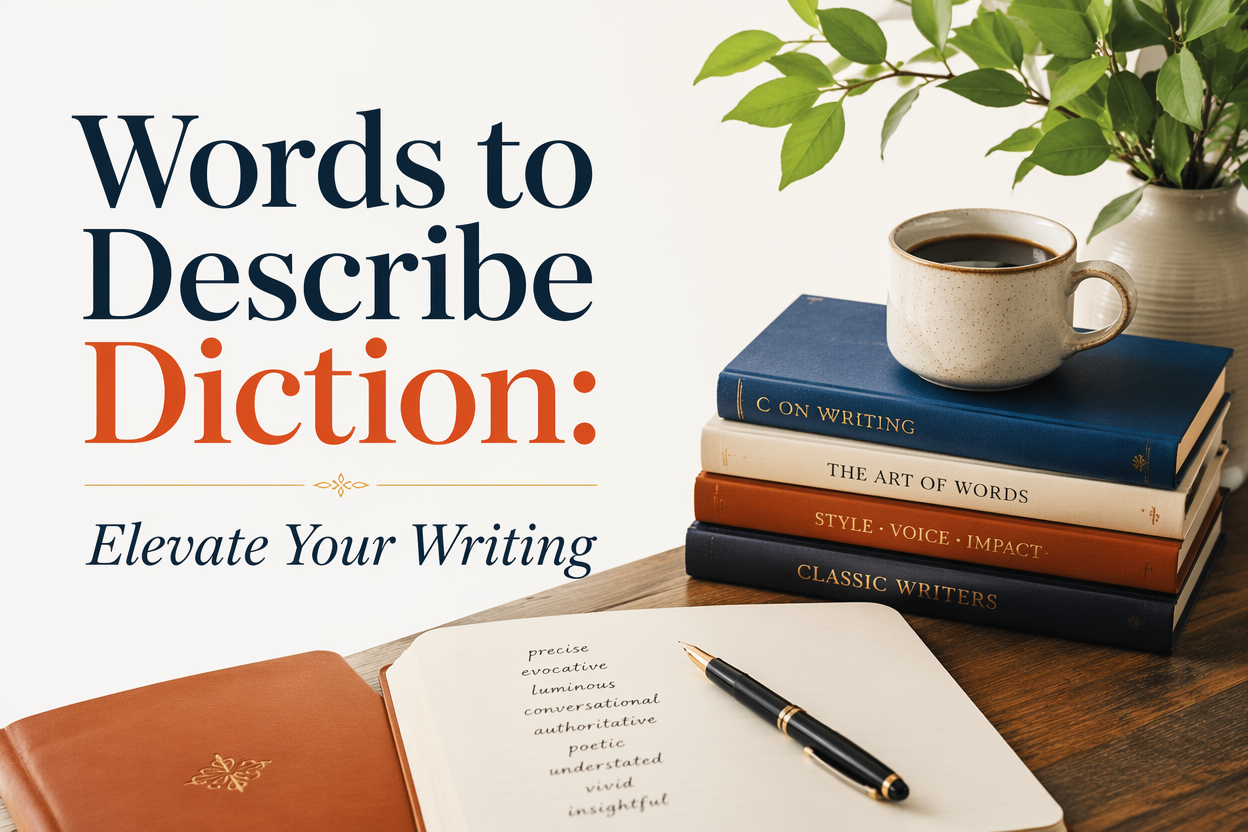
Most line edits I do go sideways for one reason: the writer keeps swapping in “better” words without deciding what kind of diction the book actually needs. Words to describe diction are useful only if you treat them as controls on a soundboard, not stickers you slap on a paragraph after the fact. When you name the quality you want on the page, you can revise with intention instead of chasing vibes.
Diction sits at the crossroads of voice, character, and reader trust. It’s the daily choice of plain vs. ornate, modern vs. old-fashioned, intimate vs. formal, specific vs. generic. You can have a brilliant plot and still lose readers if your word choices fight your genre promise or your narrator’s credibility.
I’m going to give you a working vocabulary for describing diction, then show you how to diagnose your current draft and revise it fast. This is craft that pays off in three places: on the page, in your sample chapters, and in your marketing copy where voice is often the only thing separating you from ten lookalikes in also-boughts.
Table of Contents
Diction As A Promise To The Reader
Before a reader knows your theme, they know whether your book sounds like a courtroom brief, a campfire story, a group chat, or a history lecture. They decide whether to trust you based on that signal.
This is why diction choices are not “style sprinkles.” They control pacing, clarity, and tone, and they shape how smart, funny, dangerous, tender, or reliable the narrator feels. In my experience, readers forgive many structural sins if the voice carries them. They quit fast when the diction feels incoherent, like the book can’t decide who it is talking to.
Diction And Genre Expectations
Every genre has a “normal” range of diction, and you can drift outside it on purpose. The problem is drifting by accident. For example, a cozy mystery often leans conversational and concrete, with light idiom and clean sentences. Epic fantasy tolerates higher formality and older phrasing, plus more elevated verbs and nouns. Meanwhile, contemporary romance usually rewards intimacy and immediacy, including contractions and sensory specificity.
If you write a hardboiled detective in ornate, lyrical diction, you are asking the reader to do extra work to reconcile the sound with the archetype. That can be a bold artistic move, yet it should be a deliberate move you commit to in every chapter, not a mood swing that shows up whenever you’re tired.
Diction And Narrator Credibility
Your word choices are part of characterization. For example, a teenage first-person narrator who uses clinical, abstract phrasing for emotions reads like an adult ventriloquizing a kid. A professor narrator who talks in vague, trendy slang can read like a writer chasing “relatable.” Those mismatches are small, but they add up.
One useful constraint is to build a “lexical budget” for the viewpoint character. Decide how many polysyllabic or domain-specific words they naturally use, what kind of metaphors they reach for, and what they avoid. Then revise to keep the budget consistent.
Diction And Cognitive Load
Readers can process only so much novelty at once. If your diction is dense and unfamiliar, your reader slows down. Sometimes you want that, like in a legal thriller deposition scene or a ritual incantation in fantasy. Most of the time you want the opposite because speed creates immersion.
The cognitive science term that matters here is “processing fluency,” which is strongly tied to judgments of ease, truthiness, and preference. A classic overview by Adam Alter and Daniel Oppenheimer in Perspectives on Psychological Science summarizes how fluency shapes what people believe and like. You do not need to turn your prose into baby talk, but you do need to know when your word choices are adding friction that pays you back.

A Working List Of Words To Describe Diction
When you can name what you’re hearing, you can revise with precision. I’m giving you a set of labels that editors and writers actually use, plus what each one tends to do on the page. Pick two or three that define your book’s default diction, and one “spice” label you use only in certain scenes.
Formality And Social Distance
Formal diction uses complete sentences, fewer contractions, and more institutional vocabulary. It creates authority and distance. It also risks stiffness in intimate scenes.
Informal diction uses contractions, idioms, and everyday phrasing. It creates closeness and speed. It also risks sounding careless if you overdo filler words.
Colloquial diction leans into regional or community speech patterns. It can be vivid and character-rich. It can also date your book fast if it depends on current slang.
Conversational diction mimics spoken rhythm without turning into a transcript. This works well in first-person and close third because it feels like a human is telling you something, not presenting an essay.
Time Flavor And Cultural Register
Contemporary diction sounds current, using modern phrasing and references. It reads fast and familiar, and it carries the risk of rapid aging.
Archaic diction uses older forms and vocabulary. It can add gravitas and worldbuilding in historical fiction or fantasy. It also becomes parody if you sprinkle “thee” and “forsooth” without a consistent linguistic system.
Elevated diction uses more literary word choices and carefully patterned sentences. It can heighten drama. It can also feel self-conscious if the viewpoint character would never think that way.
Clarity, Texture, And Precision
Plain diction prioritizes clarity and directness. It is not “simple” in the insulting sense. It is strategic. Plain diction shines in high-stakes scenes because readers never pause to decode.
Concrete diction names things you can see, touch, and measure. It anchors the reader in the scene.
Abstract diction leans on ideas and categories, such as “justice,” “freedom,” “betrayal,” or “happiness.” Abstract diction is useful in reflection and argument, and it can drain urgency if it replaces action.
Precise diction uses the exact word. “Scalpel” instead of “knife,” “chlorine” instead of “chemical smell.” This can signal competence and authority, especially in thrillers, sci-fi, and nonfiction. It also demands accuracy, so do not fake expertise you do not have.
Vague diction avoids naming. It often shows up when you are rushing or dodging a decision. Vague diction is the first thing I target in revisions because it is usually an easy fix with big payoff.
Emotional Temperature And Attitude
Neutral diction reports without much judgment. It can build suspense because it leaves room for reader inference.
Emotive diction conveys strong feelings in its word choice. It can increase intensity. It can also feel melodramatic if everything is “shattering” and “devastating.”
Humorous diction uses surprise, understatement, or sharp specificity. Humor is often a diction problem rather than a “joke” problem. The right verb does more than a punchline.
Clinical diction uses technical terms and detached phrasing. It can be chilling in horror or thriller. It can also create distance that kills romance and warmth.
Sound And Rhythm
Lyrical diction pays attention to sound, cadence, and image. It can be beautiful and immersive, especially in quieter scenes. It can also slow the pacing if it appears in action sequences.
Staccato diction uses shorter words and tighter syntax. It can speed a scene. It also becomes monotonous if it is your only mode of diction.
Ornate diction uses layered modifiers and rarer vocabulary. Used sparingly, it can heighten the ceremony or decadence. When used often, it reads like the book is trying to impress.
Diagnosing Your Draft Without Guesswork
Most advice on diction fails because it stays abstract. You need a diagnostic you can run on your own manuscript in an hour.
The Three-Page Voice Audit
Pick three pages from three different parts of your book. Choose one early, one middle, one late. Copy them into a separate document and mark them up.
Underline every word that feels “writerly” rather than necessary. Circle every vague noun, like “thing,” “stuff,” “situation,” “problem,” and every vague verb, like “got,” “went,” “did,” “felt.” Put a box around words that your viewpoint character would never say.
Now label the diction you actually wrote using the list above. Do it honestly. If page one reads as conversational and concrete, page two reads elevated and abstract, and page three reads clinical and formal, you do not have a style. You have a drafting voice that changes with your energy.
The High-Frequency Word Check
Run a word frequency list on your manuscript. Scrivener, Google Docs add-ons, and plenty of free tools can do this. You are looking for two things: your overused glue words and your accidental tonal tells.
Glue words are things like “just,” “really,” “very,” “suddenly,” “somehow,” and “seemed.” They are not sins, but they are often a sign you are narrating around the moment instead of writing it. Tonal tells are words that drag the voice into a register you did not intend, like modern slang in a historical voice, or corporate phrasing in a personal essay.
If you use Adazing tools like QuickWrite while drafting, you can capture your natural rhythm fast. I still recommend doing this frequency check in revision because speed drafting tends to repeat your favorite shortcuts.
The Read-Aloud Friction Test
Read a page out loud, then listen for where you stumble or lose breath. Those are diction problems more often than they are plot problems. You are hitting clusters of long words, stacked prepositional phrases, or abstract nouns that do not create an image.
When I edit my own work, I sometimes do this with text-to-speech because it removes my “author ear.” If the synthetic voice struggles, a human reader will skim.
Revision Moves That Change Diction Fast
You do not need to rewrite your novel to fix diction. You need repeatable moves that shift the register and clarity without flattening your voice.
Swap Weak Verbs For Specific Verbs
Verbs carry tone. For example, “walked” is neutral. “Stalked” adds menace. “Trudged” adds fatigue. “Drifted” adds dissociation. When you upgrade verbs, you often get to delete adverbs because the verb already contains the attitude.
Do this pass one scene at a time. Search for “was,” “were,” “went,” “got,” “did,” “felt,” and “looked.” You cannot delete all of them, and you should not try. Replace the ones that are doing important emotional work and failing.
Replace Abstract Nouns With Observable Detail
Abstract nouns are where manuscripts go to hide. For example, “Her anxiety spiked” can be fine. “Her tongue kept scraping her dry teeth, and she checked the door lock a third time” is a reader experience.
I use a simple rule. If the sentence names an emotion, belief, or theme word, I add one observable detail within two sentences unless the point is deliberate distance. This rule keeps the prose grounded without banning reflection.
Control Register With One Dial Per Scene
Register is the level of formality and specialization in your diction. Writers often shift register mid-scene when they switch from action to explanation. That shift is what makes a chapter feel uneven.
Pick one dial to turn per scene. You can decide that a negotiation scene is formal and precise, then keep the vocabulary tight and professional. You can decide that a breakup is informal and intimate, then keep sentences closer to speech rhythm. When you change the dial, do it at a scene break or a clear emotional turn.
Build A Character Word Bank
For major viewpoint characters, I keep a short list of words they would use and avoid. This list is not about catchphrases. It is about worldview.
A character who thinks in “systems,” “inputs,” and “failure points” is different from one who thinks in “luck,” “signs,” and “omens.” When you revise, you replace neutral words with the character’s natural vocabulary. That is how diction becomes voice instead of decoration.
Diction In Publishing And Book Marketing
Diction is not confined to chapters. It shows up in your blurb, your Look Inside sample, your ads, and even your author bio. If those pieces do not match your book’s diction, you attract the wrong readers and repel the right ones.
Reader taste is partly about story, yet it is also about language comfort. The Pew Research Center has tracked how reading formats and habits shift over time, and their data shows real variation in how people engage with books across demographics and formats. You can see the larger context in Pew Research Center’s Book Reading 2016 report.
Blurb Diction As Category Signaling
A blurb is not where you show off your prettiest sentences. It is where you sound like the book the reader already wants. If your novel is a snappy romcom and your blurb reads like historical lit fic, your conversion rate pays the price.
I recommend matching your blurb register to your first chapter register. If the opening is close, witty, and modern, your blurb should use similar sentence rhythm and word choices. On the other hand, if the opening is stately and mythic, your blurb should not crack jokes to chase clicks.
Sample Pages And The Three-Minute Decision
Retailers do not publish a universal statistic for how fast a buyer decides, and authors love to invent numbers here. I will keep this grounded. Amazon’s own documentation discusses that preview features like “Look Inside” affect shopping behavior because customers assess content and quality before buying. You can read that emphasis in Amazon Ads guidance on retail readiness, including previews.
In plain terms, your diction must do its job on page one. If you open with foggy abstraction or inconsistent register, you lose the reader who was already leaning toward yes.
Tooling That Helps You Stay Consistent
Consistency is the hard part when you draft fast across months. This is where tools help, as long as you know what you are trying to produce.
In Adazing’s QuickWrite, I like writing short “voice calibration” paragraphs before I draft a scene. I write five or six sentences in the exact diction I want for that chapter, then I roll straight into the scene while the rhythm is in my ear. When you come back after a week away, that calibration paragraph pulls you back into register faster than rereading ten pages.
If you also use generators for names or world terms, keep an eye on phonetics and register. A grimdark cast full of cute, bubbly names pushes diction and tone toward comedy even if your plot is bleak. Sound matters more than writers admit.
FAQs for Words to Describe Diction: Elevate Your Writing
How do I choose the right diction for my novel?
I start with three anchors: genre expectation, viewpoint character credibility, and scene pace. Pick two or three diction descriptors that define your default voice, like “conversational, concrete, modern,” then decide what moments earn a shift, like “elevated” for a ceremonial scene. Once you write those down, revise toward them instead of chasing “better words.”
What is the difference between diction and tone?
Diction is your word choice and register. Tone is the attitude those words convey, like tenderness, contempt, dread, or amusement. Diction influences tone, but they are not the same. You can write formal diction with a warm tone, and you can write informal diction with a cold tone.
How can I fix diction that feels inconsistent across chapters?
I run a three-page voice audit from different parts of the book, label the diction honestly, then pick a target register for each major viewpoint. After that, I revise in passes: verbs first, then abstract-to-concrete swaps, then a final pass for character word banks. This approach gives you consistency without sanding off your personality.
The Payoff Of Naming Your Diction
When you can describe your diction in a sentence, you can revise like a professional. You stop swapping random synonyms and start controlling distance, speed, emotion, and authority. Pick your default descriptors, run the three-page audit, and revise with a register dial in mind. Your voice will feel steadier, and your readers will feel the difference within a page.
