
There are words people mispronounce that become a reader-trust problem and a narrator-performance problem when both show up in places you cannot control, like audiobook production, podcasts, book clubs, and TikTok reviews.
I have watched a single mispronounced character name pull a listener out of a scene faster than a plot hole. On the page, your reader can glide past it. In audio, the word becomes a decision, and every decision has a cost.
You do not need to police every dialect difference, and you cannot prevent every misread. You do need a repeatable process for choosing pronunciations that fit your story world, then signaling those choices so readers and narrators do not have to guess.
Table of Contents
Why Mispronunciations Hit Authors Harder Than You Think
Mispronunciation is rarely about intelligence. It is about exposure. Reading gives people a private relationship with words, and that relationship creates confident wrongness. Merriam-Webster has pointed out that English spelling and pronunciation do not map cleanly, partly because the language pulls from many sources and keeps older spellings even after sounds change. That mismatch is a factory for mispronunciations. You can see the explanation in Merriam-Webster’s breakdown of why English spelling is so inconsistent.
For authors, the damage is specific. For example, a mispronounced term in your worldbuilding reads like sloppy research. A mispronounced surname can make it seem like you did not know your own character. A mispronounced real place name can tick off the exact readers you were hoping would champion the book.
And audio has raised the stakes. The audiobook market is large enough that narration choices can shape how the public says your words. The Audio Publishers Association tracks the format’s growth year after year. If you want the data trail, start with the Audio Publishers Association industry data page.
The Reader Trust Tax
When a reader encounters an unfamiliar word, they build a mental pronunciation. If your book later “corrects” it, whether by having a character say the word aloud or through an audiobook narrator choosing a different sound, the reader experiences friction. That friction is not catastrophic, but cumulative. It competes with the emotional momentum you worked hard to create.
The Audiobook Multiplier
On the page, “chitin” can be whatever the reader thinks it is. In audio, it becomes either “KAI-tin” or “KIT-in,” and both have defenders. If you do not decide, someone else decides for you, and the decision will be memorialized in reviews.
The Brand Consistency Problem
Series writers have an extra issue. If Book 1 trained the reader to say a name one way and Book 3’s audiobook says it another way, you get a tiny continuity error that feels like a big one. Continuity is not only about plot. It is also about sound.

How Readers Decide A Pronunciation In Their Heads
When you read silently, you still “hear” language. Cognitive scientists call this inner speech, and it plays a role in comprehension and memory. That is why a strange spelling can feel heavy on the eye and sticky in the mind.
Readers typically use three cues to pick a pronunciation. They use spelling patterns they already know, they use the linguistic neighborhood around the word, and they use genre expectations. Fantasy readers expect apostrophes and ancient-sounding vowels to behave a certain way. Romance readers expect certain surname patterns to suggest cultural origin. Thriller readers expect real-world brands and agencies to be spoken as if the news says it’s them.
Spelling Pattern Guessing
English readers lean on common letter-to-sound habits. That is why “epitome” gets pronounced as “EP-ih-tohm” by people who have only seen it in print, even though the standard pronunciation is “ih-PIT-uh-mee.” Merriam-Webster records the standard pronunciation and usage history in its epitome entry, and it is a classic example of print exposure outrunning audio exposure.
Context Guessing
Context can rescue you, but it can also mislead. Put “banal” in a literary paragraph and a reader may hear “buh-NAHL” in their head. Put it in a snappier contemporary voice, and they might say “BAY-nul” depending on the dialect they grew up with. Both exist in the wild. Your job is to choose the one that fits the voice and keep it steady.
Genre Training
If you write sci-fi, your audience is trained to accept invented terms, but they still want the terms to feel pronounceable. A name that looks like keyboard debris does not read “advanced civilization.” It reads “author did not test this out loud.”
The Mispronounced Words That Commonly Trip Up Writers
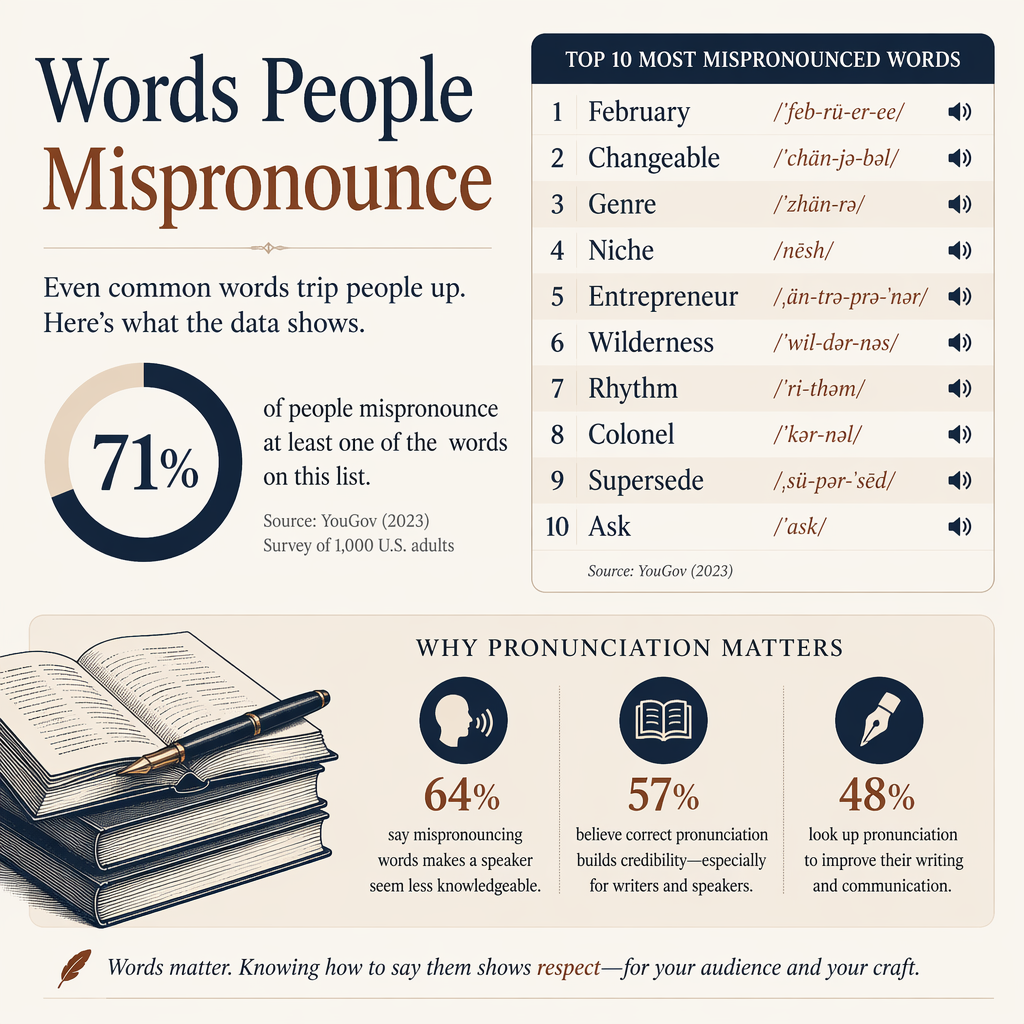
I am not interested in shaming anyone for saying a word differently. I am interested in the words that routinely create continuity problems, audiobook production headaches, and reader friction. Here are categories I see again and again, with examples you can actually use in your drafts and your style sheets.
Words Learned Mostly From Reading
These are the landmines because your most bookish readers are the most likely to have met them on the page first.
- Ephemeral (often becomes “ee-FEE-mer-uhl” instead of “ih-FEM-er-uhl”). If you care about standard pronunciation, check Merriam-Webster’s entry for “ephemeral“.
- Hyperbole (commonly “HY-per-bowl” instead of “hy-PER-buh-lee”). See Merriam-Webster’s entry for “hyperbole”.
- Segue (often “seg-yoo” instead of “SEG-way”). See Merriam-Webster’s entry for “segue”.
- Subtle (the silent “b” disappears for some speakers and shows up for others in careful speech). This word is more about performance than correctness.
These words often appear in author voice, narration, and nonfiction explanation. If your narrator trips, your authority takes a tiny hit, even when the content is strong.
Loanwords And Food Words That Get Mocked
Food words become social power plays, which is ridiculous considering most of us are just trying to order lunch. If you write contemporary fiction, these words show up in scenes because they are good props for character and class signaling. They also blow up in audio.
- Gnocchi (commonly “NO-chee” or “NO-kee” depending on exposure).
- Acai (commonly “ah-KAI” or “AH-sigh” depending on region and brand exposure).
- Quinoa (the old “kwin-OH-uh” or “KEEN-wah” argument that will outlive us all).
If a character corrects another character, that correction becomes a character moment. Use it knowingly. If you do it to show off, readers notice.
Place Names And Surnames With Local Pronunciations
Real-world place names are the fastest way to lose locals. The spelling is often not the pronunciation, and locals will defend the local sound with the energy of a sports rivalry.
- Worcester (in Massachusetts, “WUSS-ter” is what locals expect).
- Boise (you will hear “BOY-see” and “BOY-zee,” depending on the character’s background).
- Versailles (France vs Kentucky are two different words wearing the same letters).
If your book is set in a real place, an incorrect local pronunciation in the audiobook can pull locals out of the story and invite one-star “could not finish” reviews that were never about plot.
Science, Medicine, And Legal Terms That Readers Skim
Nonfiction authors and thriller writers get hit here. Readers skim technical terms, then narrators must commit to a pronunciation with no safety net.
- Cache vs cachet (people blend these constantly).
- Biome, biopic, biopsy (the “bio” vowel shifts, and readers often import the wrong one).
- Indict (the silent “c” bites people in performance).
If your book trades on expertise, wrong pronunciations can make a knowledgeable character sound like they are cosplaying competence.
How To Handle Pronunciation In Manuscripts Without Becoming Pedantic
You do not want your prose to turn into a pronunciation guide. You do want your production pipeline to have one. The best approach is to separate reader-facing cues from narrator-facing notes. Readers should feel guided. Narrators should feel supported.
Choose A Standard And Write It Down
If a word will appear more than once, or if it matters to the worldbuilding, decide the pronunciation before you publish. I keep a simple style sheet for every book that includes character names, place names, invented terms, and any real-world term I know gets argued about.
If you publish audio through ACX, Findaway Voices, or direct with a producer, that style sheet is gold. You hand it over at the start, and you prevent expensive pickups later.
Use Reader-Friendly Cues Inside The Scene
If you invented a name, you can guide pronunciation without brackets or phonetic symbols. You can do it with rhythm and parallel words. Put the name near a familiar word with a matching vowel sound, or have a character repeat it in dialogue in a way that naturally emphasizes the syllable you want stressed.
Example: If your character name is “Marin,” you can have someone say, “Marin, like the county,” if that fits the world. Or you can place it beside a word like “caring” or “sharing” if you want the “air” sound to echo subtly. You do not need to hammer it. You need to reduce guesswork.
Decide When Variation Is A Feature
Sometimes you want different pronunciations. For example, in diaspora stories, in regional fiction, in stories about assimilation, the way a name is said can be part of the theme. If that is your intent, signal it clearly and keep the variation consistent by character. Consistency is what makes variation feel purposeful.
A Simple System To Audit Your Draft For Pronunciation Traps
I treat this like any other editorial pass. You are hunting high-impact problems that will cause reader friction, audiobook errors, or public embarrassment in interviews.
The Out-Loud Pass
Read one chapter out loud and slowly, then circle every place you hesitate. Hesitation is your signal that a future narrator may hesitate too. If you do not have time, read only your first chapter and any chapter with heavy terminology, courtroom procedure, medical scenes, or invented languages.
The Narrator Sheet
Create a document with four columns: term, preferred pronunciation, notes, and source. For real words, I point to a dictionary entry. For names and places, I add a short note about cultural origin or inspiration. If you are writing a series, keep the same document across books so you do not drift.
If you are building a brand around your author name, pen name, or imprint, do the same for those. Podcast hosts will guess, and the internet will repeat the guess.
The Beta Listener Check
Text betas are useful. Audio betas catch different problems. Ask one friend to read a page aloud and record it on their phone. Do not correct them mid-stream. Listen for the words they stumble on or “solve” in an unexpected way. That is your data.
Tools That Keep You Consistent
This is one place where a little tooling saves your brain. I use Adazing tools when I am generating names or testing variations because it is easier to see patterns and duplicates at scale. If you use a name generator, do not stop at “cool.” Read the candidates aloud, search for real-world homographs, and run a quick “how do people say this” check before you fall in love.
If you draft quickly in something like QuickWrite, you can leave a simple marker such as “[pron]” next to a term you want to audit later. That keeps momentum while still protecting the final product.
FAQs for Words People Mispronounce
Should I add phonetic spellings in my novel for hard names?
I rarely recommend it inside the prose because it can feel intrusive. I prefer subtle in-scene cues and a clear pronunciation list for your narrator and your ARC team. If you have a strong reason, like a first-person narrator who would realistically spell out a name for comedic or character reasons, do it sparingly and keep it in voice.
Do I need to worry about “correct” pronunciation if English has many dialects?
You need to focus on consistency and intent rather than worry about the global standard. If a character is from Glasgow, their pronunciation choices should reflect that. If your nonfiction book is for a US audience and you will be on US podcasts, it is smart to align your own spoken usage with what that audience expects for high-visibility terms.
How do I prevent an audiobook narrator from mispronouncing my invented terms?
Give them a style sheet before they record, then ask for a short sample that includes the terms you care about. Catching one wrong syllable in a five-minute sample costs you nothing. Catching it after the full book is recorded can mean pickups, delays, and an understandably annoyed narrator.
The Real Goal For Pronunciation Choices
You are not trying to win an argument about how a word “should” be said. You are trying to reduce friction so your reader stays inside the dream of the story, and your narrator can perform without guessing.
Pick your pronunciations deliberately, document them once, and treat them like any other continuity rule. Your future self, your narrator, and your most attentive readers will notice the difference.
