
You can write a gorgeous plot outline, hit every beat, and still lose readers if they do not care about the person inside the problem. When authors ask, “Why are characters important to a story?”, I give the same answer every time: characters are the delivery system for meaning, tension, and feeling, and your plot is only as strong as the reader’s bond with the people living it.
That bond is not magic, and it is not luck. It is craft. You build it through desire, friction, choice, voice, and consequence, then you reinforce it scene after scene until the reader trusts you with their time and emotions.
I want you to treat character work as structural work. If your book has saggy middle syndrome, thin conflict, bland dialogue, or a blurb that reads like a summary, the fix is often character-focused, even when it looks like a plot problem.
Table of Contents
Characters As The Reader’s Reason To Keep Turning Pages
Readers keep reading for one reason: they want to know what happens next. Character is what gives that question teeth. For example, a car chase is noise until you know who is in the car, what losing means to them, and what they are willing to do to win.
In my editing work, I see authors over-invest in events and under-invest in the human engine that makes events matter. They outline external stakes, then forget to attach those stakes to an internal pressure that appears on the page. You feel this when a chapter ends, and the only hook is “then another thing happened.”
Desire Creates Narrative Gravity
A character with a clear want pulls the story forward. The want can be noble, petty, confused, or contradictory, but it has to be active. For example, “She wants to be safe” is passive unless safety requires a choice that risks something. “She wants to keep her sister out of foster care, even if it means stealing evidence from the precinct” is a want with teeth.
On your next scene, write one sentence that names what your viewpoint character wants before the scene ends. Then write one sentence that names what they fear will happen if they do not get it. If you cannot write those two sentences without squinting, your scene is running on fumes.
Stakes Are Personal Before They Are Global
World-ending stakes do not automatically create urgency. Personal stakes do. I have watched readers forgive improbable plots because the emotional logic stayed true to the character. I have also watched them quit “high stakes” stories because nothing felt intimate.
If you are writing epic fantasy, your war still lands hardest when it threatens the character’s identity, relationships, or core belief. If you are writing cozy mystery, the stakes still land when your sleuth risks losing her community or self-respect. The scale changes by genre; the personal cost does not.
Curiosity Lives In Contradiction
A character becomes sticky when the reader sees two truths rubbing together. For example, the principled prosecutor who hides a family scandal. The tender dad who cannot stop lying. The influencer who hates being seen. Contradiction creates questions, and questions create page turns.
Pick one core trait you are leaning on too hard, “brave,” “cynical,” “kind,” and add a counter-pressure that is equally real. Then force that contradiction to show up through action, not explanation, within the next three chapters.

Characters As The Engine Of Conflict And Tension
Plot conflict is character conflict with the volume turned up. When a story feels flat, it is often because the opposition is vague, interchangeable, or external-only. A storm, a villain, or a deadline can work, but tension stays alive when it comes from two wills that cannot both win.
I also see authors default to “misunderstanding” conflict because it is easy to draft. The cost is reader trust. If the entire book would collapse with a two-minute conversation, your tension is brittle.
Opposition Needs A Human Face
Your antagonist does not need to be evil, but they do need to be committed. Their goal should collide with the protagonist’s goal at the level of values and choices, not just logistics. For example, a rival chef who wants the same restaurant space is fine. A rival chef who believes your protagonist is poisoning the industry and wants to expose them is better. Now every decision has moral heat.
When revising, write the antagonist’s “because” sentence. If the answer is “because I am bad” or “because the plot needs it,” you have work to do. Give them a belief that would sound reasonable in their own mouth.
Pressure Tests Reveal Character Faster Than Backstory
Backstory explains. Pressure reveals. Under stress, characters default to habits, then adapt, then break. That sequence is what makes them feel alive. If your character stays competent, unflappable, and correct through every scene, you will get a clean manuscript and a bored reader.
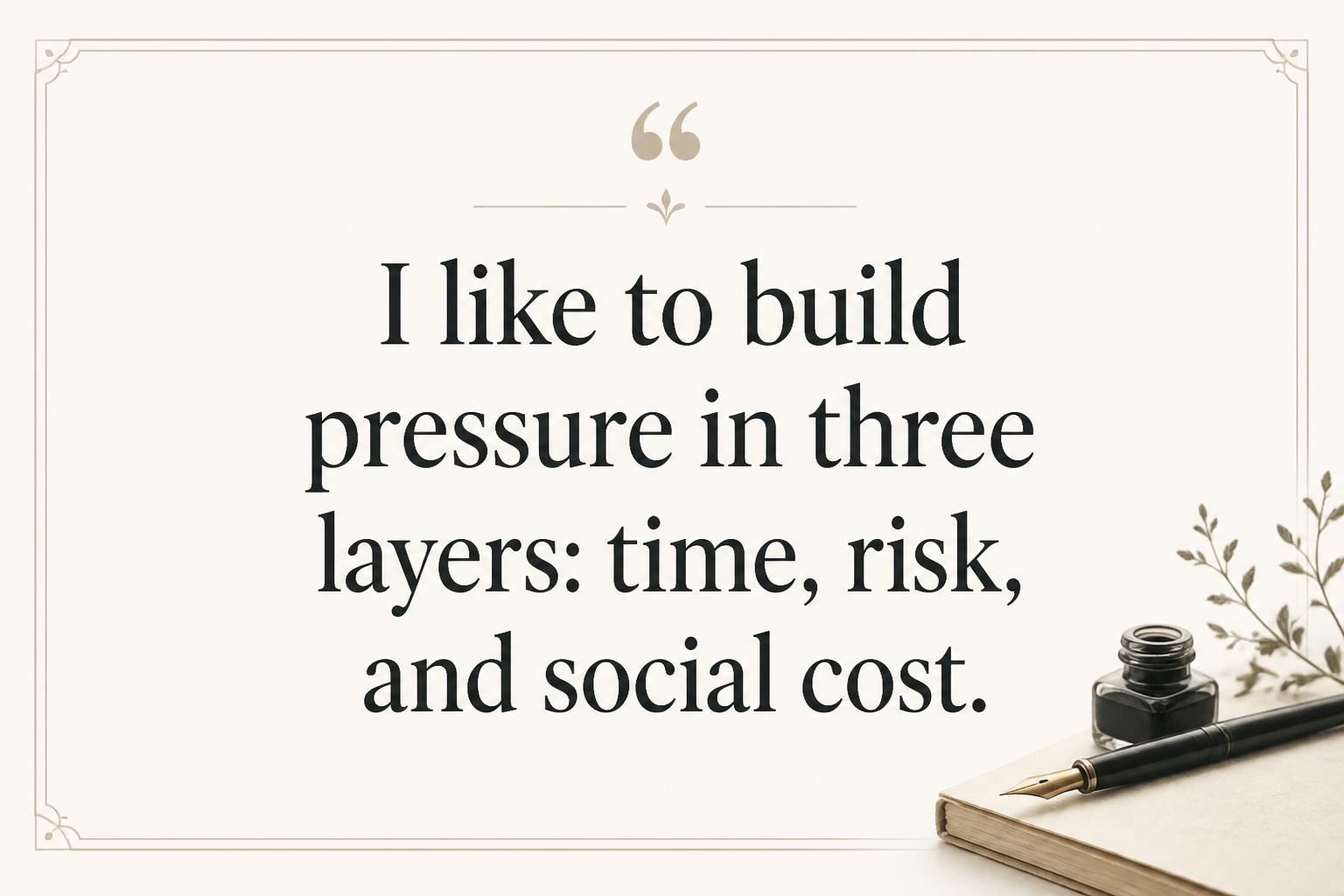
I like to build pressure in three layers: time, risk, and social cost. Time compresses options. Risk attaches consequence. Social cost threatens reputation, belonging, and love. Put at least one of those in every major scene, then watch what your character does with fewer “good” choices available.
Choices Create Tension Better Than Events
Events happen to characters. Choices belong to them. When you want a chapter to feel tense, put your protagonist in a position where every option costs something they care about. Then force them to act before they can gather perfect information.
To test your writing, highlight the decision points in your draft. If you do not see frequent moments where the character must choose, you are writing a sequence of happenings. Add decision points, and your plot will tighten without extra explosions.
Characters As The Vessel For Theme And Meaning
Theme is what your story keeps arguing about. Readers do not engage with theme because you wrote a wise line. They engage because a character’s choices force them to feel the argument. If your theme is forgiveness, you do not prove it with speeches. You prove it when forgiving costs the character pride, safety, or justice.
This is where authors either get preachy or get vague. Preachy happens when the author answers the theme on the page. Vague happens when the story never puts the theme under real pressure. The sweet spot is when the character’s lived experience keeps the question open until the end.
Theme Lives In Repeated Decisions
If your protagonist makes the same kind of choice in three different contexts, readers start to see what the story is about. The contexts escalate, and the cost grows. The pattern becomes meaning.
In your next writing, list three moments where your protagonist faces the theme. For a story about loyalty, that might be “lie to protect a friend,” “take blame for a colleague,” or “betray a mentor to save a stranger.” If you cannot list three escalating tests, your theme is probably decorative.
Belief Systems Beat Message Statements
I trust a character’s belief system more than any line of dialogue about beliefs. Show me what they rationalize, what they refuse, what they excuse, and what they cannot live with. That is theme in motion.
Write one paragraph in your notes that starts with “My protagonist believes…” Then add “because…” Then add “until…” That “until” is where your story begins.
Reader Empathy Tracks Moral Logic
Empathy is not agreement. It is understanding why a person did what they did. When readers bail on a character, it is often because the moral logic got skipped, not because the character did something dark.
If you want a character to do something questionable, build the chain of reasoning in visible steps. Do not rush from “she is stressed” to “she burns down the lab.” Put the smaller compromises on the page first, then pay them off.
Characters As The Tool For Memorability And Voice
In publishing terms, memorable characters drive word-of-mouth and read-through. Readers forget plots. They remember people. That is why fan art forms around characters, why review quotes mention names, and why series stick.
There is also a marketing angle authors ignore. Your cover, blurb, and Amazon Look Inside do their job when they imply a character readers want to spend time with. A book can be perfectly positioned in the right categories, then fizzle because the sample pages feel like a generic camera floating above events.
Voice Comes From Attitude Under Constraint
Voice is the character’s attitude toward what is happening, expressed through what they notice, what they ignore, and how they interpret pressure. Two characters can describe the same alleyway and give you two different books.
On the page, I look for three consistent signals: sensory bias (what they notice first), value bias (what they judge), and coping style (how they handle discomfort). Write a page of internal narration where your character encounters a problem and cannot fix it yet. Their coping style will show up fast.
Specificity Beats Quirk
Authors sometimes manufacture “memorable” with quirks, odd hats, catchphrases, unusual pets. Those things can be fun, but they do not replace a distinct value system and a pattern of choices. A character becomes memorable when they are specific in how they want, fear, and justify.
Take one character you worry is bland and answer these questions in your notes: What do they lie about? What do they brag about? What do they refuse to ask for? Then put one of those answers into a scene through behavior, rather than a confession.
Series Read-Through Depends On Character Appetite
If you write series, the best predictor of read-through is whether readers want more time with the lead, not whether your plot twists are clever. This is why some thrillers with simple plots still sell like crazy. The character has an appetite. Readers get addicted to watching them think, choose, and win or fail.
One practical move you can do is write a “series promise” sentence for your protagonist. “Every book, she will…” solve a kind of problem, confront a personal flaw, protect a relationship, chase a vice. If you cannot write that sentence, readers will have trouble predicting why they should buy book two.
Character Craft That You Can Apply In Drafting And Revision
Character advice turns useless when it stays abstract. Here is how I actually apply it when I am drafting, revising, or diagnosing a manuscript that is not landing.
The Three-Layer Character Blueprint
I build characters in three layers that interact on the page.
- Surface: Job, skills, habits, social role, how they speak when they want to be liked.
- Private: Shame, fear, secret desire, the story they tell themselves about why they are right.
- Core: A value they will not abandon without breaking, and the wound or history that formed it.
When a scene falls flat, I check which layer is actually present. If you are stuck in Surface, you get competent cardboard. If you are stuck in Private, you get introspective fog. If you are stuck in Core with no surface behavior, you get speeches. Put all three on the page through action and reaction.
Scene Questions That Fix A Sagging Middle
Mid-books sag when scenes do not change anything important. Character-based scene design fixes that. For each scene, answer four questions in one or two lines.
- What does the viewpoint character want in this scene, specifically?
- What stands in their way, and what does that opposing force want?
- What choice do they make under pressure?
- How does that choice change the next scene’s options?
If you cannot answer the last question, your scene may be a detour. Cut it, combine it, or rewrite it so the character’s choice closes one door and opens a worse one.
Dialogue That Carries Character Without Info-Dumps
Dialogue feels alive when each line has a goal. Characters speak to get something: approval, control, distance, reassurance, dominance, truth. When dialogue turns into a summary of backstory, the goal disappears and so does the tension.
When revising, label every line in a dialogue scene with the speaker’s intention in brackets in your private draft. If three lines in a row have the same intention, the exchange is probably looping. Change the power dynamic or add an interruption that forces a new tactic.
If you want help with the mechanics, Adazing tools can reduce the friction around character work. I have used name generators and word generators to avoid placeholder nonsense that drains energy from a draft, and writing tools like QuickWrite are useful when you need to keep forward motion as you test a new character voice. Tools will not invent your character for you, but they can keep you from stalling out on the small stuff.
FAQs for Why Are Characters Important to a Story? Unpacking Their Role and Impact
Can a plot-driven story succeed with simpler characters?
Yes, especially in fast genres where readers prioritize pace, like some action thrillers or high-concept mysteries. The trade-off is that your “simple” characters still need clear desire, consistent moral logic, and pressure-based choices. If you remove those, the story reads as events stapled together, and even plot-hungry readers start skimming.
How do I know if my character is strong enough?
I use three tests. First, can you describe what your character wants without mentioning the plot? Second, would your character still be interesting in a quiet scene where nothing explodes? Third, if you swapped your protagonist with another in-genre protagonist, would the story break? If the answer to that third test is no, your character is probably too generic.
What is the biggest character mistake you see in indie drafts?
The biggest one is mistaking backstory for characterization. Pages of history do not create attachment unless present-tense behavior shows the scar in the character’s choices. Put the past on the page only when it changes the character’s strategy in the moment, and you will feel your story tighten.
The Character Standard That Pays Off
Your reader does not buy a plot diagram. They buy time with a person who feels real enough to argue with, root for, and worry about. If you strengthen desire, opposition, and choice, your structure improves, your theme sharpens, and your marketing gets easier because you can describe your book through a compelling human problem.
Write fewer “things happen” scenes. Write more scenes where a character wants something badly, pays for a choice, and walks out with fewer comforting options than they had when they walked in.
