
Where to find beta readers is rarely your real problem. Your real problem is finding beta readers who can tell you the truth you need, in the format you can actually use, on a timeline that still lets you publish. You do not need a crowd. You need a small, reliable circuit that matches your genre, your goals, and your tolerance for blunt feedback.
I have watched authors collect twenty volunteers and still learn nothing because the questions were vague and the readers were mismatched. I have also watched authors work with three well-chosen beta readers and fix a book’s pacing, character logic, and opening hook in one revision pass. The difference is the quality of the ask and where you recruit.
I am going to give you the best places to find beta readers, what each place is good for, and the process I use to get usable notes rather than polite compliments and ghosting.
Table of Contents
Beta Readers Vs. Critique Partners Vs. ARC Readers
If you recruit the wrong kind of reader, you will be disappointed, and they will feel like they failed you. So I separate these roles before I post anywhere.
Beta readers react like ordinary target readers. They tell you where they got bored, confused, thrilled, or emotionally checked out. They are ideal for story logic, pacing, clarity, voice, and whether the promise of the premise pays off.
Critique partners are closer to colleagues. They look at craft at the sentence and scene level, spot patterns across your work, and often trade chapters over months. They are slower to recruit, harder to keep, and wildly valuable if you both write in adjacent lanes.
ARC readers read a near-final manuscript to leave reviews at launch. They can flag a typo or two, but if you are still fixing plot structure at the ARC stage, your production schedule is already in trouble. If you sell on Amazon, reviews matter, and Amazon itself frames why they matter for discovery and conversion in its own documentation on customer reviews.
The practical move is simple. Decide which of the three you need right now, then recruit for that role only. Mixing them creates confusion and resentment.

The Beta Reader Profile That Actually Helps
Most authors recruit “people who like to read.” That is like hiring “people who like food” to test a restaurant menu. You want readers who can finish books in your genre and can explain their reaction without trying to rewrite your voice.
Genre Fit and Reading Velocity
I look for readers who have read at least five books in my subgenre in the last year and can finish a beta read in two to four weeks. If you write cozy mystery, a reader who only reads grimdark fantasy will give you feedback that is technically sincere and practically useless.
If you are unsure what “fit” looks like, pull up your Amazon category, scan the top twenty covers, then read a handful of one-star and five-star reviews. Those reviews tell you what readers punish and what they reward. That is your beta reader job description.
Emotional Honesty Over Writing Advice
The best beta readers report their experience. They do not lecture you on what you “should” do as a writer. I would rather hear “I kept forgetting who Maya was” than “You need more characterization.” One is actionable. The other is a vague opinion wearing a trench coat.
Reliability and Boundaries
I ask one question before I send anything: “If you cannot finish, will you tell me by X date?” The right reader says yes without drama. Flaky readers do not become stable halfway through your manuscript.
Pay attention to how they communicate before you send pages. Slow replies, unclear answers, or guilt-driven enthusiasm are early warnings.
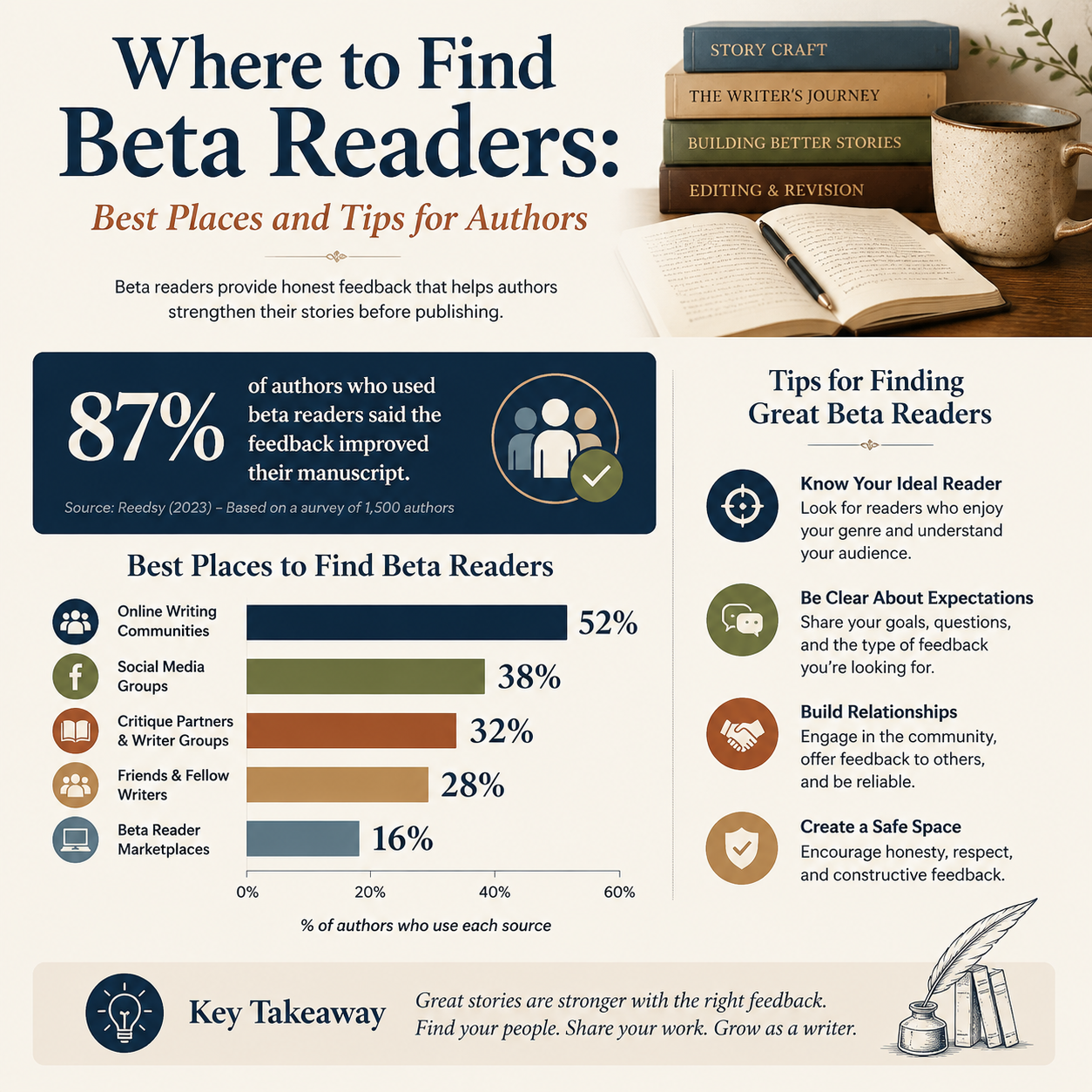
Best Places to Find Beta Readers Online
Online recruiting works because it lets you reach genre readers at scale. The weakness is that scale also attracts people who want free books more than they want to help you. I treat every platform as a fishing spot with a specific bait.
Genre Facebook Groups and Reader Communities
Facebook remains one of the best places to find active genre readers, especially in romance, fantasy, thriller, and cozy. The groups that work are reader-forward, not writer-promo dumps. Search for groups that use phrases like “Book Club,” “Reader Group,” “Street Team,” or “Advanced Readers.”
Post like a professional. Say what the book is, the subgenre, the heat level or content warnings if relevant, the expected timeline, and what you will provide in return. Return can be a free copy, a thank-you in acknowledgments, or a swap if you have time to read for them too.
Keep your request short and specific. Then take interested people into a private message to confirm fit and send a one-page beta-reader guide.
Goodreads Groups and Genre Forums
Goodreads is slower than Facebook, but the readers tend to be more bookish and more accustomed to discussing what worked and what did not. Look for groups related to your subgenre and participate for a week before asking for help. If your only footprint is “read my book,” you will get ignored.
If you are using Goodreads as part of a launch plan, remember that Goodreads runs on reader trust. A beta-reader post that feels like a marketing pitch lands badly there.
Reddit and Discord Writing Servers
Reddit can be excellent when you respect the rules and the culture. Subreddits like r/BetaReaders, r/writing, and genre-specific communities can connect you with serious readers, especially for speculative fiction. Read the posting rules carefully, include trigger warnings, and be clear about word count and timeline.
Discord writing servers can produce long-term critique partners, which is the real prize. The trade-off is time. You will need to show up, talk craft, and build rapport before asking strangers to spend ten hours on your draft.
Reedsy, Scribophile, Critique Circle, And Similar Sites
Workshopping platforms are great for feedback on excerpts and craft-level critique. They are less reliable for full-manuscript reads unless you already have relationships there. If you only need to test your first 10,000 words or your opening chapter, these sites can save you weeks of waiting.
I like them most for the “do readers understand what this book is by page five” problem. That problem kills sales because readers drop books early. Reader drop-off is not hypothetical, and Audible itself explains how completion rates factor into its system in its description of listening and returns policies. Platforms pay attention to whether people finish.
Best Places to Find Beta Readers In Person
In-person beta readers tend to be more reliable because social friction is real. People who have shaken your hand are less likely to vanish. The downside is that local groups can skew toward mainstream tastes, so you have to screen more carefully for genre fit.
Local Writing Groups With Genre Breakouts
Many writing groups have a mix of poets, memoirists, and novelists, all at different stages. That can be helpful for craft, yet it can distort genre expectations. If you write romance and your group hates romance, you will get advice that sandpapers off the exact thing your readers came for.
Use writing groups to find critique partners, then recruit beta readers elsewhere. Or recruit beta readers from the group only after you confirm they read your genre for fun.
Libraries, Bookstores, And Book Clubs
Librarians and bookstore staff know readers. If you are polite and realistic, they can point you toward local book clubs that match your genre. Do not ask a librarian to “find you beta readers.” Ask whether they know of a romance book club, a sci-fi club, or a thriller group that meets locally.
When you pitch a book club, offer an incentive that respects their time. A free copy is baseline. A short Zoom Q&A about the writing process after they read can be a bonus for those who are curious. Do not turn it into a sales event.
Conventions and Genre Meetups
Cons are expensive and loud, yet they are incredible for building a small circle of serious genre people. The readers who attend a fantasy con and line up for panels are the readers you want. If you attend, have a simple one-page handout with your book’s premise, comps, content warnings, and how to sign up.
If you want a no-fuss signup, use a simple form. If you already use Adazing tools for your author workflow, treat recruitment the same way you treat book production. Create one clean, reusable asset and keep it consistent across platforms.
How to Ask for Beta Reading Without Wasting Everyone’s Time
Most beta reads fail because the author sends a manuscript with no framing, no timeline, and no questions. Readers either drift away or they give you fuzzy notes because they do not know what you want.
The Beta Reader Invitation That Gets Yeses
I keep the invitation to five parts.
- What it is: title or working title, genre, subgenre, and word count.
- The promise: one sentence that states the hook in plain language.
- Time: a clear deadline with permission to decline.
- What feedback looks like: “inline comments optional, end-of-book notes preferred.”
- Boundaries: content warnings and whether the draft is rough or polished.
Notice what is missing. I do not beg. I do not apologize for needing feedback. I do not ask them to teach me how to write. I invite them to react as readers.
The Questions That Produce Actionable Notes
I send a short beta reader guide with targeted questions. If you ask, “What did you think?” you will get, “I liked it.” Your draft deserves better than that.
These are my go-to questions for fiction.
- Where did you feel tempted to skim, and what scene were you in?
- What did you think the book’s promise was by the end of chapter one?
- Which character felt most real, and which felt like they existed to move the plot?
- What was confusing, even if you eventually figured it out?
- Did the ending satisfy the story the opening promised?
For nonfiction, I swap in questions about credibility, structure, and application.
- What did you expect to learn, and did the book deliver it?
- Where did you doubt me, and why?
- Which chapter dragged, and what would you cut?
- What did you want an example of that I did not give?
- What did you do differently after reading, even in a small way?
Format, Tools, And Friction
If you want readers to comment, reduce friction. For example, Google Docs works well for many people. A Word file with Track Changes works for others. A clean EPUB on a Kindle is better for immersive reading, but worse for note-taking. Pick one primary format and one backup format.
My preference is to give beta readers an EPUB for reading plus a simple form for feedback. That keeps their experience close to how real readers will consume the book while still giving you structured answers you can sort.
If you are still drafting and you need help generating scenes or testing variations, I use tools to keep my creative momentum up before I send anything out. Adazing’s QuickWrite helps me get cleaner drafts on the page so my beta readers can focus on story problems, rather than typos and placeholders.
Paying Beta Readers and Building a Repeatable System
Free beta readers can be great. Paid beta readers can be great. The mistake is thinking “paid” automatically means “better.” Paying buys reliability and priority. It does not buy taste alignment, and it does not buy your reader understanding your subgenre.
When I Pay
I pay when the schedule is tight, when the book is a major release for me, or when I need specialized sensitivity feedback. If you are publishing on a rapid-release cadence, unpaid readers will struggle to keep up. That is not a moral failing. It is math.
If you hire a professional beta reader, ask for a sample of their feedback on a past book, ask what genres they read for fun, and ask how they deliver notes. If they cannot describe their process, you are gambling.
What To Offer When You Do Not Pay
If you are recruiting volunteers, reciprocity still matters. Offer something concrete.
- A finished ebook copy and a paperback at cost for those who want one.
- A name in acknowledgments, if they want it.
- A swap, only if you can truly deliver on time.
- Early access to the next book for readers who finish and give useful notes.
The readers you want are busy adults with big to-read piles. Treat their time like it matters, and they will treat your book the same way.
How I Turn Beta Readers Into A Launch Asset
A strong beta reader group often becomes the seed of an ARC team, and that turns into a stable launch crew over multiple books. I track who finishes, who gives actionable notes, and who communicates clearly. I do not track who flatters me.
Keep a simple spreadsheet with name, email, genre preferences, turnaround time, and the quality of their feedback. When you release book two, you will not be scrambling from zero again.
When you are ready to consider the reader-facing side, remember that beta feedback can improve the elements that sell the book. For example, a clearer hook helps your blurb. A stronger opening improves your Look Inside conversion. Better pacing increases read-through, which matters for series authors.
FAQs for Where to Find Beta Readers: Best Places and Tips for Authors
How many beta readers do you actually need?
I prefer three to seven for most novels. Fewer than three can leave you unsure whether a problem is real. More than seven often produces conflicting opinions that slow your revision. If you write epic fantasy at 200,000 words, you might need more attempts to get that many completions, since long books increase drop-off.
When in the process should you send to beta readers?
I send after I have a complete draft that I have revised at least once for big-picture problems. Beta readers are not the people you want for a messy, half-formed draft unless you explicitly recruit for developmental brainstorming. The cleaner the draft, the more their feedback targets story and structure.
What do you do when beta feedback conflicts?
I look for patterns, then I diagnose the underlying cause. If one reader hates your ending, it might be a matter of taste. If four readers say the climax felt rushed, that is a pacing issue you can fix. When feedback disagrees, I trust readers’ accounts of their experience, and I trust myself on the solution.
A Beta Reader Plan You Can Repeat
You will find beta readers faster when you stop recruiting “anyone” and start recruiting a specific type of reader for a specific job. Pick two online locations and one in-person channel, write a clean invitation, and screen for genre fit and reliability before you send your manuscript.
If you build a small roster and treat those readers well, you will not have to hunt from scratch for every book. You will have a system, and that system will improve your writing and steady your publishing schedule.
