
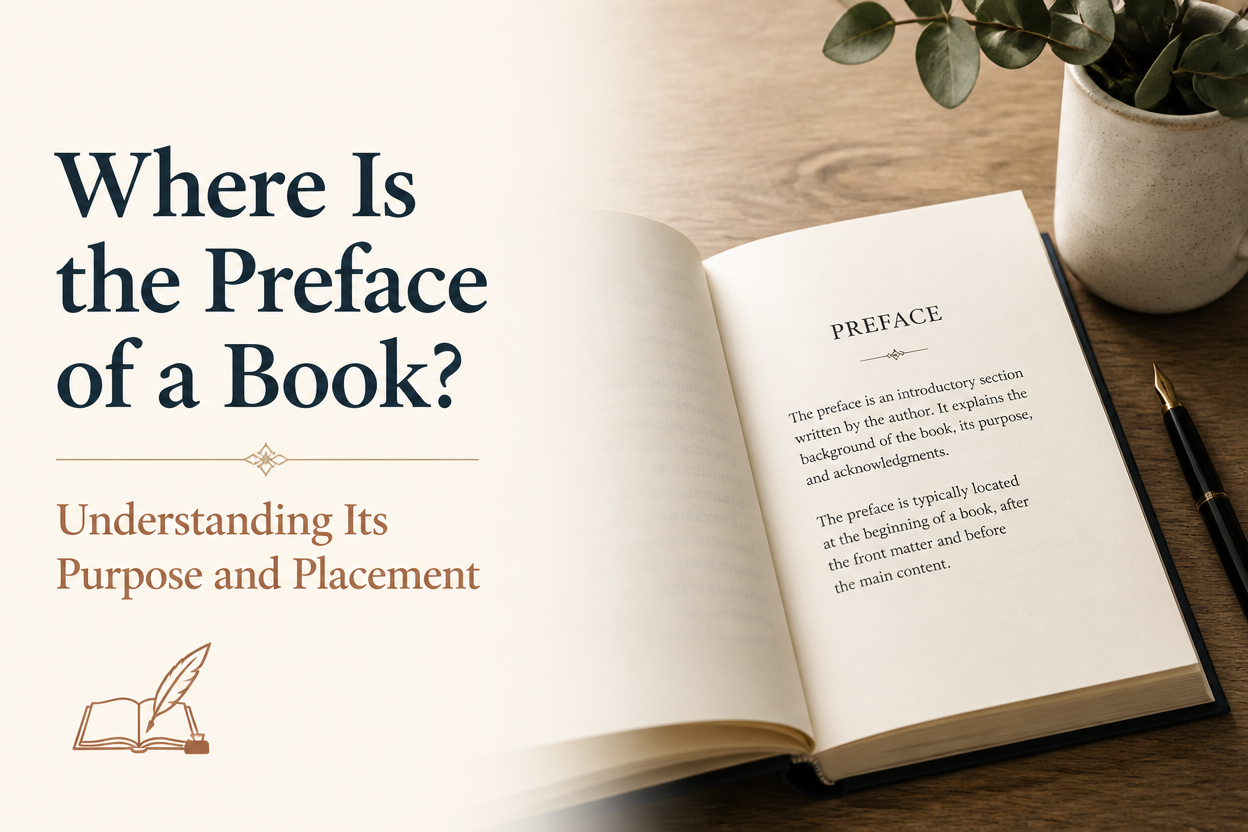
Where is the preface of a book? The answer is simple and consistent across modern publishing: the preface sits in the front matter, after the title and copyright pages, and usually before the introduction or the main text.
Placement matters because readers treat front matter like an on-ramp. If you put the wrong thing too early, you slow down momentum. If you put the right thing in the right place, you earn trust, give context, and get out of the way so the book can do its real job.
Here’s exactly where a preface typically goes, what it is for, when you should skip it, and how to write one that does not become a speed bump.
Table of Contents
Preface Placement in the Front Matter
A preface belongs in the front matter, which is everything before Chapter 1 or before the first page of the main content in nonfiction. In a standard order, your preface comes after the title page and copyright page, often after a dedication and an epigraph, and typically before an introduction.
If you are publishing on Amazon KDP, the “Look Inside” preview often shows some front matter, which means your preface may become part of the first impression. That is a reason to be intentional about length and relevance. A preface that reads like throat-clearing will push a browser toward the back button.
Typical Front Matter Order for Nonfiction
Here is the sequence I use most often for nonfiction when a preface is truly needed:
- Half title (optional)
- Title page
- Copyright page
- Dedication (optional)
- Epigraph (optional)
- Table of contents
- Foreword (if you have one)
- Preface
- Acknowledgments (sometimes here, sometimes in the back)
- Introduction (if your book uses one)
- Chapter 1
Some publishers put the table of contents after the preface. In my experience, that choice depends on genre norms and how much you need the reader to scan the structure early. For most practical nonfiction, I keep the table of contents early because it sells the roadmap.
Typical Front Matter Order for Fiction
Fiction rarely needs a preface. When it appears, it is often a framing device for a classic edition, a translated work, or a curated collection. If you are writing a novel and feel tempted to add a preface to explain the worldbuilding, that is a revision note, not a front matter feature.
If you do use one in fiction, place it after the copyright page and before the story begins. Keep it short and purposeful, then let the opening scene carry the weight.
Page Numbering and Formatting Expectations
Prefaces are usually numbered with lowercase Roman numerals (i, ii, iii) as part of the front matter, while the main text restarts with Arabic numerals (1, 2, 3). This is standard print convention and still useful in ebooks for clean navigation.
If you are building your interior in Word or Atticus, check the section breaks so the numbering restarts correctly. If you are producing a paperback through KDP or IngramSpark, your print PDF should show the front matter and body as distinct sections. Readers may not consciously notice, but they do notice when a book feels “off” in ways they cannot name.

What a Preface Actually Does for Your Reader
A preface explains the book’s origin, scope, and approach from the author’s perspective. It is not there to sell, not there to prove credentials, and not there to apologize for what the book is not. Your reader opens a book to get value or story. The preface earns its place by helping them get that value faster and with fewer wrong expectations.
Scope and Promise Clarification
The best prefaces answer practical questions that otherwise cause frustration halfway through the book. If your book uses a specific methodology, a nonstandard structure, or a particular definition of a contested term, the preface is where you set that expectation.
Example for nonfiction: If you wrote a productivity book that is intentionally “no apps, no planners, no color-coded calendars,” say so up front. You are saving the right readers time and preventing negative reviews from people who expected a tool roundup.
Reader Guidance for How to Use the Book
If your book can be read straight through or used as a reference, a preface can explain how you intended it to work. This is especially useful for cookbooks, workbooks, writing craft manuals, and books with exercises.
When I build author tools at Adazing, I think in terms of workflows. Your preface can do the same thing. Tell the reader how to move through the material, what to skip if they are advanced, and how to return to earlier sections if needed. That is useful. A five-page personal memoir about your motivation is usually not.
Context Without Spoilers or Biography Dumps
Context is good when it changes comprehension. Context is noise when it is a resume or a behind-the-scenes diary. If your book is about writing to market, then a note about the data sources you used belongs in the preface. If your book is a fantasy novel, your entire childhood love of dragons belongs in your newsletter welcome sequence, not in the front matter.
If you want to include a personal note, keep it tied to the reader’s outcome. One or two paragraphs can build rapport. Ten paragraphs will test their patience.
Preface vs Foreword vs Introduction
Authors mix these up constantly, and the confusion creates front matter bloat. Each element has a different job, and when you give one element three jobs, you get an unfocused mess that delays the reading experience.
Foreword
A foreword is written by someone other than you, usually a subject-matter expert, a well-known author in the genre, or a credible practitioner. Its job is social proof and framing. It says, “This book matters, and I vouch for it.” If you wrote the foreword, it is not a foreword.
Forewords tend to be short, and they are often signed with the foreword writer’s name and affiliation. If you can get a meaningful foreword from the right person, it can help sales in nonfiction and certain prestige fiction editions. If you can only get a generic endorsement, skip it and use a strong cover quote instead.
Preface
You write the preface yourself and focus on why and how the book came to be, along with any constraints, terminology, or approach the reader needs to know. It is about the book as a project and the reader’s expectations.
In craft terms, I treat the preface as the place to resolve confusion before it happens. It should reduce friction later in the reading experience.
Introduction
An introduction is part of the book’s argument or narrative. It pulls the reader into the subject, states the stakes, and sets up the journey. In many nonfiction books, the introduction does heavy lifting that authors mistakenly try to do in the preface.
If you write nonfiction, the introduction should read like the beginning of Chapter 1 in terms of momentum. The preface should feel like a quick orientation; then it gets out of the way.
If you are still uncertain which one you need, here is a clean diagnostic. If the material covers the book’s creation and its usage, it belongs in a preface. If it is about persuading the reader to care about the topic, it belongs in an introduction. If it is about someone else validating the book, it belongs in a foreword.
When to Include a Preface and When to Skip It
Prefaces are optional. Many strong books do not need them. The problem is that writers often add a preface because they feel they need to explain something they did not fully solve in the manuscript. Readers should not pay that cost.
Strong Reasons to Include a Preface
I recommend a preface when at least one of these is true:
- Your book has a specific method, vocabulary, or boundary that will confuse readers without a quick orientation.
- Your book is a new edition, so you need to explain what changed and who this edition is for.
- Your book has a nonstandard structure, like a modular “pick a chapter” design, and you need to teach the reader how to use it.
- Your book has sensitive context that affects interpretation, like a memoir with privacy decisions or a history book with sources and omissions clearly identified.
If none of these apply, I usually cut the preface and fold the useful parts into the introduction or the first chapter.
Common Reasons to Skip a Preface
Here are the prefaces that work against you:
- Prefaces that ask forgiveness for length, tone, or limitations. That is a confidence leak.
- Origin-story prefaces that read like a blog post about your process.
- Worldbuilding prefaces in fiction that exist because the opening chapters are not carrying their own clarity.
- Credential prefaces that try to win an argument by listing degrees and achievements rather than delivering value on the page.
If you are worried about credibility, use your author bio, your back cover copy, and your content itself. Readers trust specific, usable guidance more than they trust an impressive-sounding paragraph.
Trade-Offs for Ebooks and Audiobooks
Ebook buyers tend to sample before they buy, which means your preface can appear in the first screenful a reader sees. That can help if it is compelling and oriented around the reader. It can hurt if it delays the hook.
Audiobooks add another wrinkle. A preface read aloud feels longer than it looks on a page. If you’re planning an audiobook, keep the preface tight, or consider moving that content to a short “Author’s Note” at the end instead.
How to Write a Preface That Earns Its Pages
A good preface is short, specific, and useful. It respects the reader’s time and makes an honest promise that the book then keeps. When I edit prefaces, I am looking for one thing more than anything else: does this text reduce confusion and increase commitment, or does it simply delay the main event?
A Practical Preface Outline
If you want a structure that works in most nonfiction contexts, use this:
- One paragraph on who the book is for. Be concrete. Name the situation the reader is in.
- One paragraph on what the book covers and what it does not cover. Boundaries create trust.
- One paragraph on how to use the book. Read straight through, jump around, do the exercises, whatever fits.
- One short note on terminology, sources, or approach. Only what the reader needs to avoid misunderstanding.
For fiction, a preface rarely needs more than a paragraph or two. If you are writing a translated work, a historical edition, or a collection, keep the focus on context that affects reading.
Length and Tone Benchmarks
I aim for 300 to 800 words for most nonfiction prefaces. Longer can work in academic or historical contexts, but trade publishing has trained general readers to expect that the book starts soon after they open it.
Tone matters too. A preface should sound like you, but still like a book. If it reads like an unedited email to a friend, tighten it. If it reads like a grant proposal, loosen it.
Revision Checks That Catch Preface Problems
Before you publish, run these quick checks:
- Delete the first paragraph and see if anything breaks. If nothing breaks, you were warming up.
- Highlight sentences that begin with “I wanted,” “I decided,” or “I have always.” Keep only the ones that change how the reader will read the book.
- Search for spoilers. Prefaces sometimes drift into “here is everything that happens,” especially in memoir. Your reader should still be curious.
- Test it in your ebook preview. If your first pages are dedication, copyright, preface, and acknowledgments, your sample experience is doing you no favors.
If you are drafting a preface and you get stuck, this is where a focused writing tool helps. I use tools like Adazing QuickWrite for fast iterations because prefaces benefit from tight passes. You want clarity, not lyrical wandering.
FAQs for Where Is the Preface of a Book? Understanding Its Purpose and Placement
Does a preface come before the table of contents?
Usually the table of contents appears before the preface in practical nonfiction because the contents sell the structure and help navigation. Some publishers place the preface first, especially in literary or academic contexts. If your reader needs the roadmap early, put the table of contents first and keep the preface short.
Can I call it an author’s note instead of a preface?
Yes, and sometimes that label fits better, especially for fiction. An “Author’s Note” often signals a brief context note, research note, or sensitivity note without the formal feel of a preface. If the content is mainly usage guidance and scope, “Preface” is clearer for nonfiction.
Where does the preface go in an ebook on Kindle?
In Kindle ebooks, the preface still belongs in the front matter before the main text. Use KDP’s front matter settings and a clean table of contents so readers can jump to “Start Here,” “Introduction,” or Chapter 1. Also check your “Look Inside” experience because a long preface can push your hook out of the sample.
Conclusion
A preface belongs in the front matter, usually after the title and copyright pages, and it earns its place only when it helps your reader understand the book’s scope, approach, or intended use. If your preface is really an apology, a biography, or a patch for unclear chapters, cut it and fix the manuscript. When it is concise and reader-focused, it quietly signals professionalism that makes the rest of the book easier to trust.
