
Calling something a novella does real work for you, because it sets an expectation about pace, depth, and payoff. I see writers trip when they treat what makes a novella as a word-count trivia question, then wonder why the story feels either thin or bloated. A novella is a promise: you will deliver a concentrated, satisfying narrative arc without the sprawl of a novel.
If you write and publish your own work, the definition matters for practical reasons too. It affects pricing, format, category placement, and reader satisfaction. A reader who buys a novella expects a full story with a clean finish, not a “sample” and not a rushed novel.
Learn how to design a novella on purpose, draft it without padding, and package it in a way that sells cleanly on Amazon KDP and other storefronts.
Table of Contents
Novella Length Ranges That Actually Matter
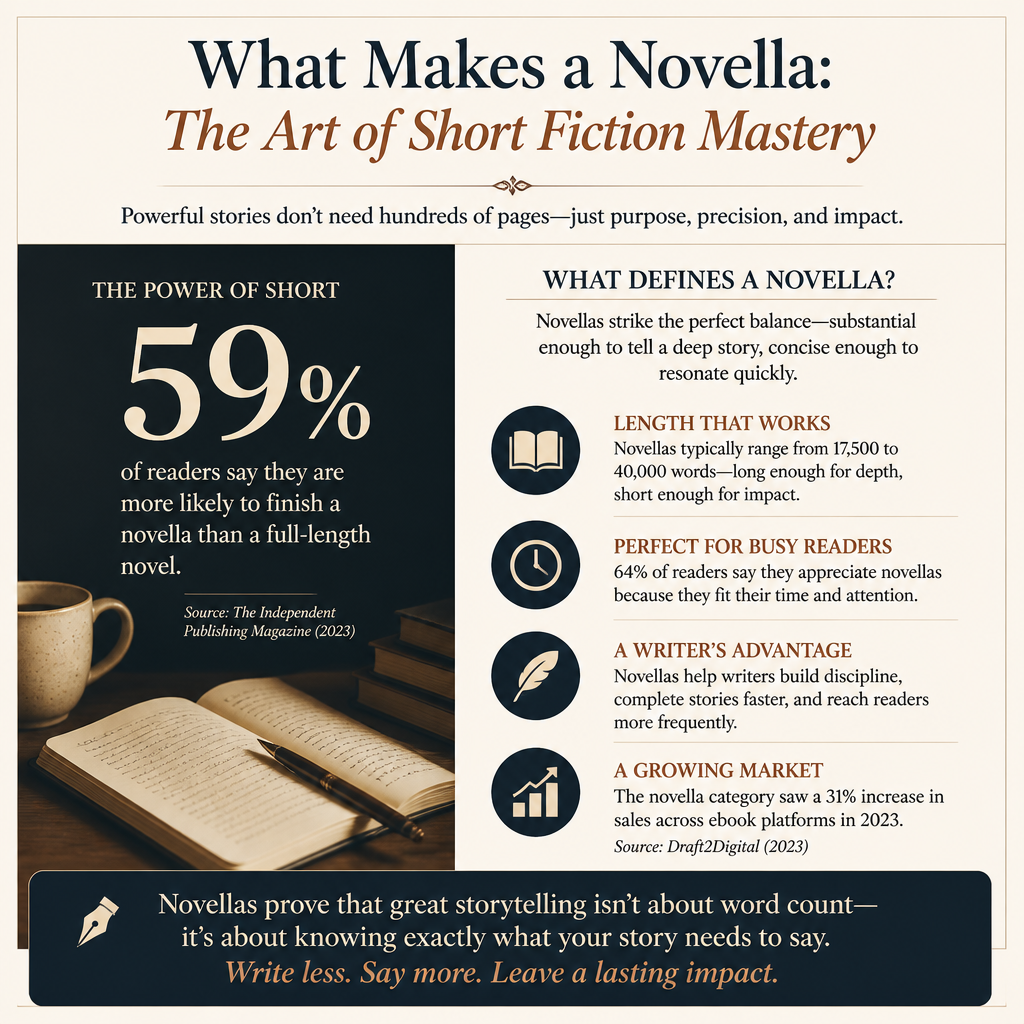
Publishers, awards, and readers all use slightly different yardsticks, so I treat length as a range plus a set of craft constraints. In my experience, most commercially viable novellas land between 20,000 and 45,000 words, with much of the genre work clustering in the high 20s to mid-30s. You can go shorter or longer, but the further you drift, the more you should question whether you are really writing a short novel or a long short story.
Industry Definitions You Can Cite
If you want a defensible definition, I point you to the groups that actually have to draw lines. The Science Fiction and Fantasy Writers Association Nebula Awards rules define a novella as 17,500 to 40,000 words. The Hugo Awards rules use the same 17,500-40,000 band. Those boundaries are not universal law, but they are widely recognized in genre circles and useful when you are positioning a book.
For authors, the more useful takeaway is that the market has already been trained to recognize that range as “a complete reading experience that is shorter than a novel.” If you call a 9,000-word piece a novella, you are creating friction for no benefit.
How Length Affects Pricing And Format
Length is not only a creative choice. It changes your unit economics. On Amazon KDP, ebooks priced between $2.99 and $9.99 qualify for the 70% royalty option in most territories if you meet the other requirements. In comparison, lower-priced books commonly fall into the 35% bracket. You can verify the current thresholds in Amazon KDP royalty options. That pricing reality is one reason many indie novellas get bundled into collections or sold as series “stepping stones” that push read-through.
Print changes the equation again, because a slim spine is harder to sell at a premium unless your audience already trusts you. If you plan a print edition, I recommend you check your target page count early, then design trim size and typography with intention.
A Working Rule I Use When Drafting
I plan a novella around the story load it can carry. If the premise needs multiple plotlines, a large cast with full arcs, and deep world infrastructure, it wants a novel. If it centers on one driving problem, one primary change in the protagonist, and a tight cast, it is likely a novella. Word count follows structure, not the other way around.

The Structural DNA That Separates A Novella From A Short Story
A short story often turns on one transformation, one revelation, or one decisive choice. A novella has room for a more complete chain of cause and effect. You still aim for compression, but you also give the protagonist time to make several meaningful decisions under escalating pressure.
When a novella fails, it usually fails in one of two ways. Either it reads like a short story that got inflated with extra scenes, or it reads like a novel that got chopped down, leaving the reader with missing connective tissue.
One Central Problem With Layered Complications
Pick one primary story question and protect it. Your protagonist wants one big thing, and the story is the attempt to get it. The complications can stack, the obstacles can change shape, and the moral cost can escalate. However, you keep the narrative aimed at that one target.
Here is a practical test I use when outlining. If you can summarize the plot as “A wants X, but Y,” and every major scene either advances A toward X or deepens Y, you are in novella territory. If you need three separate sentences to cover three separate plot engines, you are almost certainly building a novel.
A Cast Small Enough To Feel Inevitable
A novella supports fewer viewpoint characters and fewer major relationships, because every new character has a setup cost. That cost shows up as introductions, motivations, and reader memory load. In a novel, you can afford it. In a novella, that cost crowds out the forward motion that readers came for.
I recommend capping it at one viewpoint for most genres, or, if the story truly depends on it, stretching to two. If you go beyond that, you need to be ruthless about how much page time each perspective earns.
A Complete Arc With A Real Aftertaste
A novella ends with closure and resonance. It is not a teaser, and it is not a cliffhanger that exists only to force a sequel purchase. If you want to serialize, you still need each installment to feel like a finished meal, even if the series has an ongoing question in the background.
Readers forgive brevity. They do not forgive feeling cheated.
Pacing And Scene Economics In A Novella
In a novella, every scene has to earn its existence twice. It has to move the plot and deepen character, often in the same beat. If you write scenes that do only one job, you run out of runway fast.
Fewer Set Pieces, Better Chosen
A novel can contain a spectacular detour and still recover. A novella rarely can. I advise you to choose one or two major set pieces that define the reading experience, then build clean bridges between them. For example, in a thriller novella, that might be one break-in and one final confrontation. In a romance novella, it might be one irrevocable decision and one public moment of vulnerability.
If you find yourself planning five big sequences, you are either writing a novel, or you have not decided which moments actually matter.
Compression Without Confusion
Fast pacing is not the same thing as skipping. Readers need orientation, stakes, and cause-and-effect. The trick is to compress the transitions, not the logic. I often cut travel, greetings, and repeated explanations, then leave in the decisions and consequences.
When you revise, highlight the sentences that explain what the reader already inferred. Those are your first cuts.
Chapter Length And Rhythm For Binge Reading
Novellas get read in fewer sittings, so chapter rhythm matters. I like short, purposeful chapters that end with a choice, a reveal, or a shift in strategy. You do not need gimmicky cliffhangers. You need the feeling that the story is constantly tightening its grip.
If you are drafting in a tool like Adazing QuickWrite, use the speed to your advantage, then slow down in revision to tune pacing. Draft fast, revise surgical.
Choosing The Right Story For Novella Scope
The cleanest novellas start as novellas. Retrofitting a sprawling novel outline into 35,000 words is how you get hollow subplots and rushed endings. When I help authors diagnose scope, I look for a premise that naturally concentrates energy.
Premises That Thrive At Novella Length
These tend to work extremely well:
1) A single mission with a time limit. The clock does pacing work for you, and you do not need a giant supporting cast.
2) A contained setting. A snowed-in hotel, a generation ship corridor, a small town festival weekend. Fewer locations mean fewer scene transitions and less world exposition.
3) A relationship under pressure. Romance, mentorship, rivalry, partnership. The emotional line stays front and center while plot events force change.
4) A moral test. A protagonist faces a choice that costs them something real. That is novella fuel, because it rewards focus.
Premises That Usually Want A Novel
I get nervous when I see:
1) Multiple intertwined plotlines that need equal weight.
2) Big worldbuilding that requires history lessons to land emotionally.
3) A long “training” middle that exists to level up skills without immediate stakes.
You can sometimes pull these off at novella length, but you will need a very tight hand on scene selection and a willingness to imply rather than explain.
A Scope Filter You Can Use Today
Write a one-page outline with no more than eight major story beats. If you cannot get the whole story onto that page without shrinking the climax into a sentence, your story is larger than a novella. If the outline fits and still feels satisfying, you are on the right track.
Publishing And Marketing A Novella Without Underselling It
Novellas sell best when you present them as intentional. Readers do not want to feel like they are paying novel money for fewer words, and they also do not want to sort through your internal debate about what to call the book. Your packaging should signal “fast, complete, and satisfying.”
Positioning In Series And Read-Through Strategy
If you write series, novellas are excellent for read-through. You can use them as prequels, side stories, or bridge installments between major novels. The book needs a clean entry point, a satisfying arc, and a reason to continue. That reason can be character attachment, an unresolved larger conflict, or a teaser for the next premise. It should not be a chopped ending.
When you set up your also-boughts, use comp titles that reflect the reading experience, not just the genre. For example, a “cozy mystery novella” reads differently from a “cozy mystery novel,” and readers are very good at noticing when you overpromise.
Blurbs That Sell A Shorter Read
I write novella blurbs with momentum. Your blurb should foreground the hook and the stakes, then get out. If you try to justify the length, you create suspicion. If you keep the blurb focused on a single engine of conflict, the length feels like a benefit.
For those who want a simple blurb scaffold, I use this sequence: character plus want, obstacle with teeth, escalating consequence, and one question that forces the click. Then I stop.
Cover And Metadata Signals
Genre signaling matters more for novellas, because readers often buy them on impulse. Your cover should read cleanly at thumbnail size and should match the visual language of the category. If your typography disappears on a phone screen, you will lose clicks before your sample ever gets a chance.
Adazing tools can help here in a very practical way. If you use a cover maker, do a thumbnail test early and often, and compare it against the top 20 books in your Amazon category. If your cover looks like it belongs in a different aisle, fix it before you spend a cent on ads.
FAQs for What Makes a Novella: The Art of Short Fiction Mastery
How many words should a novella be?
I treat 20,000 to 45,000 words as the most common commercial range. If you want an industry line you can cite, both the Hugo Awards and the Nebula Awards define novellas as 17,500 to 40,000 words in their rules.
Can a novella have subplots?
Yes, but I keep subplots on a short leash. A novella can carry one strong main plot and one light secondary thread that directly tightens the main conflict or deepens the central relationship. If the subplot needs its own cast, arc, and resolution space, you are drifting into novel scope.
Should I label my book as a novella on Amazon?
If your audience expects that format, labeling it can reduce reader frustration and improve reviews. In other markets, it can lower perceived value, so test the language on your cover description and sales page. I often communicate length through positioning, like “a fast-paced standalone” or “a complete prequel,” while keeping the product description honest about the reading experience.
A Novella Is A Design Choice
A novella works when you commit to its constraints. Pick one central problem, keep the cast tight, choose a few set pieces that matter, and revise with a knife in your hand. If you do that, the length transforms from a limitation into a point, because you are giving readers a focused story they can finish in a night and remember a week later.
