
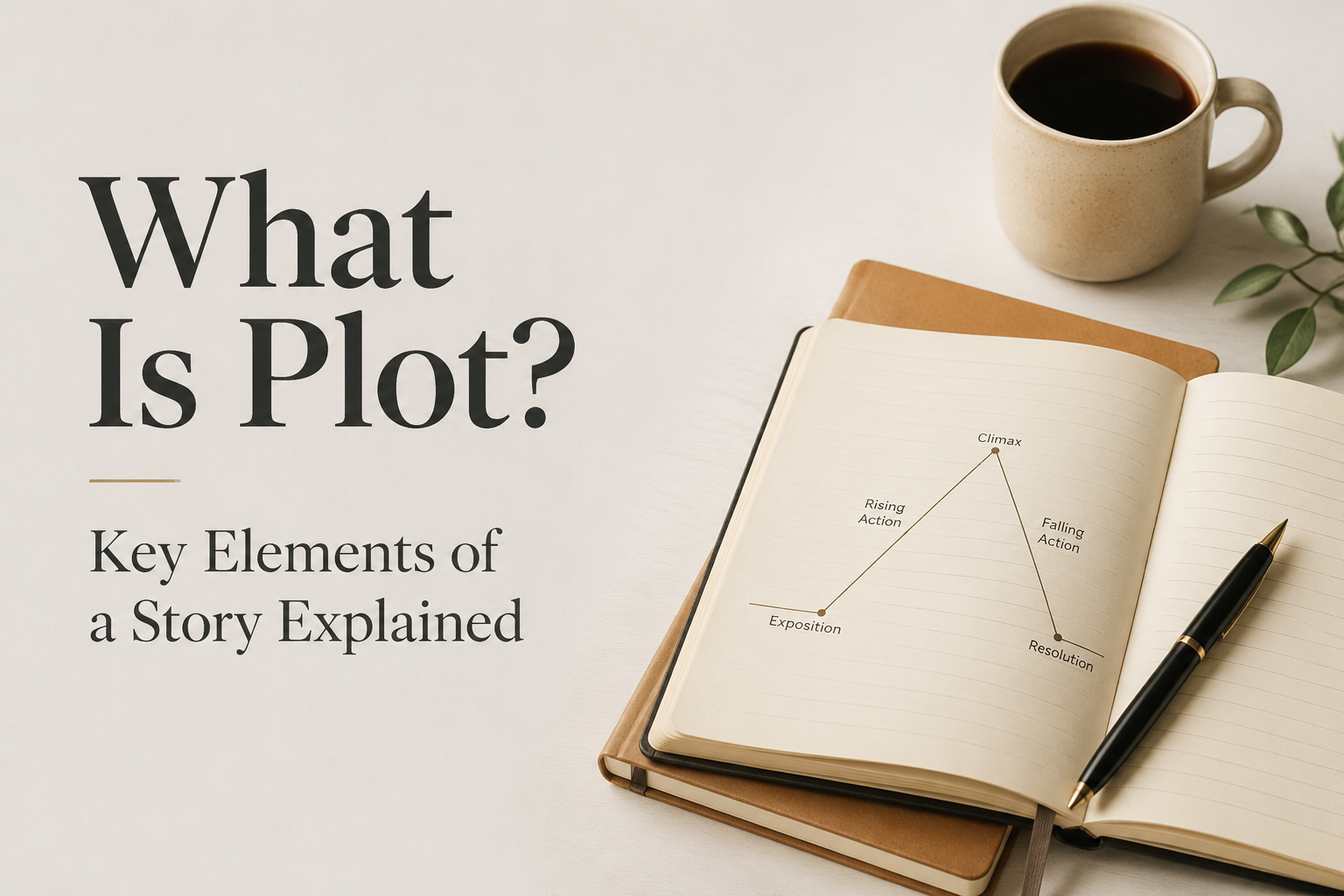
Most drafts wobble because the writer can’t answer “What is plot?” in one usable sentence, and the book pays for that confusion on every page. Plot is the chain of cause and effect created by a character pursuing a goal under pressure, where each choice produces consequences that force the next choice.
If you’re an author, that definition matters because it gives you something you can diagnose. When a scene feels flat, when the middle drags, when beta readers say they “lost interest,” the culprit is usually a cause-and-effect problem, not a prose one. Your story stopped forcing meaningful decisions, so the reader stopped leaning forward.
Here, I’ll break plot into the parts you can actually work with: goal, stakes, conflict, turning points, and resolution. You’ll also get a couple of practical checks I use when I’m outlining, revising, or trying to rescue a sagging second act.
Table of Contents
What Plot Really Does For Your Reader
Plot is the delivery system for emotion. You can write a gorgeous line, a sharp bit of dialogue, a compelling setting, and still lose the reader if nothing in the story creates a tightening sequence of consequences. Readers keep turning pages because they sense momentum. Momentum comes from problems that can’t be solved without cost.
When I’m editing fiction, I look for “because” and “therefore” links between scenes. If the best connective tissue you have is “and then,” you’re writing chronology, not plot. Chronology lists events. Plot makes events inevitable once the previous choice was made.
And plot is not the same thing as story. Story is the full experience: character, theme, voice, imagery, worldview. Plot is the spine that holds that experience upright. If the spine is weak, everything else has to work twice as hard, and you still get that familiar reader reaction: “It started strong, but…”
Plot Vs. Premise
Premise is your situation. For example, “A rookie mage joins a dangerous academy,” “A divorce lawyer falls for her opposing counsel,” or “A crew wakes up from cryosleep to find the ship off course.” These are premises, and they’re easy to pitch.
Plot begins when a specific character wants a specific outcome and takes a specific action that triggers consequences. If your outline is a list of cool situations, you have premise plus set pieces. To turn it into plot, you need decisions that narrow options and raise the cost of quitting.
Plot Vs. Theme
Theme is what your story is “about” at the level of meaning. On the other hand, plot is how you pressure-test that meaning. If you want to write about loyalty, do not write speeches about loyalty. Put loyalty in a scenario where staying loyal costs something real.
When theme feels preachy, it often means the plot is underpowered. If the events don’t force the character to choose, you end up telling the reader what to feel instead of making them feel it.
A Simple Diagnostic I Use
Pick any scene and answer three questions. What does the viewpoint character want in this scene? What stands in the way right now? What changes by the end of the scene that makes their situation harder, riskier, or more complicated?
If you can’t answer those cleanly, the scene may still be beautiful, but it’s probably not pulling its weight. Rather than adding more description, try sharpening the desire, the obstacle, or the consequence that forces a new decision.

The Building Blocks That Create Plot
Plot looks complicated when you stare at it as a whole. It becomes workable when you break it into components you can tune. I treat plot like a machine with a few necessary parts. If one part is missing, the whole thing sputters.
Character Goal
A goal gives the reader a yardstick. They can measure progress, setbacks, and risk. A good goal is concrete enough that a stranger can tell whether the character is closer or farther away.
“Find the killer” is a goal. “Find peace” is not a plot goal unless you can translate it into actions and measurable choices. If your goal is internal, anchor it to external decisions. For example, “stay sober through the trial” becomes plot when sobriety collides with temptation, secrecy, and high-stakes consequences.
Try this: Write the goal as a sentence that starts with a verb and ends with a deadline or constraint, like “Win the custody hearing before Friday” or “Steal the ledger before the gala ends.” Constraints turn desire into plot.
Stakes
Stakes answer the reader’s quiet question: “So what?” If the character fails, what happens that they cannot shrug off? Stakes can be personal, relational, professional, physical, spiritual. Whatever form they take, they still need teeth.
In my experience, writers often inflate stakes in narration and deflate them in scenes. They tell us “everything is on the line,” then the protagonist misses an opportunity and nothing changes. Stakes become real when failure has consequences that reshape the next scene.
Try this: For every major goal, write one consequence that hurts, and one irreversible consequence. “She loses her job” hurts. “She loses custody” is harder to undo. You do not need constant catastrophe, but you do need consequences that stick.
Conflict And Opposition
Conflict is pressure applied to a goal. Opposition is the source of that pressure. You need a form of “no” that has agency. For instance, a locked door is only interesting if the clock is ticking, the lock has a reason to exist, or someone is actively keeping it locked.
Opposition does not have to be a villain twirling anything. It can be a rival, a system, a relationship, a moral code, an addiction, a past mistake that won’t stay buried. What matters is that the opposition can push back in ways that force choices.
Try this: Write a one-sentence “opposition plan.” If your antagonist or opposing force has no plan, your plot will default to random obstacles. Even in literary fiction, some force obstructs the protagonist’s wants.
Consequences And Escalation
Consequences are where plot lives. A choice without consequence is flavor. A consequence without escalation is repetition. Escalation means the next problem costs more, limits options, or reveals a more serious threat.
One clean way to think about escalation is loss of resources: the protagonist loses time, allies, money, safety, reputation, certainty, or self-respect. Each loss should change what they can do next. When the character can keep behaving the same way forever, the middle becomes a treadmill.
Try this: List what your protagonist can “spend” in the story. Then track it like a budget through the draft. If they keep getting refunds, you are defusing your own tension.
How Plot Moves: Beats, Scenes, And Turning Points
Authors sometimes talk about plot as if it’s a single thing you either “have” or “don’t have.” Practically, plot is movement at multiple scales. You have micro-movement within scenes, medium movement across sequences, and major movement at turning points where the story shifts course.
Scene Goals And Scene Turns
A functional scene has a goal, conflict, and a turn. The turn is a change in value or situation: a new piece of information, a commitment made, a relationship altered, a plan blown up, a door opened that cannot be closed.
If your scenes end where they began emotionally and strategically, the book feels like it’s idling. If every scene ends with a cliffhanger, the book feels like it’s begging. I aim for scene endings that force a new choice. That creates propulsion without gimmicks.
Try this: Look at the last paragraph of each chapter. Identify the change that happened. If you cannot point to a change, rewrite the ending so the protagonist has to decide, do, or pay something before you cut to black.
Turning Points That Rewire The Story
Turning points are moments when the protagonist’s original plan stops working, and a new approach becomes necessary. In many genres, you can map them to familiar moments: inciting incident, first plot point, midpoint, second plot point, climax. I care less about the label and more about the function.
The midpoint is especially useful because it’s where many drafts sag. A good midpoint doesn’t just raise stakes; it changes the game. Either the protagonist learns something that makes their old strategy obsolete, or they cross a line that makes retreat impossible.
Try this: Write two sentences. “Before the midpoint, my protagonist believes ____ and tries ____.” “After the midpoint, my protagonist knows ____ and must try ____.” If those sentences are basically the same, your middle will feel long.
Pacing As Information Control
Pacing is often described as speed. I treat it as information control. You speed up by shortening the distance between decisions and consequences. You slow down by letting the reader process a cost, a realization, or a shift in the relationship.
If readers say the book is slow, it may simply mean they can predict outcomes too easily. Predictability kills tension faster than a slow scene does. Surprise does not have to be random. It should feel earned once it happens.
Try this: Mark every major reveal in your draft. Ask whether the reveal forces a new choice within a scene or two. If a reveal sits there like trivia, the plot did not absorb it.
Common Plot Problems And How I Fix Them
Plot trouble shows up in recognizable patterns. The fixes are also recognizable, which is good news when you are staring at a messy draft and wondering whether you have to start over. Most of the time, you do not.
A Passive Protagonist
If things keep happening to your protagonist, readers feel unmoored. A passive protagonist can work in specific designs, like satire or certain tragedies. Still, even there the character is usually choosing something, even if it’s self-destruction.
I fix passivity by giving the protagonist a decision that creates immediate fallout. A strong early decision teaches the reader what kind of book this is. It also gives you a clean chain of consequences to follow.
Try this: In the first 10 to 15 percent of the book, force a choice that burns a bridge. If your character can undo it in the next chapter, it is not doing enough work.
Meandering Middle
The middle meanders when the protagonist’s goal is vague, the opposition is fuzzy, or the consequences reset. Subplots can enrich the middle, but they cannot replace forward motion. If the main plot is stalled, extra side quests read like avoidance.
One fix I use is a “deadline plus cost.” I add a time pressure that matters, then attach a cost to delay. Deadlines aren’t only for thrillers. A romance has one. A literary novel has one too. If the reader can’t feel time narrowing, tension dissipates.
Try this: Write the midpoint and second plot point as transactions. “At midpoint, the protagonist pays ____ to gain ____.” “At the second plot point, the protagonist loses ____ and is forced to ____.” If you cannot write those, the middle likely lacks escalation.
Coincidence And Plot Armor
Coincidence can start a story. It rarely sustains one. Readers will tolerate bad luck and surprising complications. They will not tolerate a protagonist who wins because the world bends in their favor.
Plot armor shows up when consequences don’t land. For instance, the hero gets caught and is released; the secret is revealed, and everyone shrugs, or the plan fails, and nothing is lost. That pattern teaches the reader that nothing matters, which is the fastest way to kill suspense.
Try this: Pick one place where you protected the protagonist. Remove the protection and write the fallout. Your draft will get harder and better.
Plot Tools I Actually Use While Writing And Revising
Plot advice becomes useful when it turns into repeatable tools. I rely on a few methods that keep me honest. They work whether you outline aggressively or you discover the story as you draft, and they adapt across genres.
The Cause-And-Effect Outline
I outline in “because” language, for example: “Because she lies to her sister, the sister cuts her off,” or “Because the crew takes the salvage job, they inherit a tracker.”
When you write the chain this way, weak links stand out.
If you can’t write the “because,” you probably have a jump in logic or a missing scene.
Try this: Write a one-page outline where every line starts with “Because” or “Therefore.” If you find yourself writing “Meanwhile” repeatedly, you are drifting into parallel events without consequence.
The Scene Triage Pass
When I revise, I do a pass where I label every scene as one of three things: advances the goal, complicates the goal, or pays off a cost. If a scene does none of those, it belongs in a different book, or it needs surgery.
That does not mean every scene must be high action. A quiet conversation can complicate the goal by revealing a lie, shifting an alliance, or forcing a painful promise. Quiet scenes still need movement.
Try this: Paste your scene list into a document. Add a one-sentence “change” line under each scene. If you cannot write the change, you found your revision map.
Tools That Help You Draft Faster Without Losing Control
When you are managing a plot, you are also managing your own attention. Drafting gets easier when you remove friction. That is where I like having practical tools around.
At Adazing, I point authors toward tools that support craft decisions rather than replace them. If you are drafting and you keep stalling on the next beat, a focused writing tool like QuickWrite can help you stay in the scene long enough to find the turn. If you are building a cast and your names keep sounding like placeholders, Adazing name generators are a simple way to avoid breaking your own immersion. Those are small aids, yet small aids are often the difference between finishing a draft and “almost finishing” one for three years.
Try this: Set a rule for your next drafting session. You do not stop a scene until you write the turn. If you get stuck, write a temporary line in brackets and keep moving. Revision is where you perfect; drafting is where you generate consequence.
FAQs for What Is Plot? Key Elements of a Story Explained
Is plot the same as structure?
No. Structure is the pattern you use to organize plot events for effect, like three-act, five-act, Save the Cat beats, the hero’s journey, or a non-linear design. Plot is the cause-and-effect chain of decisions and consequences. You can tell the same plot in different structures, and you can use the same structure to tell wildly different plots.
Do character-driven novels need plot?
Yes, they need plot even more, because “character-driven” is often used as permission to drift. A character-driven novel still depends on goals, obstacles, and consequences. The difference is that the consequences tend to be relational or psychological, and the turning points often involve identity, trust, or moral compromise rather than explosions.
How do I know if my plot twist is fair?
A fair twist is set up in hindsight. The reader may not predict it, yet once it lands, they can see the breadcrumbs. The simplest test is to reread the scenes that precede the twist and check whether the twist changes their meaning without contradicting them. If you have to hide information the viewpoint character would reasonably notice, you are writing a cheat rather than a twist.
A Plot Definition You Can Write With
Plot is a chain of consequences driven by a character’s pursuit of a goal under pressure. That pressure forces decisions that narrow options over time. If you treat plot as cause and effect on the page, you will diagnose problems faster and revise with more confidence. Start with one scene, pin down the goal, sharpen the opposition, and end with a change that forces the next choice. Do that repeatedly, and the whole book starts to hold together.
