
A finished manuscript still leaves many authors asking, “What is copyediting?” especially after they have already revised the plot, tightened the argument, and corrected obvious typos. Copyediting is the line-by-line editorial work that makes your prose correct, consistent, clear, and appropriate for its intended reader. It deals with grammar, punctuation, spelling, word choice, continuity, fact checking, and the small habits that can make a polished book feel careless.
Copyediting matters because readers notice friction even when they cannot name it. A character’s eye color changes between chapters, a historical term appears before it exists, or a sentence forces the reader to reread it. Each problem interrupts the reading experience and chips away at your authority as an author.
I treat copyediting as a separate pass from developmental editing and proofreading. You need the story or argument settled before someone spends time refining every sentence. Once the larger decisions are stable, copyediting gives your manuscript the control and consistency it needs for publication.
Table of Contents
Copyediting And Your Manuscript
Copyediting sits between big-picture revision and final proofreading.
- A developmental editor looks at structure, pacing, character arcs, chapter order, argument, and audience.
- A copyeditor works inside that structure, checking whether each sentence says exactly what you intend and whether the manuscript follows a consistent set of rules.
The Chartered Institute of Editing and Proofreading’s page on copyediting describes copyediting as work that makes a text fit for purpose, with consistency, clarity, and language appropriate and understandable for the likely reader, achieved through vocabulary, grammar, and punctuation choices that bring clarity. That definition covers fiction, memoir, business books, academic work, and practical nonfiction, although the editor’s priorities shift by genre.
For example, in a mystery novel, I pay close attention to clues, timeline, names, and the order in which information reaches the reader. In a memoir, I check chronology, tense, place names, and claims about real events. In a business book, I look for repeated concepts, unsupported assertions, jargon, and examples that have aged since the first draft.
Copyediting also protects your voice. A good editor does not sand every author into the same smooth, neutral style. The editor should preserve deliberate fragments in dialogue, regional speech, unusual rhythm, and genre-specific language. The question is whether a choice appears intentional and consistent. For example, a strange sentence can be vivid. An accidental sentence creates doubt.
Three Levels Of Editorial Work
Authors often use editing terms loosely, and that creates expensive confusion. Ask an editor to define the service in writing before you agree to a fee. The same word can mean a light clean-up to one freelancer and a deep line edit to another.
Developmental Editing
Developmental editing addresses the book’s architecture. For fiction, the editor may examine the central conflict, stakes, character motivation, the purpose of the scene, pacing, and ending. For nonfiction, the focus may fall on the promise of the book, the order of ideas, evidence, chapter usefulness, and the distance between the manuscript and the reader’s actual questions.
You need this work when readers lose track of the plot, the middle drags, the chapters duplicate each other, or the book’s promise remains unclear after several drafts. Copyediting cannot repair a missing motivation or a weak argument with punctuation changes.
Line Editing
Line editing works at the level of style and reader experience. It examines rhythm, repetition, transitions, tone, imagery, paragraph movement, and sentence energy.
A line editor may suggest a sharper verb, remove a vague phrase, or rearrange a paragraph so the important idea arrives sooner.
Line editing can overlap with copyediting, especially on a literary or voice-driven project. The distinction helps you understand where each editor puts the emphasis: line editing asks how the prose sounds and moves; copyediting asks whether the prose is correct, consistent, and clear within the rules of the book.
Proofreading
Proofreading happens after the manuscript has been designed or formatted. A proofreader checks the pages as they will appear to readers, including page breaks, headers, folios, widows, orphans, image placement, table of contents entries, and remaining typographical errors.
A proofreader can catch a missing word. However, proofreading should not become a late developmental rewrite. For a print book, proofread the PDF created from the final interior file. For an ebook, inspect the actual EPUB or platform preview, as reflow can create problems that never appeared in the source document.
What A Copyeditor Checks
A copyeditor’s work has several connected parts. You can use the same categories during your own revision. However, a second set of eyes will catch patterns you have stopped seeing.
Grammar And Sentence Clarity
Grammar gives readers a reliable path through your meaning. A copyeditor checks subject and verb agreement, pronoun reference, modifier placement, verb tense, sentence boundaries, parallel construction, and confusing transitions. The editor also tests whether a sentence says what the surrounding paragraph requires.
Consider this sentence: “After reviewing the manuscript, the deadline seemed impossible.” The opening phrase appears to modify “the deadline,” leaving the sentence without a person doing the reviewing. A copyeditor might revise it to “After reviewing the manuscript, I realized the deadline was impossible.” The revision identifies the actor and removes the unintended comic image of a deadline reading a book.
In fiction, grammar still has to serve character and scene. A narrator may use an incomplete sentence to show panic, and a teenager’s dialogue may contain slang. I would preserve those choices when the manuscript establishes a pattern and the choice carries meaning. I would question them when they appear once because the author lost control of the sentence.
Punctuation And Usage
Copyediting includes commas, apostrophes, quotation marks, hyphens, capitalization, numerals, and abbreviations. It also includes usage decisions such as affect versus effect, lie versus lay, and fewer versus less. While style guides provide a shared reference, they cannot decide every artistic question for you.
The Chicago Manual of Style is a common reference for book publishing in the United States, especially for nonfiction and general trade manuscripts. Fiction publishers may follow Chicago with house preferences, and academic, technical, or legal books often follow a specialized guide. Ask your editor which guide applies before the edit begins.
Consistency matters more than collecting rules. Decide whether your book uses toward or towards, email or e-mail, numerals or spelled-out numbers, and single or double quotation marks for a given purpose. Record those decisions in a style sheet so you can apply them across chapters.
Continuity And Factual Detail
Continuity errors pull readers out of the book because they break the story’s internal contract. A copyeditor tracks a character’s age, clothing, injuries, travel time, family relationships, technology, and knowledge. For nonfiction, the editor checks names, dates, terminology, quotations, source references, and the relationship between claims and evidence.
A style sheet helps with this work. I use sections for character and place names, timeline, capitalization, spelling, numbers, recurring terms, and unresolved questions. A simple entry such as “Mara’s left wrist was injured in chapter 4; do not use right wrist later” can save you from a continuity error that readers will spot immediately.
Fact checking has limits. An editor can flag a date that conflicts with a historical record or a medical claim that needs support. You still own the final decision and responsibility for the content. For a nonfiction book, keep source notes organized from the first draft so the copyeditor can investigate a claim without reconstructing your research from scattered browser tabs.
A Repeatable Self-Edit Pass
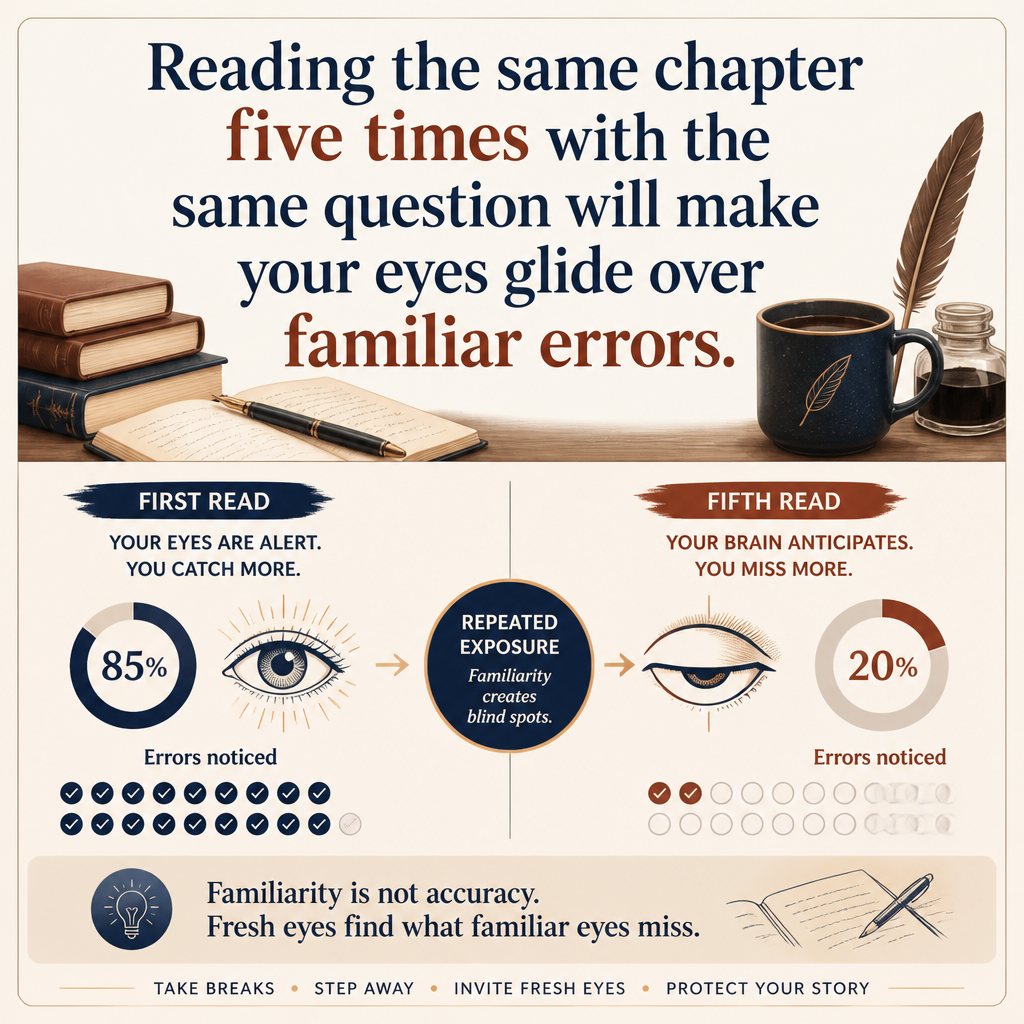
You can find many copyediting problems before hiring an editor, and doing so gives the professional a cleaner manuscript to work on. I recommend several passes with a different purpose for each. Reading the same chapter five times with the same question will make your eyes skim past familiar errors.
Read For Patterns
Search your manuscript for words you overuse. Common examples include just, very, really, suddenly, then, felt, began, and looked. None of these words is automatically wrong. Repetition becomes a problem when the same filler appears every few paragraphs or when a stronger verb hides behind a weak construction.
Read dialogue aloud. Your ear will catch repeated sentence openings, speeches that sound too similar, missing contractions, and exposition disguised as conversation. Mark places where every character uses the same vocabulary and sentence length. Give each important character a few distinct habits, then remove any habit that turns into a parody.
Build A Style Sheet
Create a document before your final copyedit. Include the spelling of names, capitalization choices, timeline facts, preferred spellings, number treatment, punctuation preferences, technology, measurements, and terms that carry special meaning in your book.
- For a fantasy novel, add invented words, geography, titles, magical rules, and pronunciation decisions.
- For a cookbook, add ingredient formatting, measurements, temperatures, and recipe sequence.
- For a memoir, add people, places, dates, and any details that require confirmation.
Your style sheet turns hundreds of small decisions into a manageable reference.
Use Software With Judgment
Grammar tools can flag patterns, repeated words, missing punctuation, and possible agreement errors. They cannot reliably judge irony, voice, subtext, dialect, or whether a deliberate rule break belongs in the scene. Treat the suggestions as questions, not commands.
Adazing’s writing tools, including QuickWrite, can help you generate alternatives when a sentence feels flat or repetitive. I still recommend making the final editorial choice yourself. While software can offer a cleaner verb or a new phrasing, only you understand the character, argument, and promise behind the sentence.
After the software pass, read the manuscript in a different format. Send it to an e-reader, change the font, or print a chapter. A visual shift breaks the familiarity that causes you to read what you intended rather than what the page actually says.
Hiring And Working With An Editor
A professional copyeditor earns the fee by bringing distance, consistency, and trained attention to a manuscript you know too well. Your job is to hire for the kind of book you wrote. A brilliant romance editor may lack the right instincts for a technical manual, and a meticulous academic editor may flatten a comic voice.
Ask for a sample edit of 1,000 to 2,000 words from the actual manuscript. Request the edited passage, comments that explain larger concerns, the editor’s estimate of the work involved, and the style guide they plan to use. A sample shows you whether the editor understands your voice and whether the level of intervention fits your needs.
Ask what the fee includes. Editors may charge by the word, page, hour, or project. Clarify whether the price covers one pass, a response to your questions, a style sheet, fact checking, references, and a second look after revisions. A low quote can become expensive when the scope remains vague.
Give your editor the manuscript in a stable format with chapter titles and page numbers. Include your genre, target audience, publication plan, deadline, style preferences, and any known problem areas. Tell the editor whether you want a light copyedit that preserves rough edges or a heavier edit that questions sentence construction throughout.
Expect to make decisions. You do not have to accept every change, and you should understand each change you reject. A professional editor offers judgment, not ownership of your book. Discuss recurring disagreements early so that the final pass is following a clear standard.
Budget also affects the right choice. A full professional copyedit may be beyond reach for a first book, especially at novel length. You can copyedit in stages, hire help for the opening chapters and a style sheet, trade manuscript reads with trusted authors, or use software for a preliminary pass. Give priority to errors that affect meaning, continuity, credibility, and reader trust.
FAQs for What is Copyediting? A Simple Guide to Perfecting Your Manuscript
How Much Does Copyediting Cost?
Copyediting prices depend on word count, manuscript condition, genre, deadline, and the editor’s level of involvement. A clean 60,000-word romance manuscript requires a different amount of work from a dense 60,000-word technical book. Ask for a sample edit and a written scope before comparing quotes.
Should I Copyedit Before A Beta Reader?
Send beta readers a readable manuscript, though you do not need to pay for a final copyedit before gathering reader feedback. Beta readers should focus on plot, pacing, character, argument, or usefulness. After you revise from their comments, hire a copyeditor for the stable manuscript. A final proofread follows formatting.
Can I Copyedit My Own Book?
You can catch many errors through separate passes, read-aloud work, search tools, and a detailed style sheet. Familiarity will still hide mistakes, especially in passages you revised many times. For a professional release, pair your own work with an outside reader or editor when your budget permits.
Give Your Manuscript A Controlled Finish
Copyediting makes your manuscript easier to trust. It protects meaning, preserves voice, and removes the small errors that interrupt a reader’s attention. The work begins with a stable draft, a defined style, and a clear understanding of the service you need.
Build your style sheet, run separate self-editing passes, and hire a copyeditor whose experience fits your genre. Then review every suggested change as the author. Your name stays on the cover, so your judgment belongs in the final line.
