
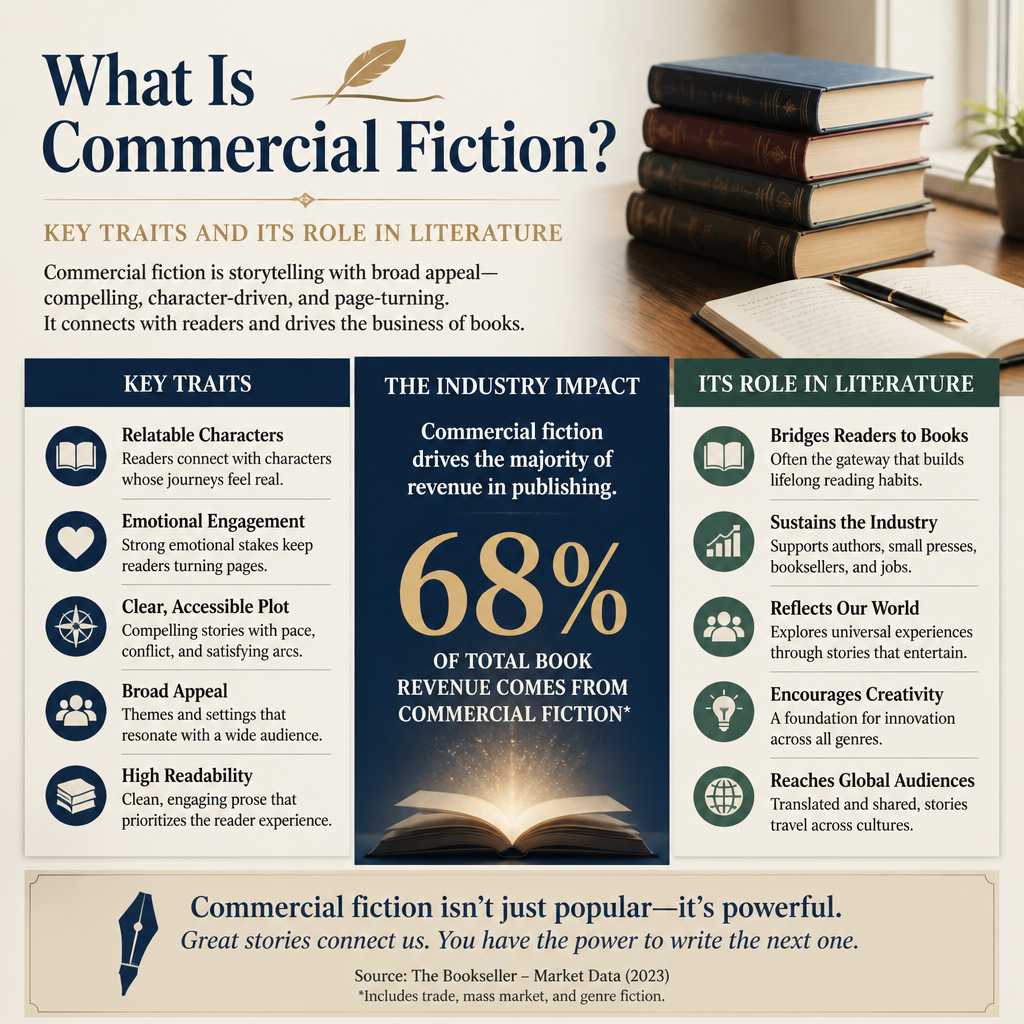
Every author eventually has to answer “What is commercial fiction?” because the label affects your story decisions, your cover, your pitch, and the readers you hope to reach. Commercial fiction is written for a broad audience and shaped around the reading experience that audience expects. It aims to attract attention, create momentum, and deliver a satisfying experience within a recognizable genre.
That description says nothing about quality. A commercial novel can have elegant prose, moral complexity, and serious literary ambition. Its commercial purpose means the author has designed the reading experience with discoverability and reader satisfaction in mind. I see this distinction matter most when writers mistake accessibility for shallowness and then bury a strong story under slow openings, vague positioning, or a cover that signals the wrong genre.
For an independent author, commercial fiction gives you a useful way to make creative decisions. You can write the book you care about, then identify the promises your ideal readers expect and deliver those promises with skill. The work starts with understanding the form, then continues through structure, genre signals, packaging, and marketing.
Table of Contents
Commercial Fiction Starts With Reader Demand
Commercial fiction begins with a relationship between story and reader expectation. For example, a mystery reader expects a question worth solving, escalating danger, and a meaningful reveal. A romance reader expects an emotionally credible relationship arc and a satisfying commitment. A fantasy reader expects a speculative world with rules, pressure, and consequences.
These expectations give you a contract with the reader. You can bend the contract through voice, setting, structure, or theme. However, the central pleasure still needs to arrive. For example, a mystery without a compelling mystery creates frustration. A romance that ends before emotional resolution feels unfinished. A thriller that spends 100 pages delaying the first serious threat has a marketing problem before it has a prose problem.
Genre Promise And Reader Trust
Genre fiction is commonly defined through conventions that help readers recognize the kind of experience a book offers. Encyclopaedia Britannica’s overview of literary genre describes genre as a distinctive type or category of literary composition. Critics’ attempts to systematize these categories must retain a degree of flexibility, since the categories can break down on closer scrutiny. Those conventions give your book a place on a bookstore shelf, a digital sales page, or a recommendation list.
I recommend writing down the promise of your genre in one sentence before you revise. For a psychological thriller, you might write, “A vulnerable protagonist uncovers a hidden threat before the person behind it destroys her life.” Every major scene should increase danger, reveal information, deepen suspicion, or force a choice connected to that promise.
Accessibility And Depth
Commercial writing needs a clear reading path. Readers should understand who wants what, what stands in the way, and why the outcome matters. You can still write layered characters and complex themes. However, the reader needs enough orientation to keep moving through the complexity.
When I edit a commercial manuscript, I check whether the first chapter delivers three signals: a specific point of view, an immediate source of tension, and a question that creates forward motion. A beautiful opening that offers none of these signals asks the reader to do unpaid editorial labor. Give your first chapter a situation that changes the character’s day and creates a consequence for the next scene.

The Core Traits Of Commercial Fiction
While commercial fiction varies by genre, successful examples tend to share a working set of traits. The story has a defined audience, a clear central engine, recognizable genre signals, and a payoff that respects the reader’s investment. These traits affect every layer of the book, from the first sentence to the product description.
A Strong Central Premise
A commercial premise can usually be explained in a sentence with a protagonist, a goal, an obstacle, and meaningful stakes. For example, “A chef opens a restaurant” gives you a situation. “A disgraced chef has six weeks to save her family’s restaurant by winning a televised cooking contest run by her former mentor” gives you a story engine.
Your premise should create more than an interesting setting. It should produce choices, so ask what your protagonist must pursue, what force makes that pursuit difficult, and what loss follows failure. Then test the premise against your genre. For instance, a romantic suspense premise needs both relationship pressure and danger. Removing either one changes the book’s identity.
Forward Momentum
Commercial readers tend to reward movement. That movement can come from plot events, emotional changes, discoveries, escalating risk, or a deadline. A quiet scene earns its place when it changes the reader’s understanding of a character or alters what can happen next.
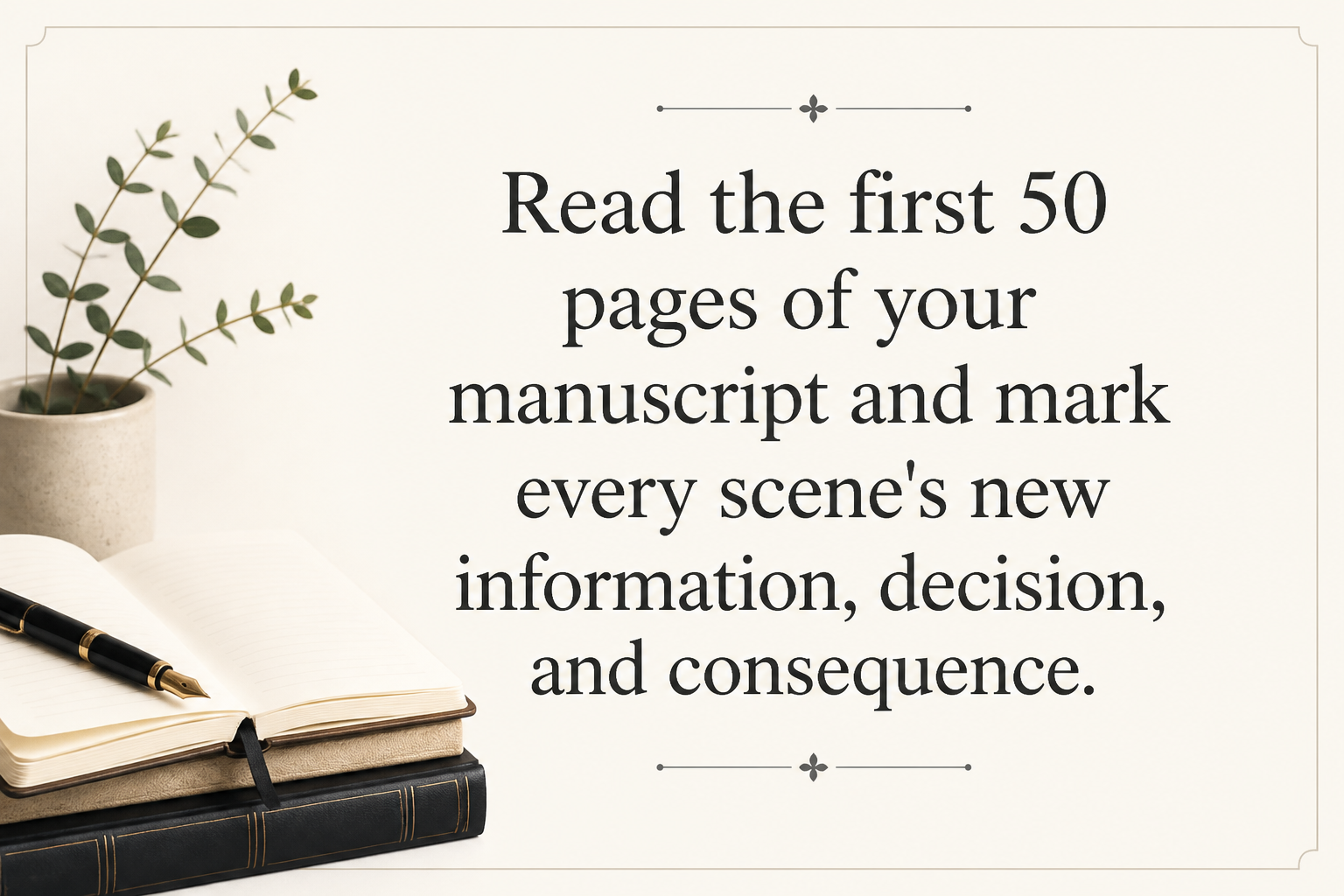
Read the first 50 pages of your manuscript and mark every scene’s new information, decision, and consequence. If a scene contains only atmosphere or conversation, tie it to a choice, since this exercise often exposes repeated introductions, backstory that arrives before its pressure point, and subplots that do not affect the main story.
A Satisfying Payoff
Commercial fiction makes a promise early and pays it off late. The ending should answer the central question, complete the main emotional movement, and leave the reader with the feeling that the story’s pieces belong together. A twist works when the evidence was present and the meaning changes. A surprise that depends on withheld information feels like a rule change.
Outline your final act before you draft the middle. I want to know what decision resolves the main conflict, what emotional truth the protagonist accepts, and what image or scene will give the ending its final weight. While you can change the outline later, you cannot revise toward a satisfying ending when you have no idea what satisfaction means for this book.
Commercial Fiction Across Popular Genres
Commercial fiction appears across the shelves readers browse every day. Romance, mystery, thriller, fantasy, science fiction, horror, historical fiction, and women’s fiction all contain commercially positioned books. The label describes the book’s relationship with its audience and market, and it can cross genre boundaries through hybrid forms.
For example, a historical mystery may combine period detail with an investigation. A romantic fantasy may pair a relationship arc with political danger and magic. A domestic thriller may focus on marriage, parenthood, and betrayal. While hybrid fiction gives you room to create a distinctive premise, your cover copy and metadata still need to tell readers what kind of experience they will receive.
Genre Signals On The Page
Genre signals include character roles, setting, pacing, vocabulary, conflict, and familiar scene types. For example, a cozy mystery often signals its tone through a contained community, an amateur investigator, and an emphasis on deduction. A military science fiction novel signals its audience through command structures, technology, tactical stakes, or institutional conflict.
Choose two or three comp titles published within the past few years and study their opening chapters. Record when the first crime, attraction, threat, supernatural event, or major discovery appears. You are gathering information about reader pacing, not copying another author’s sentences.
Hybrid Books And Clear Positioning
Hybrid books need a primary shelf. While you can write a romance with a mystery plot, your sales page needs a dominant promise. Decide whether the relationship or the investigation drives the reader’s reason to buy. Then let the title, cover, blurb, categories, and keywords support that decision.
Amazon KDP’s metadata guidelines for books explain how authors use these fields to describe a book and help readers find it. Treat metadata as a reader-facing promise. Choose categories that fit the actual manuscript, and use phrases your audience would type when searching for a book like yours.
Commercial Fiction And Literary Value
Commercial fiction plays a substantial role in literature because it brings readers into sustained contact with stories. A novel does not lose artistic value because it has a readable plot, a clear genre, or an audience beyond a small circle of specialists. Many commercial novels examine grief, class, race, family, power, faith, and identity through forms that invite many readers to keep turning pages.
The commercial and literary labels describe different priorities, and plenty of books occupy the space between them. A literary novel may foreground language, interiority, ambiguity, or formal experimentation. Meanwhile, a commercial novel may foreground plot, pace, and recognizable emotional payoff. These are tendencies rather than laws, and a writer can give a page both propulsion and beauty.
I often see authors create a false choice between serious ideas and reader pleasure. The stronger approach is to make the ideas operate through the story. Let a character’s belief shape a decision, let a social system create the obstacle, and let the ending force the reader to measure what the protagonist gained against what the protagonist lost. Theme becomes memorable when it changes the action.
Commercial Success And Artistic Control
Commercial intent also gives you useful discipline. A target audience helps you decide which subplot deserves space. Genre conventions help you build tension. A defined ending helps you cut scenes that exist only because you enjoyed writing them.
While those constraints can sharpen a novel, they also carry trade-offs. For example, a tightly paced thriller may leave less room for extended reflection. A high-concept romance may need to resolve its central relationship even when you prefer an open ending. Decide which reading experience you want to create, then accept the craft demands that come with it.
Writing And Positioning Your Commercial Novel
Commercial fiction succeeds through alignment. The manuscript, cover, blurb, sample pages, categories, and advertising copy need to point toward the same audience. A polished book with an inaccurate cover can attract the wrong clicks and produce poor read-through. Meanwhile, a strong cover with a vague blurb can lose the reader before the sample does any work.
Build The Manuscript Around A Promise
Write a one-page promise document before revision. Include the genre, target reader, central premise, main emotional payoff, comparable titles, and three conventions your manuscript will honor. Add three choices that give the book its own identity. This document keeps revision focused when you face tempting scenes that belong to another story.
Then revise in descending order of consequence. Start with the central conflict and character goal. Check the midpoint, the escalation, and the final resolution. After the structure holds, revise scene openings, paragraph movement, dialogue, and sentence-level style. Line editing cannot rescue a story whose protagonist has no urgent problem to solve.
Package The Book For Discovery
Your cover should signal genre at thumbnail size. Look at it beside the top 20 books in your intended category on Amazon. Record the typography, color range, image style, and emotional tone. While your cover can stand apart through a strong concept or distinctive execution, it still needs to help the right reader identify the book.
Write the blurb as a sales argument rather than a synopsis. Name the protagonist, show the desire, introduce the force of resistance, and end with the consequence or question that creates urgency. Save secondary characters, backstory, and the full sequence of events for the synopsis or author notes.
Adazing’s book cover makers and writing tools such as QuickWrite can help during these production stages. I use tools for ideation and iteration, then apply human judgment to genre fit, character logic, voice, and reader expectation. Software can give you ten premise variations. You still have to recognize the one that creates a novel with enough pressure to sustain 80,000 words.
Market After Publication
Publication gives you data you could not have before release. Watch click-through rates, review language, sales-page conversion, and read-through across a series. If readers praise the characters but complain about a slow middle, revise your pacing in the next book. If ads attract clicks and few purchases, inspect the cover, blurb, price, and sample pages as a group.
Book marketing also rewards repetition. Share a scene built around the central conflict, collect honest ARC reader language, test several ad images, and continue presenting the book after launch week. Commercial fiction depends on reader discovery, and discovery often comes from many ordinary appearances across retailer pages, newsletters, social posts, and recommendations.
FAQs for What Is Commercial Fiction? Key Traits and Its Role in Literature
Is Commercial Fiction The Same As Genre Fiction?
While the terms overlap, they describe different ideas. Genre fiction refers to a recognizable category such as romance, mystery, or fantasy. Commercial fiction describes a book positioned for a broad readership and built around a clear promise. A genre novel can be highly literary, and a commercial novel can combine several genres.
Can Commercial Fiction Have Literary Qualities?
Yes. Commercial fiction can use ambitious structure, distinctive prose, complex themes, and difficult moral questions. The reader still needs a strong reason to continue and an ending that fulfills the central promise. Literary quality grows from precise choices on the page, not from removing plot or accessibility.
How Do I Position My Commercial Novel?
Choose the primary genre, study recent comp titles, and align your cover, blurb, sample, categories, and keywords with that genre. Test your cover as a thumbnail and ask beta readers what they expect the book to contain. If their answers vary widely, your packaging needs a clearer signal.
Write For The Reader You Want
Commercial fiction gives you a disciplined way to connect artistic choices with reader experience. Define the promise, build pressure around it, deliver the genre pleasure, and package the book so the right audience can recognize it. I recommend treating those decisions as part of the writing itself. Your readers encounter the promise before they encounter your first sentence, and a well-built commercial novel keeps that promise all the way to the final page.
