
A writer who asks “What is character development in real life?” has already found a useful question. How do people become different through choices, pressure, and consequence? The answer gives you a working model for building characters who feel human rather than assembled from traits.
Character development in real life means the gradual change in a person’s beliefs, habits, values, relationships, and sense of identity. Consider how this plays out across different lives: a shy teenager may learn to speak up after protecting a friend, a generous parent may become guarded after years of betrayal, and a confident executive may discover that control has cost her intimacy. Each person carries a history, meets pressure, makes choices, and lives with the results.
For a writer, real-life development matters because readers recognize the pattern even inside a fantasy kingdom or a murder investigation. A character reveals a changing inner life not by becoming kinder, braver, or happier, but by responding to experience that reflects genuine change. I recommend studying change as a chain of cause and effect, then giving that chain visible expression in scenes.
Table of Contents
Character Development As Lived Change
A character begins with a working view of the world. She believes loyalty keeps people safe, he believes affection creates weakness, and another character thinks money solves every practical problem. These beliefs shape behavior long before the plot places them under strain.
Real people rarely announce a new worldview after one dramatic event. They rationalize, resist, repeat old habits, and absorb small lessons. For example, a betrayal may produce suspicion, a later friendship may challenge that suspicion, and a final choice under pressure reveals which belief has gained control.
Beliefs Beneath Everyday Behavior
Start your character with a private rule. The rule could be “I must stay useful to deserve love” or “Nobody helps without wanting something in return.” You can build dozens of scenes from a single sentence because the rule applies to work, romance, money, conflict, and friendship.
Give the character evidence that supports the rule. For example, a child who was praised only for achievement may grow into an adult who treats rest as guilt. Then give the character experiences that expose the rule’s cost. For instance, a partner may ask for emotional honesty when the character offers another solution, another gift, or another hour at work.
Identity Shaped Through Story
Psychologist Dan P. McAdams describes identity as a life story people build from remembered events, present concerns, and imagined futures. His work on narrative identity offers writers a useful lens since a person interprets events rather than filing them as neutral footage. You can read his overview, “Narrative Identity,” in Current Directions in Psychological Science.
Use that principle in your draft. Ask what event your character treats as proof of personal failure, what memory she edits to protect her self-image, and what future she privately rehearses. The same event can produce different development in different people because each person assigns it a different meaning.

The Forces That Produce Change
Pressure creates the conditions for development. Desire supplies direction, and consequence supplies education. Without all three, a character may possess an attractive personality and remain dramatically flat.
Suppose your protagonist wants a promotion, fears public humiliation, and believes competence protects him from rejection. His manager assigns him a presentation after a colleague takes credit for his work. For example, the presentation tests his fear, his ambition, and his belief in his competence in a single event. The resulting choice carries more weight than a paragraph describing his confidence.
Pressure From Relationships
Relationships expose development because other people remember who your character used to be. For instance, a sister can point out that your supposedly independent hero always asks for help even in sarcasm; a spouse can recognize the old avoidance pattern before the character does, and a child can require an apology that pride has delayed for years.
Build at least one relationship that rewards the character’s old behavior and another that challenges it. Consider a controlling detective who thrives with a junior partner who follows orders but struggles with a witness who refuses to be managed. Each relationship pulls a different version of the character into view.
Pressure From Consequences
Readers believe change when behavior produces a result the character can feel. For example, a character who lies to preserve a friendship may lose the friend’s trust once the lie surfaces; a character who keeps every promise may become exhausted, resentful, and unavailable; and a character who refuses violence may save one person and endanger another.
Track consequences across scenes. After every major choice, write three notes: what did the character gain, what did the character lose, and what belief did the result strengthen or weaken? This simple record prevents convenient development that appears only when the plot needs a lesson.
Observation Before Interpretation
Real-life development becomes visible through behavior. People may claim they have forgiven a parent, but still rehearse old arguments in the car. Someone may call herself confident and still ask three friends to approve a harmless email. A person who says he values honesty may tell the truth only when the truth costs him nothing.
Those contradictions give fiction its human texture. I start character work with observable details before assigning a diagnosis or label. While labels can help you think, scenes require choices, gestures, omissions, and speech patterns.
Small Behaviors With Large Meaning
Choose a behavior that carries history. For instance, your character checks the door twice because a former partner once entered during an argument; she keeps grocery receipts because scarcity shaped her childhood, and he sends voice messages rather than making calls because live conversation leaves him exposed.
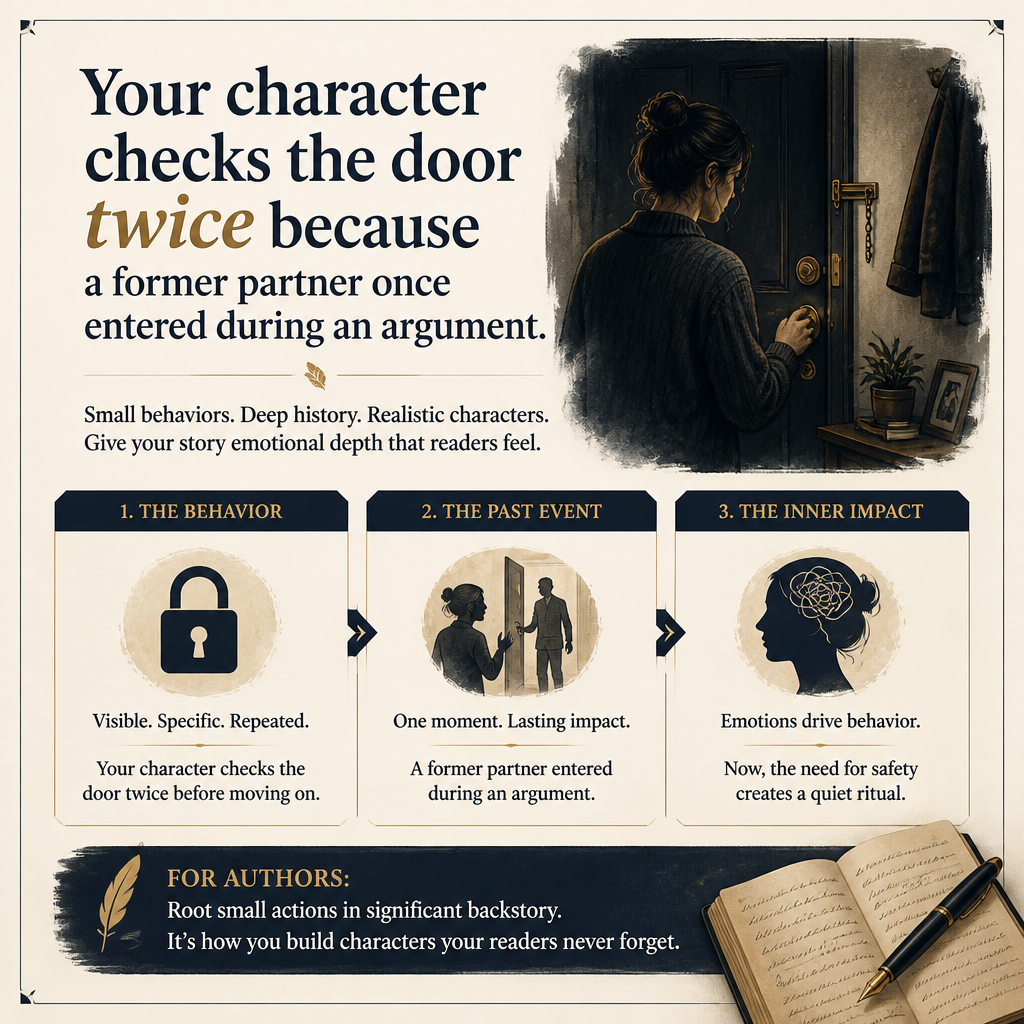
Repeat the behavior with variation. Early in the book, the character checks the door and misses the conversation. Later, she checks it once, hears the other person ask whether she feels safe, and answers honestly. The altered behavior itself makes the development evident, without requiring you to explain every emotional change.
Language, Silence, And Self-Protection
Speech reveals the distance between what a person experiences and what a person can admit. For example, a grieving character may discuss insurance paperwork with perfect precision, a jealous character may criticize a rival’s manners, and a frightened character may become funny at exactly the wrong moment.
Give each important character a preferred defense. Some people intellectualize, some become agreeable, some attack first, and some disappear into work. Then place that defense under conditions that create a problem. A lawyer who can argue any case may struggle to say, “I hurt you.” That sentence becomes a scene because the character has spent years avoiding it.
Choices That Reveal Development
Development reaches the reader through decisions. Although a backstory can explain a pattern, and dialogue can expose a belief, a choice proves what the character values when two costs collide.
The choice should contain a genuine sacrifice. For instance, a hero who saves a friend while losing a promotion faces a meaningful cost; a mother who tells the truth about her adult son’s crime risks the relationship she has protected for years. Meanwhile, a villain who spares an enemy may lose status among his followers.
The Choice Ladder
For a character arc, map four versions of the same choice. First, show the instinctive response. Next, show a partial adjustment that still protects the old belief. Then create a failure that makes the old pattern expensive. Finally, give the character a choice that reflects a revised belief.
Consider a novelist who believes asking for help proves incompetence. In the opening chapters, she hides a deadline problem. In the middle, she accepts an editor’s help only after a crisis. Later, she turns down useful advice out of shame, damaging a partnership. Near the end, she asks for assistance before the crisis arrives. Her change feels earned because the book has repeatedly tested that belief.
Growth With Residue
People carry over old habits after adopting new beliefs. For example, a recovering people-pleaser may still apologize too often, a former thief may count exits in every room, and a newly honest partner may tell the truth with unnecessary cruelty because careful honesty requires practice.
Keep some residue in the final chapters. Perfect emotional repair reads like a worksheet. Lasting development includes better choices alongside familiar reflexes. Your character earns trust through repeated behavior, and your reader sees the effort involved.
Character Development In Your Manuscript
Translate real-life development into a design problem for your book. Decide what your character believes at the opening, which desire keeps that belief in place, what pressure attacks it, and what choice proves the ending belief. Genre shapes the pressure differently: a romance centers intimacy and vulnerability, a thriller tests judgment under danger, and a memoir examines the writer’s interpretation of lived events.
I recommend writing a one-page arc before revising scenes. Use five headings: starting belief, visible pattern, pressure point, costly failure, and final choice. Under each heading, write concrete details from your manuscript. A sentence such as “she becomes more open” gives you little to revise. In contrast, “she stops deleting unsent messages and tells her sister why she left” gives you a scene.
Revision Questions For Every Act
Ask what your character wants in each act, what the character fears losing, and what the character learns from the outcome. Check whether the lesson changes behavior in the next act. If the character makes the same choice repeatedly, give the repetition a rising cost or cut one of the scenes.
Read the manuscript for emotional causality. A new belief should grow from an experience the reader has witnessed. A sudden confession, apology, or sacrifice needs preparation through earlier choices. Readers may accept a surprising decision, but resist one with no psychological trail.
Tools For Working Writers
Character generators can help when you need a name, occupation, cultural detail, or contradiction to spark a draft. Adazing offers name and word generators along with writing tools such as QuickWrite, and I use tools like this for prompts rather than final answers. The story still depends on your judgment about desire, pressure, and consequence.
Keep your character notes beside the manuscript and update them after major scenes. Track promises, secrets, fears, and changed assumptions. A clean character arc supports your blurb, your comp titles, and your marketing because readers respond to a character’s problem before they care about your production process.
FAQs for What Is Character Development in Real Life?
How Does Character Development Happen In Real Life?
Character development happens through repeated interaction between experience and choice. A person encounters pressure, interprets the event through existing beliefs, responds, and lives with the result. Over time, repeated choices can change habits, relationships, values, and identity. For fiction, show that process through scenes rather than describing the finished personality.
What Is An Example Of Real-Life Character Development?
A person who avoids conflict may learn to speak directly after avoiding a necessary conversation causes a friendship to end. The development includes the old habit, a painful consequence, a new understanding, and later behavior that reflects the change. Your character needs the same sequence in a form that fits the plot.
Can A Character Develop In A Negative Direction?
Yes. Development can lead to bitterness, isolation, cruelty, or deeper denial. For instance, a generous character may become controlling after repeated exploitation, and a principled character may excuse corruption after gaining power. Give the decline understandable choices and rising costs, so the reader follows the path even when the destination feels disturbing.
Give Change A Visible Cost
Real character development leaves evidence. A person changes because experience makes an old pattern harder to sustain, and the new pattern demands a different choice. Write the belief, pressure it through relationships and consequences, then let behavior reveal the result.
When you revise your manuscript, circle every scene where your protagonist chooses under pressure. The circles should show movement across the book. If they show the same response from beginning to end, your plot may be busy while your character remains still. Give the character a belief worth testing, a cost worth feeling, and a final choice the opening version couldn’t have made.
