
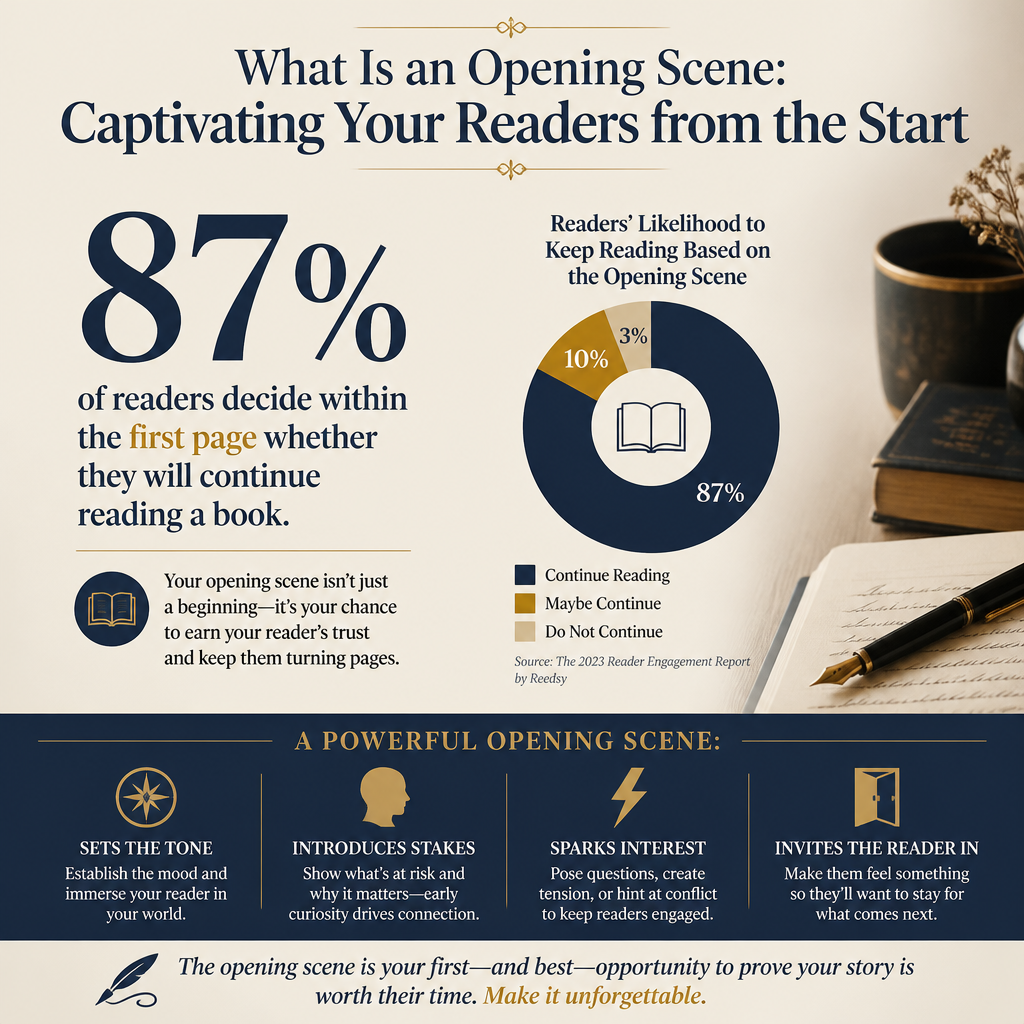
A writer deciding “What is an opening scene?” needs to understand its job before polishing a single line. The opening scene is the first meaningful unit of action in your book, where the reader meets a situation that creates curiosity, pressure, or emotional investment. It gives the story a direction and gives the reader a reason to continue.
Your opening scene doesn’t need an explosion, a murder, or a shocking confession. It does need movement. The character might want something, face a problem, make a decision, discover a threat, or enter a situation that changes the available choices. For example, a quiet scene in which a woman removes her wedding ring before answering the door can create more tension than a car chase if the reader understands that the gesture carries consequences.
I treat the opening scene as a promise about the reading experience ahead. For example, a thriller promises danger and unanswered questions. A romance introduces emotional possibility and an obstacle to intimacy. On the other hand, a fantasy establishes a character’s relationship to power, culture, or the unknown. Your first scene doesn’t need to explain the whole novel. It needs to make the reader trust that the novel knows where it is going.
Table of Contents
What An Opening Scene Does
An opening scene performs several jobs at once. It introduces a character or situation, establishes a narrative voice, creates a question, and begins the chain of cause and effect that carries the plot. You can delay some information, but you cannot delay the sense that something is happening.
Think of the scene as a contract with your reader. The details, tone, conflict, and point of view suggest what kind of attention the book expects. A first chapter filled with clipped observations and physical danger creates a different contract from one built around wry social commentary at a dinner party.
Aristotle’s discussion of beginnings in Poetics treats the beginning as the part that does not need to follow an earlier event and that leads naturally toward what follows. That principle still gives you a useful test. Your opening scene should feel like a genuine starting point for the reader, even when the story’s history began years earlier.
A Character Under Pressure
Pressure gives a scene shape. For instance, your protagonist might be trying to hide a mistake before a parent arrives, deliver a resignation letter before losing courage, or identify which guest at a wedding has brought a weapon. The scale can remain intimate. Pressure exists whenever the character has something to gain or lose within the scene.
Give the character a short-term objective that can be understood through behavior. A line such as “Mara wanted a better life” describes a theme. In contrast, a scene in which Mara deletes a job offer before her partner sees it gives the reader something to watch.
A Question That Creates Motion
Curiosity comes from a gap between what the reader knows and what the reader wants to know. Who left the blood on the kitchen floor? Why does the child recognize a dead language? What happened during the ten minutes the narrator cannot remember? A good question pulls the reader through the scene because the answer matters to someone on the page.
Write down the question your opening raises. Then check the scene’s details against it. Each paragraph should deepen the question, complicate the character’s position, or move the reader toward an answer. Decorative description that does none of those jobs can wait for a later page.

The Ingredients Of A Captivating First Scene
A strong opening scene usually combines an active character, a specific setting, a disturbance, and a choice. These ingredients can appear in different proportions across genres. Literary fiction may place greater weight on voice and emotional tension. Meanwhile, commercial fiction often brings the disturbance earlier. Every genre still needs a reason for the reader to care what happens next.
Specificity Over General Atmosphere
Begin with a detail that reveals more than its surface meaning. For example, a detective washing fingerprints from a child’s bicycle tells us about the detective’s work and the relationship that produced the evidence, and a bride counting exits during her rehearsal dinner plants a threat before anyone names it.
Specific details also help you avoid the familiar opening built from weather, a mirror, or a character waking up. Those openings can work when the detail carries conflict. For instance, a woman waking because someone is whispering her name through the wall creates a problem in the bedroom. Meanwhile, a character waking, showering, dressing, and making coffee gives the reader a routine without a reason to follow it.
A Disturbance With Consequences
The disturbance should alter the character’s immediate options. For example, a mysterious letter matters when the protagonist must decide whether to open it, burn it, or hand it to the police. On the other hand, a stranger at the door matters when letting that person inside risks exposing a secret.
Keep the disturbance connected to the story’s central pressure. For instance, a random car accident may create excitement. However, it can feel artificial when the novel later becomes a family drama with no connection to the crash. The opening earns its place when the trouble grows from the book you intend to write.
A Choice That Reveals Character
Readers learn who your protagonist is through decisions under pressure. For example, a character who lies to protect a sibling makes a different promise from one who tells the truth to preserve a career. You can save the backstory for later, since the choice gives the reader immediate evidence.
Try ending the scene on a decision rather than an explanation. The protagonist might sign the document, board the train, open the basement door, or delete the message. That choice creates a clean bridge into the next scene and gives your first chapter forward motion.
Opening Scene Types For Different Genres
The genre affects the promise your opening needs to make. Readers bring expectations shaped by the books they already enjoy, and your first scene either confirms those expectations or deliberately reshapes them. A surprise earns its effect only when the reader understands what convention you are bending.
Crime And Thriller Openings
Crime and thriller openings often work through a threat, a discovery, or a time limit. You might begin with the crime itself, with the investigator receiving a disturbing piece of evidence, or with an ordinary person making a mistake that draws dangerous attention.
Choose a point of view that gives the reader useful tension. For instance, a killer’s perspective can create dread because the reader sees more than the victim; an investigator’s perspective can create mystery because the reader discovers evidence alongside the character, and a civilian viewpoint can create vulnerability because the character lacks the training to understand the danger.
Skip the information dump about the case. Put the investigator in a room, give the investigator a problem, and let the evidence interrupt an action already underway. Readers can learn the history of the crime after they have a reason to care about its outcome.
Romance And Women’s Fiction Openings
Romance needs a character with emotional stakes and a meaningful obstacle to connection. The first scene can introduce the future love interest, the life the protagonist may have to leave, or the wound that shapes the protagonist’s choices.
Attraction alone rarely carries an opening. Give the characters a practical problem that reveals their values. For instance, a chef refuses a lucrative partnership because it requires changing the restaurant’s identity. On the other hand, a single father misses an important meeting because his daughter needs him. The romantic possibility becomes stronger when the reader sees what each character protects.
Fantasy And Science Fiction Openings
Speculative fiction has a special burden because the setting may include unfamiliar technology, history, or magic. Your opening should give the reader one stable human experience before asking the reader to absorb new rules.
Start with a character using the strange element for a concrete purpose. For example, a courier crosses a city by stepping through shadows because she has five minutes to deliver a living message, or a technician hides a forbidden memory inside a public transit system. After all, an inspection begins at dawn. The worldbuilding enters through action, so the reader learns what the system does and why it matters.
Limit the invented names in the first pages. A reader can remember a new term when the term solves a visible problem. Three invented governments, six historical events, and a paragraph explaining bloodline law create work before the story has created desire.
Revision Tests For Your Opening Scene
While first drafts often contain the material your story needs eventually, they frequently begin before the actual trouble. Revision means locating the earliest moment when the protagonist’s choices start to change. That moment usually belongs closer to page one.
The Scene Question Test
Write one sentence answering, “What does the reader want to know after the first page?” Use a concrete question. “Will the sheriff find the missing girl before the river rises?” gives you something to measure. On the other hand, “What is going on?” suggests the scene may lack focus.
Read the first page and mark every sentence that creates, sharpens, or complicates that question. While large stretches without a mark may contain useful prose, they probably belong later. Cut them temporarily and see whether the scene gains pressure.
The Desire And Decision Test
Name the viewpoint character’s immediate desire. Then identify the decision the character makes by the end of the scene. A scene with neither often behaves like a preface, even when it carries a chapter number.
The desire can remain small. For example, a woman wants to leave a party before her former friend approaches, or a boy wants to keep his father from seeing the report card. Small desires become compelling the moment they carry personal consequence and an obstacle that keeps shifting.
The Read-Aloud Test
Read the opening aloud after you revise it. Your ear catches repeated sentence patterns, vague verbs, and dialogue that exists only to deliver background. I pay special attention to the first paragraph because authors often load it with description and explanation before the voice has found its natural pace.
Ask a trusted beta reader what they think the book is about after the first chapter. Their answer can expose a mismatch between your intended genre and the promise on the page. An opening written like a literary mystery may draw the wrong early readers if you’re selling a fast commercial thriller.
Polishing The Promise Of Your First Chapter
Once the scene works, polish the presentation around it. Your opening chapter, book description, category choice, keywords, and cover should point toward the same reading experience. A tense opening paired with a soft, generic cover creates friction before the reader reaches page one.
Look at your cover as a thumbnail on an Amazon KDP search page. The title and author name should remain readable, and the visual signal should match the scene’s genre. A handcrafted cover can give you more control over that signal. Adazing offers book cover design services to help you test concepts before you commission a finished design or publish the book.
Your blurb should raise the central question introducing the opening scene. It shouldn’t summarize every event in the manuscript. Name the protagonist, the pressure, the opposition, and the consequence of failure. Readers should recognize the same book in the cover, blurb, sample pages, and opening scene.
Use your first readers for focused feedback. Ask where their attention sharpened, where they felt confused, and what they expected the book to become. Avoid asking whether they liked the opening because the answer gives you a reaction but lacks diagnosis. ARC readers can help later with pacing and genre fit. On the other hand, a developmental editor can identify structural problems before you send the manuscript out.
One last warning deserves space. Don’t force a dramatic opening that the rest of the novel cannot support. For instance, a murder in chapter one creates a reader expectation around investigation, danger, and consequence. Meanwhile, a comic domestic mystery can begin with a missing cake, a ruined wedding dress, or a suspicious neighbor. Match the size of the opening promise to the story’s actual engine.
FAQs for What Is an Opening Scene: Captivating Your Readers from the Start
How Long Should An Opening Scene Be?
An opening scene can run for two pages or twenty, depending on the genre, point of view, and amount of change. End it when the character has made a choice or the situation has materially changed. Page count matters less than whether the scene creates forward pressure.
Should An Opening Scene Start With Action?
Action means change, so the scene needs movement in the character’s situation. While physical action can work well, a decision, a discovery, an argument, or a social threat can carry equal force. Start at the moment when the reader has a reason to care about the character’s next move.
Can I Start With A Dream Or Flashback?
You can, though both forms create extra distance from this present story. For example, a dream earns its place when it reveals a problem the character must face immediately. Meanwhile, a flashback earns its place when a past event changes the reader’s understanding of the opening situation. Test the scene in chronological order before keeping the delayed version.
Give The Reader A Reason To Continue
Your opening scene succeeds when it raises a live question, puts a character under pressure, and leads to a choice that alters what can happen next. Draft that movement before you polish the language. Once the scene has a working engine, refine the voice, sharpen the details, and align the book’s cover and blurb with the promise on the page.
Read your first chapter as a stranger would. Ask what the character wants, what threatens that desire, and what you need to know next. Then revise until the answer appears through action rather than explanation. The reader doesn’t need your whole story on page one. The reader needs a reason to turn the page.
