
A mystery novel loses its grip when every clue points in the same direction. That’s why understanding “What is a red herring in literature?” matters before you plant one in your own plot. A red herring sends your reader toward an appealing explanation that later proves false, misdirecting attention from the real answer. Used with discipline, it creates suspense, deepens character, and gives your final reveal room to land.
The device works because readers want to solve the story alongside the protagonist. They collect evidence, form a theory, and test each new detail against it. Your red herring gives them a theory that feels earned. When the truth arrives, the surprise should come from a better explanation that was present all along.
The danger sits in the difference between misdirection and cheating. A false clue needs a believable connection to the central mystery. In addition, your story needs to hand readers enough information to revise their explanation afterward. I recommend treating a red herring as a promise of interpretation, not a lie about the world.
Table of Contents
Red Herring Meaning And Literary Function
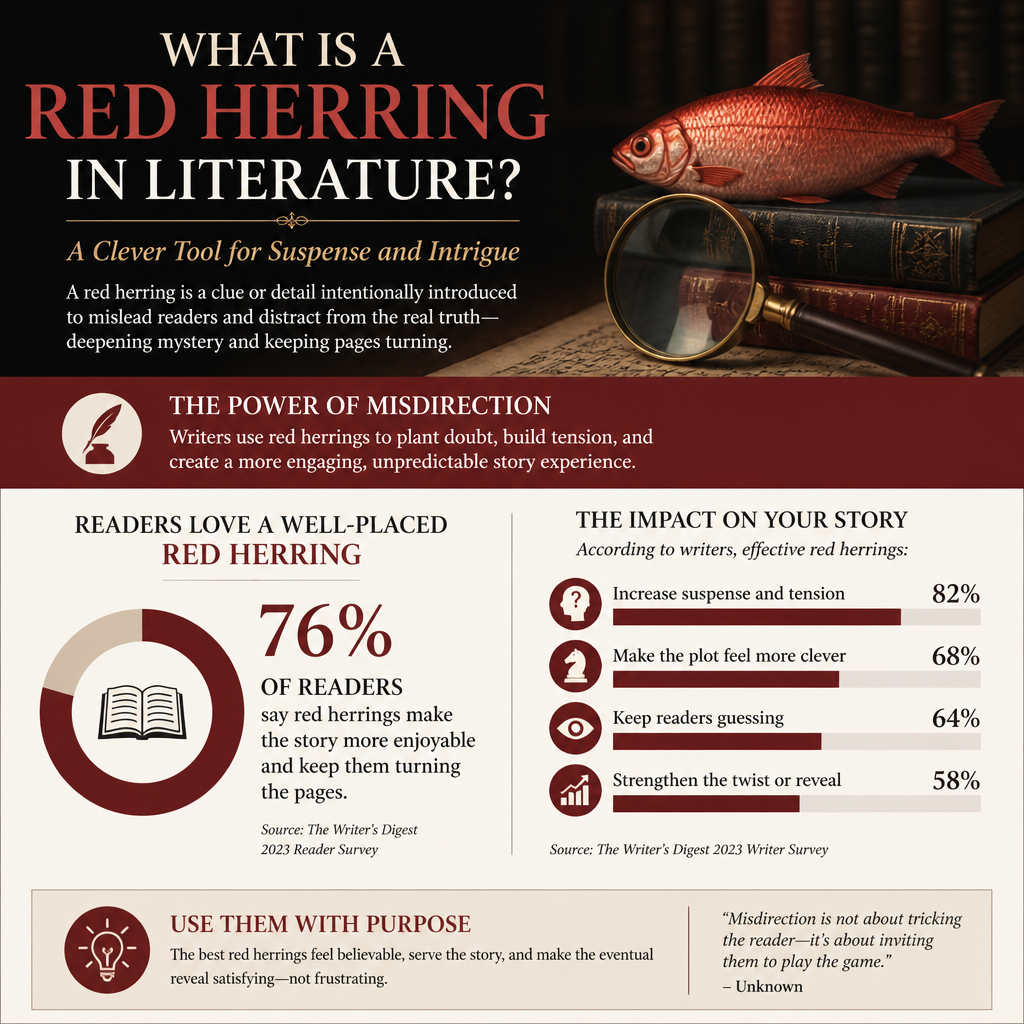
A red herring is a false lead that draws attention away from the actual explanation of a mystery, conflict, or hidden motive. The term commonly applies to a clue, suspect, event, detail, or interpretation that appears significant because it fits the evidence available at the time.
Encyclopaedia Britannica defines a red herring as a clue that misleads or distracts from a relevant question. In fiction, the device has a practical purpose: it controls what the reader thinks matters. You are managing attention, which is one of the central jobs of suspense.
The Reader’s Working Theory
Readers rarely experience a mystery as a sequence of neutral facts. They build a working theory from the details you provide. A red herring gives that theory shape by offering a plausible answer before the real answer appears.
Suppose a detective investigates a locked-room murder. The victim’s business partner has a fresh cut on his hand, a hidden debt, and a reason to fear the police. Those facts point toward guilt. Later, the detective learns that the partner cut himself opening a broken window, hid the debt to protect his sister, and feared exposure for a separate financial crime. The partner remains compromised. In the end, the murder belongs to someone else.
That structure gives the reader a satisfying revision. The clues were real. Their meaning changed.
Suspense Through Delayed Meaning
Suspense depends on delayed meaning. You reveal a fact before the reader understands its full significance, then allow competing explanations to develop. The red herring occupies one of those explanations and keeps the reader moving through the uncertainty.
Use the device to raise questions such as who benefits from the crime, why a character keeps lying, or what happened before the opening scene. Each false lead should intensify one of those questions. A clue that creates no useful question is decoration, and decoration rarely sustains a mystery.

How Red Herrings Work In A Plot
A strong red herring usually has three parts. It carries genuine evidence, supports a credible interpretation, and eventually yields to a stronger explanation. Remove any one of those parts and the device weakens.
Evidence With Two Possible Meanings
Start with a detail that can support the false and true theories. A character burns a letter. The reader may assume the letter contains proof of blackmail. The actual explanation could involve a promise made years earlier, a protected identity, or a warning the character cannot allow anyone else to see.
The detail must matter in both readings. If the burned letter has no bearing on the central conflict, the reader will feel the author placed it there only to manufacture noise. I write down both meanings before I draft the scene. Early on, the false meaning drives suspense. Later, the true meaning pays off.
A Credible Emotional Motive
Readers accept a false suspect more readily when that character wants something strongly enough to conceal the truth. Fear, shame, jealousy, loyalty, greed, and self-preservation can all produce behavior that resembles guilt.
Give the suspect a private problem that exists beyond the crime. For instance, a grieving brother may lie about his whereabouts because he was meeting a drug dealer to settle the dead man’s debt. A respected professor may destroy evidence because she stole research years earlier. Those choices make the suspect morally complicated, which gives the red herring a life beyond its plot function.
Character motivation also protects your reveal from feeling mechanical. The reader should understand why the false suspect acted strangely, even after learning that the suspect did not commit the central crime.
A Stronger Explanation Waiting Beneath
Your true solution needs greater explanatory power than the red herring. It should account for the false clue, the missing information, the suspect’s behavior, and the story’s emotional stakes. A late twist that explains only the final chapter will feel attached to the book rather than built into it.
Before drafting, create two columns. Label one “reader’s theory” and the other “actual explanation.” List every major clue under both columns. When a clue fits only the first column, revise it or remove it. A well-built mystery can surprise readers without asking them to forget what they read.
Red Herring Examples Writers Can Study
Classic detective fiction offers the clearest examples because its structure makes the false lead easy to see. The method also appears in fantasy, thrillers, romance, and literary fiction whenever a character or reader forms an incorrect interpretation of an event.
The Suspicious Character
The suspicious character is the familiar version. For instance, a detective finds a wealthy heir arguing with the victim, discovers that the heir will inherit the estate, and learns that the heir lied about leaving the house. The evidence creates a clean path toward guilt.
To deepen the device, give the heir a different secret. Perhaps the argument concerned an affair, an unpaid loan, or a plan to expose fraud. The heir lied because the truth would ruin a family member. The murder then belongs to the quiet attorney who arranged the inheritance years earlier.
This pattern works when the false suspect remains active after suspicion falls away. Let the heir make choices, take risks, and affect the investigation. A red herring with agency becomes a character. A red herring who vanishes after suspicion fades becomes a disposable prop.
The Object That Appears To Solve Everything
An object can misdirect attention with remarkable efficiency. For example, a missing key, a bloodstained scarf, a second wedding ring, or an old photograph can appear to answer the central question. Your reader sees the object and assigns it a meaning before the protagonist has enough context.
The best object-based red herrings have a visible history. One scarf might belong to a former lover. Another key might open a storage room. A third photograph might show a person who supposedly died years earlier. Each object raises a question, and the answer should connect to the story’s deeper conflict.
Use physical details with restraint. Three suspicious objects in one chapter teach the reader to distrust every prop. One carefully placed object can hold attention for half a novel.
The False Interpretation
Some red herrings live in the protagonist’s assumptions. A woman hears footsteps outside her apartment and believes an old stalker has returned. She spends the next several chapters investigating him, only to discover that the footsteps belonged to a neighbor delivering messages from her missing sister.
This form works especially well in psychological suspense and literary fiction because the false lead reveals the protagonist’s wounds. The character interprets new evidence through an old fear, and the eventual correction changes the reader’s understanding of the person, not only the plot.
Red Herring Mistakes That Break Trust
The most common mistake I see is a false lead built from withheld information. The author knows the real explanation, hides it from the reader, and then presents the solution near the ending. That technique creates a brief moment of surprise, followed by disappointment, because the reader never had a fair chance to reason through the mystery.
Information The Protagonist Could Not Know
Point-of-view control determines whether a red herring feels fair. In a close first-person mystery, you cannot hide a fact the narrator clearly observed unless the character misinterpreted it or overlooked it for a meaningful reason. In third-person limited narration, you have similar limits around what the viewpoint character perceives.
You can conceal a motive, an identity, or the significance of an object. You should be careful about concealing an event that happened directly in front of the protagonist. Readers forgive mistaken interpretation. They resent missing information that the narrative quietly possessed.
A False Lead With No Cost
A red herring should carry a consequence. For example, the detective follows the wrong suspect, losing time. In another case, the heroine trusts the wrong ally and gives away a hiding place. Elsewhere, the investigator publishes an accusation that damages an innocent person’s life.
Consequences prove that the false lead matters. They also create pressure for the next phase of the story. Give your protagonist a price for the wrong theory, then let that price shape the final investigation.
The Last-Minute Villain
A villain who appears in the final chapter without earlier presence rarely feels like a satisfying surprise. Seed the character through actions, references, absences, or consequences. You can keep the villain’s identity hidden while allowing the villain’s influence to remain visible.
Read your draft once from the villain’s perspective. Mark every scene where the villain’s plan affects the plot. Add two or three earlier traces that carry one meaning before the reveal and another meaning afterward. Readers should recognize the pattern when they look back.
How To Plant And Test A Red Herring
I build a red herring backward from the reveal. First, I write the actual explanation in one sentence. Next, I identify the evidence that proves it. Then I design a false explanation that accounts for enough of that evidence to feel persuasive.
A Simple Drafting Method
Write these four lines before you draft the relevant chapters:
- The truth is…
- The reader will suspect…
- The false suspect is hiding…
- The clue changes meaning when…
Fill each line with concrete information. “The reader will suspect the neighbor” gives you a usable direction. “The reader will suspect someone close to her” leaves too much work for the draft to solve.
Plant the red herring in an ordinary scene before you need it. A casual mention of the neighbor’s muddy boots carries more weight after the murder than it did during breakfast. Early placement gives the clue a natural life and keeps the plot from announcing its machinery.
Testing Reader Fairness
Give three trusted beta readers only the opening chapters and ask them to name their current theory. Do not ask whether they like the mystery. Ask which facts support their theory, which details confuse them, and what they expect the protagonist to investigate next.
After they finish the manuscript, ask whether the solution felt surprising, inevitable, or arbitrary. Surprising and inevitable is the target. Arbitrary means your evidence needs revision. A reader who guesses the answer early may still enjoy the book if the character work and complications remain strong, so do not judge the red herring by whether every reader misses it.
You can also use Adazing’s writing tools during revision to generate alternate names, motives, or relationships for secondary characters. A fresh motive often turns a flat false suspect into a person with a private problem and a credible reason to lie.
FAQs for What Is a Red Herring in Literature? A Clever Tool for Suspense and Intrigue
What is the difference between a red herring and a plot twist?
A red herring misdirects the reader toward a false explanation. In contrast, a plot twist changes the reader’s understanding of the story through a new revelation. One device can support the other, since a false lead may prepare the reader for a twist that explains earlier evidence.
How many red herrings should a mystery novel contain?
Use enough false leads to create competing theories, then remove any lead that delays the story without adding motive, consequence, or useful information. A short mystery may need one major red herring. Meanwhile, a full-length thriller can support several secondary false leads if each one changes the protagonist’s choices.
Can a reader know the red herring is false?
Yes. Suspense can come from watching a protagonist pursue the wrong answer, especially when the reader understands the emotional reason for the mistake. The device depends on pressure and consequence, so reader knowledge does not automatically weaken it.
Make The False Lead Earn Its Place
A red herring earns its place when it creates a persuasive theory, exposes character, and points back toward the truth after the reveal. Give your false lead real evidence, a motive that exists beyond the mystery, and consequences that change the investigation.
Then test the draft with readers who will explain their theories in detail. Revise the clues until the final answer feels both surprising and supported. Suspense comes from uncertainty. In contrast, reader trust comes from evidence. Your red herring has to honor both.
