
What is a cliffhanger in a story? The answer matters because the chapter’s ending can determine whether a reader closes the book or keeps reading past midnight. A cliffhanger leaves a character facing an unresolved danger, decision, revelation, or question. The reader has enough information to feel the pressure without holding the answer that would release it.
Used well, a cliffhanger creates forward motion. Careless use feels like the author cut the chapter in half and called the missing pages suspense. The difference comes from causality, character investment, and the promise of a meaningful answer. Build all three before you end a scene on uncertainty.
Cliffhangers work in thrillers, romance, fantasy, mysteries, literary fiction, and memoir, with the form changing by genre. For example, a thriller may end with a gunshot, a romance with a devastating misunderstanding, and a mystery with evidence that changes the list of suspects. The craft principle stays consistent: your reader must care about the unresolved event and trust that the next scene will earn the answer.
Table of Contents
The Core Mechanics Of A Cliffhanger
A cliffhanger interrupts a story at a moment of heightened uncertainty. The character has reached a point where something significant is about to happen, has just happened, or has become newly possible. The scene ends before the consequences become clear.
That definition contains three working parts. The scene creates a question. That question carries emotional or practical stakes. The interruption then delays the answer without making the reader feel deceived.
Questions With Consequences
A weak cliffhanger asks a question that does not affect the story. Who sent the anonymous text? What was inside the drawer? Why did the dog bark? Those details can create a brief pause in the reader’s attention. They will not sustain a chapter turn unless the answer changes what the character can do next.
A stronger question carries consequences. Will the detective open the evidence locker after learning that her own fingerprints are inside? Will the bride tell the truth after discovering that the groom already knows? Can the apprentice use forbidden magic to save her brother, knowing the spell will expose her identity?
As you revise, underline the question created by each chapter ending. Then write down what changes if the answer is yes and what changes if the answer is no. If neither outcome affects the character’s goal, raise the stakes or choose a different ending.
Pressure At The Cut
A cliffhanger works best when pressure has been building through the scene. Explosions and a sudden villain with a knife are not the requirement. A character who receives a medical diagnosis, hears a name from the past, or sees a wedding ring on the wrong hand can create a powerful break when the preceding pages have established why that moment matters.
The final line should feel like the next unavoidable beat has arrived. It can reveal new information, force a decision, introduce immediate danger, or reverse the reader’s understanding of an earlier event. The strongest endings make the next page feel necessary.
Read your last paragraph aloud. Pay attention to whether the final sentence adds pressure or only announces mystery. For example, a line such as “She wondered what would happen next” describes suspense from a distance. Compare that with “The voice on the answering machine belonged to the man she had buried three years earlier,” which creates a problem the reader can picture.

Types Of Cliffhangers For Authors
Different cliffhangers produce different reading impulses. Choose the form that matches the promise of your book and the emotional state of the scene.
The Peril Cliffhanger
The character faces immediate physical, emotional, or professional danger. For instance, a door opens, a car loses control, a hostage hears the lock turn, or a lawyer discovers that the contract she signed transfers ownership of her company. The reader wants to know whether the character survives or escapes.
Peril works when the danger has been prepared. Give the reader a clear sense of the threat and the character’s limited options. If a villain appears from nowhere in the final paragraph, the scene feels rigged. Plant the weapon, the weakness, or the deadline earlier so the danger grows from the story.
The Revelation Cliffhanger
A revelation changes the meaning of what came before. For example, the detective recognizes the victim’s handwriting in her own journal. The fantasy hero discovers that the prophecy names her as the destroyer. The romantic lead learns that the person who sabotaged the relationship was protecting him from a larger threat.
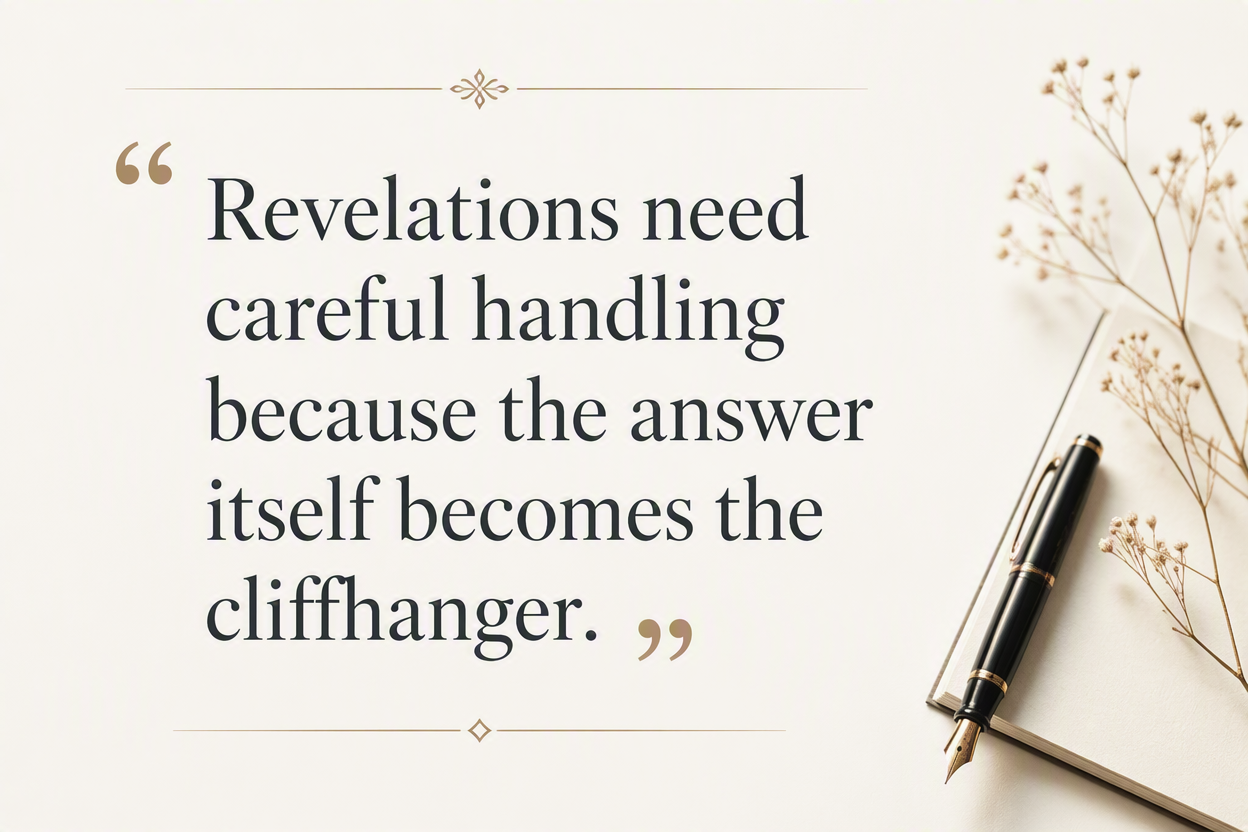
Revelations need careful handling because the answer itself becomes the cliffhanger. Give the reader enough evidence to understand the significance, then end before the character can process every implication. You want surprise followed by interpretation. A random secret creates confusion. Preparation turns the same secret into a reason to re-read.
The Decision Cliffhanger
A decision cliffhanger places the character at a moral or strategic fork. For instance, she can expose her brother or let an innocent person take the blame. He can accept the inheritance and abandon his principles, or walk away from the money that could save his family. The reader continues because the decision reveals character.
Don’t use a decision cliffhanger for choices the character has no reason to weigh. Show the competing values before the chapter ends. A reader should understand what each option takes from the character.
The Promise Cliffhanger
A promise cliffhanger announces an approaching event that carries strong narrative weight. For example, an expedition reaches the sealed city. Two exes agree to meet after ten years. A killer sends a message promising one final victim. The scene ends before the meeting, arrival, or confrontation occurs.
This form works especially well at the end of a section or part. It gives the reader a destination and a reason to keep reading. The event still needs a complication when it arrives. If the promised confrontation unfolds exactly as expected, the suspense drains away.
Cliffhangers Across Chapters And Acts
A cliffhanger can operate at several levels. For example, a chapter ending creates a short-range question. An act break brings a larger change in the story’s direction, and the ending of a novel leaves the reader wondering about the character’s future, the series promise, or the meaning of the journey.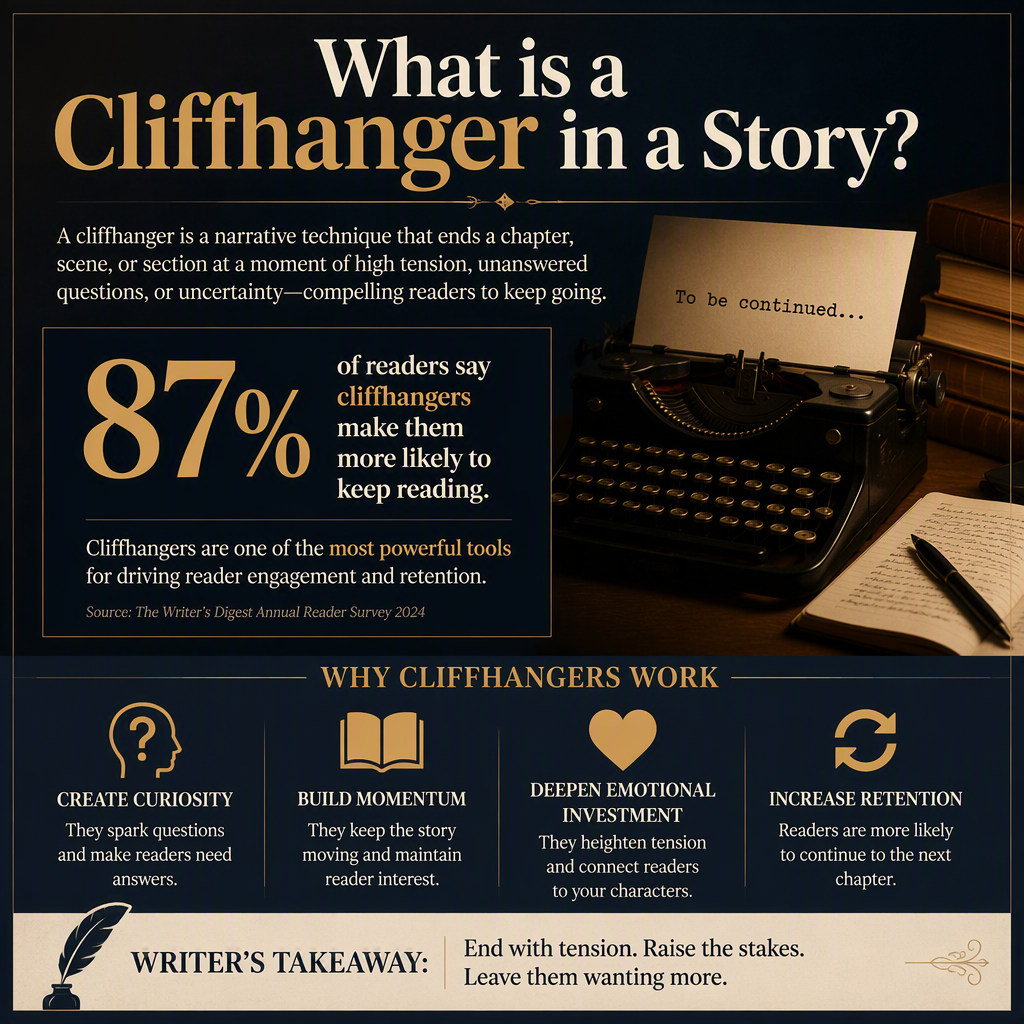
Chapter-End Tension
Chapter cliffhangers should vary in scale. If every chapter ends with a life-threatening attack, the device loses force, and your book starts to sound like a burglar testing every window in the same house. Mix physical danger with discoveries, decisions, emotional reversals, and promises.
Give each chapter a dominant movement. A character may begin by pursuing a missing person and end by learning that the person has been pursuing her. The chapter’s final turn should change the reader’s understanding of the goal. The following chapter can then take up the consequences rather than repeat the same suspense beat.
Act Breaks And Major Reversals
Large-scale cliffhangers often arrive after a character commits to a course of action. For example, a detective identifies the killer and then realizes the killer has been listening. Two lovers decide to leave town but then find the passport has been stolen. A rebellion begins, and the leader receives proof that the supposed enemy is her father.
These breaks carry more weight because they alter the story’s direction. Place them after enough development for the reversal to matter. A shocking event in chapter two may be dramatic. It cannot function as a major turn if the reader has no investment in the people or the problem.
As you outline, write one sentence for each act break that begins with “After this, the character must…” Complete the sentence with a new action, obligation, or pursuit. If the answer repeats the previous act, your break needs a stronger consequence.
Cliffhanger Mistakes That Lose Trust
Suspense depends on a silent agreement between author and reader. You can delay information. A fair delay is the condition. The reader doesn’t need every fact in advance. What the story owes them is a path to the answer.
The Fake Emergency
A fake emergency ends with danger that disappears because the character wakes from a dream, remembers a harmless explanation, or escapes through an ability the story never established. This can work in a deliberately surreal book. In a realistic thriller, it teaches readers to discount your endings.
Check each danger against the rules of your story. Ask whether the character has the skill, resource, or relationship needed to get out of it. Plant that resource before the cliffhanger and attach a cost to using it.
The Withheld Information Problem
Authors sometimes hide information from the reader that the viewpoint character already knows. The chapter ends with “She saw who stood in the doorway,” and the narrative refuses to name the person. That gap creates irritation because the character has no reason to withhold the fact from herself.
Control information through a legitimate viewpoint limit. Your character finds a familiar coat in the doorway and recognizes the voice before the face appears. Uncertainty then belongs to the reader too, since the scene has a physical reason to delay recognition.
The Endless Series Of Pauses
A book can contain too many cliffhangers. When every chapter cuts away before a conversation, fight, kiss, or discovery reaches a result, the reader stops feeling anticipation and starts feeling manipulation. You need resolution between suspense beats so each new question has room to matter.
I recommend resolving at least part of the previous question early in the next chapter. For example, the detective survives the attack, then discovers the attacker’s motive. A couple kisses, then one of them finds the hidden letter. Partial answers reward the reader and open a more difficult question.
Writing And Revising Strong Cliffhangers
Start with the character’s immediate problem instead of the final line. A cliffhanger is the visible edge of a sequence of choices, pressures, and discoveries. Without that sequence, a dramatic sentence has nothing underneath it.
A Revision Pass For Chapter Endings
Use this five-question pass on every chapter ending:
- What does the viewpoint character want at the start of the scene?
- What new fact, threat, decision, or promise changes the situation?
- What question does the reader carry beyond the page?
- What personal cost makes the question matter?
- What answer or consequence will the next scene deliver?
Write the answers in plain language. “The energy shifts” tells you very little. “Mara must choose between exposing her father and allowing the kidnapping charge to stand” gives you a workable ending and a clear next scene.
The Read-Through Test
After revising, read the final page and the first page of the next chapter together. The transition should create movement. The next chapter may slow down for a reaction, investigation, or conversation. It still needs to address the pressure you created.
Ask a beta reader where they felt compelled to continue and where they felt the book was withholding information. Those answers can differ. A reader who continues out of curiosity is responding to a cliffhanger. Someone who reads on out of obligation is usually responding to momentum elsewhere in the book.
For a manuscript you plan to publish, inspect your sample pages on Amazon KDP as well as in your word processor. Chapter endings influence the reading experience, and the opening sample needs to deliver an early question without delaying the central conflict for several pages.
Adazing’s writing tools, including QuickWrite, can help you generate alternate scene turns when a chapter ending feels flat. Treat generated ideas as raw material. Your character’s established motives and your genre’s promise must decide which ending belongs in the manuscript.
FAQs for What is a Cliffhanger in a Story?
Does Every Chapter Need A Cliffhanger?
No. Every chapter needs forward motion. That can come from a decision, an emotional change, a discovery, or a completed task. Save sharper cliffhangers for moments when delaying the answer adds pressure. A quiet chapter can end with resolution and still set up a stronger turn later.
How Long Should A Cliffhanger Last?
The answer depends on the question and the genre. A chapter-level danger usually deserves attention early in the next chapter. A mystery revelation may remain partly unresolved for several chapters if each delay adds evidence or changes the suspect list. Keep giving the reader meaningful progress so the delay feels intentional.
Can A Story End With A Cliffhanger?
Yes, especially in a series. Give the current book a satisfying result before opening the next problem. A romance series should resolve the central couple’s relationship. A fantasy novel can finish the immediate quest and reveal a larger threat. Readers accept an open door when they have received a complete emotional experience in the book they purchased.
Make The Unanswered Question Matter
A cliffhanger succeeds when the reader needs an answer because the character’s future has changed. Build the pressure through choices and consequences, stop at the moment of greatest uncertainty, and give the next scene enough substance to reward continued reading.
Go through your manuscript and mark every ending. Beside each one, write the question, the stakes, and the promised consequence. Revise the final lines that create curiosity without cost. Your best cliffhangers will leave the reader unsettled for a specific reason, with the next page already carrying weight.
