
Before drafting an argument, essay, review, or nonfiction chapter, you need to understand the answer to the question, “What is a claim in writing?” A claim is the specific position you want your reader to accept. It gives your evidence direction and turns a collection of observations into a case that goes somewhere.
For a novelist, claims appear in craft essays, author newsletters, book proposals, and reader-facing commentary. In nonfiction, claims shape every chapter. For example, “Exercise helps people” is too broad to guide a chapter. A sharper version, “A ten-minute walk after lunch gives remote workers a reliable break from screen fatigue,” gives you something to prove, qualify, and develop.
I see the same mistake in manuscripts and marketing copy: writers collect facts, examples, and opinions without deciding what those materials are supposed to establish. The result may sound informed. Readers still finish without knowing the writer’s position. You can fix that by treating the claim as the load-bearing sentence of every argument.
Table of Contents
The Working Definition Of A Claim
A claim is an arguable statement that expresses your position on a subject. It needs room for reasonable disagreement. For example, a sentence such as “The novel has twelve chapters” states a fact any reader can check. In contrast, “The novel’s short chapters create the urgency promised by its thriller premise” makes an interpretation that requires support.
The claim answers what you want your reader to believe after reading a section. Evidence answers the follow-up: what makes that belief reasonable? Your reasoning explains how the evidence connects to the claim. Those three parts form the basic movement of an argument.
Claims And Topics
A topic gives you a subject, and a claim gives you a position about that subject. For example, “Self-publishing” names a topic, whereas “Self-publishing authors should choose a cover based on genre signals before adding personal design preferences” states a claim. The second version gives you a standard you can defend with examples from Amazon search results, reader expectations, and cover testing.
Authors often mistake a topic for a thesis because a topic feels productive. It can generate pages without creating direction. Before you draft, finish this sentence: “My reader should accept that…” The words that follow usually reveal your claim.
Claims And Facts
Facts carry information. Claims interpret information or recommend a course of action. For example, a book’s average review of 4.2 stars is a fact. The argument that the same review section reveals a mismatch between the book’s promise and its actual reading experience is a claim.
Facts can support a claim. However, a pile of them cannot replace one. Read through your research notes and label each sentence as fact, example, opinion, or claim. You should be able to point to the sentence that tells every group of notes what it is there to prove.
The Parts That Give A Claim Strength
A strong claim has a subject, a precise position, and a scope you can handle. It also fits the evidence available to you. Writers get into trouble when a sentence makes a sweeping promise, and the draft supplies one anecdote from a writing group.
Compare these two claims:
- “Social media is bad for authors.”
- “Authors who spend launch week chasing daily engagement can lose time needed for reader follow-up and ad testing.”
The first claim covers too much territory. The second identifies a behavior, a time period, and a plausible consequence. You can support it through launch schedules, marketing records, and a comparison of activities that produce measurable reader contact.
Specificity And Scope
Specificity gives your reader a clear target. Scope keeps the target within reach. For example, a claim about “all readers” demands evidence from a broad population. Narrowing to “early reviewers of a cozy mystery” gives you a smaller group and a genre-specific context.
I recommend adding three limits to a vague claim: who, under what conditions, and with what result. In practice, “Book trailers work” becomes “A short book trailer can help a fantasy author explain an unfamiliar world on TikTok when the opening image and spoken premise arrive within the first few seconds.” You can test each part of that sentence and revise any part your evidence fails to support.
Precision And Qualification
Qualification makes an argument more trustworthy because it shows that you understand its boundaries. Words such as “often,” “under these conditions,” and “for debut authors” can prevent a claim from promising more than your evidence can carry.
Do not weaken every sentence with timid language. Qualify the part that genuinely depends on genre, budget, audience, or platform. For example, a handmade cover may suit a personal essay collection with a narrow audience. On the other hand, a commercial romance cover usually needs recognizable signals that help a browsing reader place the book immediately.
The Claim-Evidence-Reasoning Test
Use this test on every major paragraph:
- Write the claim in one sentence.
- List the evidence that supports it.
- Write one sentence explaining the connection.
Suppose your claim says, “A blurb should emphasize the protagonist’s immediate problem.” Your evidence might include three successful romance blurbs that introduce a desire, obstacle, and consequence in their opening lines. Your reasoning explains that a browsing reader needs a fast emotional question before the plot details become useful.
The Purdue Online Writing Lab’s page on developing strong thesis statements argues that a main claim must be debatable and narrow enough to support with the evidence you can supply. That simple structure works for a blog post, a proposal chapter, and a nonfiction book manuscript.
Claim Types For Author Arguments
Different claims ask readers to accept different kinds of positions. Naming the type helps you choose evidence. For example, a claim about a book’s theme requires textual details and interpretation. Meanwhile, a claim about launch timing rests on sales records, platform information, or carefully framed experience.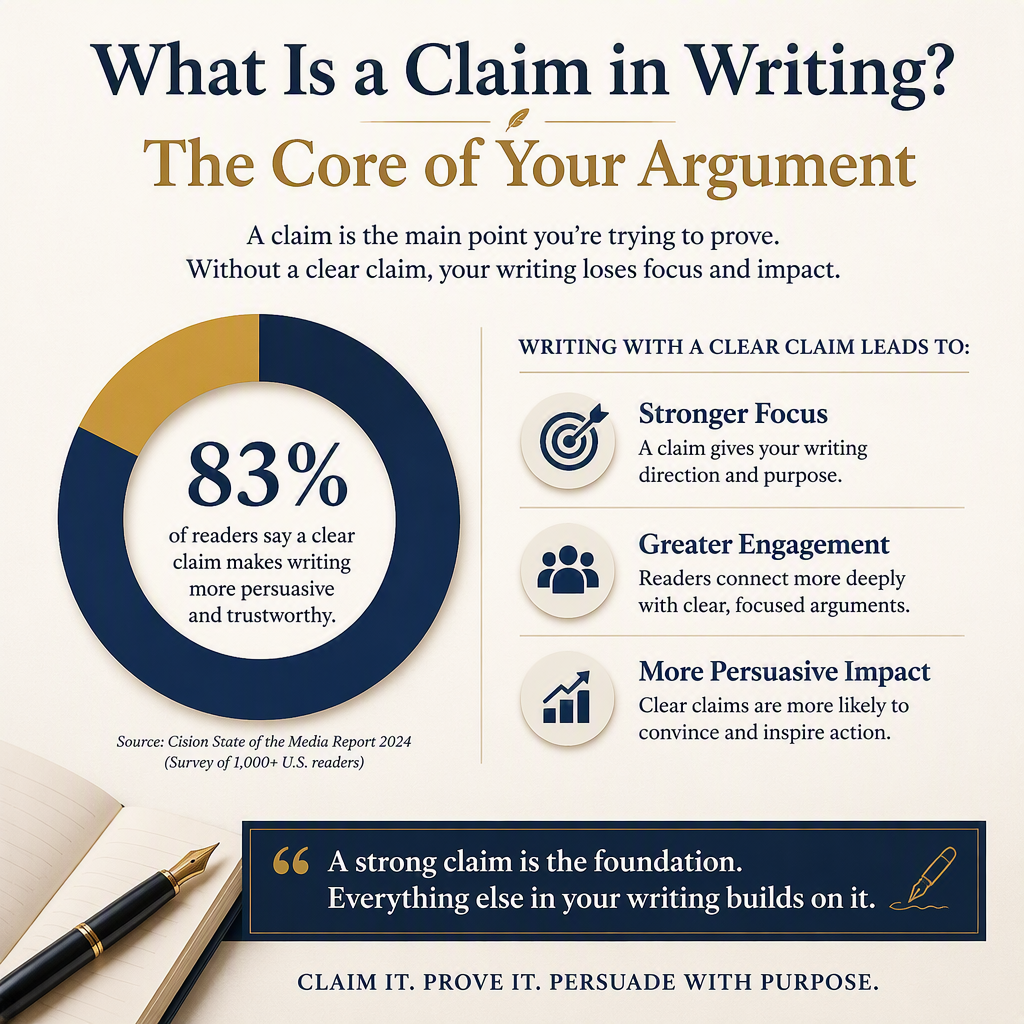
Claims Of Fact
A claim of fact asserts that something happened, exists, or can be verified. For example, “Amazon KDP allows authors to select up to three categories during the publishing process” is a factual claim that belongs with current documentation. Platform rules change, so check the official KDP category guidance before publishing advice based on it.
In your manuscript, factual claims require accurate records and clear dates when circumstances may change. Keep a source list for statistics, platform policies, historical statements, and research findings. Your reader should be able to distinguish documented information from your interpretation.
Claims Of Value
A claim of value judges quality, importance, effectiveness, or meaning. For example, “First-person present tense creates greater intimacy in every memoir” is a value claim with an impossible reach. A more workable version says, “First-person present tense can intensify a memoir scene when the narrator’s immediate sensations matter more than retrospective explanation.”
Value claims need standards. Explain what you mean by “effective,” “strong,” or “intimate.” For example, a useful book cover may improve genre recognition, communicate tone, or remain legible as a thumbnail. Once you name the standard, your judgment becomes open to debate, and your reader can follow your reasoning.
Claims Of Policy
A policy claim recommends an action. “Authors should send an advance review copy six weeks before launch” is a policy claim. Its usefulness depends on the book, the review team, the genre, and the author’s schedule.
Policy claims need consequences and trade-offs. Sending ARCs early gives reviewers time to read and post. It also creates a longer window for files to circulate and for a draft cover or blurb to receive public scrutiny. State the conditions under which your recommendation holds up. I would recommend a six-week window for a planned launch with a committed review team, and a shorter window for a fast release with a small private group.
Claims Inside A Thesis And Chapter
Your book’s central thesis is a large claim. Each chapter should develop a smaller claim that advances that thesis. Think of the thesis as the promise of your argument and the chapter claims as the proof gathered along the route.
For example, a book about sustainable creative careers might carry this thesis: “Authors build steadier careers when they treat publishing as a repeatable practice with defined limits.” One chapter could claim, “A release calendar protects creative energy by separating drafting, production, and promotion.” Another could claim, “A small backlist gives an author more useful marketing options than a single heavily promoted title.” Each chapter now has a distinct job.
Thesis Claims
A thesis claim should answer the book’s governing question. It needs enough range to sustain the full manuscript and enough precision to guide the reader. For example, “Writing matters” cannot organize a book because it leaves the subject, audience, and argument undefined.
Try this formula during planning: “For [specific audience], [specific practice or condition] leads to [specific result] because [reason].” Filled in, that becomes something like “For independent nonfiction authors, a narrow book promise leads to stronger sales copy because readers can recognize the problem the book solves.” The formula is a draft tool, not a sentence you must preserve.
Chapter Claims
A chapter claim should be smaller than the thesis and larger than a paragraph point. For example, if your chapter concerns blurbs, its claim might be, “A strong blurb creates a forward-facing question through character desire, pressure, and consequence.” Your sections can then examine each element, show examples, and address genre differences.
Write the chapter claim at the top of your working document. After each section, ask whether the material supports it, complicates it, or belongs elsewhere. This prevents the common nonfiction problem of a chapter becoming an attractive pile of related information.
Testing And Revising Your Claims
A claim earns its place through pressure. Ask what a thoughtful reader would challenge, what evidence would change your mind, and where your wording reaches beyond the material. This process strengthens the argument before an editor or reviewer finds the weak joint for you.
The Skeptical Reader Test
Read your claim as an intelligent skeptic. Ask four questions:
- What exactly does this sentence assert?
- What evidence would persuade me?
- What reasonable exception matters?
- What does the claim ask the reader to do or believe?
Take the sentence “Authors need an email list.” A skeptical reader could ask whether that applies to a poet with a small local audience, a novelist with no launch plan, or a writer who already has permission-based access through another channel. Revise it to fit the situation: “An email list gives an author a durable way to reach interested readers during launches, especially when platform visibility changes.” The revised claim still recommends the list. The benefit and its limits now come with it.
The Evidence Audit
Match each claim to evidence that can actually support it. For example, a personal experience can establish what happened in your publishing process, not what happens for every author. A survey can show reported behavior without proving why people behave that way.
With research-heavy nonfiction, keep source notes beside the relevant draft paragraph. Craft writing calls for marking examples from published books with title, author, edition, and page number. Advice drawn from your own practice needs a condition that shaped the result. Readers trust a bounded claim more than a universal promise.
Revision For A Clearer Position
During revision, move your strongest claim closer to the beginning of the section. Replace abstract nouns with observable actions. For example, change “A strategic approach to discoverability is beneficial” to “Use the same genre terms in your title, subtitle, description, and retailer categories so readers encounter a consistent promise.” The second sentence gives the writer and reader something to inspect.
Adazing’s writing tools, including QuickWrite, can help you generate angles when a section feels thin. I still recommend judging every generated idea against your actual claim, evidence, and audience. A tool can produce possibilities. Your editorial judgment decides which possibility belongs in the book.
FAQs for What Is a Claim in Writing? The Core of Your Argument
What Is A Simple Example Of A Claim?
An example would be “Independent authors should test a book cover at thumbnail size before approving the final design.” It recommends an action and gives you a clear reason to investigate whether the title, genre signal, and focal image remain readable in a retailer search.
How Long Should A Claim Be?
A claim can fit in one sentence. Length matters less than precision. If the sentence contains several separate positions, divide it into smaller claims and give each one its own evidence. A reader should understand the position without rereading the sentence.
Can A Claim Be An Opinion?
Yes. A claim often expresses an opinion, especially in criticism, craft advice, and persuasive nonfiction. The opinion becomes useful when you state the standard behind it and support it with relevant evidence. “This ending is weak” gives the reader little to assess. “This ending feels weak because it resolves the external plot and leaves the protagonist’s central choice unexplained” gives the judgment a reason.
Give Every Section A Position
Your argument becomes easier to draft, revise, and market when every major section has a clear claim. The claim tells you which research belongs, which example earns space, and which sentence wanders away from the reader’s question.
Before your next writing session, write one sentence for your book’s thesis and one sentence for each chapter. Test each sentence for scope, evidence, and a recognizable position. Then draft toward those sentences with the confidence that comes from knowing what you want your reader to believe.
