
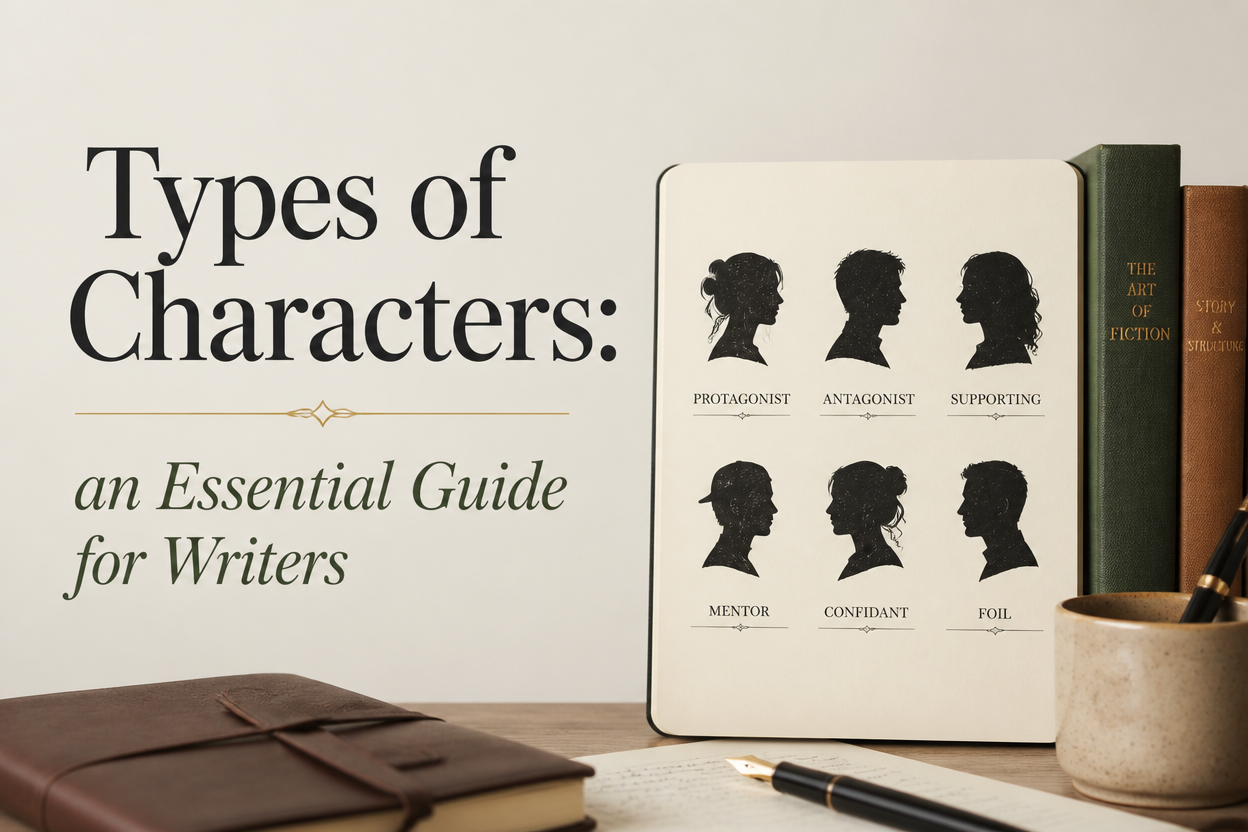
Every novel becomes easier to control once you understand the types of characters and the job each person performs in the story. For example, a protagonist drives the central pursuit, an antagonist applies pressure, and a foil reveals qualities your main character may not recognize. These roles give you a working map for building a cast that creates conflict, carries theme, and keeps readers oriented.
Character categories overlap. In a single story, your protagonist may also be a dynamic character, a tragic hero, and an unreliable narrator. A mentor can double as a foil, and a love interest may grow into a secondary protagonist in a later book. Treat these labels as flexible craft tools, and avoid locking any character into a single rigid box. I use the labels to diagnose a manuscript, especially when a story feels crowded, or the central conflict lacks pressure.
The useful question is simple: what does each character do for the reader’s experience? Once you can answer that, you can combine character types with purpose. That same answer tells you which characters to cut because they repeat a function, which supporting role to deepen, and which minor figure needs enough specific desire to earn a place in the book.
Table of Contents
Core Character Roles
Start with the roles that push the plot forward. The characters who fill them give readers a basic grasp of desire, resistance, consequence, and change.
The Protagonist And Main Character
The protagonist carries the central dramatic question by wanting something, facing resistance, making choices, and living with the results. Because that struggle drives the book, the main character also receives the greatest share of the reader’s attention. The narrator can be someone else entirely, so readers sometimes follow the protagonist through another character’s eyes. For example, Jay Gatsby drives the plot of The Great Gatsby, and Nick Carraway tells the story as its viewpoint character.
A compelling protagonist needs more than a sympathetic personality. Give this character a specific desire, a reason the desire matters now, and a weakness that complicates the pursuit. In The Hunger Games, Katniss Everdeen’s wish to protect her sister gives the opening a concrete emotional engine. As the story unfolds, her choices widen that private goal into a public challenge.
To test your own protagonist, write one sentence that names their external goal, internal need, and cost of failure. If you cannot write that sentence, your plot may still be operating at the level of atmosphere or premise.
The Antagonist And Primary Opposition
That resistance can come from a villain, a rival, a government, a family system, or a force of nature. Literary fiction often turns the opposition inward, so the antagonist may be a social expectation or a private belief that keeps the protagonist from acting.
Whatever form the opposition takes, its motive matters. A villain who only wants power often feels thin, since power alone reveals little about how a person thinks or acts. Give the opposing character a reason that makes sense from their own point of view. For example, President Snow protects the brutal political order of The Hunger Games because he believes fear preserves control. That belief excuses none of his cruelty. It accounts for every move he makes against Katniss, and that steady logic gives the conflict a clear shape.
Once your antagonist’s motive is clear, list three ways they can apply pressure without repeating the same threat. Picture a public humiliation, a financial consequence, and a betrayal. All three can come from the same opponent and still produce very different scenes.
The Deuteragonist And Supporting Cast
The deuteragonist holds the second-strongest dramatic position. This character may be a best friend, love interest, sibling, partner, or rival whose choices materially affect the protagonist’s path. In The Lord of the Rings, Samwise Gamgee supports Frodo through every stage of the journey. His loyalty also tests Frodo’s capacity to continue, so Sam’s choices carry real weight in the quest itself.
Like Sam, every supporting character earns their space through distinct desire and consequence. Take a friend who exists only to deliver jokes. That character can become memorable once the humor hides a fear, a professional ambition, or a moral limit. The same principle applies across your cast, so give every recurring character a private objective that continues beyond the protagonist’s immediate problem.

Characters Built Through Contrast
Some characters matter because they reflect the protagonist. Others reveal a path the protagonist might follow. Both kinds create meaning through comparison, so design them together as a connected set. A character invented in isolation has nothing to be measured against.
The Foil
The most familiar of these paired roles is the foil, a character whose differences make someone else’s traits stand out. For example, Dr. Watson’s practicality makes Sherlock Holmes’s eccentric reasoning easier to see. Contrast can also run through a whole group, as the March sisters in Little Women reveal one another’s temperaments, values, and limitations through their differences.
That contrast does not require a foil to oppose the protagonist in every scene. The strongest foils often share a goal and choose different methods. Picture two sisters who both want to protect their family. One stays silent to keep the peace, and the other forces every problem into the open. Since both want the same outcome, the reader can weigh the cost of each approach.
To apply this, choose one trait you want readers to notice in your protagonist, then build a foil who handles the same pressure differently. Once both characters exist, put them in a scene where each approach comes with a real cost.
The Confidant And Love Interest
A confidant gives the protagonist a place to speak, test an idea, or reveal information the reader needs. This role can help with pacing because dialogue turns internal thought into dramatic exchange. That convenience has a downside. A confidant who exists only to ask questions becomes a thin excuse for your protagonist to explain things to the reader.
To avoid that trap, give the confidant a view that creates friction. For example, a friend who agrees with every decision offers comfort and little else. Let that friend understand the protagonist and still object, and the scene gains real movement. As the story develops, that friction should change the relationship itself.
The same need for independence applies to a love interest, who needs an identity beyond romantic access to the protagonist. Give this character work, values, boundaries, and a goal that creates complications. With those pieces in place, the relationship becomes dramatically useful, because affection can raise the cost of a decision.
The Mentor And Guardian
A mentor gives knowledge, permission, training, or a model for action. Guardians play a related role by protecting a boundary, person, tradition, or piece of information. The two often appear together in fantasy and young adult fiction, and they work just as well in any other genre.
Mentors become interesting when their guidance carries a cost. They may conceal information, teach a dangerous skill, or demand that the protagonist earn trust. Their power also needs clear limits, because a mentor who can solve every problem drains the story of tension.
To set those limits, write down what your mentor knows, why they withhold it, and what they fear the protagonist will do with it. Then remove the mentor from one major scene and force the protagonist to act without instruction.
Characters Defined By Change
A character’s role describes what they do in the story. Their arc tracks something different, namely, how their understanding or behavior changes over time. A static character can still anchor a strong plot, as long as the tension comes from somewhere other than personal change.
Dynamic Characters
In contrast, a dynamic character changes in a meaningful way because of the story’s events. That change may involve belief, identity, loyalty, courage, or moral judgment. For example, Ebenezer Scrooge moves from isolation and greed toward generosity in A Christmas Carol. His transformation works because the story gives readers clear evidence of his old behavior and the consequences of his new choices.
Like Scrooge’s, every convincing change grows out of pressure. A character who announces a new belief out of nowhere in the final chapter has delivered a statement with no arc to support it. To earn the change, place the character in repeated situations that test the same weakness, then raise the cost each time.
An arc grid helps you track that pressure. Build it around four moments: the character’s starting belief, the event that challenges it, the choice that exposes resistance, and the final choice that proves change. Once it is filled in, the grid can guide scene decisions when the middle of the manuscript starts to wander.
Static Characters
On the other hand, a static character keeps a stable core belief or behavior through the story. That stability can create strength, menace, comedy, or tragedy. In Agatha Christie’s mysteries, Hercule Poirot’s methods stay recognizable from book to book, giving the reader a reliable center as each case grows more complicated.
Consistency on its own can still leave a character feeling empty. Give the character a clear set of principles and test them under pressure. For example, a detective who refuses to lie may lose a witness because of that rule. Loyalty can backfire in the same way when a friend keeps protecting someone who has become dangerous. Each time, the character’s refusal to change is what drives the consequences.
Round And Flat Characters
Another useful distinction separates round characters from flat ones. Round characters carry layered motives, contradictions, and specific responses, and flat characters center on one dominant quality or function. Neither type is better by default. A minor character may stay flat because the story only needs them as a quick source of information, comic relief, or resistance.
The balance shifts once a character starts making major choices, because readers then expect more dimensionality. If a flat character controls a murder investigation, inherits the family business, or decides whether a relationship survives, the limited portrayal will draw attention for the wrong reason.
To decide where depth belongs, rank your cast by narrative responsibility. Characters who alter the plot deserve the fullest inner life. Minor figures can stay clear and efficient, with a memorable detail that helps readers track them without a separate biography.
Archetypes, Stock Figures, And Stereotypes
Archetypes take that efficiency further by giving readers a familiar pattern they can recognize quickly. For example, the trickster, caregiver, rebel, innocent, ruler, and sage appear across myths and modern fiction. That pattern gives you a starting shape for a character. To feel alive on the page, the character still needs individual history, language, desire, and contradiction.
Stock characters work from an even narrower template, such as the hard-boiled detective, the stern headmaster, or the jealous rival. In genre fiction, these figures establish expectations with very few words. Much of the reader’s enjoyment then depends on how you fulfill or complicate those expectations.
Stereotypes cross a different line by reducing people to assumptions about identity or social group. Such assumptions box a character in before they ever get a chance to act. A character’s culture, disability, class, religion, gender, or sexuality should shape their experience with specificity and care, and none of these traits should ever stand in as a shortcut for moral character.
To keep a familiar type from sliding into a stereotype, run a three-part revision test. Name the familiar pattern, list the details that make this person singular, and identify the choice that violates the reader’s first expectation. With those three answers, you can keep the archetype’s clarity and still give the character a life that belongs to them.
Character Types In Genre Fiction
Genre adds its own set of reader expectations to every character type. For example, a romance needs a relationship with escalating emotional stakes. Mystery readers look for a detective or investigator who can pursue the truth. Open a fantasy, and you will often meet a mentor, companion, rival, or chosen figure. Together, these patterns tell readers what kind of promise your book makes.
Genre Promises And Character Function
Within those patterns, each genre also sets its own demands. In romance, both central partners need agency, since a love interest who only waits for the protagonist to become ready ends up feeling like a prize to be won. Mystery shifts the focus to the detective, who needs a method and a personal reason to keep pursuing the case. Science fiction draws much of its ethical conflict from a character’s response to technology, turning abstract questions into human decisions.
To see how these expectations play out, study the top books in your category, paying attention to the sample pages, blurbs, covers, and reader reviews. As you read, track which character roles appear, where the central relationship changes, and what readers praise or criticize. Categories and keywords can bring the right audience to your book. Once those readers arrive, the manuscript still has to deliver the character experience they expect.
Ensemble Casts And Viewpoint Control
Some books spread that experience across a whole group. An ensemble cast gives several characters meaningful influence over the story, which also creates a bookkeeping problem. Readers need a reason to remember each viewpoint, so every perspective should reveal information or emotion that no other character can provide.
To give readers that reason, assign each viewpoint character a distinct desire, voice, and form of knowledge. If two narrators interpret every event in the same way, merge their roles or remove one viewpoint. Keeping these differences straight gets easier with a simple character chart that tracks goals, secrets, relationships, and chapter appearances across a draft.
That chart becomes even more useful in a series, where you need to decide which characters belong to the current book and which belong to the larger arc. A secondary character can stay unresolved when that uncertainty raises a real question for the next volume. Whatever you hold back, the current book still needs to deliver the emotional payoff it set up.
Character Design And Book Marketing
Beyond the manuscript itself, character decisions affect your blurb, cover, categories, and promotion. For example, a blurb built around a detective’s case reads differently from one built around a widow’s emotional recovery. The cover carries the same signal, using genre conventions, typography, imagery, and tone to hint at the character experience inside.
Because so much depends on these signals, write the character promise before you design any promotional material. Name the protagonist, desire, threat, and unusual complication in a few clean lines. Adazing tools can help you develop names, generate early word choices, or test promotional language. These generators offer possibilities. The final call still belongs to you and your manuscript, because only you know whether a name fits the character’s history and the book’s promise.
FAQs for Types of Characters: An Essential Guide for Writers
What Are The Main Types Of Characters?
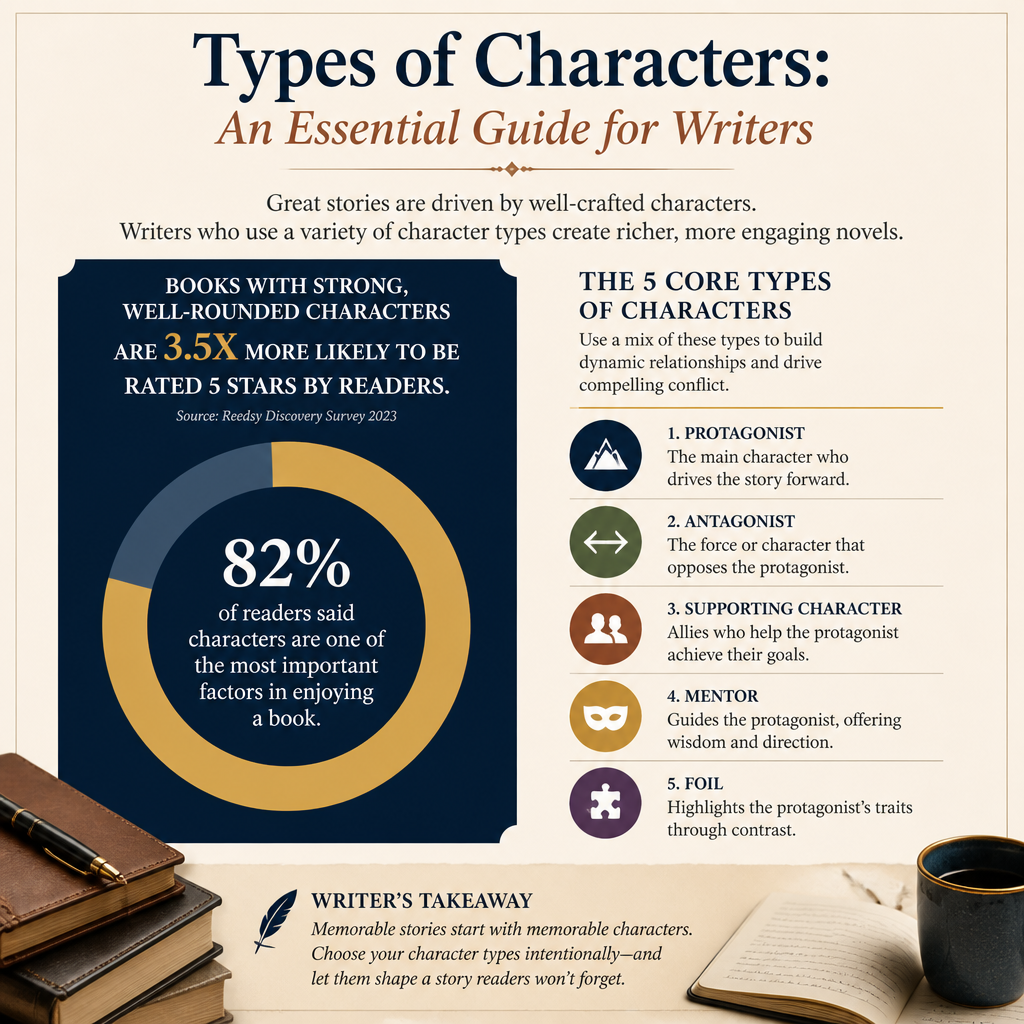
The main types include protagonists, antagonists, deuteragonists, foils, mentors, confidants, love interests, dynamic characters, static characters, round characters, flat characters, archetypes, and stock figures. These categories describe different functions, so one character can belong to several types at once.
How Many Characters Should A Novel Have?
Your novel needs enough characters to create pressure, reveal the protagonist, and develop its central relationships. Beyond that baseline, the right number depends on genre, length, and plot complexity. Whatever the final count, give each recurring character a distinct desire and consequence, and cut or combine any characters who deliver the same information and create the same kind of conflict.
How Do I Create A Memorable Supporting Character?
Start by giving the supporting character a private goal, a clear point of view, and a choice that affects the protagonist. A specific habit, image, or phrase will help readers recognize them on the page. From there, let the character disagree with the protagonist for a reason rooted in their own values.
Build Characters Around Choice
Character labels help you see how a story is built. Choices are what set that structure in motion. To put this into practice, start with the protagonist’s desire, design opposition that attacks it, and give supporting characters goals that collide with the main plot. Then revise every major scene so a character chooses, pays a price, or changes what they believe.
That work gives your cast a purpose readers can feel. In return, you get cleaner scenes, stronger blurbs, and a book you can position with confidence, whether you publish with Amazon KDP, a traditional house, or your own sales channels.
