
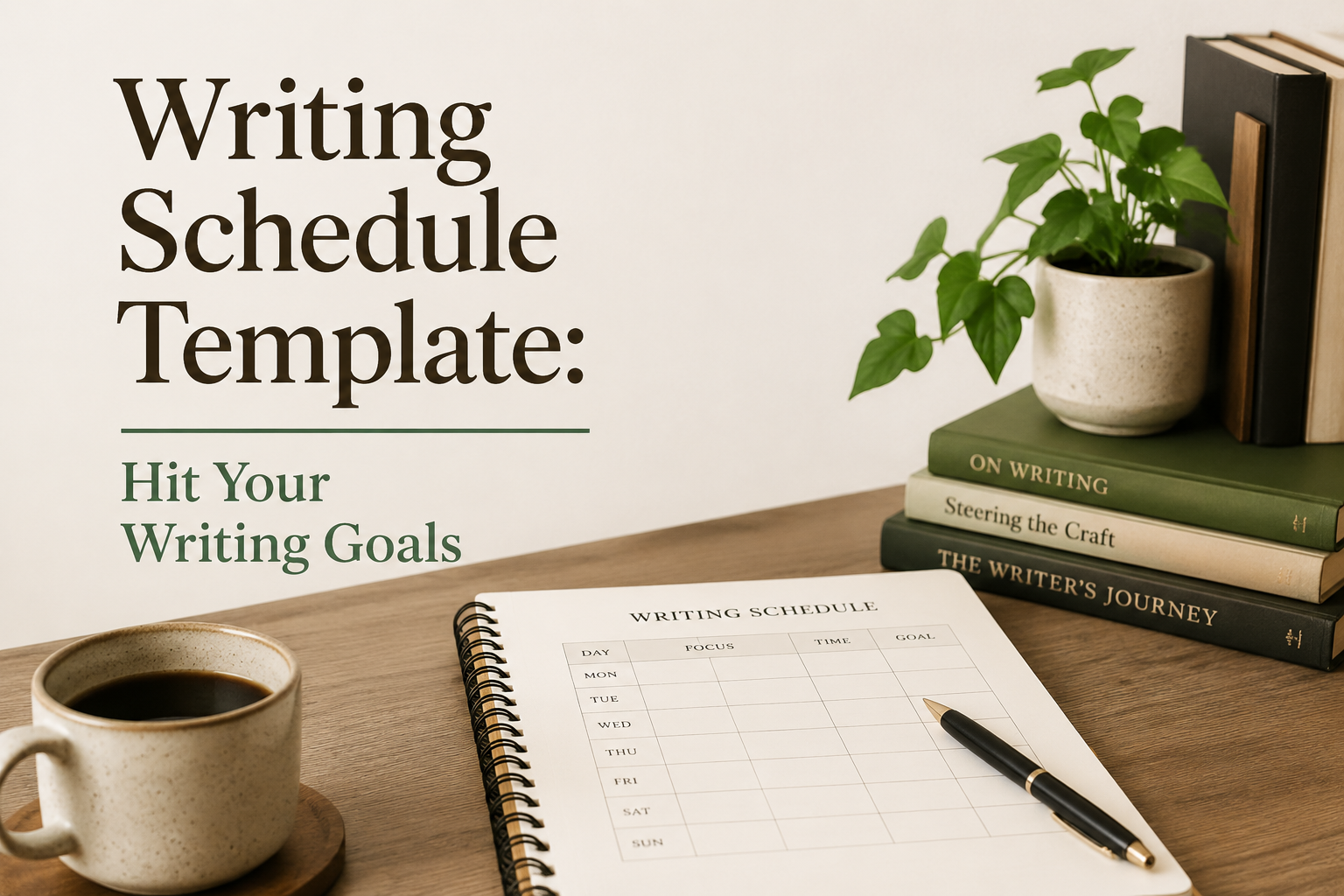
A writing schedule template only works when it is built around your real constraints, not your fantasy self. Most authors do the opposite, then blame their discipline when the plan collapses on day four. If you want to hit your writing goals, you need a schedule that matches your drafting speed, your attention span, and the business demands around publishing.
I have watched talented writers stall for months because they treated the schedule as a moral contract instead of a practical tool. Your schedule is a container. It needs the right size, a lid that closes, and space for the mess you already know is coming.
Here is what I recommend and what I use myself. You will pick a measurable goal, choose a cadence you can repeat, protect the writing block, and then build a review loop so the plan corrects itself rather than shaming you.
Table of Contents
Writing Goals That Translate Into Pages
The fastest way to break a schedule is to set a goal you cannot measure. “Write more” is not a goal. Neither is “finish my book soon.” A writing schedule template needs a unit you can track on a calendar and a unit you can hit on a bad day.
I recommend you choose one primary metric for drafting and one secondary metric for maintenance. For most authors, primary is word count, and secondary is time. Time matters because it is what you actually reserve in your life, and word count matters because it is what ships a draft.
Pick A Goal With A Deadline You Control
If you are self-publishing, you control the release date, which means you control the writing deadline. That is power, and it is also a trap. The mistake I see is picking a date based on motivation rather than math.
Do this instead. Decide when you want a complete draft, not a published book. Then work backward and include revision time, beta reads, and editing. If you do not, your “writing schedule” becomes a drafting schedule that pretends the rest of publishing is optional.
Use A Floor And A Stretch Target
You need two numbers. The floor is what you can hit even when you are tired and the day got away from you. The stretch target is what you hit when the scene is hot, and you have room to run.
Example for a novel drafter: Floor 300 words, stretch 1,000.
Example for a nonfiction author: Floor 30 minutes, stretch 90 minutes. Floors keep streaks alive. Streaks keep books alive.
Convert The Book Into Weekly Deliverables
Your brain handles “this week” better than “sometime this year.” Break the draft into weekly chunks, then put them on your calendar.
If your draft target is 80,000 words in 16 weeks, that is 5,000 words per week. If you write five days a week, that is 1,000 words per day. If you write three days a week, that is 1,667 words per writing day. The math is boring, which is why it works.

A Writing Schedule Template That Fits Real Life
A schedule that assumes perfect mornings, silent houses, and endless focus is a schedule for someone else. Yours needs to match your energy patterns and obligations. When the template respects your real life, you stop negotiating with yourself every day.
I use a simple weekly template with three types of blocks: drafting, admin, and recovery. Authors usually schedule drafting and ignore the other two, then wonder why the drafting time gets eaten up.
The Weekly Template I Recommend
Start with a week, not a month. Months feel impressive and fail quietly. Weeks show you the truth fast enough to fix it.
- 3 to 6 drafting blocks (45 to 120 minutes each)
- 1 revision block (30 to 60 minutes, light touch only)
- 1 publishing block (60 minutes for platform, ads, blurbs, metadata, or outreach)
- 1 recovery block (reading in-genre, research, long walk, or anything that refuels your language)
If you are drafting a first book, be biased toward drafting blocks. If you are running a series and a backlist, your publishing block keeps the machine from stalling.
Choose A Cadence: Daily, Every Other Day, Or Weekend Heavy
Different cadences work for different brains and jobs. Here is how I see it in practice.
- Daily works when your sessions are short and you have a stable routine. It is great for voice continuity.
- Every other day works when you need longer sessions to get traction. It is also kinder on parents and shift workers.
- Weekend heavy work when weekdays are chaotic. It requires stronger scene planning so you do not spend half of Saturday remembering what you meant.
The test is simple. If you regularly skip two sessions in a row, the cadence is wrong, or the blocks are too large.
Build The Template Around Triggers, Not Willpower
I do not trust willpower. I trust cues. A cue is a repeatable trigger that tells your brain “this is writing time” without debate.
Pick one cue you can repeat: the same location, the same playlist, the same beverage, the same document opening ritual. This cueing effect is a standard idea in habit formation, and it lines up with the behavioral model popularized by BJ Fogg at Stanford, which emphasizes making behaviors easier and attaching them to reliable prompts. See BJ Fogg’s Behavior Model for the basic framework.
Then make the first five minutes stupidly easy. Open the document, read the last paragraph, and write the next sentence. If you are using a drafting tool like Adazing QuickWrite, set it to open directly to the current chapter so you do not waste your start-up momentum hunting through files.
Time Blocking That Writers Actually Keep
Writers love the idea of time blocking and hate the reality of it. The problem is not time blocking. The problem is scheduling blocks that are too long, too frequent, or too vulnerable to interruption.
I recommend you treat writing blocks like appointments with an editor you respect. You do not reschedule because you “do not feel like it.” You reschedule only when something real happens, and then you move the block rather than delete it.
Right-Size The Block For Your Attention Span
If you are consistently failing a 2-hour block, you are not lazy. You are mismatched. Change the block size.
- 45 minutes is enough to draft a scene beat and stop cleanly.
- 60 to 90 minutes is the sweet spot for many authors because it supports warm-up, flow, and a landing.
- 120 minutes is for experienced drafters or deep work days with a protected environment.
I have seen plenty of productive authors write 500 words in 45 minutes, five times a week, and release consistently. Consistency beats heroic sessions you cannot repeat.
Use A Start Ritual And An End Marker
Start rituals prevent procrastination loops. End markers prevent the “I have to keep going, or I will lose it” anxiety that burns writers out.
Start ritual: Read the last 200 to 400 words, write one sentence that bridges into the next moment, then keep going.
End marker: Stop mid-thought with a note to yourself about the next line or next beat. Your future self will thank you, and you will restart faster.
Protect The Block With A Real Boundary
If your writing time is always interruptible, it is not scheduled. It is wishful thinking.
Pick one boundary you can hold. Put your phone in another room. Use focus mode and close your email. Tell your household you are unavailable unless someone is bleeding or the kitchen is on fire. If you write outside the house, choose the same cafe table, bring headphones, and keep your setup identical.
If you need evidence that interruptions harm performance, look at the research on task switching and attention. The American Psychological Association has reported on the cost of multitasking and switching, including time lost and performance drops. The summary is in the APA’s overview of multitasking research.
Templates For Three Common Author Schedules
You do not need the perfect schedule. You need a schedule you can run for eight weeks without resentment. Below are three templates I have seen work across genres and career stages.
Pick the one that matches your constraints, then adjust the word counts after you collect two weeks of data.
The Nine-To-Five Author Template
This template is for writers with a day job and limited weekday energy.
- Mon: 60 minutes drafting (floor target)
- Tue: Off or 30 minutes outlining next scene
- Wed: 60 to 90 minutes drafting
- Thu: 30-minute revision, polish, or continuity check
- Fri: Off
- Sat: 2 hours drafting (stretch target)
- Sun: 60 minutes publishing admin plus 30 minutes planning
If your weekdays are unreliable, shift Monday and Wednesday to early mornings or lunch breaks and keep Saturday as the anchor session.
The Full-Time Drafting Template
This template is for writers building a catalog fast, often series fiction.
- Mon to Fri: 2 drafting blocks per day (60 to 90 minutes each)
- Daily: 15-minute continuity log update
- Thu: 60 minutes publishing tasks (ads, newsletter, promos)
- Sat: Optional light revision or rest
- Sun: Full rest
The continuity log matters more than people think. It prevents the expensive kind of revision where you have to rewrite 20,000 words because you forgot a character’s injury switched legs.
The Parenting And Caregiving Template
This template is for writers whose day is broken into fragments.
- 3 micro-sessions per week (20 to 30 minutes, floor target only)
- 1 anchor session per week (90 minutes, stretch target)
- Daily 5-minute notes session on phone or notebook
If you are writing in micro-sessions, outlining becomes your best friend. Keep a running “next beat” list for each scene so you can drop in and write immediately. Adazing tools like name and word generators can also help when you are short on time and need a quick nudge to avoid stalling on details.
Tracking, Course Correction, And Finishing
Schedules fail when they are treated as static. Your life changes, your book changes, and your speed changes as you gain momentum. The fix is not more motivation. The fix is a review loop.
I track three numbers: sessions completed, total words, and average words per session. That is enough to forecast a deadline and spot problems early.
The Weekly Review That Keeps You Shipping
Once a week, look at your calendar and answer these questions in writing.
- How many sessions did I plan, and how many did I complete?
- What was my average word count per session?
- Which day failed, and what caused it?
- What is the smallest change that prevents that failure next week?
Then adjust the template. Move blocks to safer times. Reduce the block length. Lower the daily word target and add one extra session. This is how professionals work. They use feedback instead of self-judgment.
Two Tools That Prevent Mid-Draft Collapse
The middle of a book is where schedules go to die. The draft is no longer exciting, the ending is far away, and your brain starts pitching new projects like it is getting a referral fee.
Two tools help.
- A scene list with one sentence per scene, including the turning point. If you get stuck, you pick the next scene and write to the turn.
- A “done” definition for each session. “Draft the confrontation in Chapter 12 through the reveal” beats “work on Chapter 12.”
If you are drafting inside a tool that supports project organization, create a separate note for the scene list and keep it visible. When the day is rough, the scene list keeps you moving.
Publishing Reality And Scheduling Around It
If you are planning to publish, your schedule should acknowledge the business side. Amazon KDP categories, keywords, cover design, blurbs, and launch prep take time, and they are easier when scheduled in small blocks rather than dumped on the week before release.
For a reference point on timelines, Reedsy has a helpful overview of the publishing process and the time editing and production can take. See Reedsy’s breakdown of how long it takes to publish a book. Your timeline will vary by genre, budget, and whether you hire freelancers, but the general stages are real.
When you reach the cover and promotion period, tools from Adazing can save you hours. A cover maker helps you prototype ideas and do a thumbnail test before you pay for a final design, and promotion tools help you plan repeatable marketing touches that keep a book from vanishing after launch week.
FAQs for Writing Schedule Template: Hit Your Writing Goals
How many days a week should I write to finish a book?
You need enough sessions that your weekly word target is realistic for your pace. I see a lot of authors finish drafts in three to five sessions per week. If you only write once a week, that single session has to carry the whole project, and missed weeks become lost months.
Should my schedule be time-based or word-count-based?
For drafting, I prefer word count as the primary metric and time as the container. You reserve 60 minutes, then you aim for a word target within it. For revision, time-based targets work better because quality is harder to measure by the word.
What do I do when I miss my writing sessions?
Do not try to “catch up” with a brutal marathon. Move the missed block to the next available slot, then reduce the next session to a floor target so you re-establish momentum. If misses happen repeatedly on the same day, the problem is scheduling, not character.
A Schedule That You Can Repeat Beats A Schedule That Looks Impressive
Your writing schedule template should feel almost boring when it is working. You sit down, you write, you stop, and you come back tomorrow or the next planned session. Pick a cadence you can keep, set floor and stretch targets, and run a weekly review that adjusts the plan based on real data. That is how books get finished, edited, published, and marketed without you burning out halfway through Chapter 9.
