
Writing novellas is where a lot of good authors finally stop overbuilding and start finishing. The form rewards tight decisions, clean craft, and a realistic production rhythm, which is why novellas are one of the most reliable ways I know to grow your catalog without burning out.
If you have a half-dozen novel ideas stalled at 30,000 words, or you keep revising Chapter One as it owes you money, a novella can reset your process. It forces you to choose a single emotional promise, execute it fast, and get the book into readers’ hands while your excitement is still alive.
My argument is simple. A successful novella is not a “short novel.” It is a deliberate design with fewer moving parts, higher scene density, and a sharper contrast with the reader. If you treat it that way, you get creative freedom and a publishable product. If you treat it like a novel you forgot to finish, you get a rushed ending and reviews that say “I wanted more” in the worst way.
Table of Contents
Novellas Win When You Pick One Promise And Build Only For That
The fastest way to ruin a novella is to ask it to carry the same load as a novel. A novel can sprawl. It can afford two subplots, a B-relationship, a rival faction, and a long middle where you deepen the world. A novella cannot carry all of that and still feel intentional.
Start by naming the one promise your cover and blurb will sell. It can be:
- A revenge payoff
- A locked-room puzzle
- A meet-cute with a hard deadline
- A descent into a haunted house where the protagonist leaves changed or doesn’t leave at all.
Then cut anything that does not pressure that promise.
The One-Line Contract
I write a one-liner I can’t wiggle out of. “A courier with a stolen spellbook has one night to cross a city under curfew before the mage who owns it finds her.” That sentence tells me the engine, the clock, and the likely ending shape. It also tells me what does not belong, like a second protagonist, a detour to explain the empire’s tax policy, or three chapters of childhood trauma.
Do this on paper before you draft. If you can’t state the contract in one line, you are still ideating. That is fine, but don’t draft yet.
One Change In The Protagonist
Novellas feel satisfying when the protagonist changes in one decisive way. They become brave, honest, ruthless, forgiving, or finally committed. Pick one axis of change and build scenes that test that specific thing. If you try to “arc” the character in four directions, you will end up with a character who learns several lessons, none of which land.
When you outline, write the change on a sticky note and keep it visible. I mean literally visible. It stops you from writing attractive scenes that do not serve the transformation.
One Major Complication, Not Five Minor Ones
In a novella, I would rather you write one complication that truly rearranges the story than stack little obstacles like speed bumps. A big complication forces new choices, new costs, and a new ending shape. A “minor obstacle” often exists to pad word count, and readers feel that.
Here’s what I suggest you do. Write your midpoint turn first. Decide what happens around the 50 percent mark that makes the protagonist’s initial plan impossible. Then write everything else to set up and pay off that turn.

Length Control Comes From Scene Density, Not Smaller Sentences
Most novella drafts bloat for one reason. The author keeps scenes that repeat the same beat. Two conversations that accomplish the same revelation. Three travel scenes that all say “the road is dangerous.” Four chapters of the protagonist thinking about doing the thing instead of doing it.
Novellas reward density. Each scene should change the situation in a way that the next scene must respond to. When a scene ends, something should be truer, worse, or more urgent.
Track Inputs And Outputs Per Scene
I label scenes with “input” and “output.” Input is what the character knows and wants when the scene begins. Output is what they know and want when it ends. If the output is basically the same as the input, that scene is a draft note, not a scene.
Try this on a manuscript you already have. Print your chapter list, write one sentence per scene, and circle any scene where the output is emotional processing without a new decision. Keep one processing scene if you need it. Cut the rest.
Use Fewer Locations On Purpose
Every new location asks for orientation, sensory detail, and logistical continuity. That costs words. It also costs reader attention. In a novella, reusing locations is not “cheap.” It is focused.
Pick two or three primary spaces and exploit them. In romance, that might be the workplace, one social hub, and one private space where vulnerability can happen. In fantasy, it might be the inn, the streets, and the forbidden place. When you return to a space, you can skip reorientation and go straight to conflict.
Replace Exposition With Pressure
Exposition often creeps in because the author wants the world to feel complete. In shorter work, completeness comes from specificity under stress. You do not need a glossary of political factions. You need the protagonist to get stopped at a checkpoint because the wrong crest is on their papers. A single pressured moment implies a larger system without describing it.
Now, for every paragraph of explanation in your draft, ask what conflict could reveal the same fact. Then write that scene and delete the explanation.
Structure That Fits A Novella Reader’s Patience
A novella reader gives you less slack. That is not hostility. It is the purchase expectation. They picked something shorter because they want momentum. If your opening feels like a warm-up lap, they will bounce to something else in their Kindle library.
I like a three-act spine for novellas, but I compress the transitions. You still need setup, escalation, and payoff. You just can’t take 25 percent of the book to clear your throat.
Start With A Problem That Demands Motion
Your first chapter should contain an immediate problem with a cost. It can be:
- A job offer with a deadline
- A body that must be moved
- A breakup that detonates the friend group
- An eviction notice
- A prophecy that arrives with assassins, not a parchment and polite applause.
Write your opening scene so that by the end, the protagonist has made a choice they cannot unmake. If they can go back to normal life in the next chapter, raise the cost.
Escalation Through Fewer, Harder Decisions
Novellas escalate through decision difficulty. Each decision should cost more than the last. In a novel, you can have a few “bridge” chapters where the protagonist gathers resources. In a novella, gathering should either go wrong or come with a betrayal, a discovery, or an irreversible commitment.
If your middle feels thin, add a decision that splits the protagonist from their safe option. Burn the bridge. Spend the money. Confess the secret. Break the treaty. Kiss the person who complicates everything.
An Ending That Pays A Specific Price
What makes a novella ending hit is clarity of cost. The protagonist wins, but it costs a relationship. They lose, but they keep their integrity. They escape, but they leave someone behind. Readers accept shorter work when the emotional math adds up.
When you draft your final scene, state the price in plain language. Do not hide it in vagueness or lyrical fog. You can write beautifully and still be clear.
Revision For Novellas Works Best In Two Passes
Editing a novella like a novel is where authors waste weeks. You line-edit every paragraph, polish every metaphor, and then realize you need to cut 8,000 words of subplot. That is backwards.
I do two passes. First, I fix the structure and the scene’s purpose. Then, I fix the language. This order keeps you from polishing scenes you will later delete.
The Scene Audit Pass
On the first pass, I ask four questions for every scene.
Does this scene force a decision? Does it change the plan? Does it reveal something that matters later? Does it increase the cost or the clock?
If a scene gets two “no” answers, I either cut it or merge it into another scene.
Then, copy your draft into a document where each scene has a header. Under each header, write one line for what changes. If you cannot write that line, the scene is not doing enough work.
The Compression Pass
After the scene audit, I compress. I cut duplicate beats, soften repetitions, and remove “as you know” dialogue. I also hunt for summaries that should be scenes and scenes that should be summaries. A duel needs a scene. A day of uneventful travel can be one sentence.
This is where a tool like QuickWrite from Adazing can help if you struggle to rewrite efficiently. I use drafting tools to generate alternate phrasings and transitions fast, then I choose the version that matches my voice. The goal is speed with control, not outsourcing your style to a button.
The Line Pass For Voice And Rhythm
Only after the book is structurally sound do I polish sentences. In novellas, rhythm matters because the book is read in fewer sittings. You can feel monotony faster. Vary sentence length, tighten dialogue tags, and watch for paragraphs that explain what the scene already showed.
When you line edit, read the book out loud for ten minutes. If your mouth trips, your reader’s eye will too.
Publishing A Novella Requires Clear Positioning And A Real Sales Plan
Novellas sell when you package them honestly and target the right reader behavior. Some genres treat novellas as a normal meal. Others treat them like a snack. Your job is to present the snack to people who want a snack.
Pricing, categories, and series strategy matter more for novellas than for novels because readers have strong expectations about length-to-price value.
Pricing Reality And Reader Expectations
There is no universal price that works, but there is a universal penalty for confusing value. Many indie authors price novellas lower than novels and use them to drive read-through into a series. If you are in Kindle Unlimited, you get paid by pages read, which changes the math again. Amazon explains how Kindle Unlimited payouts work through the KDP Select Global Fund documentation, and you should read it so you are not guessing.
Now, look at the top 20 books in your Amazon category that are about your length. Note the common price points, cover style, and blurb tone. Then decide if you are matching the shelf or deliberately standing apart.
Series Placement That Builds Read-Through
My favorite use of a novella is as a bridge. A prequel that introduces the world without spoiling the main arc. A side-character story that deepens a relationship readers already care about. A “between books” event that resets stakes and reminds readers why they love your cast.
If you write standalones, consider novellas as reader acquisition. A low-friction entry point can outperform your “magnum opus” because it gets people to try you. Once they like you, they will follow you to longer work.
Reedsy’s guide on novella length and expectations is a useful sanity check when you are deciding how to present the book. Length norms are not laws, but they shape buyer assumptions.
Covers And Metadata That Respect The Format
Your cover still has to pass the thumbnail test. Readers decide with their eyes first, and that is not a moral failing; it is shopping. If your novella is priced as a novella but looks like an amateur short story, you lose sales. If it looks like an epic fantasy tome but is 35,000 words, you risk negative reviews from mismatched expectations.
Tools help here. I have seen authors use Adazing’s cover maker to mock up three variations, then run a simple poll in their newsletter or reader group. You are not asking people to design your cover. You are checking clarity, genre signal, and legibility at small size.
For book description craft, I follow the same rule I use for novels. A blurb raises a question and sells an experience. It does not list events. If you want a good benchmark for what readers respond to, Written Word Media has data-driven marketing advice on writing book descriptions that aligns with what I see in the trenches.
FAQs for Writing Novellas: Simple Tips for Creative Success
How many words should my novella be?
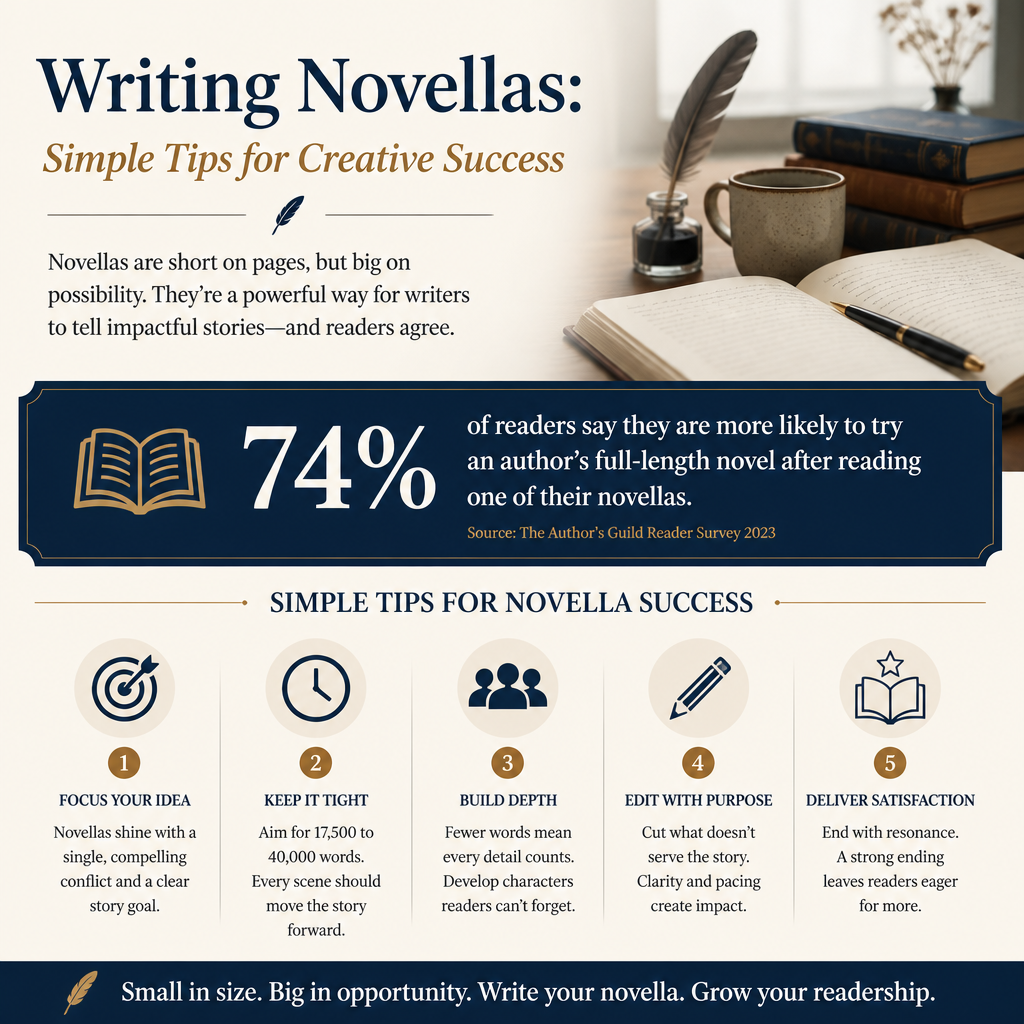
For most commercial fiction, I see novellas land comfortably around 20,000 to 40,000 words, with genre expectations nudging that range up or down. What matters more than a number is whether you deliver a complete emotional payoff without padding. If you are at 55,000 words and it reads tight, you might be in short novel territory, and that is fine as long as your packaging matches.
Can a novella have subplots?
Yes, but you need to treat a subplot like a pressure valve, not a second story. I allow one subplot if it either raises the stakes of the main plot or directly tests the same character flaw. If your subplot could be removed without changing the ending, it is taking oxygen that your main line needs.
Should I publish novellas in Kindle Unlimited?
It depends on your genre and your release plan. Kindle Unlimited readers often binge series, which can make novellas work well as entry points or bridges. The trade-off is exclusivity to Amazon while enrolled. I decide based on where my readers already buy, how strongly my genre performs in KU, and whether the novella’s job is discovery or direct income.
A Novella Is A Craft Choice You Can Repeat
If you want creative success with novellas, treat them as precision builds. Pick one promise, write dense scenes that force decisions, and revise in the right order so you are not polishing dead weight. Then publish with packaging that tells the truth about what the reader is buying, and aim the book at read-through, not validation.
If you do that a few times in a row, you end up with something most authors quietly want. You end up with finished work in the world and a growing audience that trusts you to deliver a satisfying experience in whatever length you choose.
