
Your cozy mystery lives or dies on one promise: the reader gets the comfort of a familiar world and the satisfaction of a fair puzzle. Writing a cozy mystery usually gets reduced to “keep it clean and add a cat,” but the books that actually earn a read-through do something more deliberate. They build a dependable reading experience on purpose, then sneak in fresh character work and sharper clues inside that safety.
I’ve edited enough mysteries to see the same pattern. When a cozy stalls, it’s rarely the prose. It’s almost always a broken contract, usually in pacing, tone, or how the clues are handled. If you want a series readers auto-buy, treat the cozy like a machine with tolerances, then decorate it with your voice.
Here’s how I’d build that machine, along with the craft choices you can apply in your next outline and draft.
Table of Contents
Genre Promise And Reader Contract
A cozy mystery is a moral and emotional space, not just a “no explicit gore” checklist. The reader shows up expecting community, competence, and a world they want to spend time in, even while something is wrong. If you deliver dread, cruelty, or random chaos, you might still have a mystery, but you won’t have a cozy that cozy readers recommend to their friends.
Comfort Without Losing Stakes
The stakes in a cozy are real, but they’re local. For example, a death threatens a town’s stability, a business, a reputation, a friendship, and a sense of safety in a small circle. That scale is your advantage because it lets you write sharp consequences without turning the book into a grim endurance test.
If your draft feels “too soft,” don’t fix it by adding a more violent killer or a darker backstory. Increase pressure with time, complex relationships, and social cost. Set a fundraiser that will collapse if the protagonist can’t clear an innocent suspect. Make the next clue arrive during a public event where the protagonist can’t quietly process it.
Boundaries That Keep You In Cozy Territory
Decide your boundaries early and stick to them. Cozy readers tolerate death. They do not tolerate lingering gore, sexual violence on-page, or a narrative voice that seems to enjoy suffering. You can reference ugly motives and still keep the camera where a cozy wants it, which is on problem-solving and community ripples.
If you are unsure where your line is, do a shelf check. Pull five top-selling cozies in your sub-niche and skim their murder discovery scene, their interrogation scenes, and their confrontation. Match the distance and the language level. This is one of those times when copying the temperature is smarter than trying to be “original.”
The Amateur Sleuth Justification
The amateur sleuth is a feature and a risk. Readers love competence, but they don’t want a protagonist who behaves like a reckless cop. Give your sleuth a clean reason to investigate that doesn’t rely on constant trespassing and melodramatic danger.
My favorite justifications are practical ones. The protagonist’s business depends on the event going well, their friend being the prime suspect, or the police being overwhelmed, and the protagonist has access to spaces the police do not. If you can state the reason in one sentence, you’re safe. If it takes a paragraph of excuses, fix it now, because the reader will feel that strain every time your sleuth pushes into the plot.

Setting, Cast, And The Cozy Engine
In a cozy mystery, the setting is your puzzle board, your marketing hook, and your series glue. A bookstore, bakery, yarn shop, garden center, antique mall, or seaside inn is doing commercial work for you before the reader even meets the corpse.
A Place That Generates Motive
Pick a setting that naturally produces conflicts and secrets. A small town with a historic preservation committee, a seasonal festival calendar, and a tight local newspaper gives you endless reasons for people to lie. A catering business brings you into different venues and social tiers, which expands your suspect pool without turning your book into a travelogue.
When you design the town or neighborhood, build a short list you can reuse: three recurring public spaces, five recurring locals, and two institutions that create friction. A school, a church, a landlord, a developer’s group, a tourist board. These are motive factories.
Recurring Characters With Jobs In The Story
Cozy casts get bloated fast because writers fall in love with quirky side characters. For example, quirky is fine, and unnecessary is expensive. Every recurring character should do at least one job: suspect, alibi provider, clue deliverer, emotional foil, or series continuity anchor.
Here is a simple test. If you removed a character from the book, would you lose a clue, a misdirection, or a meaningful pressure point? If the answer is no, merge them with someone else. The result is a sharper cast and fewer names for the reader to juggle.
If you struggle with naming, I use Adazing’s tools for speed. A name generator is not a creative shortcut; it’s a drafting accelerant. Spend your real brainpower on motive and contradiction, not on staring at a blank line where “Mrs. Something” should be.
The Series Anchor And The “Return Visit” Feeling
Cozy series sell because readers come back for the world. Give them repeatable pleasures: the shop routines, the food, the pets, the town politics, the friend group, the slow-burn romance that never hijacks the mystery.
One practical move is to build a “standing scene” so you can retool each book. The weekly book club meeting. The farmers’ market setup. The morning opening routine at the cafe. That recurring structure makes the reader feel at home and gives you a reliable stage for information exchange and interpersonal pressure.
Clues, Red Herrings, And Fair Play
Most cozy drafts fail the puzzle in a very specific way. The writer withholds the real clue, then expects the reveal to feel brilliant. The reveal feels arbitrary instead. Fair play is not a rule you follow to impress mystery purists. It is how you create the deep satisfaction that makes readers binge.
Planting Clues In Plain Sight
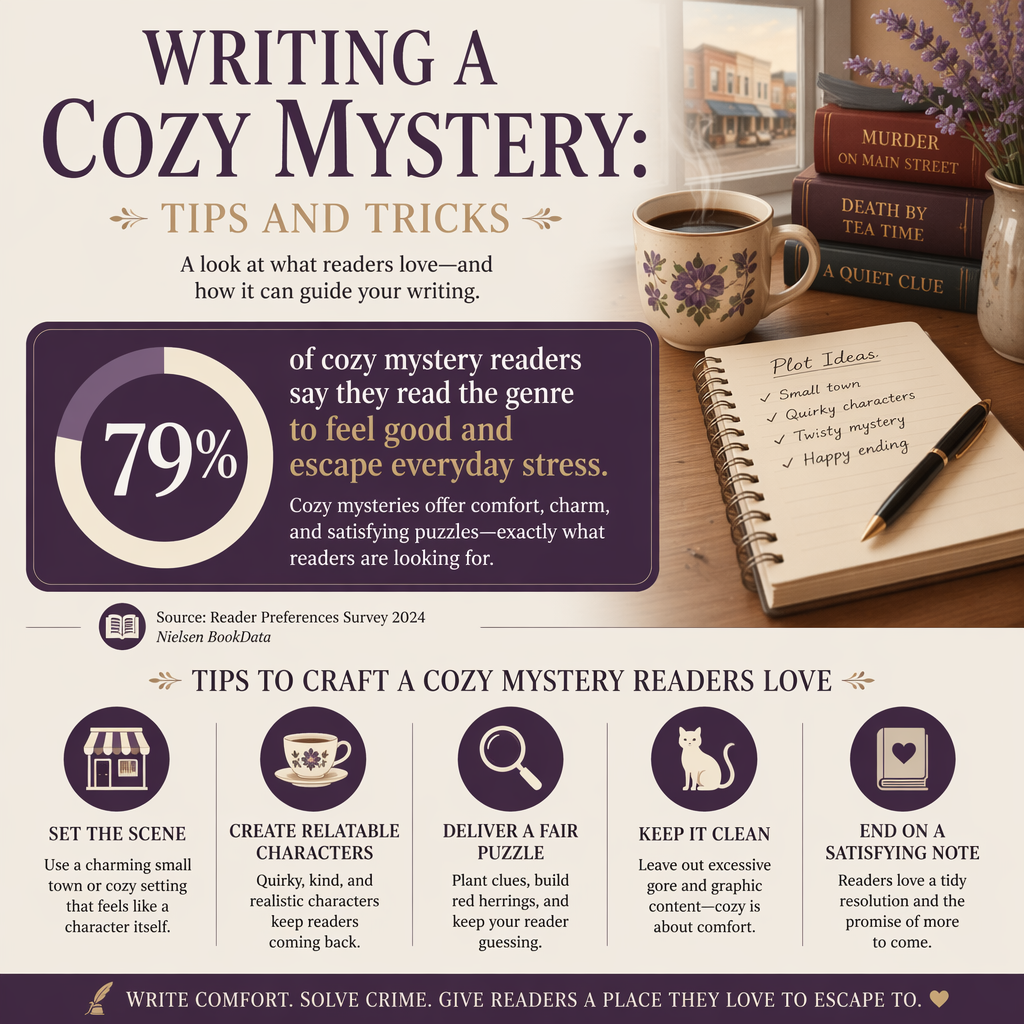
A clue should be visible, meaningful, and misinterpretable. Visible means it is on the page. Meaningful means it connects to the solution. Misinterpretable means it can point to at least one wrong suspect in a plausible way.
I like to write a list of clues before drafting. Not vague beats like “finds evidence,” but actual objects and facts: a receipt from the garden center dated Sunday, the victim’s phone with a cracked corner, a missing library book, a peculiar brand of tea, a smear of clay on a cuff. Then I decide where each clue first appears and what innocent explanation it has at that moment.
If you want a clean technique, try the “three touches” rule. Mention the clue once in a casual context, bring it back with slight emphasis later, then let it matter in the third appearance. The reader feels smart because their brain recognizes the pattern.
Red Herrings That Are Honest
A red herring is not a lie. It is a true thing that seems like it means something else. For example, the husband actually is cheating, but he did not kill anyone. The mayor really is taking bribes, but the bribe relates to zoning, not murder. These sub-secrets feed the cozy vibe by giving the town texture while still playing fair with the reader.
Avoid red herrings that exist only to stall. If your sleuth chases a “mysterious stranger” for six chapters and that strand never matters again, readers feel the padding. Every misdirection should still reveal character, motive, or relationships that affect the final confrontation.
Confessions, Confrontations, And Credible Solutions
Cozy readers will accept a lot of coincidence, but will not accept an ending that relies on a villain monologue that comes out of nowhere. Your solution needs a chain of causation the reader can follow, even if they did not guess it.
I recommend you draft your reveal as a timeline first. Who did what, in what order, and why each step made sense to them at the time. Then write the scene version. If the timeline has holes, the scene version will feel like you are waving your hands and hoping the reader doesn’t notice.
Also, the police can be present without being incompetent. Give the detective a real job in the story: friction, boundaries, occasional information, and a reason the amateur can contribute. A respectful, professional dynamic reads better than the “cops are useless” routine.
Pacing, Structure, And Chapter-Level Tension
Cozy pacing is a balancing act. Readers want time in the world, but they also want steady forward motion. When a cozy drags, it usually has too many “hanging out” scenes that do not change the investigation.
A Practical Beat Map
There are many ways to structure a mystery, but I keep seeing a reliable cozy rhythm:
In the opening, establish the setting, pleasure, and the protagonist’s normal. Introduce the social web fast, then let the disruption land. The body appears early enough that the reader doesn’t feel tricked. By the middle, the protagonist has met most suspects, gathered several tangible clues, and made at least one wrong assumption with consequences. In the final third, the pieces click into a new theory, pressure spikes, and the protagonist forces a confrontation that feels earned.
You can hit these beats in your own sequence, but you need the reader to feel consistent movement. If you finish a chapter and nothing has changed, cut or rewrite it until it turns the case, the relationships, or both.
Scene Design That Keeps The Pages Turning
Every scene should have three things: a goal, an obstacle, and a result that changes the board. The goal might be “get the victim’s appointment book,” the obstacle might be “the receptionist hates the protagonist,” and the result might be “the book is missing, and the receptionist lies about last night.” That result creates a new question, which is what pulls the reader onward.
I also watch how chapters end. You don’t need cliffhangers every time. You do need a reason to read one more. End on a new piece of information, a decision, or a contradiction. If you end on a tidy wrap-up, the reader gets a natural stopping point, and cozy readers are busy people with phones full of other options.
Information Control Without Withholding
Good mystery writing is selective. Bad mystery writing is secretive. Tell the reader what the protagonist sees and knows, then let the protagonist interpret it imperfectly. That is where suspense comes from.
If you find yourself writing lines like “she noticed something odd” without telling us what it is, stop and put the object on the page. You can still keep the meaning hidden, but the physical detail must be there. This is also where a clean drafting workflow helps. When I draft fast, I miss plants. When I revise, I add them back deliberately.
A tool like Adazing QuickWrite can help you draft at speed, but the real win is using that speed to get to the revision phase sooner, where puzzle craft actually happens.
Revision, Packaging, And Selling The Series
A cozy that reads well and a cozy that sells are close cousins, not twins. The gap is usually packaging and positioning, and the fix is often less painful than writers fear.
Revision Passes That Matter
I do cozy revisions in layers. First, I check the solution logic, scene by scene, with a list of clues in front of me. Then I check character consistency and relationship arcs, because cozy readers track community dynamics like sports fans track stats. Finally, I do a line pass for tone, trimming anything that pushes too far toward grim or snarky.
One trick I rely on is the “suspect ledger.” I keep a simple document that shows each suspect’s motive, opportunity, and alibi, and where each is introduced. If a suspect disappears for 80 pages, the reader forgets them and the reveal loses punch. Bring them back onstage with a natural reason.
Cover, Blurb, And Metadata That Match Cozy Expectations
Cozy readers decide by signals. Cover style, typography, and color palette do genre work fast. If your cover looks like a gritty thriller, you will attract the wrong reader, and your reviews will punish you for a problem your story did not create.
When you design or commission your cover, do a thumbnail test. Shrink it to Amazon search size and see if the title still reads and the genre still lands. I’ve used Adazing’s cover tools for mockups because they let you try multiple genre-appropriate directions before you spend money on final art. The trade-off is that templated designs can look similar across the market, so if you use a tool-based design, customize the typography and focal elements to make your series recognizable at a glance.
Your blurb should sell the setup and the hook, not the plot. Reedsy has a clear breakdown of blurb fundamentals that aligns with what actually works on sales pages, and I point writers to Reedsy’s guide to writing a book blurb when they need a reset.
On Amazon KDP, categories and keywords matter, but they only help if the book delivers what those labels promise. Amazon’s own documentation is blunt about how categories work and how you can update them, and it is worth reading Amazon KDP’s guidance on categories so you are not guessing.
Series Strategy And Read-Through
Cozy authors often underuse the simplest sales engine they have, the back matter. Put the next book link in every ebook. Offer a reader magnet that fits your cozy tone, like a prequel short story or a bonus recipe packet tied to your setting, and collect email signups.
If you run ads, run them to book one and judge success on read-through, not on book one’s royalty alone. Written Word Media has published reader behavior research that supports what I see in the wild, and their Amazon reader survey data is useful for understanding how readers find and buy ebooks. You are building a habit in your audience, and habits pay you back slowly and repeatedly.
FAQs for Writing a Cozy Mystery: Tips and Tricks
How soon should the murder happen in a cozy mystery?
Soon enough that the reader feels they bought the right book. I aim for the inciting disruption early and the body not long after, often within the first several chapters. If you delay too long, your opening better be delivering strong setting pleasure and a compelling non-murder problem that will matter once the case starts.
Do cozy mysteries need a romance subplot?
No, but many cozy readers enjoy one. If you include romance, keep it secondary to the investigation and consistent with the cozy tone. A low-heat, slow-burn relationship that creates social complications can add a lot, while a high-drama romance that steals the spotlight usually weakens the mystery.
How do I keep my clues fair without giving away the ending?
Put the real clues on the page, then distract the reader with plausible alternate explanations and competing secrets. Fair play comes from visibility, not from clarity. If the reader can reread and see the proof was there, your ending will land even for someone who never guessed the killer.
A Cozy That Readers Trust
The best cozies feel effortless, and that ease is engineered. Build a setting that produces motive, keep your cast tight and functional, plant visible clues with honest misdirection, and revise the logic until it reads like a clean chain of cause and effect. When you package the book with genre-correct cover signals and a blurb that sells curiosity, you give readers what they really want from a cozy series: a place they trust and a puzzle that pays off.
