
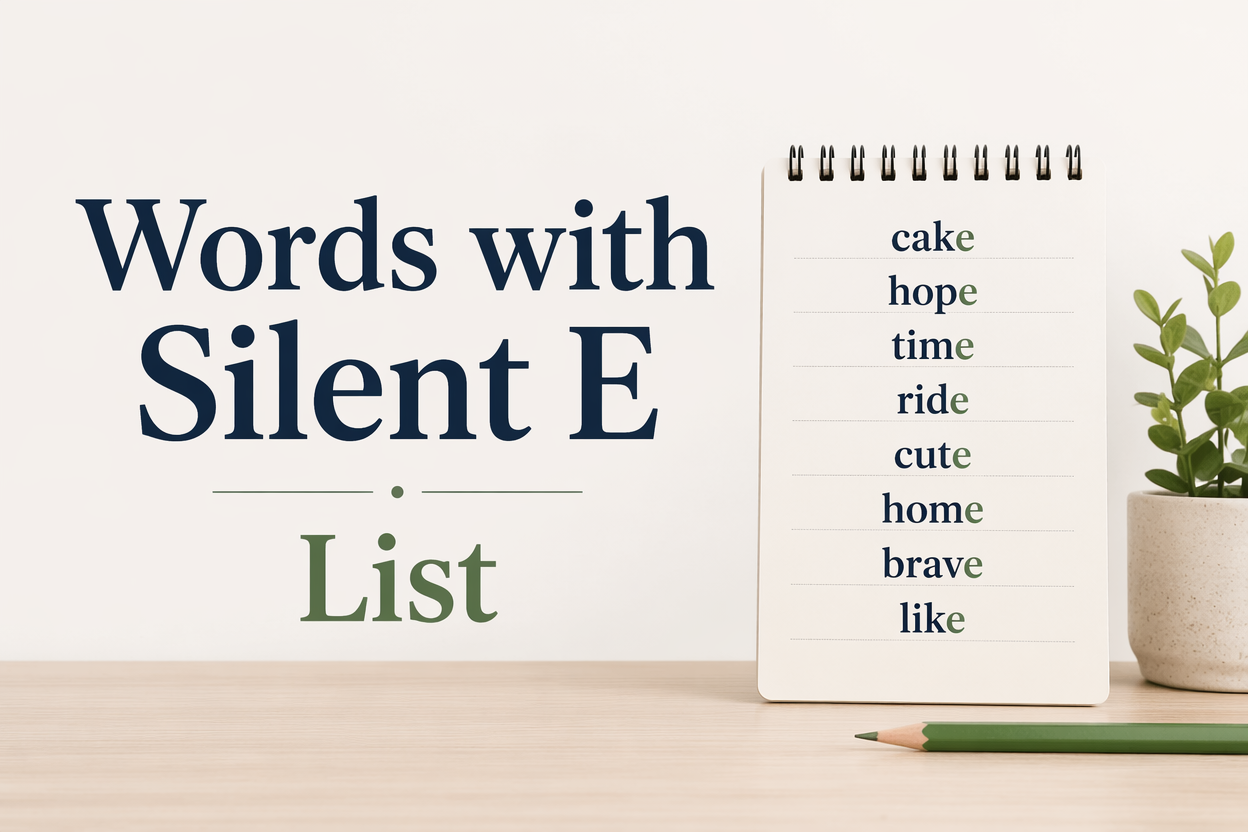
Here’s a list of words with silent e you can actually use. The silent e pattern is one of those spelling things that looks simple but trips people up for years (kids and adults, no shame).
I’m going to give you word lists grouped by what the silent e is doing because that’s the part that makes it stick, and I’ll also point out the annoying exceptions.
Table of Contents
What silent e actually does and why it matters
Look, “silent e” isn’t silent because it’s useless. It’s silent because it’s doing its work from the shadows. Most of the time, it changes the vowel sound before it.
The classic pattern is:
- cap becomes cape
- kit becomes kite
- hop becomes hope
- cut becomes cute
That’s the “magic e” thing you probably heard in school. I still call it that sometimes. It’s catchy.
Silent e as a vowel sound switch
In practice, the silent e usually turns a short vowel into a long vowel.
Short vowel: a like “cat.”
Long vowel: a like “cake.”
And the final e doesn’t get pronounced, but it changes the whole vibe of the word.
When I’m working with students who keep mixing up “rid” and “ride,” I don’t hammer rules at them. I make them say both words out loud and exaggerate the vowel. They hear it. Then the spelling makes more sense.
Silent e that isn’t about the vowel at all
Silent e isn’t always there to make the vowel long. Sometimes it’s there because English likes to keep certain words from ending in an awkward letter pattern. Or it’s there to mark a soft sound.
Examples:
- have, give, live (the vowel stays short)
- chance, fence, price (the c is soft)
- huge, charge (the g is soft)
This is where people get irritated, because they want one rule. English doesn’t care.
A quick reality check on English spelling
Honestly? English spelling is a patchwork of Old English, French, Latin, and Greek, and then a bunch of printing and pronunciation shifts. That history appears in things like silent letters, including silent e. There’s a famous shift (the Great Vowel Shift) that helps explain why spellings don’t always match modern pronunciations. If you’re curious about the background, Encyclopaedia Britannica‘s overview is a solid starting point.

Words with silent e that make the vowel say its name
Now, here’s the bread-and-butter list. These are the words in which the silent e makes the earlier vowel long. I’m grouping them by vowel, because that’s how I teach it and it’s how most people remember it.
Long A words with silent e
- cake
- name
- game
- late
- gate
- made
- same
- safe
- race
- place
- plane
- grade
- shade
- brave
- shape
- save
Long I words with silent e
- kite
- ride
- fine
- time
- line
- side
- mile
- nine
- smile
- slide
- shine
- prize
- drive
- stripe
- write
- quite
Long O words with silent e
- hope
- home
- rope
- nose
- note
- bone
- stone
- phone
- whole
- close
- those
- chose
- smoke
- stroke
- quote
Long U words with silent e
- cute
- mule
- tube
- June
- rule
- tune
- rude
- use
- cube
- flute
- prune
- excuse
- refuse
- amuse
Thing is, the “long U” group is where people start arguing, because sometimes it’s “yoo” (cute), sometimes it’s “oo” (rule). Still, the silent e is part of the spelling pattern, even if the pronunciation shifts around.
Words with silent e that soften C and G
Now, my favorite use of silent e. It’s sneaky and genuinely helpful. In these words, the final e often signals that c or g should be soft.
The soft c sounds like /s/. Soft g sounds like /j/. And yes, there are other ways to get those sounds. But silent e is one of the cleanest.
Silent e with soft C words
- face
- place
- space
- race
- peace
- price
- nice
- slice
- dance
- chance
- fence
- since
- ounce
- notice
Silent e with soft G words
- huge
- page
- stage
- age
- cage
- rage
- change
- charge
- large
- bridge
- fringe
- judge
- badge
Here’s what I mean in a super practical way. If you drop the e, sometimes you change the sound, and sometimes you make the spelling illegal-looking in English.
- race vs rac (that second one isn’t a word)
- huge vs hug (completely different word)
And yeah, this is where spelling starts to feel like coding: one tiny character, totally different output.
Words with a silent e that keep the vowel short
Real talk: these are the ones people complain about. Because you see a final e and you expect the vowel to go long. Then it doesn’t. And your brain goes, “Cool. So the rule is fake.”
It’s not fake. It’s just not the only reason the silent e exists.
Common short vowel plus silent e words
- have
- give
- live
- love
- come
- some
- done
- none
- gone
In my experience, “have” and “give” are the two that stick out early, because they show up everywhere. And they don’t behave.
Why this happens
Sometimes the silent e is there because English words generally don’t love ending in a plain v. That’s why you see have instead of hav, give instead of giv. This isn’t the kind of rule you can apply to everything, but it explains a lot of the weirdness.
Other times, it’s just historical spelling hanging around while pronunciation moved on. That’s the whole thing.
Words people misread because of this
- love (not “lōve”)
- come (not “cōme”)
- done (not “dōne”)
If you’re helping someone learn these, I recommend treating them like sight words for a while. Not forever, but just long enough that the brain stops trying to “fix” them into the magic-e pattern.
How I practice silent e words without making it miserable
You need a way to practice that doesn’t feel like copying lines for detention.
Use word pairs that show the flip
I love minimal pairs. Same letters, one silent e, different vowel sound. It’s immediate feedback.
- cap, cape
- tap, tape
- rid, ride
- kit, kite
- hop, hope
- not, note
- cub, cube
- tub, tube
Say them. Then write them. Then mix them up and see if you still catch the meaning. That last part matters more than people think.
Sort words by what the silent e is doing
This is the trick that gets you past memorizing.
- Group 1: silent e makes the vowel long (make, ride, hope, cute)
- Group 2: silent e softens c or g (chance, fence, huge, page)
- Group 3: silent e doesn’t change the vowel (have, give, love, done)
When I’ve done this with learners, you can almost see the stress drop. Suddenly, the “exceptions” are in a bucket rather than floating around like landmines.
A quick note on how common these patterns are
English spelling patterns show up a lot in everyday reading. An analysis of English text found that the most frequent 100 words make up about half of written English. That’s why oddballs like have and give matter so much. They’re everywhere. For kids especially, phonics patterns are a major piece of learning to read well (not the only piece, but a major one).
That’s not me trying to get academic about it. It’s just reassurance that spending time on silent e isn’t busywork.
FAQs for Words with Silent E List
What is the silent e rule?
Most of the time, a final e makes the vowel before it long, like cap to cape. But it can also soften c or g, or sit there for historical spelling reasons. So it’s a rule, but it’s not the only rule.
Why does “have” have a silent e if the a is short?
English generally avoids words ending in plain v. The e is doing spelling housekeeping, not vowel-changing. Same idea with give and live.
How can I tell when a silent e makes the vowel long?
I look for a simple consonant between the vowel and the final e, like a plus t plus e in late. Then I check whether the word is one of the common short-vowel exceptions (have, give, love, come, some, done). After a while, your brain starts predicting most of the time correctly.
Are there words that end in e where the e is not silent?
Yep. Think cafe (often pronounced with an “ay” sound at the end) or some names and borrowed words. And plenty of words end in e where it’s silent, but the vowel behavior isn’t the magic-e pattern, like little or table, where the ending is part of a syllable pattern instead.
The takeaway I want you to keep
Here’s what I mean when I say the silent e is useful. It usually changes a vowel sound. Sometimes it softens c or g. And sometimes it’s just there because English spelling has baggage.
If you only memorize one thing, I recommend this: don’t treat silent e words as a category. Sort them by the job the letter e is doing. That’s when the list turns into something you can actually use.
