
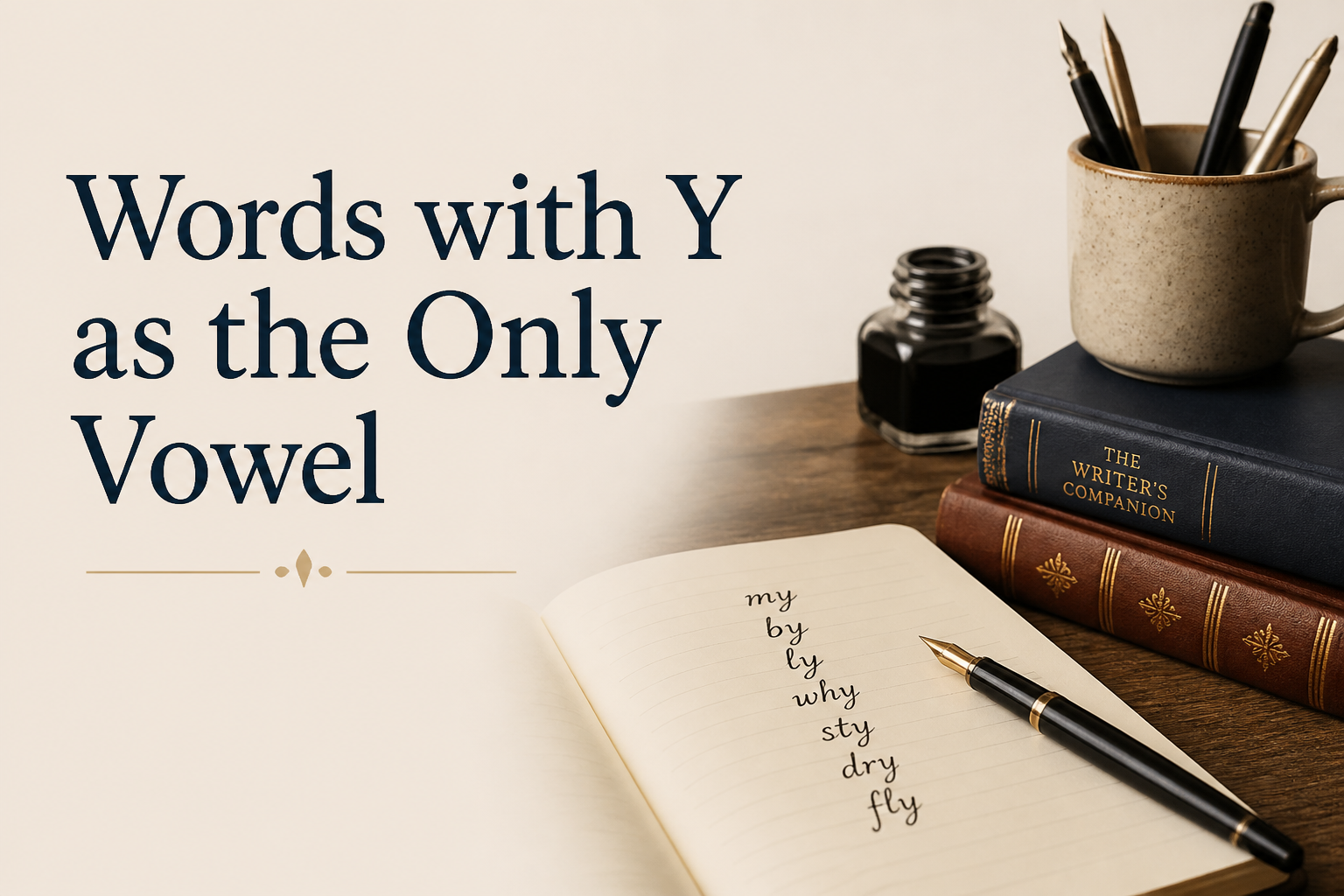
Your draft gets sharper when you can reach for words with Y as the only vowel on purpose, instead of tripping over them by accident. These odd little spellings are useful tools for voice, worldbuilding, and micro-rhythm, but they also create legibility risks if you stack too many together or use them where your reader is already working hard.
I use Y-only-vowel words the way I use sentence fragments or italics: sparingly, with intent, and in places where the payoff is immediate. When you do that, a word like “sly” can sharpen a line, “crypt” can harden the atmosphere, and “myth” can carry weight without extra description.
The tricky part is that “Y” is a vowel sometimes and a consonant sometimes, and different dictionaries and style guides talk about it in slightly different ways. For writing purposes, you can treat this as a practical category: words where the only written vowel letter is Y. That simple definition will give you a reliable list you can actually use while drafting.
Table of Contents
Why Y-Only-Vowel Words Matter on the Page
You do not need these words to write a good book. You need them when you want a particular texture that plain vowel-heavy words do not deliver. A lot of Y-only-vowel words are short, punchy, and consonant-forward. On the line, that means speed and bite.
They also play well with certain genres. For example, fantasy and horror love “crypt,” “nymph,” and “myrrh” because the shapes feel old, carved, and ritualistic. Thrillers like “sly” and “gym” because they are tight and modern. Meanwhile, literary fiction uses “myth” and “lynx” to compress meaning.
Sound And Mouthfeel You Can Control
If you read your prose out loud, you can hear how Y-only-vowel words change cadence. For example, “sly” lands like a flick. “Crypt” lands like a door shutting. That is not mystical; it is just phonetics. You are forcing the line to lean on consonants, and that makes the reader’s inner voice tighten up for a beat.
Use that effect where it helps. A tense beat, a cutting bit of dialogue, a setting detail you want to feel cold or cramped. Then get out.
Reader Load And The Point Where Clever Becomes Drag
These spellings are familiar in isolation. They become work when you cluster them. If your paragraph is already dense with names, invented terms, or technical language, adding “sylph,” “wyrm,” and “myrrh” in the same breath can tip the reader into rereading mode.
My rule is simple. If I want a reader to move fast, I keep the orthography clean. If I want them to slow down and feel the texture, I can afford one gnarly word per paragraph.
A Clean Definition That Keeps You Consistent
For this article, I am using a writer’s working definition: the only vowel letter appearing in the spelling is Y. That means words like “myth” and “crypt” qualify, while words like “rhythm” qualify, and words like “syzygy” qualify, but words with A, E, I, O, or U in the spelling do not.
If you want a reference that matches how modern dictionaries describe Y’s role, see Merriam-Webster’s explanation of why Y is sometimes a vowel. In practice, what matters is that you pick a definition and use it consistently when you build your own word bank.

A Practical List You Can Actually Use While Drafting
When you are drafting, you do not need a thousand rare Scrabble pulls. You need a few dozen reliable options that fit common narrative jobs: description, action, dialogue, and world detail. Here is a curated set, grouped by how I see writers actually use them.
Short And Common Words
These are the ones you can drop into almost any manuscript without drawing attention to themselves: my, by, shy, sly, spry, dry, try, cry, fly, fry, pry, why, gypsy (note: “gypsy” is common in older texts but contested and often avoided as an exonym; choose it carefully).
Also useful: myth, lynx, hymn. “Hymn” is especially handy because it reads cleanly, even though it looks harder than it is.
Atmosphere And Setting Words
These show up constantly in fantasy, horror, and historical work: crypt, glyph, nymph, sylph, myrrh, tryst, gypsy (again, watch that one), wyrm.
“Glyph” earns its keep in any scene involving inscriptions, runes, graffiti, iconography, UI symbols, or even branding. “Crypt” is more than a place. It is a mood. Use it when you want that mood fast.
Energy And Movement Words
These do small mechanical jobs in action and dialogue: skydive does not qualify, but spry, fly, fry, pry, try, dry do. Whys and trys can be plurals in some contexts, but they can look clunky. I rarely use them unless the voice is playful or the line is intentionally informal.
One word that writers love for its strange elegance is syzygy. It refers to the alignment of celestial bodies, and it appears in astronomical and astrological contexts. If you use it, earn it with context, because it will slow down the page. For a solid definition, see Britannica’s entry on syzygy.
How To Deploy Them For Voice, Character, And Genre
Most writers treat word choice as decoration. It is not. It is a control surface. Y-only-vowel words are one of those tiny levers you can pull to make a narrative voice feel sharper, older, stranger, or more compressed.
Dialogue That Sounds Like A Person, Not A Word List
In dialogue, your biggest danger is trying to sound “writerly.” For example, a character who says “sly” or “shy” sounds normal. A character who keeps dropping “sylph” and “syzygy” sounds like they swallowed a dictionary.
I recommend a simple filter. If your character could plausibly say the word in a heated moment, it is safe. If they need to pause to retrieve it, you are shifting attention away from the scene and onto your cleverness.
Worldbuilding That Feels Lived-In
Y-only-vowel words can help you build naming systems and cultural texture, especially in fantasy and science fiction. “Glyph” is a good example because it can be literal, symbolic, religious, bureaucratic, or technical depending on context. A “guild glyph” reads like a real artifact in a real society because it implies practice and repetition.
Do not treat these words as instant worldbuilding. The reader believes your world when details recur with variation. If your magic system uses glyphs, show them in different contexts: on a door, on a coin, burned into a wrist, stitched into a banner. Repetition with purpose does more than any single exotic term.
Line-Level Rhythm In Action And Suspense
When I am tightening an action scene, I look for vowel-heavy clusters that make the line mushy. Swapping one word for a tighter Y-only-vowel option can clean a sentence without rewriting the whole paragraph. For example, “sly” can replace “sneaky” in the right voice. “Crypt” can replace “burial chamber” if the context supports it. “Tryst” can replace “secret meeting” when you want the line to carry romance or betrayal.
The trade-off is clarity. If your replacement is more compressed but less clear, you pay for it in reader friction. In suspense, that friction can be useful. In action, it usually is not.
What Counts As A Vowel Here, And Why Readers Disagree
Some readers learned a strict school rule. Others learned a flexible one. Some never cared and just read. That means you will see disagreement in writing groups any time someone says “Y is the only vowel” and another person says “Y is not a vowel.” Both are responding to different definitions.
In English, Y functions as a consonant in words like “yes” and as a vowel in words like “myth.” That is standard dictionary treatment, not a niche opinion. You can point skeptics to Merriam-Webster’s entry for Y, which reflects the letter’s dual role.
Letter-Based Lists Versus Sound-Based Lists
A letter-based list is what you want for drafting tools and word banks. You are searching spellings, not phonemes. A sound-based list gets messy fast because you are dealing with accents, stress patterns, and the fact that English spelling is a museum of its own history.
If you are building a tool inside your workflow, stay letter-based. It stays predictable, and predictable is what you want at the keyboard.
Loanwords, Names, And The Edge Cases
Words like “myrrh” and “syzygy” are real English words, but they have strong “specialized” vibes. Proper nouns are another category. You can invent a city named “Llyr,” and it will fit the constraint, but it will also read as Welsh-inspired and may carry unintended associations.
My advice is to treat edge-case words as seasoning. Use them when the scene earns the attention they demand.
Tools And Exercises For Writers Who Want A Personal Word Bank
If you want this to help your writing rather than into trivia, build yourself a short list you can use during revision. That list should match your genre and your voice.
A Fast Revision Pass For Texture
I do this in late revision, after structure and character are settled. Pick one chapter where the prose feels bland or overly padded. Find three places where you are using a long phrase to do a small job, then test a swap with a tighter Y-only-vowel word.
For example, replace “secret meeting” with “tryst” when romance or betrayal is present. Replace “burial chamber” with “crypt” when the setting supports it. Replace “quick” with “spry” when you want a character to feel wiry rather than fast.
A Dialogue Exercise That Prevents Overuse
Write a page of dialogue between two characters arguing. Allow yourself one Y-only-vowel word per character, total. That constraint forces you to pick the moment where the word has maximum effect, which is the whole point.
When you are done, read it out loud. If the word pops like a prop, you picked the wrong one. If it disappears into voice while still sharpening the line, keep it.
Building Lists With Writing Software Without Losing Your Flow
I like having a “micro-dictionary” for whatever I am drafting, especially in genre fiction, where you are balancing voice, clarity, and pace. This is where tools can help. In Adazing, I often point authors toward tools like QuickWrite for drafting speed, then I tell them to do the finesse work in a dedicated revision pass. The drafting brain and the word-bank brain do not play nicely at the same time.
If you want a practical workflow, keep a living note called “Y-Only Words” and add to it only when you naturally encounter a word you like. Do not go hunting for fifty obscure options you will never use. You will forget them, and then you will force them into sentences to justify the hunt.
FAQs for Words with Y as the Only Vowel
Is “y” always a vowel in these words?
No. “Y” is a letter that can function as a vowel or a consonant depending on the word. In a letter-based list like this, you are focusing on spelling. The reason these words are useful is that the spelling tends to produce a particular clipped, consonant-heavy feel in English prose.
Are there long common words where Y is the only vowel?
There are a few that show up more than you would expect, like “rhythm” and “gypsy,” plus “syzygy” if you write astronomy, astrology, or certain flavors of fantasy. Most long ones are specialized, so I treat them as deliberate pacing tools rather than everyday vocabulary.
How many of these words should I use in one scene?
One or two is plenty in most scenes. If you use a cluster, do it where you want the reader to slow down and taste the language, like a ritual, a riddle, an inscription, or a moment of dread in a crypt. If you want speed and clarity, keep the spellings simple and save the texture for later.
Using This Trick Without Turning It Into A Trick
Y-only-vowel words work when they serve the story’s pace and voice. Pick a small set that fits your genre, use them where the sound supports the moment, and resist the urge to pile them up to prove you can. The reader does not reward you for clever spellings. The reader rewards you for a line that lands clean and a scene that moves.
