
Most drafts that feel “flat” have the same hidden problem: you have events, but you do not have a conflict in a story that puts real pressure on a character’s choices. So what’s a conflict in a story?
When I edit manuscripts, I see authors mistake conflict for noise, arguments, violence, or a villain with a sneer. However, conflict is simpler and harsher than that. Conflict is the force that keeps desire from being satisfied cleanly, and it remains long enough to demand a decision. If you want narrative tension that survives chapter after chapter, you build conflict that cannot be solved without cost.
I am going to define conflict precisely, show you the types that actually matter on the page, and give you a practical way to diagnose whether your scenes are producing tension or just motion.

Table of Contents
Conflict As The Engine Of Choice
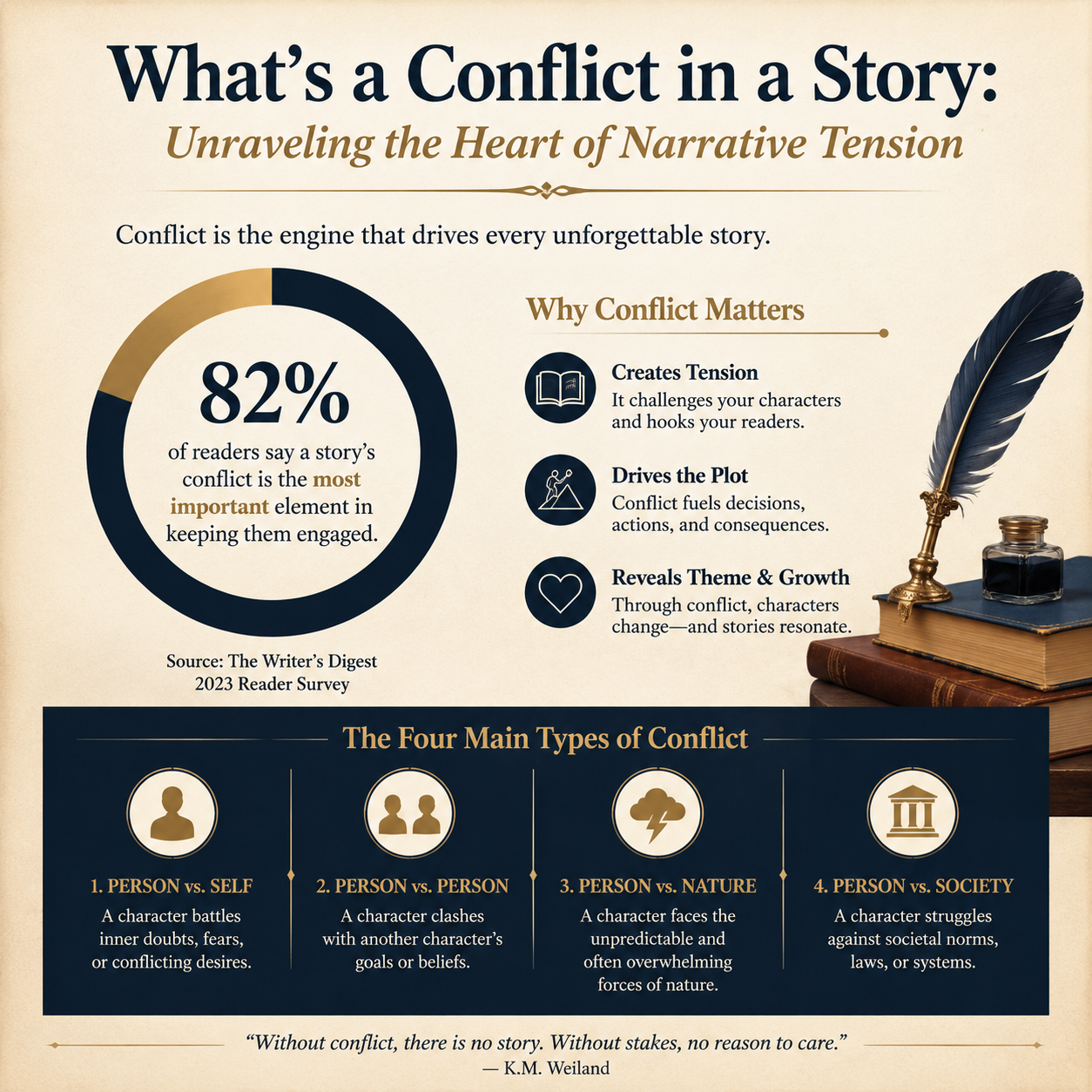
Conflict is the gap between what a character wants and what reality allows. The “reality” part can be another person, a system, a body, a belief, a storm, or time. What matters is that the character cannot get what they want without doing something that tests them.
If your character can get what they want by walking across the room and asking politely, you have a situation. If your character must decide between two outcomes they both care about, you have conflict. That decision is where tension lives, because the reader sees the trap forming around the character’s values.
Want, Obstacle, Stakes, And The Cost Of Action
When I evaluate a scene, I look for four items that should be visible in the reader’s mind, even if you never state them outright.
- Want: What does the character want right now, in this scene, in one sentence?
- Obstacle: What specific thing stops them from getting it cleanly?
- Stakes: What happens if they fail, and why should the reader care?
- Cost: What does it cost to try, even if they succeed?
The cost is the part authors skip, and that is why the tension evaporates. If trying has no downside, the character can keep trying forever, and the story becomes a loop.
Conflict Versus Drama
Drama is the visible expression of conflict. Conflict is the underlying pressure that creates the drama. You can write a loud confrontation with no real conflict if nothing changes and no one risks anything. You can write a silent scene where a character decides to lie to their spouse and feel your reader’s stomach tighten, because the lie creates a future collision the character cannot control.
If you want an easy test, ask yourself whether the scene forces a choice that closes off options. When choices do not narrow, readers do not feel time moving forward.
What Readers Are Actually Tracking
Readers track patterns of intention and consequence. This is not a theory; it is what you see in reader reviews when they complain that a book is “boring” and then list three chapters of things happening. They are telling you that they did not perceive meaningful consequence.
On the cognitive side, tension works because people allocate attention to uncertainty and potential threat. If you want the research angle, Kahneman’s work on attention and limited cognitive resources is a useful grounding. A story earns attention by presenting a problem the brain predicts will matter but cannot resolve yet. Your conflict creates that unresolved prediction.
Types Of Conflict That Actually Show Up In Drafts
Textbook lists can be helpful, but authors often treat them like a bingo card. I care less about labeling your conflict and more about whether it functions on the page. Still, the classic categories help you see what tool you are reaching for and what you are ignoring.
Character Versus Character
This is the cleanest form for most commercial fiction because it naturally generates escalation. One person wants X, another person wants Y, and both cannot be true. The mistake is writing an “opponent” who is mean. A good opposing character has their own coherent want, and your protagonist is an obstacle in their way.
If you write thrillers, romance, fantasy, or contemporary, this form does a lot of work. In romance, the opponent is often not an enemy. It might be the love interest’s competing duty, a family expectation, or a mismatch in timing that forces hard decisions.
Character Versus Self
This conflict becomes powerful when it is behavioral rather than philosophical. A character who “struggles with fear” is vague. A character who always tells the truth, then chooses one lie to protect someone, has a self conflict the reader can measure.
If you are writing literary-leaning fiction, memoir-like fiction, or character-driven series, your inner conflict needs external proof. Show me the choice and the consequence, not the thought spiral. That is where the reader trusts you.
Character Versus Society
Society conflict is about rules, institutions, norms, and power. It reads best when the system is concrete. “The patriarchy” does not stop a character in a scene. A hospital policy, a courtroom procedure, an immigration deadline, a religious community’s sanctions, or a corporation’s nondisclosure agreement stops a character in a scene.
This is also where research pays off. If you are writing near a real domain, take the time to get the friction right. Readers spot fake process immediately, and then your conflict feels like a cardboard wall.
Character Versus Nature And Time
Storms, wilderness, illness, aging, and deadlines can create relentless pressure. The pitfall is sameness. A blizzard is terrifying for three chapters and then becomes wallpaper unless it forces new choices. Use nature or time as a constraint that changes what is possible, then make your character pick a loss they can live with.
Time is an underrated antagonist for authors writing mysteries and heists. A deadline turns “figure it out” into “figure it out now, with incomplete information,” which is where bad but fascinating decisions happen.
How Conflict Creates Narrative Tension On The Page
Conflict is the source. Tension is the feeling. The gap between those two is technique. You create tension by managing information, pacing consequence, and making the reader believe the cost is real.
Escalation That Changes The Situation
Escalation is not louder arguments or bigger explosions. Escalation is a narrowing of options. The character tries A, it fails, and now A is no longer available. They try B, it partly works, and now it creates a new problem. The reader feels the vise tightening because the character cannot simply reset.
If your chapters repeat the same attempt with the same outcome, your conflict is stalled. The fastest repair is to rewrite the second attempt so it changes the board. Someone learns something. For example, a resource is lost. A relationship takes damage. A promise gets made that cannot be unmade.
Information Control Without Cheap Tricks
Suspense is the reader knowing a threat exists and watching the character walk toward it. Mystery is the reader not knowing what is true and trying to figure it out. Both rely on controlled information, and both collapse when the author withholds information the viewpoint character would obviously consider.
If you write in close third or first, you owe the reader honest access to the character’s mind. You can still hold back interpretation; you can still let them misread, but you cannot hide basic awareness. Readers do not call that suspense. They call it author manipulation.
For a practical reference, I point authors to Britannica’s overview of suspense since it cleanly captures the distinction between anticipation and surprise. Surprise is a spice. Anticipation feeds the whole meal.
Stakes That Feel Personal, Not Abstract
Stakes are not “the world will end” by default. Stakes are what the character loses that they cannot replace. In a cozy mystery, stakes might be reputation, belonging, or the loss of a small business. In epic fantasy, stakes can be kingdoms, but they still land hardest when tied to a person the reader loves.
If you are unsure whether your stakes are working, ask a brutal question: if the protagonist fails, would the reader still want to keep reading? If the honest answer is no, then you built spectacle without attachment.
Building Conflict That Holds A Whole Book Together
You can write strong scene conflict and still end up with a meandering story. Book-level conflict needs a structure that keeps pressure on the protagonist across acts, not just across pages.
External Goal, Internal Need, And The Link Between Them
I separate goal and need. The external goal is what the protagonist pursues in the plot. Meanwhile, the internal need is the belief or wound that shapes how they pursue it. The story becomes satisfying when the external conflict forces the internal issue into the open.
For example, your protagonist wants to win a court case. Their deeper need might be to stop tying self-worth to approval from an absent parent. The case forces them to choose between a win that costs their integrity and a loss that costs their ego. That is conflict that reinforces theme without a speech about it.
Opposition With Agency
Your antagonist, rival, or opposing force needs agency. They act, they adapt, and they pursue their own goal. A passive opponent, even a powerful one, creates a plot where the protagonist pushes until the wall breaks. A smart opponent changes tactics, forcing the protagonist to do the same.
If you are writing series fiction, this becomes even more important. Readers return for a continuing problem that evolves, not a new cardboard villain each book.
Conflict Webs For Subplots
Subplots work when they are not decorative. Each subplot should either increase pressure on the main conflict or complicate the protagonist’s choices. A romance subplot that gives the hero comfort but never asks them to risk the relationship is a rest stop, not a subplot.
I like a simple method: write your main conflict in one sentence, then write each subplot conflict in one sentence, then draw one line connecting each subplot to the main. If you cannot explain the connection in plain language, cut or redesign the subplot.
If you like working visually, I often outline this in a single document before drafting. Tools help here, and I am not shy about that. In Adazing’s QuickWrite, I would build a short list where each scene line includes Want, Obstacle, Stakes, and Cost. The point is not fancy software. The point is forcing yourself to state the pressure plainly so you stop writing scenes that look active but do not turn.
Diagnosing And Fixing Weak Conflict In Your Draft
You do not need a new plot to fix weak conflict most of the time. You need stronger friction, clearer stakes, and consequences that stick. I will give you the edits I reach for first, because they are the most cost-effective changes for a working author.
The Scene-By-Scene Conflict Check
Pick any chapter that feels slow. For each scene, answer these questions in a separate document.
- What does the viewpoint character want in the next ten minutes of story time?
- Who or what blocks them, specifically, in the physical world?
- What choice do they make because of that block?
- What changes by the end of the scene that cannot be undone?
If you cannot answer one of those, revise the scene until you can. When authors tell me, “That scene is for character development,” I ask which choice develops character. Development comes from decisions under pressure, not from idle reflection.
Sharper Obstacles Over More Obstacles
Piling on obstacles often makes a scene feel contrived. A sharper obstacle is usually better. Give the protagonist one problem that hits their values, their resources, or their relationships, then make it behave consistently.
For example, you can add three henchmen, a locked door, and a sudden fire alarm. Or you can write one obstacle that matters, such as the protagonist’s mentor standing guard at the door. That single obstacle creates moral cost and future fallout.
Consequences That Land On The Next Page
Consequence delayed too long feels theoretical. Engineer at least one consequence that hits immediately. For example, a friend withdraws help. A debt gets called in. The protagonist loses a tool they relied on. The love interest sees the lie and says nothing, which is worse.
Readers respond to cause-and-effect because it signals competence. If the story reacts to the protagonist’s actions, the reader trusts that their time is not being wasted.
If you find yourself stuck inventing consequences, a random generator can help you break your own habits. Adazing’s name generators are handy for sparking new characters, places, and concrete details, but the real use is to prompt you to ask, “Who pays for this choice?” You are trying to create a living world that pushes back.
FAQs for What’s a Conflict in a Story: Unraveling the Heart of Narrative Tension
Do I need a villain for a story to have conflict?
No. You need opposition, and opposition can be a deadline, a social rule, an illness, a competing desire, or a loved one whose goal collides with the protagonist’s. A villain is one clean way to personify opposition, and many genres reward that clarity, but the real requirement is pressure that forces costly choices.
How early should conflict appear in a novel?
I like to see it on page one in some form, even if it is small. The early conflict does not have to be the main plot problem. However, it should reveal a want and an obstacle so the reader learns how your protagonist behaves under pressure. If your opening pages are purely description or backstory, you are asking readers to invest before they have a reason.
What is the difference between conflict and stakes?
Conflict is the opposition that blocks the character’s desire. Stakes are what the character stands to lose if they fail or make a wrong choice. You can have conflict with weak stakes, such as a disagreement that changes nothing. You can also have high stakes with weak conflict, such as “save the world” with no credible opposition. Strong stories line them up so the opposition threatens something the character cannot casually replace.
A Conflict That Forces A Cost
If you want narrative tension that holds, build conflict that cannot be solved cleanly. Give your protagonist a specific want, put a specific obstacle in the way, and attach stakes that matter to them personally. Then let every attempt leave a mark, because consequence is what turns a sequence of scenes into a story readers finish and recommend.
